
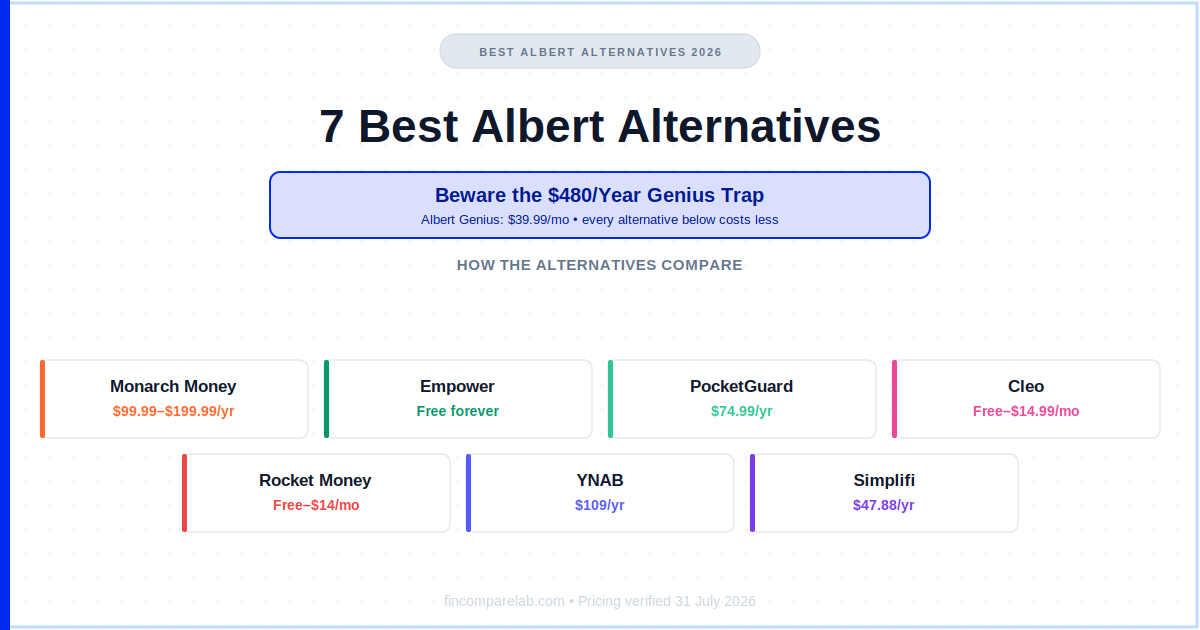
Albert alternatives are worth exploring in 2026 whether you’re comparing budgeting dashboards or looking past Albert’s cash-advance feature entirely — and the right pick depends heavily on which reason brought you here.
⚡ Quick Verdict
Monarch Money is the strongest all-around Albert alternative for budgeting and net worth in one dashboard. Empower is the best pick if $0 forever is your priority. PocketGuard is the simplest “safe to spend” replacement, and Cleo is the closest match if it’s really Albert’s AI-and-advance combo you’re after.
How We Review Apps · Pricing verified from official app websites — 31 July 2026
On this page:
- What’s the best Albert alternative overall?
- Are you looking for a budgeting app or a cash-advance app instead of Albert?
- Which budgeting apps replace what Albert does?
- How does Albert’s pricing compare to these alternatives?
- Is Monarch Money a good Albert alternative for couples?
- Is PocketGuard a simpler alternative to Albert’s budgeting style?
- Is Cleo a good alternative if you want Albert’s cash-advance feel with lower fees?
- Is Rocket Money a better fit if bill negotiation is why you use Albert?
- Is Empower the best free alternative to Albert?
- Is YNAB worth switching to if you want serious budgeting, not just monitoring?
- Is Simplifi a good fit if you want automated tracking without the subscription tiers?
- What do people ask about Albert alternatives?
What’s the best Albert alternative overall?
Monarch Money is the best overall Albert alternative for most people who want budgeting, net worth, and couples sharing in one app. Empower is the strongest free pick, and Cleo is closest if it’s really the AI-plus-advance combo you’re after.
I get asked “what should I use instead of Albert” for two very different reasons, and it’s worth sorting out which one applies to you before you read further.
Some people want a cheaper way to get a small cash advance between paychecks. Others want a better budgeting and net-worth dashboard and just happen to have landed on Albert first. This post is built for the second group.
The seven apps below made this list of albert alternatives because they overlap with at least one core Albert feature — budgeting, net worth tracking, automated saving, or a lighter AI-assistant experience — and I’ve verified every price directly against Albert’s own Standard, Genius, and Family plans rather than relying on older, cached figures.
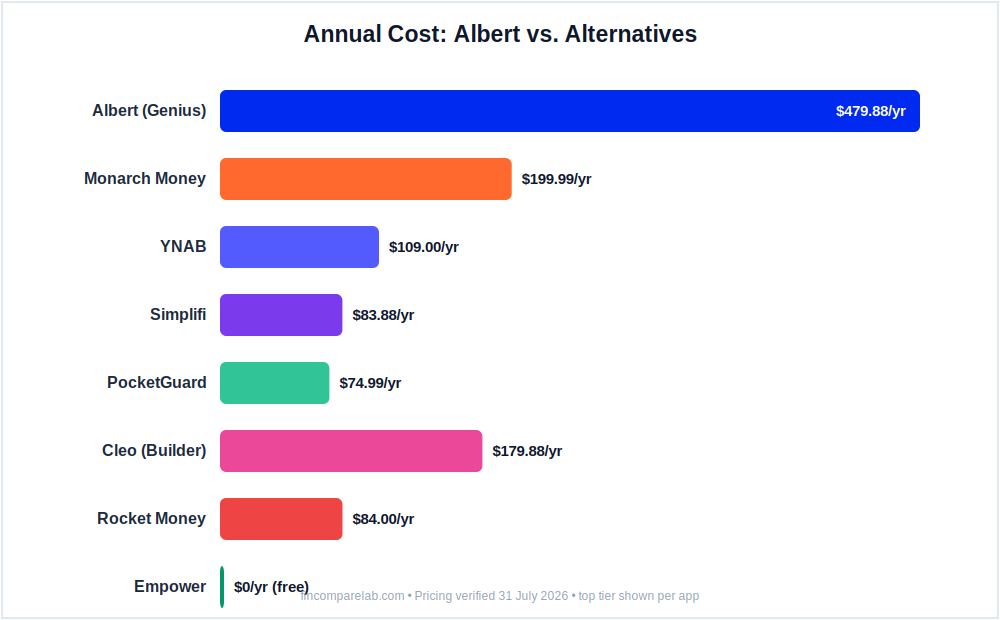
If Genius’s $39.99 a month ($479.88 a year, confirmed directly on Albert’s own pricing page) is what sent you looking for albert alternatives, that reaction makes sense. Several of the picks below cost nothing, and none of them charge anywhere close to that for the budgeting features most people actually use day to day.
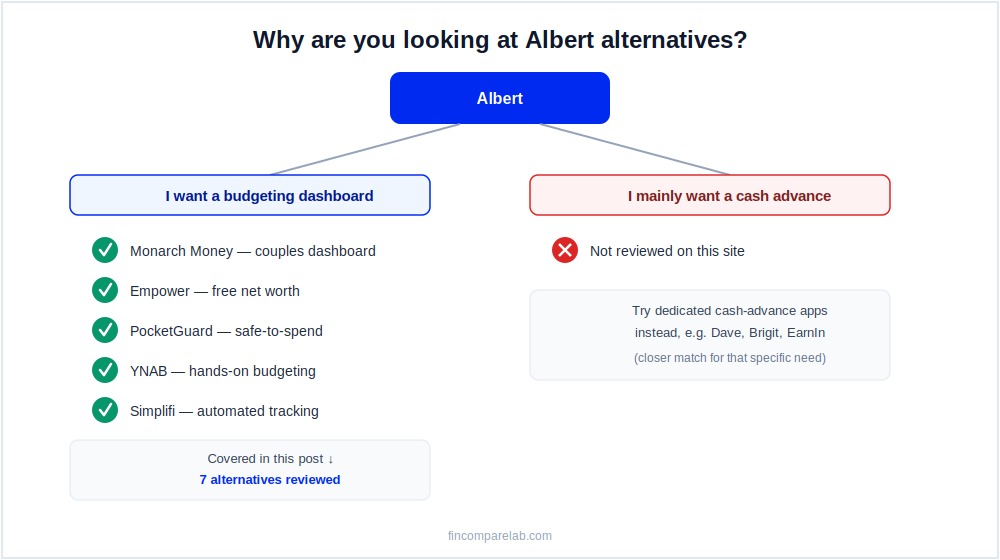
Are you looking for a budgeting app or a cash-advance app instead of Albert?
Quick gut check: if the main thing you use Albert for is the Instant cash advance, apps like albert in that specific category — think Dave, Brigit, or EarnIn — are a closer match than anything on this list, since they’re built around advances rather than budgeting.
This site focuses on budgeting and personal-finance-management apps, so I’m not reviewing pure cash-advance apps here. What I can tell you honestly: Albert’s own Instant advance ranges $25–$1,000 and no longer requires a subscription to access, which somewhat narrows the gap between Albert and dedicated advance apps on that specific feature.
If it’s the budgeting, saving, and investing side of Albert you’re evaluating — or you’re comparing an albert bank alternative for everyday banking plus budgeting — keep reading. That’s the comparison the rest of this post is built around.
Most people searching for albert app alternatives land in one of these two camps without realizing there’s a split at all. That’s exactly why the wrong recommendation shows up so often in generic “best apps” lists.
Which budgeting apps replace what Albert does?
Albert bundles four things into one subscription: budgeting and spending tracking, automated saving, investing, and human “Genius” advice. Most alternatives are better at one or two of these than at all four at once.
It’s also worth knowing that Genius isn’t Albert’s only paid tier. Standard costs $19.99/mo and includes investing, identity protection, credit monitoring, and cash-back rewards — everything except the AI-powered Genius assistant and the fee-free Instant advance. For someone who only wants those core features, Standard is less than half of Genius’s cost, though it still runs $239.88/yr, more than most of the alternatives below charge for a full year.
| Albert feature | Closest alternative |
|---|---|
| All-in-one dashboard + couples budgeting | Monarch Money |
| Free net worth + investment tracking | Empower |
| “Safe to spend today” style budgeting | PocketGuard |
| AI chat assistant + smaller advances | Cleo |
| Bill negotiation + subscription cancellation | Rocket Money |
| Serious, hands-on zero-based budgeting | YNAB |
| Automated spending-plan tracking | Quicken Simplifi |
Pricing verified from official app websites — 31 July 2026.
How does Albert’s pricing compare to these alternatives?
Side by side, the price gap between Albert’s higher tiers and most budgeting-only apps is bigger than people expect until they actually line the numbers up.
| App | Price | Free tier? |
|---|---|---|
| Albert (Genius) | $39.99/mo ($479.88/yr) | Core banking only |
| Monarch Money | $99.99–$199.99/yr | ❌ No |
| Empower | Free (optional paid advisory) | ✅ Yes, forever |
| PocketGuard | $74.99/yr | ⚠️ Narrow free tier |
| Cleo (Builder) | $14.99/mo ($179.88/yr) | ✅ Basic tier free |
| Rocket Money | $0–$168/yr | ✅ Yes, forever |
| YNAB | $109/yr | ❌ No (34-day trial) |
| Quicken Simplifi | $47.88–$83.88/yr | ❌ No (money-back guarantee) |
Pricing verified from official app websites — 31 July 2026.
A useful way to frame it: even YNAB, generally considered a premium budgeting app in its own right, costs less per year than four months of Albert Genius. That gap is the whole reason albert alternatives has become such a common search in the first place.
Two comparisons come up constantly once people start weighing this out. An albert vs monarch search usually means someone deciding between Albert’s all-in-one banking approach and Monarch’s budgeting-and-net-worth-only dashboard — the short version is that Monarch wins on shared visibility and cost, while Albert still wins if you specifically want banking and cash advances bundled in.
An albert vs cleo search tends to mean something different: someone comparing the two apps that both blend AI assistance with smaller cash advances. Cleo’s top tier still comes in well under half of Albert’s Genius price.
Is Monarch Money a good Albert alternative for couples?
Monarch Money is the strongest albert alternatives pick for couples who want one shared dashboard instead of Albert’s more individual-account setup.
Core costs $99.99/yr or $14.99/mo, with Plus at $199.99/yr for households that want more customization.
The 7-day free trial now requires a payment method upfront, so billing starts automatically unless you cancel first.
Where Monarch pulls ahead of Albert: both partners see all accounts, spending, and net worth in one shared view without needing separate logins, and there’s no Genius-style upsell layered on top. Where Albert still has an edge: automated savings transfers and human advisor access aren’t part of what Monarch offers.
Morgan’s take: if the reason you’re looking at albert alternatives is “I want my partner and me looking at the same numbers,” Monarch is the one to try first. See my full Monarch Money review for the hands-on breakdown.
Is PocketGuard a simpler alternative to Albert’s budgeting style?
PocketGuard strips budgeting down to one number — what’s safe to spend after bills, savings, and goals are covered — which is philosophically close to what Albert’s dashboard tries to do.
Plus costs $12.99/mo or $74.99/yr with a 7-day trial. A free tier exists but stays narrow, roughly two linked accounts and two categories, so most people who stick with PocketGuard end up on Plus. Among albert app alternatives, this is the one that trades away automation for simplicity.
The trade-off versus Albert: PocketGuard doesn’t offer cash advances, automated savings transfers, or human advisors. What it does instead is make the daily “can I afford this” question faster to answer, without a $39.99/mo tier sitting at the top. My full PocketGuard review covers the free-tier limits in more detail.
Is Cleo a good alternative if you want Albert’s cash-advance feel with lower fees?
Cleo is the pick on this list that overlaps most with Albert’s cash-advance-plus-budgeting combination, just at a noticeably lower price point. Among albert alternatives, this is the closest like-for-like match on features.
Cleo’s free tier includes budgeting and spending insights. Plus runs $5.99/mo, Pro is $8.99/mo, and Builder — Cleo’s highest tier, with a $500 cash-advance cap — is $14.99/mo.
That top tier alone still costs roughly a third of Albert’s Genius plan.
I’ve compared these two directly in my Albert vs Cleo comparison if you want the full side-by-side, including how their advance limits and AI-assistant styles actually differ in practice.
Is Rocket Money a better fit if bill negotiation is why you use Albert?
If the Albert feature you actually use is bill negotiation or catching forgotten subscriptions, Rocket Money is built around exactly that job rather than treating it as one feature among many.
Rocket Money is free forever for tracking subscriptions and recurring charges. Premium runs $7–$14/mo on a pay-what-you-think-is-fair model, with a 7-day trial, and adds bill negotiation plus net worth tracking. Of all the apps like albert on this list, this is the one built around a single job rather than a bundle.
Albert also offers bill negotiation through its own service, but Rocket Money’s entire product is built around that single job, which tends to show in how thoroughly it catches recurring charges people forget they’re paying for. See my Rocket Money review for the full feature list.
Is Empower the best free alternative to Albert?
Empower is the best free albert alternatives pick if net worth tracking and investment visibility are what you actually want, without paying a monthly fee for any of it.
The core Personal Dashboard — net worth tracking, an investment checkup, and a retirement planner — is genuinely free forever. Empower also offers an optional paid wealth-management arm charging 0.49%–0.89% of assets under management, but nothing about the free dashboard requires it. Of every albert alternatives option here, this is the one with the clearest “genuinely free” claim.
The honest trade-off: Empower doesn’t do day-to-day budgeting, cash advances, or automated saving the way Albert does. It’s a net-worth and investment tool first, which makes it the strongest complement to a separate budgeting app rather than a full Albert replacement on its own. My Empower review covers the free dashboard in full.
Is YNAB worth switching to if you want serious budgeting, not just monitoring?
YNAB is the pick for people who find Albert’s automated “here’s your budget” approach too passive and want to actively assign every dollar a job instead.
YNAB costs $14.99/mo or $109/yr, with a 34-day free trial — noticeably longer than Albert’s 30 days. One subscription covers up to six people, which works well for families as well as couples. It’s also one of the few apps like albert on this list with a genuinely education-first philosophy rather than an automation-first one.
This is the biggest philosophical jump on the list: YNAB expects hands-on engagement rather than automation, and that’s exactly why its community credits it with breaking paycheck-to-paycheck cycles that passive tracking apps, including Albert, tend not to fix on their own. My YNAB review and YNAB pricing guide go deeper on both the trial and the cost.
Is Simplifi a good fit if you want automated tracking without the subscription tiers?
Quicken Simplifi keeps Albert’s automated, connected-account approach to budgeting without splitting features across four subscription tiers the way Albert does.
Simplifi’s current promo, confirmed on Quicken’s official pricing page, runs $3.99/mo ($47.88/yr through 29 August 2026), stepping up to a standard $6.99/mo ($83.88/yr) after that.
Billing is annual only, and there’s no monthly option. Instead of a free trial you get a 30-day money-back guarantee, and it’s one of the few apps on this list confirmed to work across both the US and Canada.
Its standout feature is a continuously updating “left to spend” projection, which does a similar job to Albert’s dashboard without gating anything behind a $39.99/mo tier.
What do people ask about Albert alternatives?
Here are quick, honest answers to the questions I see most often around Albert alternatives, cash advances, and whether Albert’s cost is worth it.
What are the best alternatives to Albert in 2026?
Monarch Money for an all-in-one couples dashboard, Empower if you want net worth and investment tracking for free, PocketGuard for simple daily spending control, and Cleo if it’s Albert’s AI-and-advance combination you actually want to keep.
Are there free apps like Albert?
Yes. Empower’s Personal Dashboard is free forever, Rocket Money’s subscription-tracking tier is free forever, and Cleo and PocketGuard both have working free tiers, though PocketGuard’s stays fairly narrow.
Is Albert worth $480 a year?
It depends entirely on how many Genius features you actually use. If you’re mainly there for the cash advance, best apps like albert for that specific need tend to cost less. If you use the AI assistant, investing, and advisor access regularly, the math looks different.
What’s a good Albert alternative for cash advances instead of budgeting?
Cleo comes closest among the budgeting apps on this list, with a $500 cash-advance cap on its Builder tier at $14.99/mo. Dedicated cash-advance apps like Dave, Brigit, and EarnIn are a closer match if that’s genuinely your only priority.
Is Monarch Money better than Albert for couples?
For shared budgeting visibility, yes — Monarch was built around both partners seeing the same dashboard, while Albert’s account structure is more individually oriented.
Is Albert safe to use?
Albert’s cash and savings features are FDIC-insured through its partner banks, and the app uses standard bank-level security. Safety hasn’t been the common complaint in verified reviews — cancellation difficulty has.
Does Albert have a free tier?
Core budgeting and banking functionality is free, but Investing, identity protection, credit monitoring, and the AI-powered Genius assistant all sit behind the $19.99/mo Standard or $39.99/mo Genius plans.
What are the most-searched albert app alternatives right now?
Based on the pricing and features people compare most, Monarch Money, Empower, and Cleo come up the most often among albert alternatives — Monarch for couples, Empower for free net worth tracking, and Cleo for anyone who wants to keep the AI-plus-advance combination at a lower price.
Should you get Albert Standard or Genius, or switch to one of these apps like albert instead?
Standard at $19.99/mo covers investing, identity protection, and credit monitoring without the AI assistant or Instant advance. If those two Genius-only features aren’t ones you’ll actually use monthly, several apps on this list — Monarch, Empower, PocketGuard — cover the same core budgeting and tracking job for less than Standard costs on its own.
If you only take one thing from this list of albert alternatives: match the app to the specific reason you were looking, not to whichever name shows up first in a generic roundup.
Someone who wants Albert’s dashboard and nothing else is best served by Monarch or Empower. Someone who wants the advance and Genius chat is better served by Cleo. Someone who wants strict, hands-on control is better served by YNAB.
Whichever reason brought you to this page, the apps above are worth trying against your own accounts before committing to another year of any subscription — including Albert’s. If you’re still weighing the cash-advance side specifically, my Albert pricing guide breaks down every tier in full.
