
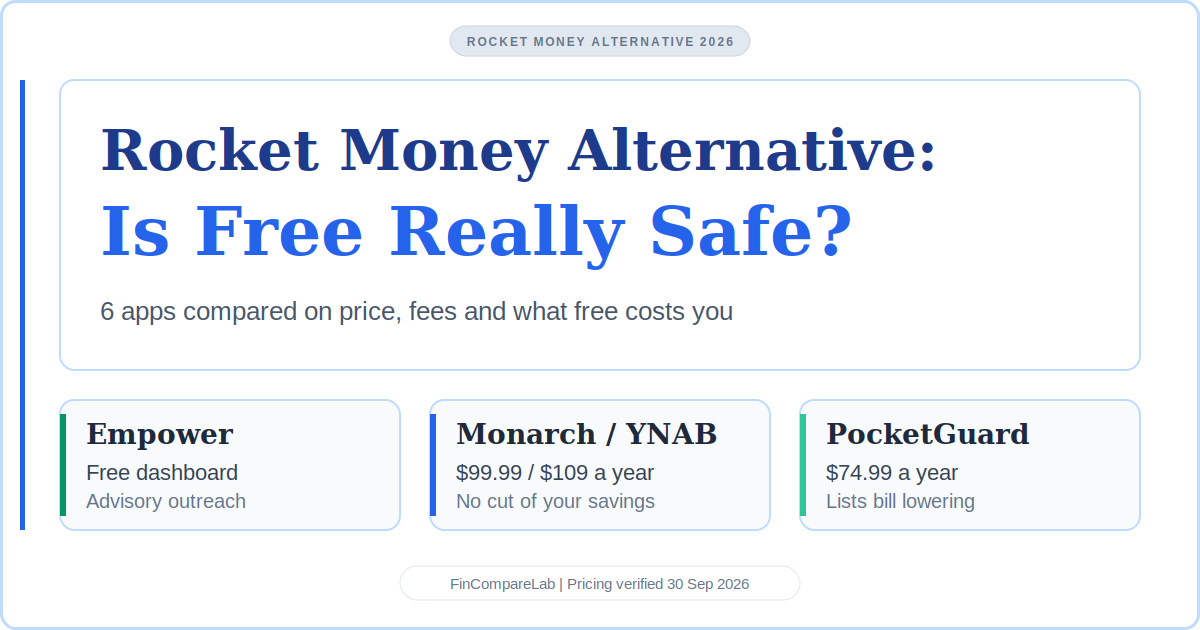
The best rocket money alternative depends less on features than on what free was quietly costing you.
⚡ Quick Answer
Among rocket money alternatives, Monarch Money ($99.99/yr) is the closest full replacement, YNAB ($109/yr) fits people who want to change spending habits, and Empower is the only free pick worth using. Free isn’t free everywhere: Rocket Money’s free tier keeps 35% to 60% of first-year savings when a bill negotiation succeeds, and Empower’s free dashboard comes with advisory outreach. Among the paid apps, only PocketGuard lists bill lowering.
How We Review Apps · Pricing verified from official app websites — 30 September 2026
In this guide
- What Is the Best Rocket Money Alternative in 2026?
- Is Free Really Safe? What Does a Free Budgeting App Actually Cost You?
- How Much Does Rocket Money’s Bill-Negotiation Fee Cost Compared With Premium+?
- What’s the Best All-in-One Rocket Money Alternative?
- What’s the Best Rocket Money Alternative for Changing Spending Habits?
- Is Empower the Best Rocket Money Free Alternative?
- Which Rocket Money Alternative Is Cheapest for the First Year?
- Which of the Apps Like Rocket Money Also Lowers Bills?
- What’s the Best Rocket Money Alternative for iPhone and Mac?
- How Do These Alternatives to Rocket Money Compare on Price?
- Do Any Rocket Money Alternatives Cancel Subscriptions or Negotiate Bills?
- How Do You Switch From Rocket Money Without Losing Your History?
- Should You Keep Rocket Money’s Free Tier Alongside Another App?
- Which Rocket Money Alternative Fits Your Situation?
- What Do People Also Ask About Rocket Money Alternatives?
What Is the Best Rocket Money Alternative in 2026?
Monarch Money is the best rocket money alternative for most people at $99.99 a year. YNAB ($109/yr) suits people who want to change spending, Empower is free for net worth tracking, and PocketGuard is the only paid pick that also lowers bills. Copilot fits Apple users, and Simplifi is cheapest at $3.99 a month.
People searching for alternatives to Rocket Money usually start with the fee, so I ranked these six Rocket Money competitors on four costs of free instead of feature lists. Fee cost is the slice of your savings an app keeps. Some free products are funded by advisory outreach (contact cost), every linked app adds a bank connection (data cost), and leaving can mean losing your exports (exit cost).
That framing is why the question of whether free is really safe has no one-word answer. Rocket Money says it uses bank-level 256-bit encryption and connects through Plaid, so the risk on its free tier is the price of the extras, not theft.
I haven’t audited any app’s security. I’m comparing published terms, prices and business models as of 30 September 2026, and every one of these apps like Rocket Money gets the same four checks. My guide to the best free budgeting apps covers the wider field.
Is Free Really Safe? What Does a Free Budgeting App Actually Cost You?
Free is safe in the security sense when an app links through a reputable aggregator, but it is rarely free of cost. The price shows up as fees on optional services, advisory outreach or feature limits.
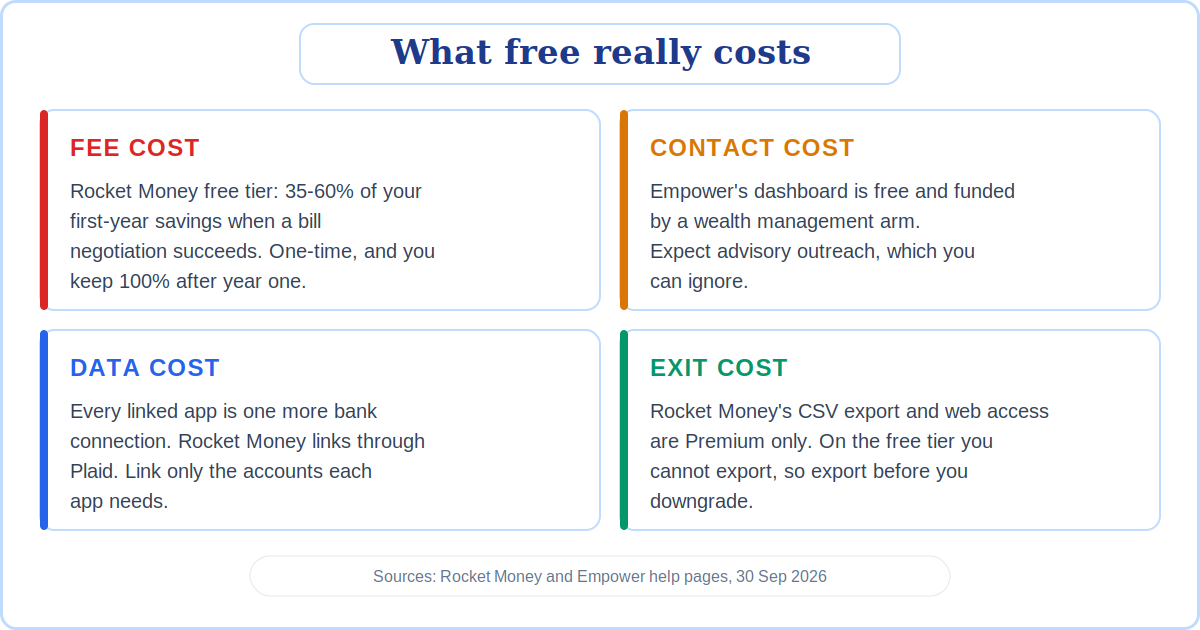
Rocket Money’s free tier shows the pattern best. You get subscription tracking, upcoming-bill reminders and a credit score view, but cancellation help, unlimited categories, transaction export and web access sit behind Premium, per Rocket Money’s own pricing breakdown. Bill negotiation stays open to free users, with the 35% to 60% fee attached.
One discrepancy remains unresolved. The same article’s tier table lists up to 3 category budgets on Free, while its prose says two custom categories. I’d treat the free budget as two to three categories and check the app before you rely on it.
Empower runs the opposite model. Its own FAQ says the dashboard and tools are completely free, and the company earns from an optional wealth management service. Rob Berger’s roundup warns that the advisory team will reach out, and that outreach is the contact cost.
Paid apps swap those costs for a subscription. Monarch, Copilot and PocketGuard each say on their own pages that they don’t sell your data or show ads. That is a published claim, not a security audit, and my Monarch Money safety guide and Copilot Money safety guide go deeper on the details.
Ownership is the last piece. Rocket Money is a Rocket Companies subsidiary, the same group that owns Rocket Mortgage, though its footer says each company is a separate legal entity. Truebill joined the group in December 2021 and became Rocket Money in 2022, so a Truebill alternative search is really a search for this same app’s rivals.
How Much Does Rocket Money’s Bill-Negotiation Fee Cost Compared With Premium+?
On a negotiation that saves you $300 in the first year, Rocket Money’s fee runs from $105 at 35% to $180 at 60%. Premium+ costs a flat $15 a month with no success fee, so it wins once a single negotiation would cost more than a month or two of membership.
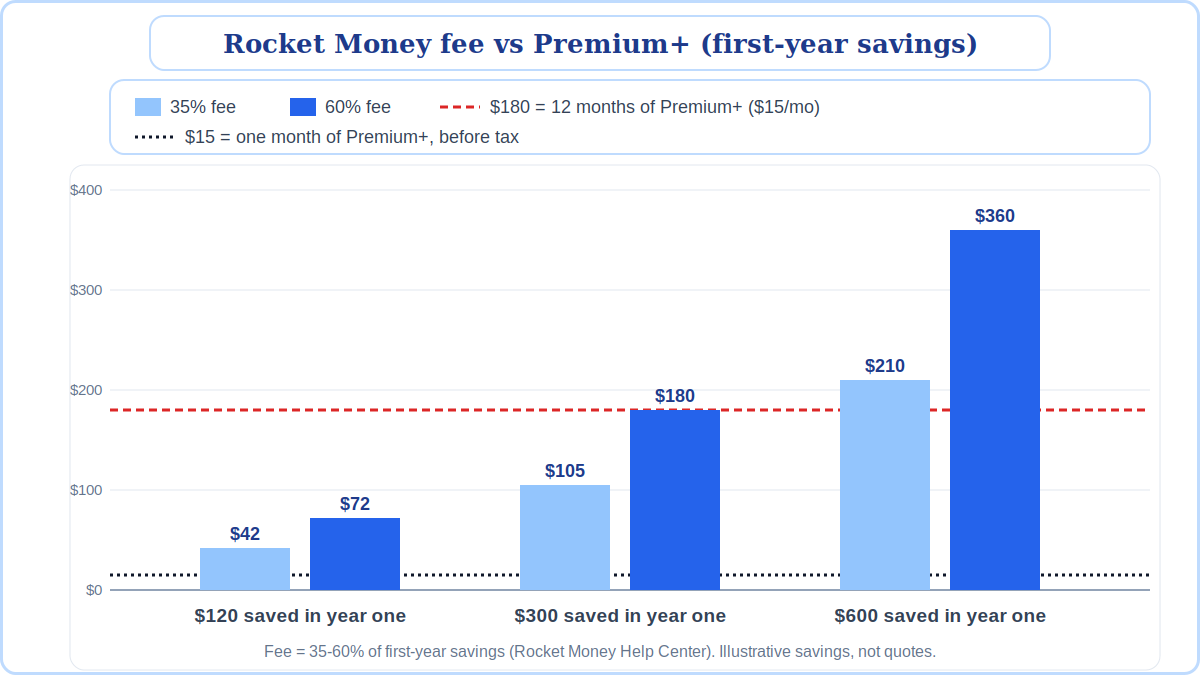
The fee is a percentage of first-year savings, charged once, and you keep all of it afterward, per the Rocket Money Help Center. There is a 48-hour window before the charge unless you set up a payment plan, which can be weekly, bi-weekly or monthly for up to 12 months. The fee isn’t refundable once charged.
Twelve months of Premium+ costs $180 before tax. At the 60% end, $300 of savings produces the same $180 fee, and at 35% you need about $514 of first-year savings to match it. Someone negotiating three or four bills a year should compare Premium+ against the combined fees.
Two edge cases matter. The fee is a share of annualized savings, and the savings process article says discounts can last 6, 12 or 24 months, so a six-month promo could leave you paying a bigger slice of what you actually keep. Premium+ also limits you to one negotiation at a time, and its terms and exclusions apply.
A one-month Premium+ membership is tempting when $15 sits next to a $105 fee. The Premium+ help article says negotiations are free while your membership is active, and it doesn’t say what happens if you cancel mid-negotiation. Ask support before you try it. My Rocket Money review and Rocket Money pricing guide cover the plan structure.
What’s the Best All-in-One Rocket Money Alternative?
Monarch Money is a budgeting and net worth app that syncs your accounts, tracks investments and lets a partner join at no extra cost. Core runs $99.99 a year ($8.33 a month) or $14.99 monthly, and Plus is $199.99 a year, annual only, according to Monarch’s pricing page.
The trial is 7 days and needs a payment method up front, which is short for an app this deep. New users can take 30% off Core for the first year with the WELCOME code, and my Monarch Money discount guide explains what is and isn’t verified. At $99.99 a year, Core costs about two coffees a month.
This is the app on the list I’ve used for real. After 15 years on YNAB, I tried Monarch once the year before and it didn’t stick, then made the full switch this year. I like the receipt scanning and the browser extension that auto-splits transactions.
The limits are just as real. Monarch is better than Rocket Money at budgeting depth, but it has no free tier, no bill negotiation and no cancellation service. As a rocket money alternative, it trades a fee for a flat subscription.
My Monarch Money review, the Monarch Money pricing guide and the Monarch vs Rocket Money comparison cover the details. Try Monarch Money
What’s the Best Rocket Money Alternative for Changing Spending Habits?
YNAB is a zero-based budgeting app that asks you to give every dollar a job before you spend it. It costs $109 a year ($9.08 a month, about two coffees) or $14.99 monthly, with a 34-day trial that needs no card when you sign up direct, and one subscription covers up to six people, per YNAB’s pricing page.
The real cost is time. I used YNAB for 15 years, and the daily reconciliation and month-end YNAB dance eventually felt like busywork, which is why I moved on. If your problem is overspending rather than not knowing where money goes, that friction is the point, and the zero-based budgeting guide explains the method.
YNAB works as a rocket money alternative for people who want rules instead of reports, but it has no subscription cancellation and no bill negotiation. Students can get a free year through the verified college program. Read the YNAB review, compare it in YNAB vs Rocket Money, or see other zero-based budgeting apps. Try YNAB
Is Empower the Best Rocket Money Free Alternative?
Empower is a free rocket money alternative for net worth and investment tracking, built as a dashboard with a retirement planner and a fee analyzer. Among free alternatives to Rocket Money, it stands out for investment analysis, and the company earns from an optional wealth management service.
Most free apps like Rocket Money fund themselves through fees or upsells, and Empower funds itself through advisory. That makes it the strongest rocket money free alternative if you mostly want net worth and investment tracking.
Budgeting is basic, Rob Berger notes you can’t add manual cash transactions, and Empower won’t cancel subscriptions or negotiate bills. His April 2026 roundup lists a 4.8 App Store rating, but Android ratings vary across reviewers, so I’m leaving out a Play Store number until I can confirm the listing.
Read the full Empower review, see how it compares in Monarch vs Empower, or browse the best net worth tracking apps. Try Empower
Which Rocket Money Alternative Is Cheapest for the First Year?
Quicken Simplifi is the cheapest paid rocket money alternative at $3.99 a month billed annually ($47.88 for the year), down from a $6.99 list price, on Quicken’s Simplifi page. The offer covers new memberships ordered directly from Quicken by October 28, 2026, and it renews at the then-current rate.
There is no free trial, only a 30-day money-back guarantee that also covers 30 days after an auto-renewal, per Quicken’s support article. Simplifi builds a Spending Plan from income minus bills and goals, shows upcoming bills and lists your subscriptions. It won’t cancel them, and you can share the account with one other person.
The promo rate has moved at least twice since May, so check the live price before you pay. My Simplifi review covers the plan, and the Simplifi discount guide tracks the offer. Try Quicken Simplifi
Which of the Apps Like Rocket Money Also Lowers Bills?
PocketGuard is the only paid rocket money alternative here that lists bill lowering and subscription cancellation on its pricing page. Premium costs $74.99 a year ($6.25 a month), $12.99 monthly or $149.99 lifetime, with a 7-day trial and no free tier listed, per PocketGuard’s pricing page.
Bill lowering runs through a partner, Billshark. You submit a cell, cable or WiFi bill, and Billshark only takes a cut if it saves you money, according to PocketGuard’s Lower My Bills page. The page doesn’t state the percentage, so ask for the exact rate before you authorize anything.
The free tier is the messy part. The live pricing page lists only the 7-day trial, but some third-party guides still describe a free version, so I treat it as gone unless PocketGuard says otherwise.
Read the PocketGuard review or PocketGuard pricing guide, and see PocketGuard vs Rocket Money. Try PocketGuard
What’s the Best Rocket Money Alternative for iPhone and Mac?
Copilot Money is the rocket money alternative built around iPhone, iPad and Mac, with a web app and no native Android version. It costs $95 a year (about $7.92 a month) or $13 monthly, with no free tier, and its FAQ page lists a one-month free trial.
Couples don’t need two subscriptions. Copilot’s help center explains sharing one account through a Magic Link sign-in, though that means a shared login with full control on every device, not separate logins. I haven’t verified that the web app matches the iPhone app feature for feature.
Copilot won’t cancel subscriptions or negotiate bills. If you already use Monarch, my Monarch vs Copilot comparison shows where the two differ, and couples can also see the best budgeting apps for couples. Try Copilot
How Do These Alternatives to Rocket Money Compare on Price?
Rocket money alternatives run from free to $109 a year, and only Empower is free outright. Rocket Money sits first as the baseline.
| App | Price | Trial | Free tier | Lowers bills or cancels? |
|---|---|---|---|---|
| Rocket Money | Free, Premium $7 to $14/mo, Premium+ $15/mo | 7-day Premium trial | ✅ Limited | ✅ Cancels on Premium, negotiates (35% to 60% fee, none on Premium+) |
| Monarch Money | $99.99/yr or $14.99/mo, Plus $199.99/yr | 7 days, card required | ❌ No | ❌ Tracks only |
| YNAB | $109/yr or $14.99/mo | 34 days, no card | ❌ No | ❌ No |
| Empower | Free | Not needed | ✅ Yes | ❌ No |
| Quicken Simplifi | $3.99/mo billed annually ($47.88/yr), list $6.99/mo | None, 30-day refund | ❌ No | ❌ Tracks only |
| PocketGuard | $74.99/yr, $12.99/mo or $149.99 lifetime | 7 days | ⚠️ Trial only | ✅ Billshark bill lowering and cancellation |
| Copilot Money | $95/yr or $13/mo | 1 month | ❌ No | ❌ Tracks only |
Pricing verified from official websites, 30 September 2026.
Do Any Rocket Money Alternatives Cancel Subscriptions or Negotiate Bills?
Only PocketGuard among the paid rocket money alternatives lists both, and only on its Premium plan. Monarch, YNAB, Empower, Simplifi and Copilot track or budget for recurring charges and leave the cancelling to you, so replacing Rocket Money’s concierge means picking PocketGuard or doing the work yourself.
Rocket Money says its team needs 2 to 10 days to cancel a subscription, and Rob Berger says its cancellation feature doesn’t always work in practice. If cancelling is your main reason to stay, my guide to cancelling Rocket Money covers the steps.
A do-it-yourself audit takes about 20 minutes. Export or scroll back 13 months of card and bank transactions, because annual charges hide outside a 90-day window. Sort by merchant, then by amount, and flag any merchant that repeats at the same amount.
Then check the places where apps bill you directly. On an iPhone, open Settings, tap your name and choose Subscriptions. On Android, open Google Play, tap your profile icon and choose Payments and subscriptions.
How Do You Switch From Rocket Money Without Losing Your History?
Export first, then cancel Premium, because transaction export and web access are Premium features. On the free tier you can’t export a CSV at all, so plan around that before you downgrade.
- On Premium, export your filtered transaction list to CSV before you touch your plan.
- Link the same accounts in your new app and let both run side by side for two to three weeks.
- Compare the recurring-charge lists, and add anything the new app missed to your do-it-yourself list.
- Cancel Premium only after any bill negotiation you started has finished, and read the fee in your success email.
- Decide separately whether to delete the account, since cancelling Premium and deleting an account are different steps.
On the history question, I chose a clean break when I left YNAB. I skipped importing years of CSVs, loaded only the previous month’s balances and archived the old files, because imported credit-card transfers would have distorted the cash-flow reports. Starting fresh kept mine readable from day one.
Should You Keep Rocket Money’s Free Tier Alongside Another App?
Yes, pairing it with another rocket money alternative works if you use it only for tracking, but every extra app is another bank connection. If you’re trialing apps similar to Rocket Money, the same rule applies to each. Rocket Money’s free tier gives you subscription tracking and bill negotiation access without a subscription, which pairs well with a paid budgeting app.
The safety catch is the connection count. Each app you link holds its own access to your accounts, so link only the checking and credit-card accounts you need. Remove connections you no longer use from your bank’s connected-apps settings or Plaid’s consumer portal.
If you’d rather skip bank linking entirely, a spreadsheet works. My sister site compares that route in Google Sheets budget trackers vs apps, and the budget calculator gives you a quick starting split.
Which Rocket Money Alternative Fits Your Situation?
Match the rocket money alternative to the Rocket Money feature you would miss most, and treat price as the tiebreaker.
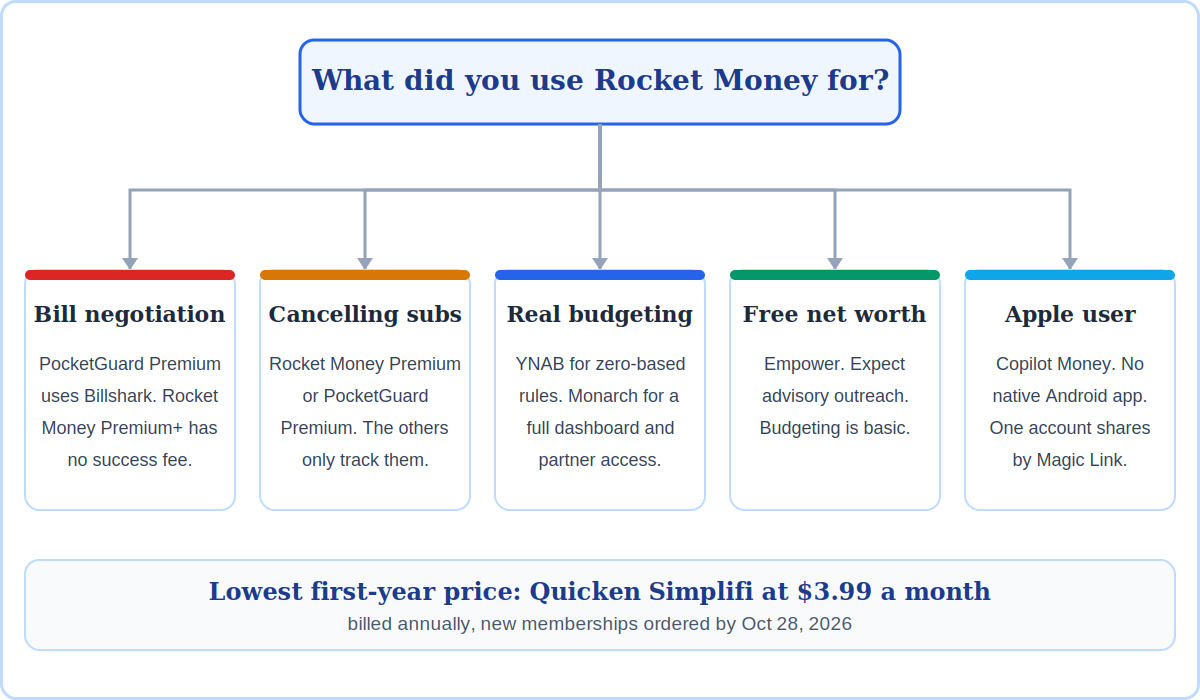
- If the bill-negotiation fee pushed you out, Monarch and YNAB charge a flat subscription and take no cut of your savings.
- If you still want bill help, PocketGuard Premium lists Billshark and Rocket Money Premium+ removes the success fee.
- If you only want free net worth tracking, Empower fits, and the best free budgeting apps list has more free options.
- If first-year price decides it, Simplifi at $3.99 a month wins until October 28, 2026.
- If you use an iPhone and care about design, Copilot fits, and there is no native Android app.
- If you are new to budgeting, start with the best budgeting apps for beginners or take the Find My App quiz.
What Do People Also Ask About Rocket Money Alternatives?
These are the questions that come up most once people compare a rocket money alternative seriously.
What is a good free alternative to Rocket Money?
Empower is the best rocket money free alternative if you mainly want net worth and investment tracking. Its dashboard is free, funded by an optional wealth management arm, so expect advisory outreach as the trade-off. Rocket Money’s own free tier also stays free until a bill negotiation succeeds, and then the fee is 35% to 60% of first-year savings.
Is there an app like Rocket Money that negotiates bills?
PocketGuard Premium lists a Lower My Bills feature that runs through its partner Billshark, which only takes a cut if it saves you money. Rocket Money’s Premium+ plan ($15 a month) also negotiates bills with no success fee. The other apps like Rocket Money in this guide, Monarch, YNAB, Empower, Simplifi and Copilot, don’t negotiate bills.
Can I use Rocket Money and another budgeting app at the same time?
Yes, and many people keep Rocket Money’s free tier for subscription tracking and bill negotiation access while a paid app handles budgeting. The catch is that every linked app is another bank connection, so link only the accounts each one needs. Two apps also mean two sets of category rules to maintain.
Why do people look for apps like Rocket Money?
The most common reasons are the 35% to 60% bill-negotiation fee, Premium’s pay-what-you-want pricing, and the need to connect bank accounts through Plaid. Some also want deeper budgeting or investment tracking than Rocket Money provides. Rob Berger’s hands-on review adds that its cancellation feature doesn’t always work in practice.
What is the cheapest alternative to Rocket Money?
Empower is the cheapest because its dashboard is free. Among paid apps, Quicken Simplifi costs $3.99 a month billed annually ($47.88 for the year) for new memberships ordered directly from Quicken by October 28, 2026. It renews at the then-current rate, which was $6.99 a month at the list price.
Is Empower really free?
Yes, Empower’s own FAQ says the dashboard experience and financial tools are completely free. The company earns money from a separate wealth management service, and Rob Berger notes its advisory team will contact you about it. You can ignore the outreach and keep using the dashboard.
Does Copilot Money work on Android?
No, Copilot Money has no native Android app. It runs on iPhone, iPad and Mac, and it has a web app you can open in a browser on any device. I haven’t verified that the web app matches the iPhone app feature for feature.
Which apps like Rocket Money work best for couples?
Monarch adds a partner at no extra cost, YNAB covers up to six people on one subscription, and Simplifi lets you share with one other person. Copilot shares one account through a Magic Link sign-in, which gives your partner a shared login with full control rather than a separate one. Rocket Money’s partner sharing is a Premium feature.
If Simplifi is your pick, the $3.99 rate ends for new orders on October 28, 2026, so that is the one date to beat. Everything else can wait while you run a free trial on real transactions, since YNAB gives you 34 days and Monarch gives you 7.
📚 Read Next
Full disclosure →
