
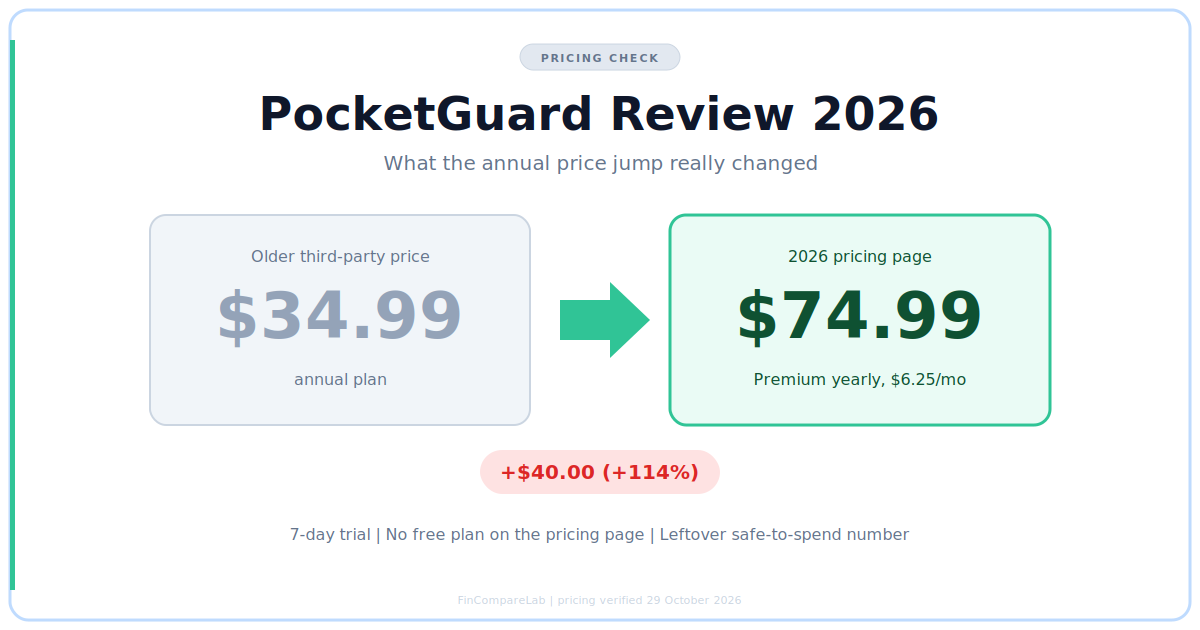
This pocketguard review checks the $34.99 to $74.99 annual price jump against PocketGuard’s own pricing, terms and feature pages, so you can see which numbers are confirmed and which are not.
⚡ Quick Verdict
The PocketGuard app still does one job well, because Leftover shows what you can spend after bills, budgets, goals and debt payments. But the annual plan is now $74.99, the pricing page lists no free plan, and bank sync is the weak spot users mention most. It suits overspenders who want one daily number, not strict zero-based budgeters or investors.
How We Review Apps, Pricing verified from pocketguard.com — 29 October 2026
What is PocketGuard, and what does this pocketguard review cover?
PocketGuard is a budgeting app for the US, Canada and the UK that links your accounts and shows one number, Leftover, after bills, budgets, goals and debt payments. Premium costs $74.99 a year with a 7-day trial, and the pricing page lists no free plan. This pocketguard review checks every claim against official pages.
PocketGuard, Inc. is based in Menlo Park, California, and its site says more than 1 million customers use it. The PocketGuard app runs on iPhone, Apple Watch, Android and the web. I haven’t run it through a full budget cycle, so this pocketguard review rests on official pages, the Terms of Use, store listings and published user reports, and I label anything I couldn’t confirm.
I used YNAB for 15 years, from 2011 until earlier this year, before moving to Monarch. Daily reconciliation and the month-end YNAB dance had turned into busywork, so I ask one question of PocketGuard, whether a single number cuts a chore or adds one. My YNAB review and Monarch Money review cover the other two sides.
If you are still choosing, the best budgeting apps for beginners list filters the field, and the best PocketGuard alternatives cover what to try if this one does not fit.
What is the real PocketGuard cost in 2026?
Premium is $74.99 billed yearly ($6.25 a month), $12.99 monthly ($155.88 over twelve months) or $149.99 once for lifetime access. Each option starts with a 7-day trial. The pricing page lists no free plan, so the trial is the only no-cost way in.
| Plan | Price | 12-month cost | Trial |
|---|---|---|---|
| Premium, yearly | $74.99 ($6.25/mo) | $74.99 | 7 days ✅ |
| Premium, monthly | $12.99/mo | $155.88 | 7 days ✅ |
| Lifetime | $149.99 once | $149.99 | 7 days ✅ |
| Free plan | None on the pricing page | $0 | Basic access for 21 days after cancelling ⚠️ |
Pricing verified from official websites, October 2026. Source: pocketguard.com/pricing and Terms of Use.
Every pocketguard cost figure in this pocketguard review comes from the pricing page and Terms, not from older write-ups.
This pocketguard review uses the pricing page’s wording where it can.
The pricing page calls the paid plan Premium, while its FAQ and the Terms of Use call it PocketGuard Plus. It is one paid plan, so searches for pocketguard plus and pocketguard premium point at the same product.
Annual billing works out to about 21 cents a day. Monthly billing costs $80.89 more over twelve months, or 2.08 times the annual price. Monthly only beats annual if you plan to quit within five months, since six payments of $12.99 already pass $74.99.
Over three years, annual billing costs $224.97, monthly billing $467.64 and lifetime $149.99. That three-year PocketGuard cost is the number to weigh, not the $6.25 headline.
The full plan breakdown sits in my PocketGuard pricing guide. To check $74.99 against your own income first, run the numbers in the budget calculator.
Did PocketGuard’s price really go from $34.99 to $74.99?
Yes. PocketGuard’s own archived pricing page shows $7.99 monthly, $34.99 annual and $79.99 lifetime on 28 June 2023, and $12.99 monthly and $74.99 annual by 12 April 2024. The exact switch date falls between those captures and is unconfirmed as of 29 October 2026.
The captures are Wayback Machine copies of pocketguard.com/pricing, the 28 June 2023 capture and the 12 April 2024 capture. The Motley Fool’s earlier PocketGuard review and Experian’s PocketGuard write-up list the same old prices, and the App Store listing still shows legacy price points.
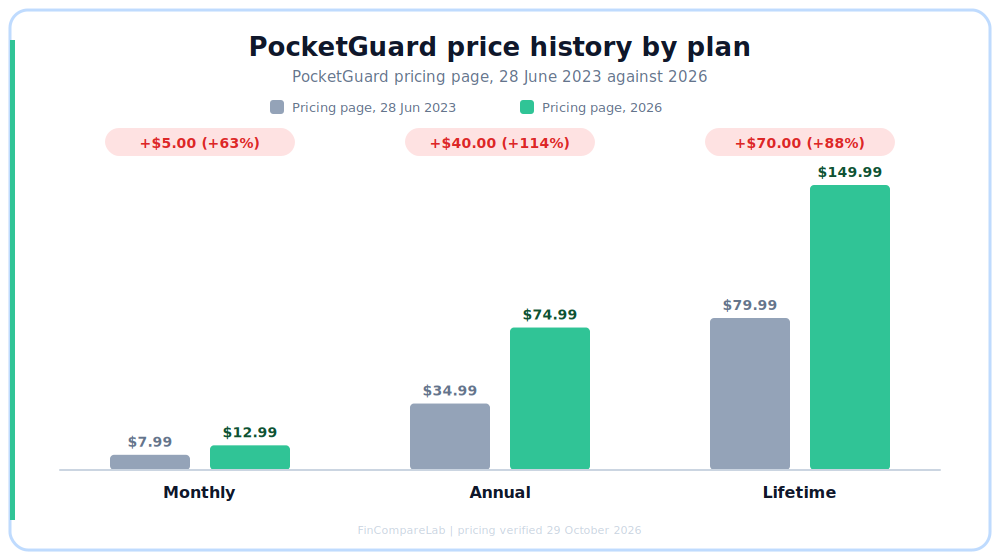
PocketGuard’s archived pricing page (28 June 2023) against the 2026 pricing page. The switch date falls between 28 June 2023 and 12 April 2024.
In dollars, the annual plan rose $40.00 (114%), monthly rose $5.00 (63%) and lifetime rose $70.00 (88%). Annual moved the most, which is why it reads as a doubled price.
An earlier version of this page put the jump in 2023 without a source. The archive shows $34.99 still live in June 2023, so the change landed after that. Any pocketguard review that still quotes $34.99 as the current price is out of date.
The pocketguard app costs more than it did, but the useful question is what that money buys.
What did the extra $40 buy in the PocketGuard app?
PocketGuard hasn’t said. Its pages list Pace, AI chat, Apple Card support and priority human support among Premium features, but none says when each arrived, so I can’t tie the $40 to a single feature. Treat any review that names one cause as a guess.
How does the new price compare with YNAB, Monarch and Goodbudget?
At $34.99, PocketGuard sat $74.01 under YNAB’s $109 annual price. Today the gap is $34.01, against $25.00 under Monarch Core at $99.99 and $5.01 under Goodbudget Premium at $80. Those competitor prices come from my 26 October checks of each official page, and the YNAB pricing guide, Monarch Money pricing guide and Goodbudget pricing guide carry the details.
The $5.01 gap with Goodbudget matters most. Goodbudget Premium adds US bank sync and unlimited envelopes, so the cheaper-than-the-rest argument for PocketGuard now depends on Leftover, not on price.
Does PocketGuard still have a free plan?
The pricing page lists no free plan. Archived copies show a Free card in December 2023 and none by April 2024. The Terms give 21 days of limited basic access after you cancel. Whether a capped free tier still exists in the app is unconfirmed as of 29 October 2026.
Third-party pocketguard reviews disagree. NerdWallet’s 2025 review described a free version with two linked accounts and two budget categories, and Penny Hoarder repeats it. Those caps match the plan PocketGuard dropped from its pricing page by April 2024, so treat them as stale unless you see them on screen. Spendalyst flags the same mismatch.
That leaves three verifiable facts and one open question. The pricing page shows no free plan, the Terms give 21 days of basic access after cancelling, and the Help Center’s Plus article (updated 31 August 2026) publishes no free-tier limits. The sign-up screen is the open question, so until it shows a permanent pocketguard free option, don’t plan around one.
The Terms include one real route to free Premium. If a financial advisor invites you through PocketGuard, your account stays on Premium for as long as that advisor relationship lasts, then reverts to basic.
A pocketguard app review that still calls the app free is probably older than the pricing page.
If you need a plan that stays free, the best free budgeting apps and my Goodbudget review cover options with a permanent free plan. If a spreadsheet might do the job, this Google Sheets budget tracker versus apps comparison covers the trade-offs.
What do you get for the money?
In the PocketGuard app, Premium bundles Leftover, Pace, unlimited accounts and category budgets, rollover budgeting, a debt payoff plan, subscription tools, transaction rules and priority human support with AI chat. Pace is live on iOS, with Android unconfirmed. The pricing page promises no ads and no data sales.
Everything below describes the pocketguard app as its official pages list it today.
Plus also adds CSV import and export, split transactions, receipt attachments and up to 50 cash accounts, per the Help Center’s Plus article.
How does Leftover work, and what happened to In My Pocket?
Leftover is the safe-to-spend number. It starts from income, subtracts bills, subscriptions, category budgets, goals and debt payments, updates as transactions arrive and resets each month. Older reviews call the same idea In My Pocket, while the official pages I read use only Leftover.
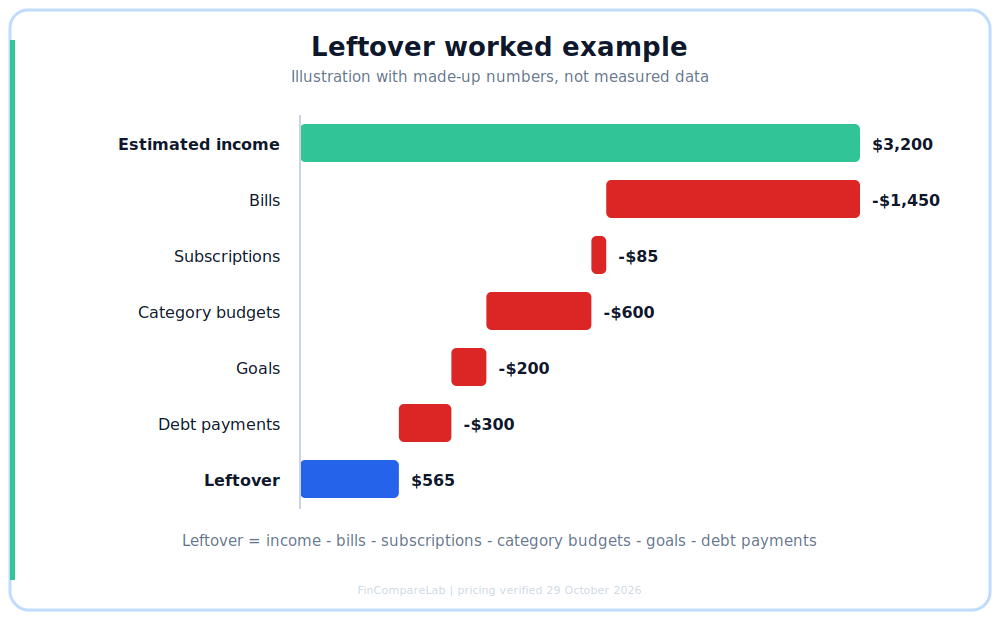
Example numbers for illustration, not measured data. Formula per PocketGuard’s Leftover page.
Leftover starts from your estimated income and updates when real paychecks land, per PocketGuard’s Leftover page. If your pay swings, the number moves mid-month, so set estimated income to your lowest recent month and let Leftover err low. My guide to budgeting on irregular income covers that setup.
Transfers between your own accounts are excluded automatically, which avoids double-counting. Leftover turns negative when a category overspends, so the warning shows before the bank balance does. The page also says you can allocate every dollar with zero-based or envelope budgeting, though I haven’t tried that mode, so I can’t say how close it gets to the zero-based budgeting method YNAB users know.
What does Pace forecast, and does it work on Android?
Pace projects your end-of-month balance from six months of cash flow plus your bills, budgets, goals and debt plan, shown on the Plan tab. The Pace page says it is live on iOS with Android following soon, but it was last modified on 10 March 2026, so Android status is unconfirmed.
Do the bill tools in the PocketGuard app save money?
PocketGuard detects recurring charges and turns them into bills. Its Cancel Unwanted Subscriptions feature only shows you how to cancel, since the Terms say PocketGuard does not contact providers on your behalf. The Lower My Bills page hands cell, cable and WiFi bills to partner Billshark, which charges only if it saves you money.
PocketGuard claims an 80% average success rate for Billshark, which is the company’s own number. The share Billshark keeps is unconfirmed on the pages I read, and only three bill types are covered, so it is not a general negotiator. PocketGuard vs Rocket Money shows who handles cancellations better, and my Rocket Money review covers its own fees.
Is the debt payoff plan better than a free calculator?
The debt payoff plan builds a schedule from the balances, rates and minimum payments you enter, with snowball or avalanche ordering. I haven’t run a real balance through it. A free calculator does the same arithmetic, including PocketGuard’s own debt payoff calculator and my debt payoff estimator, so the paid plan earns its place only if you want the schedule living next to your budget.
For a wider comparison, see the best budgeting apps for debt payoff, and my guide on how to get out of debt fast explains snowball against avalanche.
Does the net worth tracker replace a dedicated app?
PocketGuard lists a net worth tracker that syncs bank accounts, cards, loans, investments and real estate and saves daily balance snapshots. It shows balances, not portfolio analysis, and Experian calls the investment tracking basic. An earlier version of this page said PocketGuard has no net worth tracking, which was wrong. If investments drive your decisions, read the best net worth tracking apps before paying.
How reliable is the PocketGuard budget app at bank sync?
PocketGuard connects accounts through third-party aggregators, and its Terms name Finicity and Salt Edge. Official pages promise strong US and Canada connectivity, while user reports keep naming failures at specific banks. Link your main account during the trial and check it against your bank app before paying.
PocketGuard’s own pages give three different freshness claims. The Leftover page says it updates in real time, the net worth page says accounts sync a few times a day with a manual sync button, and the Terms say provider data may be collected nightly. For a same-day safe-to-spend number, that gap matters, so treat Leftover as accurate after a sync, not before.
The problem list repeated in several pocketguard reviews, including Penny Hoarder’s, names American Express Personal Savings, HSBC, Marcus by Goldman Sachs, Synchrony and PayPal in the US, plus Canadian banks such as BMO, CIBC, RBC and Scotiabank. I couldn’t read PocketGuard’s own list directly, so it is unconfirmed as of 29 October 2026. Plaid appears in third-party write-ups but not on the official pages I read.
Sync is the weak spot in most pocketguard reviews, so the trial test below matters more than any feature.
How do you test the PocketGuard app’s bank sync in the 7-day trial?
On day 1, link your main checking account and the card you use most. On day 3, compare the current balance and your last 10 transactions with your bank app. If any transaction is missing or the balance is off by more than your pending items, treat the connection as unreliable and cancel on day 5, a day before the 24-hour cutoff.
That test is the most useful part of any pocketguard review, and it costs nothing if you cancel on day 5.
On safety, the pricing page says PocketGuard does not sell data and monitors for suspicious activity. The end-user license in the Terms grants PocketGuard and its vendors limited power of attorney to retrieve your account data, and the liability section caps PocketGuard’s liability at $50.
Spendalyst and WallStreetMojo report no publicly known breach as of 2026, which is secondhand, so link only the accounts Leftover needs. The Monarch Money safety guide shows what to check in any aggregator-based app.
What do pocketguard reviews and Reddit say?
The App Store shows 4.6 from 7.7K ratings, per PocketGuard’s own reviews page. Community write-ups call it an easy start, praise subscription detection and criticize price, bank sync and shallow categories. I couldn’t read Reddit directly, so that sentiment is secondhand and unconfirmed as of 29 October 2026.
| Source | Rating | Status |
|---|---|---|
| App Store | 4.6 (7.7K ratings) | PocketGuard’s own reviews page ✅ |
| Google Play | 100K+ downloads, rating not captured | Official page, rating unconfirmed ⚠️ |
| Trustpilot | 4.0 on a 24-review snapshot, 4.3 elsewhere | Sources conflict, unconfirmed ⚠️ |
Ratings change daily. Checked 29 October 2026.
PocketGuard’s reviews page is the company’s own curated page of pocketguard reviews, so treat its quotes as marketing. The official pages link two subreddit names, r/PocketGuard on the pricing page and r/PocketGuard_app in the Help Center, so check which community a thread comes from, or whether it is r/personalfinance or r/budgeting, before you weigh it. A pocketguard reddit search returns both.
The recurring complaints in secondhand tallies match what the official pages leave open, the free tier, the price and sync. That is consistent, but it is not independent evidence, so I weigh the Terms and pricing facts above anyone’s star rating.
Why do pocket guard reviews disagree about the free plan?
Pocket guard reviews disagree because they were written at different times. Reviews from before April 2024 describe a free plan and $34.99, while 2025 and 2026 reviews describe a paid-only app. Check the publication date before you weigh any claim.
How do you read a pocketguard app review for stale prices?
Check the date first. A pocketguard app review written before 12 April 2024 probably quotes $34.99 and a free plan, and some later ones still repeat them. Compare any quoted price with the live pricing page, and discount the star rating when the numbers do not match.
What are the PocketGuard pros and cons?
The pocketguard pros and cons that survive the sourcing are short. The pros are Leftover’s one-number design, subscription detection, a lifetime option and a 7-day trial. The cons are the $74.99 annual price, no free plan on the pricing page, mixed sync reports, Pace on iOS only and a lifetime plan tied to the company’s survival.
| What works | The edge case |
|---|---|
| One number answers if you can spend today | It starts from estimated income, so irregular pay shifts it mid-month |
| Subscription detection and Billshark | Cancel Unwanted Subscriptions is information only, and Billshark covers cell, cable and WiFi |
| Lifetime at $149.99 beats annual after two years | Lifetime lasts as long as the service, and prepaid plans are not refunded if it shuts down |
| Net worth tracker and debt payoff plan included | Investment depth is basic, and I haven’t run a real debt through the planner |
| Human support and AI chat included | Freshness claims conflict (real time, a few times a day, nightly) |
Sources: PocketGuard pricing, Leftover and net worth pages, Terms of Use, Experian. October 2026.
Who should use the PocketGuard app, and who should skip it?
The pocketguard app review verdict depends on your bank and your habits, not on a star rating. The PocketGuard app fits overspenders who want one daily number, people who dislike giving every dollar a job, and anyone whose main banks sync cleanly during the trial. It is a weaker fit for strict zero-based budgeters, investors who want portfolio analysis and anyone who needs a permanent free plan.
Strict budgeters should read YNAB vs PocketGuard and the best zero-based budgeting apps. Dashboard seekers should read Monarch Money vs PocketGuard, and free envelope fans should read Goodbudget vs PocketGuard.
Couples sharing accounts will find more in the best budgeting apps for couples, and first-job budgeters can check the best budgeting apps for young adults. If you want a cash-envelope feel, the best envelope budgeting apps list shows who does it natively.
How does PocketGuard compare with YNAB, Monarch and Goodbudget?
The PocketGuard app costs $74.99 a year, against $109 for YNAB, $99.99 for Monarch Core and $80 for Goodbudget Premium. It is the lowest of the four and the only one built around a single safe-to-spend number. YNAB is stricter, Monarch is broader, and Goodbudget has the only permanent free plan.
| App | Annual | Free plan | Best for | Read |
|---|---|---|---|---|
| PocketGuard | $74.99 | None on the pricing page ⚠️ | One daily spend number | This review |
| YNAB | $109 | None after the 34-day trial ❌ | Strict zero-based control | YNAB review |
| Monarch Core | $99.99 | None, 7-day trial ❌ | One-screen dashboard | Monarch review |
| Goodbudget Premium | $80 | Free plan exists ✅ | Manual envelopes | Goodbudget review |
Pricing verified from official websites, October 2026. Competitor prices checked 26 October.
Treat any pocketguard budget app comparison with suspicion if it lists $34.99. A fair pocketguard review sets the price next to YNAB, Monarch and Goodbudget, which the table above does.
Mint closed in early 2024, and searches for pocketguard vs mint now mostly come from people replacing it. Monarch became the common replacement, with PocketGuard as the cheaper, simpler option, and the best Mint alternatives list covers the rest.
How do you cancel PocketGuard and get a refund?
The cancel steps in this pocketguard review come from the pricing page and Terms. Cancel at least 24 hours before renewal, in the mobile app under Billing, Modify subscription, or on the web under Settings, Customer Portal, Cancel plan. Refunds are pro-rata within 14 calendar days of purchase, requested by email to [email protected]. App Store or Google Play purchases also follow those stores’ terms.
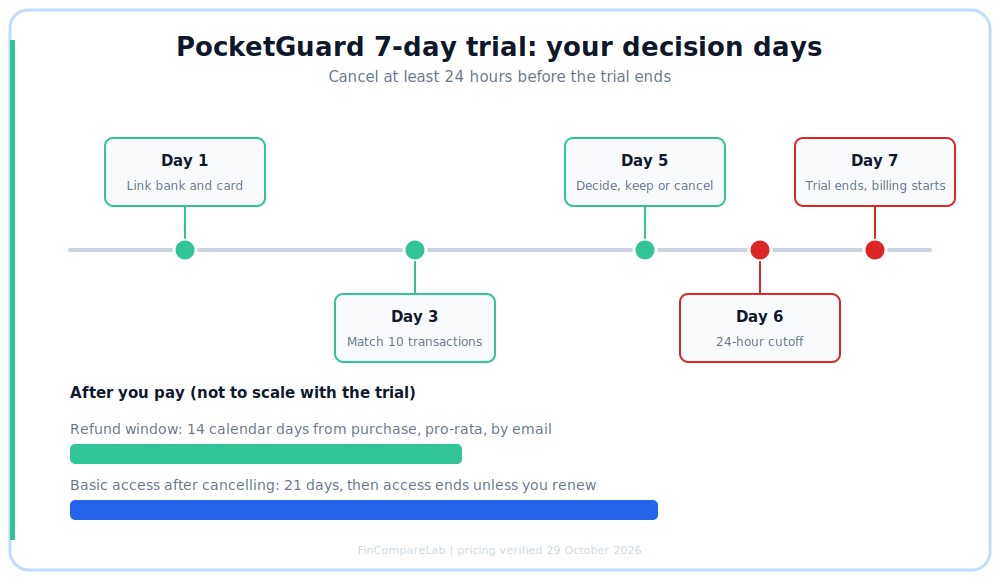
Decision days for the 7-day trial. Terms of Use, last updated 26 November 2024.
Cancelling a trial or Plus gives you 21 days of limited basic access, then access ends unless you renew. You can restore a cancelled subscription only while you keep using the service, and the Terms say that option disappears after 28 days of non-use. Cancelling does not delete your data, so deletion is a separate request.
Lifetime has its own rules, and most pocketguard reviews skip them. To switch from a subscription you cancel first (or request a refund), then buy lifetime from the sidebar. The Terms define lifetime as the life of the service, and if PocketGuard shuts down, prepaid plans are non-refundable.
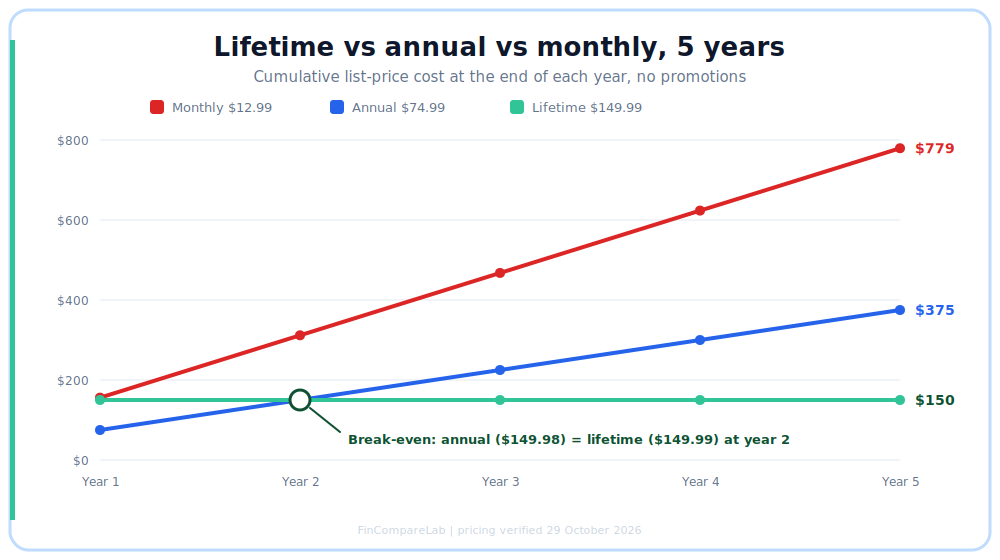
Cumulative list-price cost at the end of each year, no promotions. Lifetime ties annual at year two.
Lifetime at $149.99 equals two years of annual billing ($149.98). It pulls ahead in year three by $74.98 and by year five saves $224.96. Monthly billing passes the lifetime price in month 12.
NerdWallet’s 2025 pocketguard review reported an in-app $79.99 lifetime offer, and PocketGuard’s FAQ says only some customers see a lifetime offer. I can’t confirm either today, so check the price on screen before paying.
Is PocketGuard worth it in 2026?
This pocketguard review lands on yes for a narrow buyer, and a hard maybe for everyone else. Leftover answers if you can spend something today, and $74.99 is still the lowest of the four apps compared above. But a doubled annual price, no free plan on the pricing page and conflicting freshness claims make the 7-day trial matter more than any star rating.
That is the verdict of this pocketguard review in one line. My rule is to pay only if sync passes the day 3 check and you open Leftover unprompted on most days by day 5. If it fails either, cancel on day 5.
FinCompareLab rating: ⭐ 4.3/5
In this pocketguard review, the PocketGuard app is best for overspenders who want one daily number and whose banks sync cleanly in the trial. Held back by the doubled annual price, no free plan on the pricing page and conflicting sync-freshness claims. Not for strict zero-based budgeters or investors who want portfolio analysis.
Try PocketGuard free for 7 days.
What else do people ask about PocketGuard?
These are the questions behind most pocketguard review searches, answered from the sources above.
Is the PocketGuard app free?
The pricing page lists no free plan, only a 7-day trial, and archived copies show the free card gone by April 2024. The Terms give 21 days of basic access after you cancel, and whether a permanent free tier exists in the app is unconfirmed as of 29 October 2026.
Is the PocketGuard app safe to link to my bank?
PocketGuard says it does not sell your data and monitors for suspicious activity, and it links accounts through third-party aggregators named in its Terms. The Terms cap its liability at $50, so link only the accounts you need.
What do pocketguard reviews say about bank sync?
Most pocketguard reviews name bank sync as the main complaint, with American Express, HSBC, Marcus, Synchrony and PayPal cited most. Those lists come from secondary sources, so test your own bank in the trial before paying.
How does PocketGuard make money?
From Premium subscriptions and lifetime sales, plus its Billshark partnership for bill negotiation, whose revenue split is unconfirmed. The site also lists white-label and API pages, but I haven’t read their terms.
Why did PocketGuard’s price go up?
PocketGuard has not published a reason. Its archived pricing page shows $34.99 in June 2023 and $74.99 by April 2024, and the exact switch date is unconfirmed, so any single cause is a guess.
How do I cancel PocketGuard?
Cancel at least 24 hours before renewal, in the app under Billing, Modify subscription, or on the web under Settings, Customer Portal, Cancel plan. For a refund, email support within 14 calendar days of purchase.
Next step: start the PocketGuard app trial with your main checking account linked, and set a reminder for day 5 before you close the tab.
📚 Read Next
