
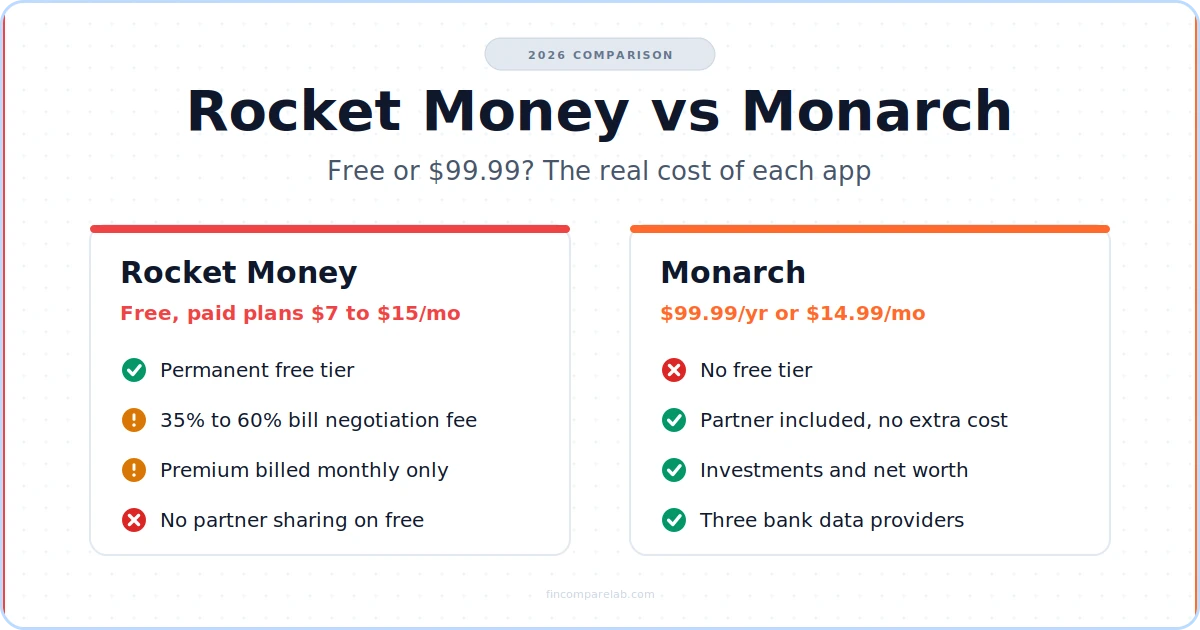
Rocket Money vs Monarch is a choice between a free app that charges you when it saves you money and a $99.99-a-year app that charges nothing extra. Pick Rocket Money if forgotten subscriptions and high bills are the problem. Pick Monarch if you want one shared dashboard for budgeting, investments, and net worth, especially with a partner.
⚡ Quick Verdict
Rocket Money’s free tier is a solid subscription audit, but its bill negotiation takes 35% to 60% of your first-year savings, and budgeting, partner sharing, and web access all sit behind a monthly-only Premium plan. Monarch costs $99.99 a year with no free plan, and that price covers your whole household. For a couple building one real budget, Monarch is the better buy. For a solo cleanup of recurring charges, start with Rocket Money free.
How We Review Apps, Pricing verified from monarch.com and rocketmoney.com — 25 September 2026
On this page:
- What’s the real difference in Rocket Money vs Monarch?
- What does Rocket Money vs Monarch cost over 3 years?
- How does the Rocket Money bill negotiation fee work?
- What does Rocket Money’s free tier leave out?
- How does budgeting work in Monarch vs Rocket Money?
- Which app tracks investments and net worth better?
- Is Monarch or Rocket Money better for couples?
- Which app connects to more banks?
- What do the app ratings say in 2026?
- How do they stack up against YNAB, Copilot, and Simplifi?
- Can you use both Monarch and Rocket Money?
- Should you pick Rocket Money or Monarch?
- What do people ask about Monarch Money vs Rocket Money?
What’s the Real Difference in Rocket Money vs Monarch?
Rocket Money is a subscription and bill manager with budgeting attached, free forever, with Premium at $7 to $14 a month. Monarch is a household finance dashboard built around budgeting, investments, and net worth, at $99.99 a year with no free tier. Rocket Money cuts recurring costs. Monarch shows the whole picture.
The business models explain most of the Rocket Money vs Monarch gap. Rocket Money earns from Premium subscriptions and from success fees when its team lowers a bill, so its best features push you toward handing over bills. Monarch earns only from subscriptions, and its pricing page leans on that point by promising no ads.
A quick note on where this Monarch vs Rocket Money comparison comes from. I run my own budget in Monarch, so the Monarch side is first-hand. I haven’t used Rocket Money myself, so its side comes from Rocket Money’s own pricing article, help center, FAQ, and app store listings, all checked on 25 September 2026. My full Monarch Money review and Rocket Money review go deeper on each app alone.
| Rocket Money | Monarch | |
|---|---|---|
| Price | Free, Premium $7 to $14/mo, Premium+ $15/mo | Core $99.99/yr or $14.99/mo, Plus $199.99/yr |
| Billing | ⚠️ Monthly only | ✅ Annual or monthly (Plus annual only) |
| Free tier | ✅ Permanent, mobile only | ❌ None |
| Trial | 7 days of Premium | 7 days, payment method required |
| Bill negotiation | ✅ 35% to 60% success fee (none on Premium+) | ❌ Not offered |
| Subscription cancellation | ✅ Premium and Premium+ | ❌ Tracking and reminders only |
| Partner sharing | ⚠️ Premium and Premium+ only | ✅ Included, no extra cost |
| Investment tracking | ⚠️ Net worth total on Premium | ✅ Performance, diversification, equity comp |
| Bank data providers | Plaid only | Plaid, Mastercard Data Connect, MX |
| App Store rating | 4.5 (393K ratings) | 4.9 (111K ratings) |
Pricing verified from official websites, September 2026.
What Does Rocket Money vs Monarch Cost Over 3 Years?
Over three years, Rocket Money costs $0 on the free tier, $252 to $504 on Premium, and $540 on Premium+. Monarch Core costs $299.97 billed annually, about $270 with the WELCOME code in year one, or $539.64 if you pay monthly.
| Plan | Per year | 3-year total |
|---|---|---|
| Rocket Money Free | $0 (plus any negotiation fees) | $0 |
| Rocket Money Premium at $7/mo | $84 | $252 |
| Rocket Money Premium at $14/mo | $168 | $504 |
| Rocket Money Premium+ | $180 | $540 |
| Monarch Core, annual | $99.99 | $299.97 |
| Monarch Core, annual with WELCOME (30% off year one) | About $70, then $99.99 | About $270 |
| Monarch Core, monthly | $179.88 | $539.64 |
Pricing verified from official websites, September 2026.
The number that decides the paid-tier Rocket Money vs Monarch matchup is $8. Rocket Money’s help center describes Premium as a paid monthly membership where you pick a monthly amount, with no annual discount. Set the slider to $8 and you pay $96 a year, just under Monarch’s $99.99. Set it to $9 and you’re at $108, already more than Monarch Core billed annually.
Most people who search Rocket Money vs Monarch 2026 assume the free app is the cheap one. That’s true only while you stay on the free tier. Once you want unlimited budgets or a shared login, you’re comparing Monarch against Premium, and Monarch’s annual plan usually wins on price.
Monarch’s trial runs 7 days and needs a payment method upfront, so set a reminder to cancel in settings before day 7 if it isn’t for you. The only Monarch discount I can confirm is WELCOME for 30% off the first year, shown live on monarch.com.
Both pricing guides go further than this Monarch money vs Rocket Money cost table. My Monarch Money discount guide explains why the 50%-off codes on coupon sites don’t hold up, and the Monarch Money pricing guide covers Core vs Plus in detail. For the Rocket Money side, see the Rocket Money pricing guide.
How Does the Rocket Money Bill Negotiation Fee Work?
Rocket Money’s negotiators contact your internet, phone, or cable provider and ask for a lower rate. If they succeed, you pay 35% to 60% of the first year’s savings, and you pay nothing if they fail.
After year one you keep 100% of the lower rate for as long as it lasts, per Rocket Money’s own pricing breakdown. Rocket Money bill negotiation is open to free users too, which is why the free tier isn’t always free in practice. The fee is based on a full year of savings, so even a small monthly cut produces a noticeable bill. It’s the single biggest feature gap in Rocket Money vs Monarch.
| Monthly bill cut | First-year savings | Fee at 35% | Fee at 60% | You keep in year one |
|---|---|---|---|---|
| $10/mo | $120 | $42 | $72 | $48 to $78 |
| $25/mo | $300 | $105 | $180 | $120 to $195 |
| $50/mo | $600 | $210 | $360 | $240 to $390 |
Fee range from Rocket Money’s pricing page, September 2026. Worked examples are illustrative.
When does Premium+ beat paying the success fee?
Premium+ costs a flat $15 a month and removes the negotiation fee entirely. The catch is access, since Rocket Companies’ August 2026 launch announcement says Premium+ is open to select subscribers now, with broader availability later this year.
If you can get it, the math depends on what you’d pay for Premium anyway. At a $7 slider, upgrading costs $96 more a year, which pays off once a negotiation saves more than $160 (at a 60% fee) or $274 (at 35%). At a $14 slider, the upgrade costs only $12 more a year, so almost any successful negotiation makes Premium+ the cheaper route.
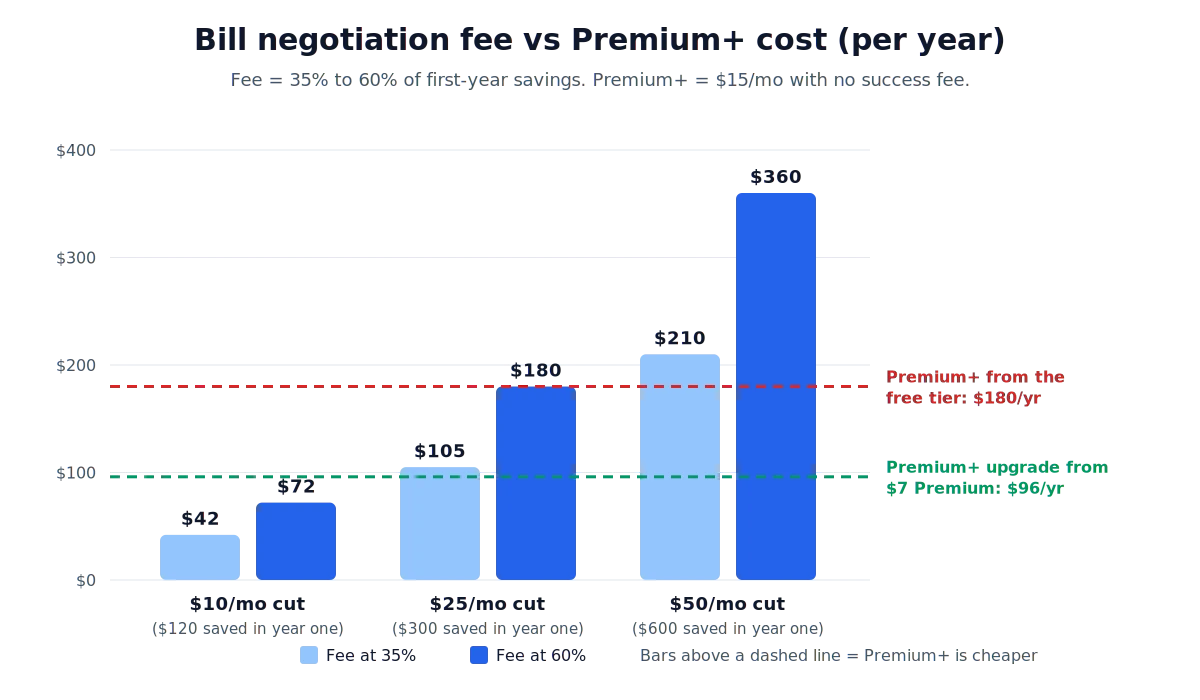
For a free-tier user weighing Rocket Money or Monarch, the picture flips. Premium+ at $180 a year only beats the fee once your negotiated savings pass $300 at 60% or about $514 at 35%. A $25-a-month cut is $300 in year one, right at that line, so a free user with one modest bill is usually better off paying the one-time fee.
On the Monarch side of Monarch vs Rocket Money, there’s no negotiation service at all. It does track recurring charges and reminds you about subscriptions and upcoming bills, so Monarch Money subscription tracking works like a watchlist that leaves the phone call to you. If you’re willing to make that call yourself, you keep 100% of the savings from day one, which is the one trade-off no fee table captures.
⚠️ Watch Out
Rocket Money notes that Premium+ terms and exclusions may apply. Before you submit a bill expecting a fee-free negotiation, confirm in the app that your account actually shows Premium+ and not regular Premium.
What Does Rocket Money’s Free Tier Leave Out?
The free tier covers subscription tracking, bill reminders, spending breakdowns, and a credit score, but it runs on the mobile app only. Partner sharing, net worth, real-time sync, cancellation help, and desktop access all need Premium.
The category count is murky. Rocket Money’s pricing table says free users get up to 3 category budgets, while the same page’s prose and the official Rocket Money FAQ both say two custom category budgets. Plan around two, and treat a third as a bonus if it shows up.
That makes the free tier a subscription audit tool, not a budget. A like-for-like Monarch vs Rocket Money budgeting comparison is Monarch against Rocket Money Premium, and on that basis Monarch costs anywhere from $16 more to $68 less per year. If a genuinely free budget is the goal, my best free budgeting apps roundup covers apps whose free tiers include real budgeting.
Credit is the one Monarch money vs Rocket Money category where Rocket Money gives more. Premium adds full credit reports and weekly FICO Score 2 updates from Experian, while free members see a basic score snapshot, per the FAQ. Rocket Money’s own comparison page claims Monarch offers only basic credit score information, so if credit monitoring matters to you, weigh that as a Rocket Money point.
How Does Budgeting Work in Monarch vs Rocket Money?
Monarch gives you two budgeting modes, Flex Budgeting and Category Budgeting, and can build a starting budget from your real spending history. Rocket Money sets category budgets with alerts, unlimited on Premium, and keeps setup light.
Flex Budgeting splits spending into fixed costs, flexible spending, and non-monthly expenses, then tracks one flexible number instead of dozens of limits. Category Budgeting gives every category its own limit and supports rollovers, which suits anyone who likes line-item control. I moved my own household to Monarch this year after 15 years on YNAB, mostly to stop the daily reconciliation.
Two small features keep me there day to day. Receipt scanning itemizes a big store run without manual splits, and the browser extension auto-splits transactions for me. That cut my weekly maintenance to a few minutes, which was the whole point of leaving strict zero-based budgeting.
Rocket Money Premium budgeting has unlimited categories, transaction rules, splits, tags, and notes. It also has Watch lists for keeping an eye on one category or merchant without committing to a full budget, and Financial Goals that automate savings toward a target or a debt paydown plan. If paying down debt is the priority, my best free debt tracker apps guide compares tools built only for that.
Neither side of Rocket Money vs Monarch is zero-based. If you want every dollar assigned a job, read what zero-based budgeting is first, then compare the best zero-based budgeting apps or my YNAB vs Monarch comparison.
Which App Tracks Investments and Net Worth Better?
Monarch, by a wide margin. Monarch Core tracks investment performance, diversification, and equity compensation, and pulls home values from Zillow and crypto from Coinbase, while Rocket Money lists a net worth total on Premium only.
Monarch’s Plus plan at $199.99 a year adds retirement forecasting, deeper investment analysis such as unrealized gains and asset allocation, business income tracking, and P&L reports. That’s worth it for a side business or real retirement modeling, and overkill for most households, since Core already covers the net worth chart most people want.
Rocket Money’s pricing table lists net worth tracking as a Premium feature and no investment analysis tools. If portfolio tracking decides Monarch or Rocket Money for you, and budgeting comes second, compare Monarch against a free investment dashboard in my Monarch vs Empower comparison, or browse the best net worth tracking apps. My Empower review covers the free dashboard on its own.
Is Monarch or Rocket Money Better for Couples?
Monarch is better for couples. One Monarch subscription covers your whole household at no extra cost, with a separate login for each person, while Rocket Money limits partner sharing to Premium and Premium+.
Monarch’s household help article is clear that you both stay under a single subscription. You also get Shared Views, which let you assign an owner to each account and transaction.
Two trade-offs rarely get mentioned. Each household shares one budget, so partners who want separate personal budgets can’t have them. And you can’t invite someone who already has a Monarch account, so a partner with an existing trial has to use a new email or delete that account first.
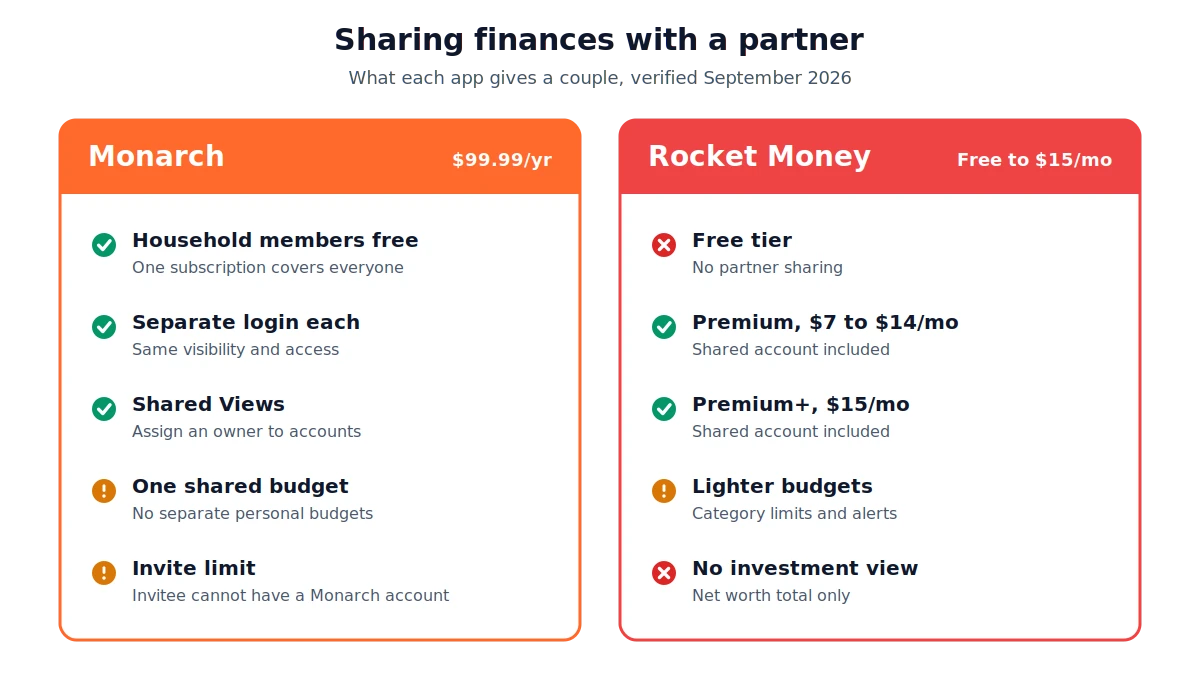
On the Rocket Money side, the free tier has no partner sharing at all. Premium at a $7 slider covers both of you for $84 a year, which undercuts Monarch, but you get a lighter budget and no investment view. For most people weighing Rocket Money vs Monarch for couples, that price edge doesn’t outweigh a dashboard designed for two.
My best budgeting apps for couples guide covers other household-first apps. If you keep finances mostly separate, the Honeydue vs Monarch Money comparison covers a free couples app with a different approach.
Which App Connects to More Banks?
Monarch has more ways in. It connects through three data providers, Plaid, Mastercard Data Connect (formerly Finicity), and MX, and lets you switch providers per bank, while Rocket Money links through Plaid alone.
That single path creates a hard edge case for Rocket Money. Its help center says you need at least one checking account that Plaid supports, or you can’t use the app at all. If your primary checking lives at a small credit union Plaid doesn’t cover, Rocket Money is off the table before features even matter. Anyone deciding Rocket Money or Monarch with a credit union account should check this first.
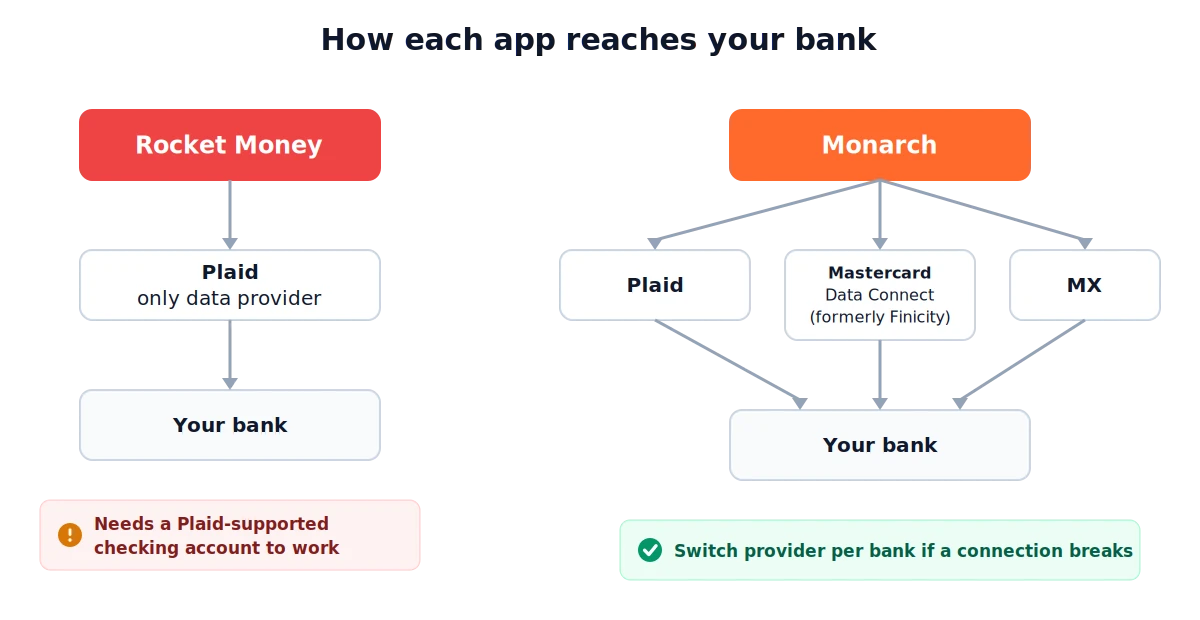
Monarch’s data provider guide says it suggests the provider with the strongest track record for your bank, and lets you pick another if a connection keeps breaking. It also publishes a connection status dashboard that rates each bank by provider.
Before you start Monarch’s 7-day trial, look up your bank there and connect your weakest institution first, so a bad link shows up while you can still cancel. My is Monarch Money safe guide covers what those connections can and can’t access.
What Do the App Ratings Say in 2026?
Both apps in the Rocket Money vs Monarch matchup rate well. Monarch holds 4.9 on the App Store from 111K ratings and 4.8 on Google Play, and Rocket Money holds 4.5 on both stores from much larger pools.
| Platform | Rocket Money | Monarch |
|---|---|---|
| App Store (US) | 4.5, 393K ratings, iPhone only | 4.9, 111K ratings, iPhone and iPad |
| Google Play (US) | 4.5, 139K reviews, 10M+ downloads | 4.8, 25.3K reviews, 500K+ downloads |
| Trustpilot | 4.0, 4,204 reviews, claimed profile | No meaningful sample (unclaimed profiles) |
Ratings checked live, 25 September 2026.
Older comparisons put Rocket Money’s Trustpilot score near 3.5 and used that as a warning sign. That gap has mostly closed, since the claimed profile now sits at 4.0 across more than 4,000 reviews. Monarch’s Trustpilot pages are unclaimed, with 33 reviews on one domain and 2 on the other, far too few to read anything into.
The size difference in the app store pools makes sense given the pricing. A free app with 10M+ Android downloads collects ratings from casual users who never pay. Every Monarch rating comes from someone who at least started a paid-plan trial, which likely explains part of its higher average.
How Do They Stack Up Against YNAB, Copilot, and Simplifi?
A lot of searches widen into three-way matchups like Rocket Money vs Monarch vs YNAB, Rocket Money vs Copilot vs Monarch, and Rocket Money vs Monarch vs Simplifi. The short version is that each third app is a different budgeting style.
YNAB is strict zero-based budgeting, the opposite of Rocket Money’s hands-off approach, so start with YNAB vs Rocket Money or YNAB vs Monarch. Copilot is Apple-only, which rules it out for Android households, and Monarch vs Copilot covers that split. Quicken Simplifi sits between Rocket Money and Monarch on depth, compared in Monarch vs Simplifi. If you’re still shopping after Mint closed, my best Mint alternatives list ranks all of them.
Can You Use Both Monarch and Rocket Money?
Yes, and a short overlap is often the smartest setup. Use Rocket Money’s free tier for a one-time subscription audit, then run your real budget in Monarch.
Decision Box: Running Both
Link your checking and credit cards to Rocket Money free, cancel what it flags, and submit any bill worth negotiating. Once the cleanup is done, let Monarch’s recurring-bill reminders take over the watching and unlink Rocket Money. Total cost is Monarch’s $99.99 plus any one-time negotiation fees.
The audit works on the free tier because tracking is free, even though cancellation help needs Premium. Cancelling a streaming service or app subscription yourself usually takes a few minutes once you know it exists. If you start a Premium trial just to use cancellation help, my guide on how to cancel a Rocket Money subscription walks through ending it before the charge.
Keeping both apps long term means two sets of alerts and two apps to open, which undoes the simplicity that made Monarch or Rocket Money appealing in the first place. For most households that friction isn’t worth it once the subscription list is clean. If neither app fits after the overlap, the best Rocket Money alternatives and best Monarch Money alternatives roundups are the next stop.
Should You Pick Rocket Money or Monarch?
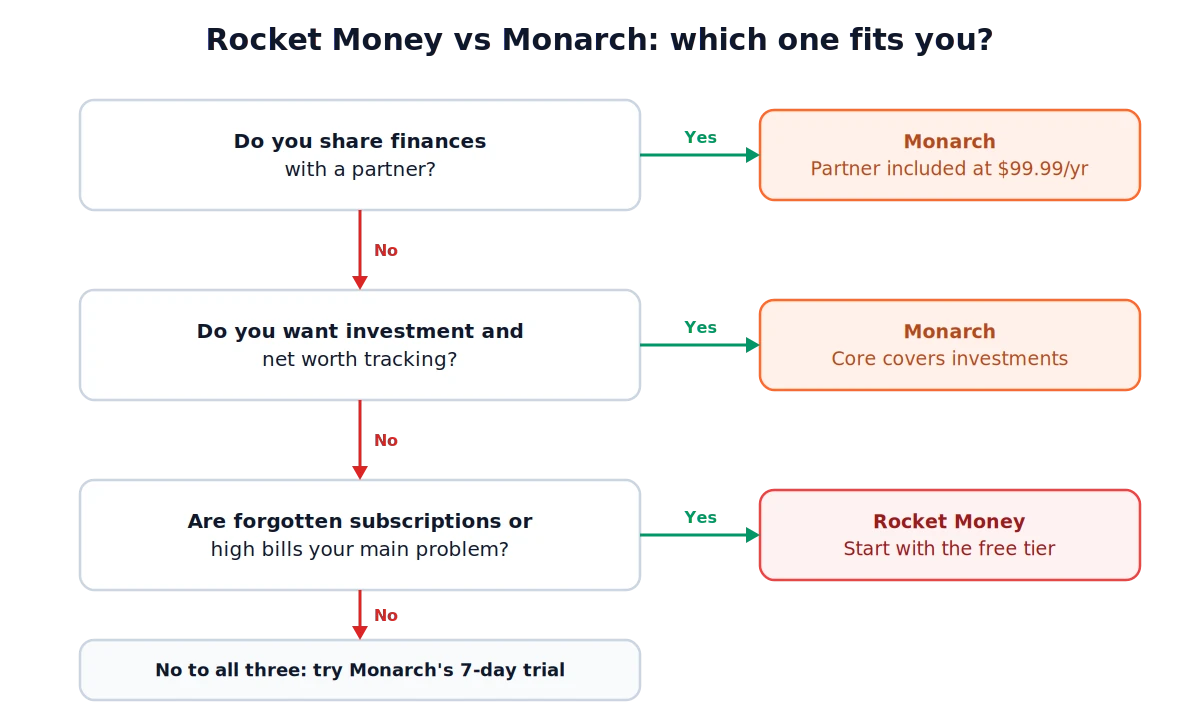
Pick Rocket Money if your money leaks through forgotten subscriptions and bills you never renegotiate. Pick Monarch if you want to budget as a household and see investments and net worth in the same place. The Rocket Money vs Monarch Money choice gets easier once you name the problem you’re paying to fix.
Decision Box
Choose Rocket Money if: you budget alone, your main goal is catching and cancelling recurring charges, your bills haven’t been renegotiated in years, or a real free tier matters more than depth. Try Rocket Money free
Choose Monarch if: you share finances with a partner, you hold investments worth tracking properly, or you’d rather pay $99.99 a year than choose between a monthly slider and a success fee. Start Monarch’s 7-day trial
So is Monarch better than Rocket Money? For a household budget, yes. If you’re asking which is better Monarch or Rocket Money for lowering bills, Rocket Money wins, because Monarch doesn’t negotiate at all. If you came here from a monarch vs rocket money reddit thread and still can’t decide, my Find My App quiz matches you to an app in a couple of minutes.
What Do People Ask About Monarch Money vs Rocket Money?
These are the questions that come up most when people compare Monarch Money vs Rocket Money.
Is Monarch Money better than Rocket Money?
Monarch Money is better for budgeting, investment tracking, and sharing finances with a partner. Rocket Money is better for cancelling subscriptions and negotiating bills, and it’s the only one of the two with a free tier.
Is Rocket Money actually free?
Yes, Rocket Money’s free tier is permanent and needs no card. It covers subscription tracking, bill reminders, spending breakdowns, and a credit score on mobile, but bill negotiation still carries a 35% to 60% success fee when it works.
Can Rocket Money cancel subscriptions for you?
Yes, but only on Premium or Premium+. Free users can see their subscriptions listed in one place, and they have to cancel each one themselves.
Does Monarch Money have a free trial?
Yes, Monarch Money has a 7-day free trial of Core or Plus. It requires a payment method, and you need to cancel in settings before the trial ends to avoid the $99.99 annual charge.
Is Rocket Money Premium+ available to everyone?
Not yet. Rocket Companies says Premium+ is open to select subscribers, with broader availability planned for later in 2026.
Is Rocket Money better than Monarch for saving money on bills?
Yes, because Monarch has no bill negotiation service. Rocket Money’s team does the calling for you, and you pay a share of the first year’s savings unless you’re on Premium+.
Which is cheaper, Rocket Money or Monarch?
Rocket Money is cheaper on its free tier and on Premium at $8 a month or less. At a $9 slider or higher, Monarch Core billed annually at $99.99 costs less than Rocket Money Premium over a full year.
The number to watch in Rocket Money vs Monarch is Premium+. Once fee-free negotiation reaches more subscribers later in 2026, the fee math above tilts further toward Rocket Money for households with big phone and internet bills, and I’ll re-run these numbers when the rollout widens. Spreadsheet people can skip both apps entirely, and this Google Sheets budget tracker vs apps breakdown walks through that route.
📚 Read Next
