

Monarch vs Simplifi in 2026 comes down to a real, confirmed $52-a-year price gap and five concrete ways that gap actually plays out in your billing, not just a headline number. I checked both apps’ live pricing pages this week and dug into their feature sets, so you can see exactly where the Monarch vs Simplifi savings come from and whether they matter for how you budget.
⚡ Quick Verdict
Simplifi is the smarter pick for solo spend-tracking: $47.88/year against Monarch Core’s $99.99/year, a $52.11 gap confirmed live on both pricing pages. Monarch earns its higher price back for couples, deeper investment analysis, and custom categories. Neither app is a bad deal here; they’re priced for different jobs.
How We Review Apps · Pricing verified from monarch.com and quicken.com — 5 September 2026
On this page:
- What’s the real Monarch vs Simplifi price gap in 2026?
- What are the 5 ways to actually save $52 with Monarch vs Simplifi?
- How do Monarch and Simplifi compare side by side?
- What’s the real difference in how Monarch and Simplifi budget your money?
- Which app is better for couples budgeting?
- Which app goes deeper on investment tracking?
- What are Monarch and Simplifi still missing?
- What does the budgeting community actually say?
- How reliable is bank syncing on Monarch vs Simplifi?
- Can you use both?
- Which one should you choose?
- Still have questions about Monarch vs Simplifi?
What’s the real Monarch vs Simplifi price gap in 2026?
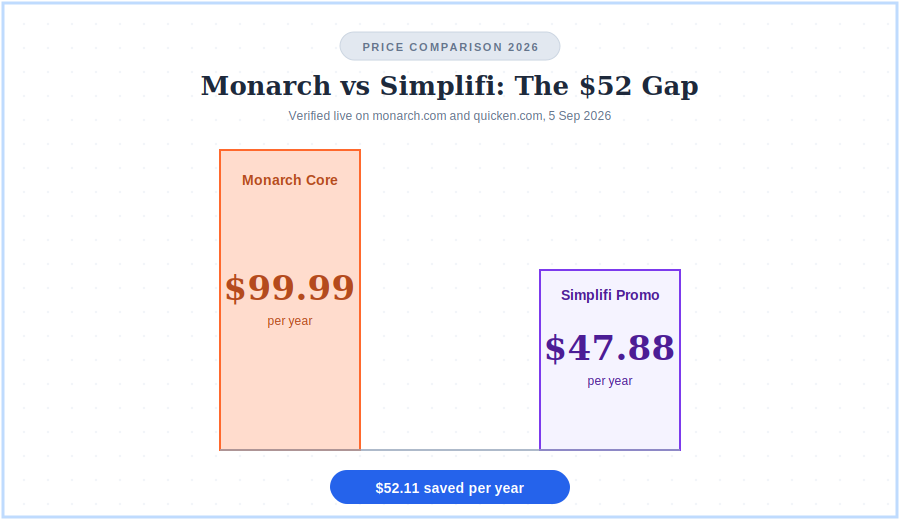
Monarch vs Simplifi pricing isn’t close right now. Simplifi’s live promo rate is $3.99/month billed annually ($47.88/year), confirmed directly on quicken.com on 5 September 2026, while Monarch Core runs $99.99/year ($14.99/month if you pay monthly instead). That’s a $52.11/year gap at Simplifi’s current promo, the number behind this whole comparison.
A few competitor roundups I checked while researching this were still quoting Simplifi’s older $2.99/month rate or a $5.99/month standard price. Neither matches what’s live today. Flip the words around and simplifi vs monarch turns up the exact same $52 gap, just phrased differently, since search order doesn’t change what either company actually charges. Here’s the confirmed breakdown for each app, straight from the source.
Simplifi pricing (verified from quicken.com, 5 September 2026): $3.99/month, billed annually as $47.88/year, shown as 42% off the $6.99/month standard rate ($83.88/year). This is a new-subscriber rate, billed annually only, with no monthly-billing option at all. There’s no free trial, but a 30-day money-back guarantee softens the up-front annual commitment.
Monarch pricing (verified from monarch.com, 5 September 2026): Core costs $99.99/year or $14.99/month, confirmed directly on the pricing page’s billing toggle. Plus, the tier aimed at business tracking and retirement forecasting, runs $199.99/year on annual billing only; there’s no monthly option for Plus at all. Both tiers include a 7-day free trial, but a payment method is required up front to start it.
For context on where these two sit against the rest of the category, my best personal finance software roundup and best net worth tracking apps list both cover how Monarch vs Simplifi stacks up against tools like Copilot and Rocket Money, if either turns out to be a closer fit than what’s here.
Is Simplifi actually cheaper than Monarch long-term?
Yes, at today’s confirmed rates. Simplifi’s promo works out to $47.88/year against Monarch Core’s $99.99/year, a $52.11/year difference. Even at Simplifi’s full standard rate of $83.88/year, which is what you’d pay if you missed the promo entirely, it’s still $16.11 cheaper than Monarch Core over a full year.
What are the 5 ways to actually save $52 with Monarch vs Simplifi?
A $52 gap in the Monarch vs Simplifi comparison isn’t just one line item. It shows up in five separate decisions you make when signing up, and missing any one of them either erases the savings or creates a new cost you didn’t plan for.
1. Pick Simplifi if solo spend-tracking is genuinely all you need. The full $52.11/year gap only exists if you’re comparing Monarch Core against Simplifi’s promo rate for a single user. If you don’t need household sharing, skip straight to the lower-cost option instead of paying for collaboration features that will sit unused.
2. Stay on Monarch Core instead of upgrading to Plus. Plus costs $199.99/year, exactly $100 more than Core, and its extra features (retirement forecasting, business P&L exports, tax-prep reports) only pay for themselves if you’re actually running a side business or actively planning retirement drawdowns. Picking Core over Plus by default preserves the value case for choosing Monarch at all.
3. Use the lower-risk entry point to test-drive first. Monarch’s 7-day trial requires a card on file before you start, which means an easy-to-miss cancellation window turns into a real charge. Simplifi skips the trial model entirely in favor of a 30-day money-back guarantee, so you’re billed once and can request a refund inside that window if it’s not a fit, rather than tracking a shorter cancel-by date.
4. Add a partner instead of paying for two subscriptions. Monarch adds a partner to the same $99.99/year plan free, with full shared access, while Simplifi’s Financial Spaces adds one person free too but with fewer tools (no per-partner flagging). Only Monarch gives that second person full parity with the primary account holder.
5. Calendar the renewal date so the promo doesn’t quietly expire. Simplifi’s $3.99/month rate is a new-subscriber, first-year offer, and missing the renewal rolls you onto $6.99/month, a $36/year jump you won’t notice until it posts. Set a reminder a week before billing.
How do Monarch and Simplifi compare side by side?
Monarch wins on investment depth, household sharing, and customizable categories. Simplifi wins on price and setup speed with its auto-generated spending plan. Neither includes a dedicated debt payoff planner, so pair either one with a free debt payoff estimator if that’s your priority.
Once you look past the sticker price, the two apps solve different problems. A monarch vs quicken simplifi feature audit shows the pricing gap is real, but so is the feature gap running the other way, toward Monarch. Search it as quicken simplifi vs monarch money and the same table below still answers it. Here’s the full Monarch vs Simplifi feature comparison across the categories that actually affect daily use.
| Monarch Money | Quicken Simplifi | |
|---|---|---|
| Price | $99.99/yr Core or $14.99/mo | $47.88/yr promo ($3.99/mo) |
| Trial / guarantee | 7-day trial, card required | 30-day money-back guarantee |
| Household sharing | ✅ Add a partner free, full access | ⚠️ One added person via Financial Spaces |
| Budgeting model | Custom categories + Flex budgeting | Auto-generated Spending Plan |
| Investment tracking | ✅ Benchmarking, allocation analysis | ⚠️ Balance and performance only |
| Debt payoff planner | ❌ Not available | ❌ Not available |
| Platforms | iOS, Android, Web | iOS, Android, Web |
| FinCompareLab rating | ⭐ 4.8/5 | ⭐ 4.2/5 |
Pricing verified from official websites, 5 September 2026.
What’s the real difference in how Monarch and Simplifi budget your money?
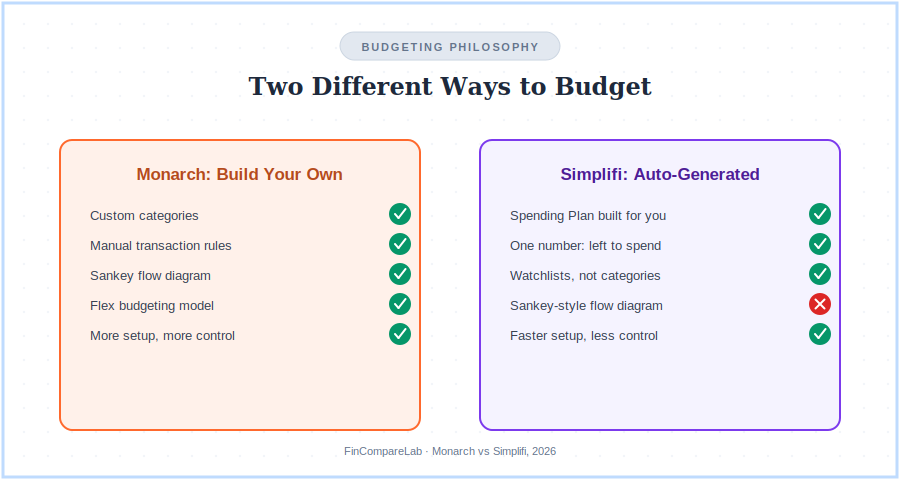
Monarch hands you a blank canvas: build categories, write transaction rules, read a Sankey diagram showing where every dollar flows. Simplifi generates a Spending Plan automatically from your income, bills, and goals, reducing everything to one number: what’s left to spend today. Picking the wrong philosophy for your personality is the real reason people abandon a budgeting app in month one.
I made this switch myself, from YNAB to Monarch, after more than a decade on a strict zero-based system. What sold me wasn’t the customization on its own; it was Monarch’s receipt scanning and the browser extension that auto-splits a single Amazon charge into its actual categories. Simplifi doesn’t offer either of those, which is exactly the trade-off its lower price reflects: less manual control, but also less manual work.
If you came from Mint, Monarch’s category system will feel familiar within a week. For the full picture of how Monarch performs on its own, see my complete Monarch Money review. If a single “can I spend this today” number is all you actually want, my Quicken Simplifi review covers the daily experience in more depth.
Which app is better for couples budgeting?
For couples specifically, the monarch money vs quicken simplifi decision isn’t close. Monarch wins clearly. Both partners get a full login on the same $99.99/year subscription, transactions can be flagged for review, and there’s a clean split between shared and individual goals. Simplifi’s Financial Spaces adds one other person too, but without per-partner transaction attribution or the same review workflow.
Does Simplifi support couples at all?
Yes, through Financial Spaces, which lets you add one other person to view and edit the shared plan at no extra cost. It’s a real feature, just a lighter one: no per-partner spending attribution, no advisor access, and no “needs review” flagging system like Monarch’s. For a broader look at how different apps handle shared money, my best budgeting apps for couples roundup covers more than just these two.
💑 Decision box: Budgeting as a couple
If you and your partner both want separate logins, transaction-review flagging, and a real “mine vs. ours” split, Monarch’s household model is worth the extra $52/year over Simplifi. If you just need one shared view without deep attribution, Financial Spaces will cover the basics.
Which app goes deeper on investment tracking?
On the investment side of Monarch vs Simplifi, Monarch goes noticeably further. It benchmarks your portfolio against indexes like the S&P 500, breaks down asset allocation, and layers investment data into the same Sankey visualization used for spending. Simplifi shows portfolio value and performance over a date range, but stops at monitoring rather than analysis.
Which app is better for tracking investments?
Monarch, by a clear margin. Its benchmarking and allocation-analysis tools are part of the Core tier already, so you don’t need to upgrade to Plus just to get them. Simplifi tracks balances and performance well enough for a quick check-in, but if you’re actively rebalancing a portfolio, that gap will show up fast.
What are Monarch and Simplifi still missing?
No side of the monarch vs quicken simplifi comparison is flawless. Neither app includes a structured debt payoff planner, and both stop at tracking balances rather than modeling a snowball or avalanche timeline. If debt elimination is the actual goal, my YNAB vs Monarch comparison and YNAB vs Simplifi comparison cover that trade-off directly, and my best debt payoff apps roundup lists tools built for exactly this.
Neither app offers a permanent free tier. Monarch’s 7-day trial requires a card up front, a real risk if you lose track of the date. Simplifi skips a trial for its 30-day guarantee instead, which still means an upfront annual charge before any refund.
If free is a hard requirement, my best free budgeting apps list and Empower review are better starting points. For full pricing history on each app, see my Monarch Money pricing guide and Simplifi pricing guide.
What does the budgeting community actually say?
Community sentiment splits along the same lines as the feature comparison. People coming from Mint who want a familiar category structure tend to land on Monarch, partly because it imports an entire transaction history via CSV upload. Couples cite household sharing as the deciding factor most often. Solo budgeters chasing the lowest price settle on Simplifi and stay there.
There’s also a recurring objection worth mentioning honestly: some commenters question paying for either app when free alternatives like Empower sync just as fast. That’s fair if passive net-worth tracking is all you need, but weaker once you factor in Monarch’s collaboration tools or Simplifi’s guided plan, neither of which Empower replicates.
See my is Monarch Money safe guide if privacy is the real hesitation, or my Monarch vs Copilot comparison and Monarch vs Rocket Money comparison if you’re weighing Monarch against something other than Simplifi.
How reliable is bank syncing on Monarch vs Simplifi?
Bank connectivity is where the Monarch vs Simplifi comparison depends on outside vendors rather than either company. Both apps depend on third-party data aggregators rather than anything Monarch or Quicken controls directly. In practice, that means sync reliability varies more by which bank you use than by which app you pick. A credit union with limited API support will behave inconsistently in either app, regardless of which one you choose.
Whether you frame it as quicken simplifi vs monarch money or the shorter version, the answer comes down to your bank. Major national banks (Chase, Bank of America, Wells Fargo, Capital One) sync cleanly on both apps. Smaller regional institutions or credit unions are where it’s worth using each app’s evaluation window to confirm your accounts before committing to a full year.
Can you use both?
Technically yes, but there’s little reason to run both sides of the Monarch vs Simplifi comparison at once. They solve overlapping problems, spending visibility and budgeting, so running both means duplicate categorization work for no added benefit. A more practical approach is using Simplifi’s 30-day guarantee and Monarch’s 7-day trial back to back, testing each against your own accounts before picking one for the year.
Which one should you choose?
The right call in the Monarch vs Simplifi decision depends less on price and more on what you’ll actually use day to day. If neither quite fits, my Monarch Money discount guide covers a few more ways to bring the Core price down. Here’s how the choice breaks down by scenario.
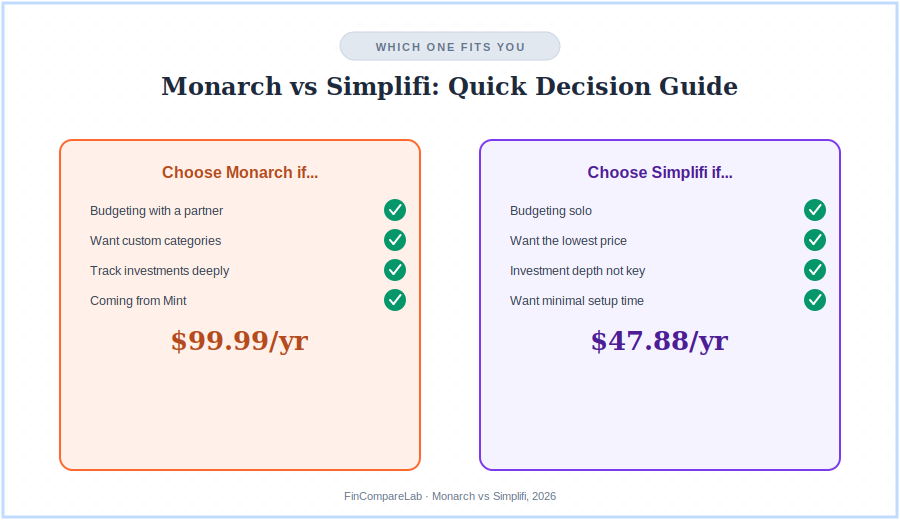
✅ Choose Monarch if:
You’re budgeting with a partner and want true shared access · you’d rather build your own categories than follow an auto-generated plan · you track investments and want benchmarking · you came from Mint and want a familiar structure.
✅ Choose Simplifi if:
You budget solo and want the lowest confirmed price in this category · you’d rather follow a generated plan than build your own · investment analysis isn’t a priority · minimal setup time matters more than customization.
Try Monarch Money if the household and investment features justify the extra $52, or try Quicken Simplifi if a lower price and less setup matter more. Either way, lock in today’s rate before it changes; Simplifi’s promo is new-subscriber pricing and Monarch’s trial terms are subject to change without much notice.
Still have questions about Monarch vs Simplifi?
Here are the questions I hear most often once people are down to these two apps specifically, whether they typed in monarch money vs quicken simplifi or the shorter version to get here.
Which is better, Monarch or Simplifi, for someone just starting out?
Searched as simplifi vs monarch or the other way around, this is usually the first real question. For most beginners, Simplifi’s auto-generated Spending Plan is easier to start with since there’s less setup in the first week. Monarch takes more upfront configuration but rewards that effort with a more customizable long-term system, which tends to matter more once you’re a few months in.
Is there a discount code for either app?
Monarch has one confirmed working code: WELCOME, roughly 30% off a first year of Core at signup. Codes claiming 50% off, including one commonly shared as MONARCHVIP, aren’t verifiable as active. Simplifi skips a separate code system; the 42%-off promo at checkout is the offer, already reflected in the $47.88/year figure used throughout.
Can I switch from Monarch to Simplifi or vice versa?
There’s no direct data migration on either side of the Monarch vs Simplifi decision. You’d need to manually reconnect your bank accounts and rebuild your budget categories in the new app. Testing each app’s trial or guarantee window before fully switching is the safer way to confirm the transition is worth it.
Do Monarch or Simplifi work outside the United States?
Both are built primarily for US bank accounts and US-based users. Simplifi’s bank connections are US-only. Monarch has broader reach and can connect to some Canadian institutions, but coverage outside North America is unreliable for both apps.
What happens to my data if I cancel Monarch or Simplifi?
Monarch retains your data for a period after cancellation in case you resubscribe, though it’s not accessible once your subscription lapses. Simplifi’s data handling works similarly, with your history staying on Quicken’s servers unless you request deletion. Export your transaction history and category lists before canceling either one, since there’s no direct migration path between them.
Prices and promo terms on both apps change without much notice, so it’s worth bookmarking this Monarch vs Simplifi comparison and checking back before you renew. If your situation shifts, you start budgeting with a partner, or you pick up a brokerage account you want to track properly, it’s worth revisiting the Monarch vs Simplifi decision rather than assuming your first pick has to be permanent.
📚 Read Next
- Monarch Money Review: Is It Worth $99.99 a Year?
- Quicken Simplifi Review: What $3.99 a Month Gets You
- Monarch Money Pricing: Every Tier and Discount Explained
- Quicken Simplifi Pricing: The Full 2026 Breakdown
- YNAB vs Monarch: Which Budgeting Style Fits You?
- Best Budgeting Apps for Couples in 2026
- Best Net Worth Tracking Apps in 2026
