
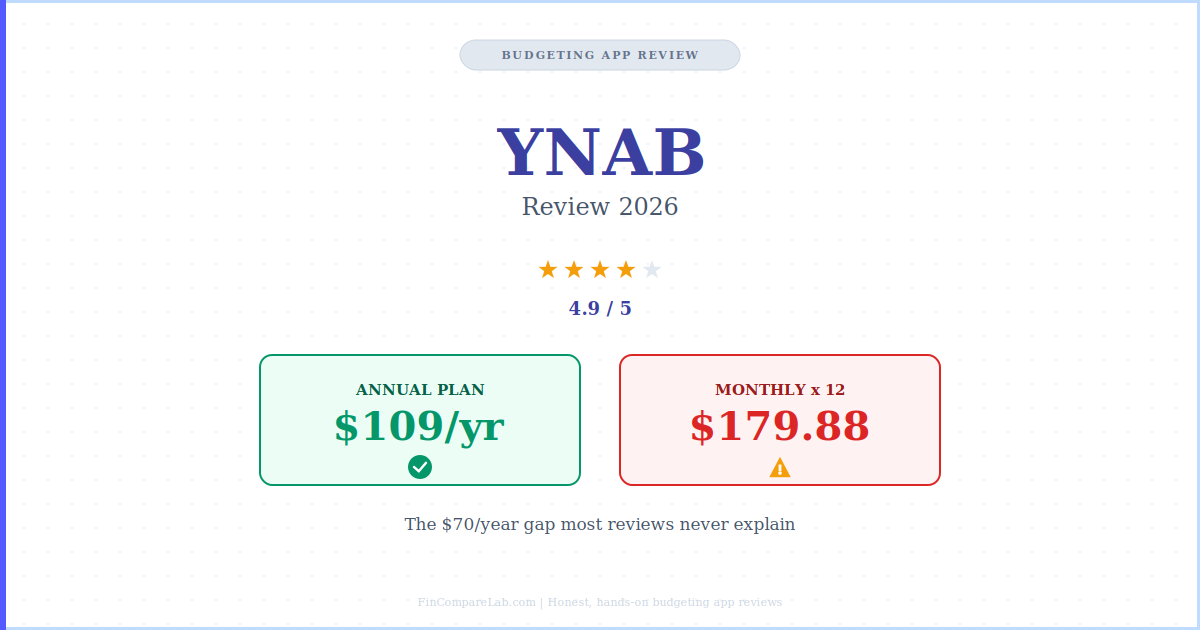
A YNAB review that only covers the four rules misses the part that actually costs people money: how you sign up changes what you pay when it renews.
⚡ Quick Verdict
YNAB is worth the $109 asking price if you actually engage with the zero-based method. The catch is that “asking price” and “renewal price” aren’t always the same number: pick the monthly plan instead of annual and you’re paying $179.88 a year, not $109. This YNAB review breaks down the method, the real cost, and exactly where that gap comes from.
How We Review Apps · Pricing verified from ynab.com — 29 August 2026
What’s in this review
- What is YNAB and how does zero-based budgeting work?
- What are YNAB’s 4 rules?
- Why does YNAB cost $179 if you pay monthly?
- What key features does YNAB include?
- What does Reddit say about YNAB’s price in 2026?
- What stood out, and what took adjusting to?
- How much does YNAB actually cost in 2026?
- Who should use YNAB, and who should skip it?
- How does YNAB compare to the alternatives?
- What are the most common questions about YNAB?
- What’s the final verdict of this YNAB review?
What is YNAB and how does zero-based budgeting work?
YNAB (You Need A Budget) runs on zero-based budgeting: every dollar you earn gets assigned a job before you spend it, rather than being reviewed after the fact. It costs $109/year or $14.99/month, with a 34-day free trial and no permanent free tier.
Most apps watch what you spend and summarize it later. YNAB has you allocate income across categories the moment it arrives, so overspending shows up as a decision in the moment instead of a surprise weeks later. That distinction is the whole reason people either love YNAB or bounce off it in week one.
For a side-by-side against the app most people compare it to, see YNAB vs Monarch Money: which fits your budgeting style.
Search “is ynab worth it” and you’ll find years of debate, because the honest answer depends entirely on whether you’re the kind of person who’ll actually sit down and allocate income each week. This YNAB review is built around that question rather than around a generic feature list, since the feature list rarely changes anyone’s mind either way.
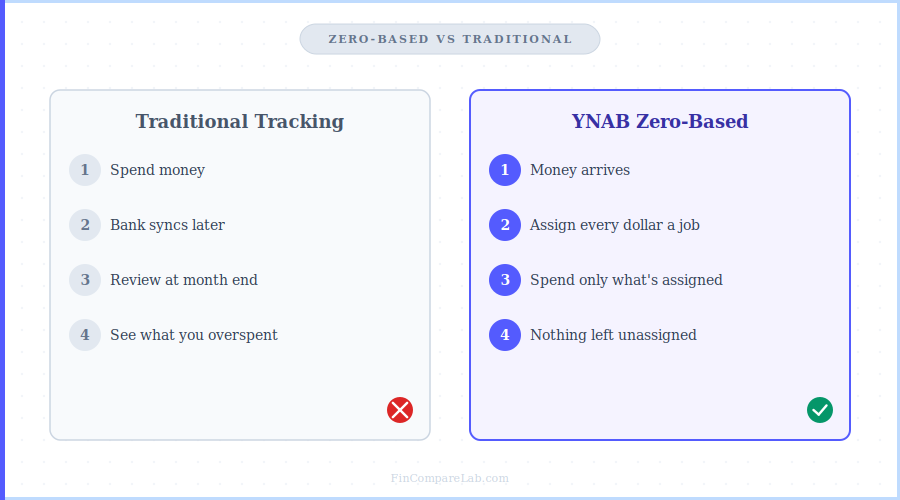
A look at how zero-based budgeting changes the YNAB cost equation compared to passive tracking apps.
Is YNAB better than a spreadsheet for budgeting?
For most people, yes, because YNAB automates the bank-sync and categorizing work a spreadsheet makes you do by hand. People already consistent with a spreadsheet, or unwilling to pay a subscription, often stick with one. For a hybrid that keeps spreadsheet control with some automation built in, see my Tiller Money review.
What are YNAB’s 4 rules?
YNAB’s four rules are the operating system the entire app is built around: give every dollar a job, embrace your true expenses, roll with the punches, and age your money. Together they define zero-based budgeting in practice, and understanding them up front makes the first-week learning curve noticeably shorter.
What does Rule 1 mean in practice?
Every dollar gets assigned to a category, rent, groceries, savings, the moment it lands in your account. Nothing sits unassigned once the month’s income is allocated.
Why does Rule 2 matter for annual expenses?
Car insurance, holiday spending, and once-a-year renewals stop being emergencies once you budget a monthly slice toward them ahead of time. The bill still arrives; it just stops being a surprise.
What happens under Rule 3 when you overspend?
You move money from another category rather than treating the overspend as a failure. The rule assumes real life will deviate from the plan and builds that flexibility in from the start.
What does “aging your money” under Rule 4 actually build?
A buffer where you’re spending money earned weeks ago, not the paycheck that just landed. That gap between earning and spending is what YNAB calls financial stability made visible.
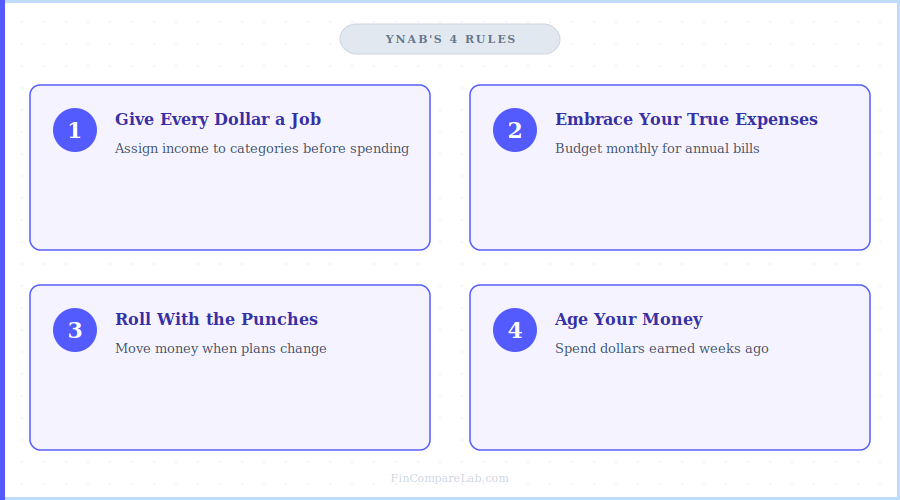
The four rules behind every YNAB review that covers zero-based budgeting.
Why does YNAB cost $179 if you pay monthly?
YNAB’s annual plan is $109/year. Its monthly plan is $14.99, which adds up to $179.88 over 12 months, roughly $70 more than paying annually. Neither price is a mistake or a markup; it’s the standard cost of flexibility versus commitment, the same on iOS, Android, and the web.
This is the gap most YNAB reviews mention in passing and never actually explain. YNAB’s own pricing page advertises the annual plan’s “$70 Savings!” badge, but it’s easy to start a trial, land on the monthly plan by default at sign-up, and never revisit the choice once the charges start.
It isn’t a billing error, a platform fee, or anything specific to where you signed up. It’s simple math that a lot of people don’t do before picking a plan: $14.99 a month, paid for a year, costs more than committing to $109 up front. The full year-by-year price history lives in my YNAB pricing guide for 2026.
If you’re already on the monthly plan and it’s working for your cash flow, that’s a reasonable trade for the flexibility. If you’re planning to keep YNAB long-term regardless, switching to annual billing is the one change that closes the $70 gap immediately.
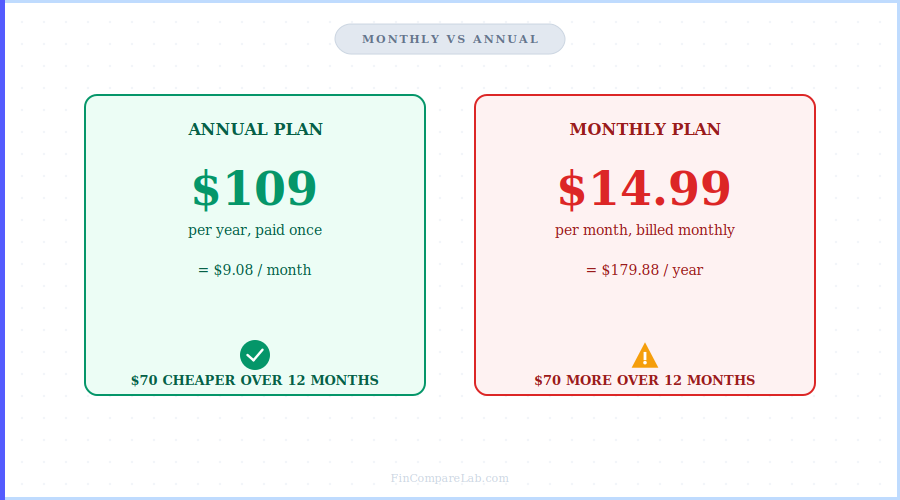
Is YNAB worth it either way? Yes, but the annual plan is worth $70 more than most people realize.
What key features does YNAB include?
YNAB’s core feature set centers on the zero-based budget screen, a loan payoff planner covering both avalanche and snowball strategies, category-linked savings goals, bank sync through Plaid, free live workshops, and shared budgets for up to six people on one subscription. Every feature covered in this YNAB review ships with both pricing tiers, so there’s no upsell path once you’re subscribed.
Does YNAB have a debt payoff tool?
Yes. The loan planner takes your balance, rate, and payment, then shows your payoff date and total interest under both avalanche and snowball approaches. Compare it against dedicated payoff tools in my best budgeting apps for debt payoff roundup, or run your own numbers with the free debt payoff estimator.
How does YNAB handle shared budgets for couples?
Up to six people access and edit the same budget in real time on one subscription, at no added cost. For a broader shortlist built around joint-finance features specifically, see my best budgeting apps for couples guide.
Bank sync runs through Plaid across most US, Canadian, UK, and EU banks, with manual entry as a fallback. YNAB also runs free live workshops weekly, real instructors rather than recordings, which noticeably shortens the credit-card-handling learning curve that trips people up in week one.
What does Reddit say about YNAB’s price in 2026?
r/ynab’s community consensus is that YNAB earns its price for people who engage with the method, but confusion between the monthly and annual plans, and general price-increase complaints, show up constantly in pricing threads.
The subreddit’s recurring theme lines up with what this review found directly: the method works, and a lot of people don’t realize how much the monthly plan actually costs over a year. Debt payoff posts, five figures paid off over one to two years, are the most common thread type, and they consistently credit the weekly category check-in rather than any single feature.
The most repeated pricing complaint isn’t the $109 annual rate itself, it’s discovering the monthly total after months of paying it. Community consensus across pricing threads points to the same fix covered above: switching to annual billing closes the $70 gap, no support ticket required.
For people who find the active-engagement model too demanding, my Monarch Money review covers the most frequently recommended switch in those same threads.
Browsing YNAB Reddit threads from the past few months turns up the same question on a loop: whether it’s worth switching from monthly to annual mid-year. It’s common enough that it’s practically its own recurring post format in the subreddit, right alongside the debt payoff success stories.
What stood out, and what took adjusting to?
YNAB’s strongest points are its behavior-changing zero-based method, a generous 34-day trial, and a best-in-class loan planner. The adjustment points are a genuine first-week learning curve, no investment tracking, and a monthly plan that costs more than most people realize over a year.
What stood out:
- The method changes spending decisions before they happen, not just the summary afterward
- A 34-day trial with no card required, long enough to actually see results
- The loan planner is the strongest debt-focused tool of any app covered on this site
- No feature paywalls; every tier gets the full product
- Shared budgets for up to 6 people at no extra cost
What took adjusting to:
- Credit card handling works differently from every other app and takes a week or two to click
- No investment or net worth tracking at all; pair with a Monarch Money subscription if you want that in one dashboard
- Going quiet for two weeks creates a real categorization backlog
- The renewal-plan gap covered above means picking monthly by default costs $70 more a year than most people realize
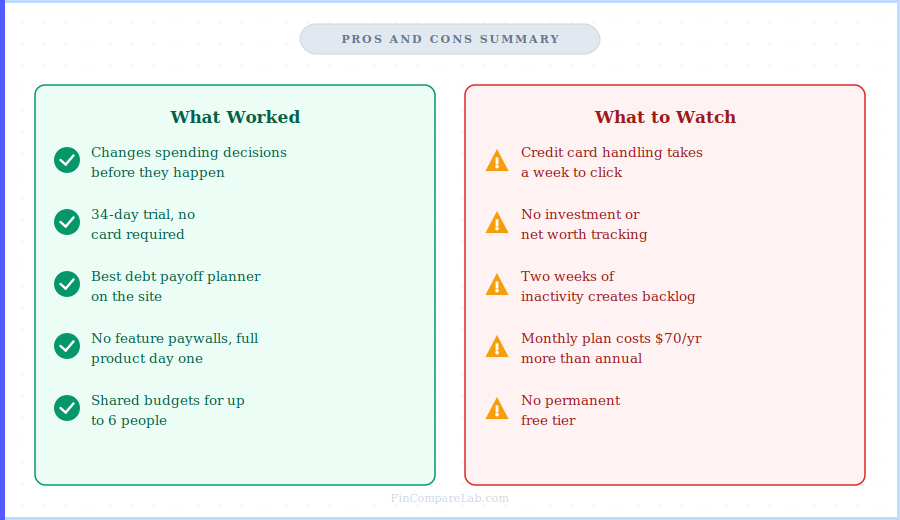
What YNAB Reddit discussions say tracks closely with what shows up here.
How much does YNAB actually cost in 2026?
YNAB costs $109/year ($9.08/month) or $14.99/month billed monthly, with a 34-day free trial requiring no card. Students get 12 months free via SheerID verification at ynab.com/college. Paying monthly instead of annually costs $179.88 over a year, roughly $70 more than committing up front.
| Plan | Cost | Notes |
|---|---|---|
| Free trial | $0 for 34 days | No credit card required |
| Annual | $109/year ($9.08/mo) | $70 cheaper than paying monthly for a year |
| Monthly | $14.99/mo ($179.88/yr) | Cancel anytime, but costs more over 12 months |
| Student | Free for 12 months | Valid .edu email via ynab.com/college |
Pricing verified from ynab.com: 29 August 2026.
Every YNAB cost figure in the table above comes directly from ynab.com, not a reseller or aggregator. For the full breakdown by plan, promo history, and how the student discount actually gets verified, see my YNAB pricing guide for 2026.
Is YNAB worth $109 a year?
For someone who engages weekly, yes; YNAB’s own data points to average first-month savings well above the annual cost. Is YNAB worth it for someone specifically focused on paying off debt? The loan planner alone answers that for most freelancers and salaried earners alike. For someone wanting passive, connect-and-forget tracking, the honest answer is no, and Quicken Simplifi or Monarch Money will serve that need better.
$109 a year works out to roughly $9 a month, about two coffees, and that math only pencils out if you’re actually opening the app and making allocation decisions rather than linking a bank account and walking away.
How much does YNAB cost per month if I pay monthly instead of annually?
The monthly plan is $14.99, billed every month with no annual commitment. Paying annually at $109 works out to $9.08 a month, so the yearly plan saves roughly $70 over twelve months of the monthly rate. Either way, the YNAB cost only applies once the 34-day trial ends, and canceling during the trial means you’re never charged at all.
Who should use YNAB, and who should skip it?
YNAB fits people actively trying to break the paycheck-to-paycheck cycle, pay off debt, or manage irregular freelance income. It’s a poor fit for anyone wanting a free-forever plan, passive tracking, or built-in investment and net worth tracking. Is YNAB worth it outside of those cases? Usually not, and that’s fine.
Use YNAB if you:
- Feel like income disappears each month with no clear cause
- Are actively paying down debt and want a payoff timeline, not just a balance
- Have irregular or freelance income
- Are a student eligible for the free year via ynab.com/college
- Budget jointly with a partner
Skip YNAB if you:
- Want a permanent free tier; see Goodbudget or EveryDollar
- Want passive, connect-and-forget tracking; Monarch Money or Copilot fit better
- Need investment or net worth tracking bundled in
- Already tried active budgeting and it didn’t stick
None of that means YNAB is a bad app; it means it’s built for a specific kind of user. If you land in the “skip” column above, my full roundup of YNAB alternatives breaks down which of those options fits which situation, rather than treating “alternative” as one single answer.
How does YNAB compare to the alternatives?
YNAB costs more than most budgeting apps at $109 a year, but it’s the only major option built specifically around active, zero-based allocation rather than passive tracking. Monarch Money offers more automation and investment tracking; Simplifi is the cheaper automated option; Tiller keeps everything in a spreadsheet.
Browsing YNAB Reddit threads about alternatives turns up Monarch Money and Simplifi most often, usually from people who liked the zero-based idea but wanted less hands-on maintenance.
| App | Best for | Annual price | Key difference vs YNAB |
|---|---|---|---|
| YNAB | Active budgeting, habit change | $109/yr | Baseline |
| Monarch Money | All-in-one dashboard + net worth | $99.99/yr | More passive, investment tracking included |
| Simplifi | Cheapest automated option | $47.88/yr (promo) | Less discipline required, no zero-based method |
| Tiller | Spreadsheet-native users | $99/yr | Google Sheets automation, no mobile app |
| EveryDollar | Debt-snowball beginners | Free / $79.99/yr | Genuine free tier, simpler |
Pricing verified from official websites: 29 August 2026. Simplifi promo rate changes frequently. Full YNAB alternatives pricing, updated monthly, lives in the roundup linked below.
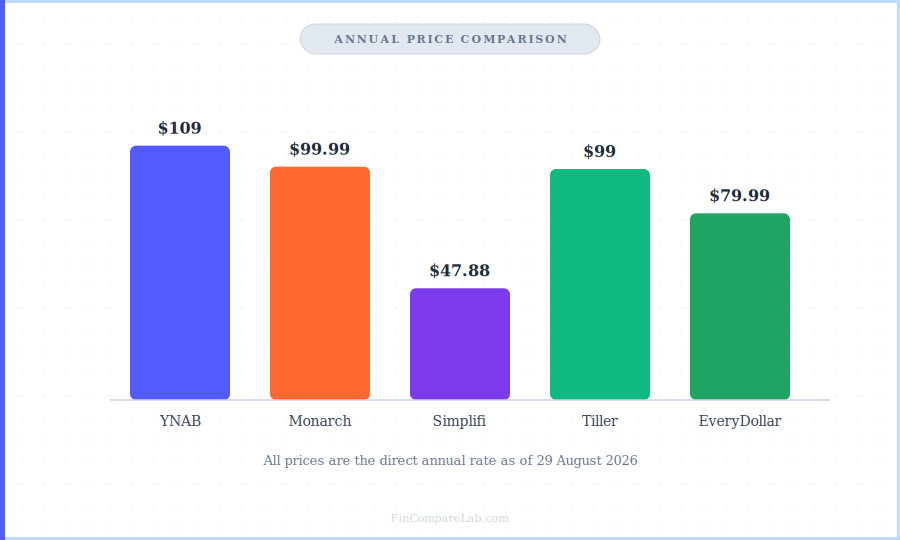
Where YNAB lands next to the leading YNAB alternatives on price.
→ YNAB vs Monarch Money: which is right for you?
→ YNAB vs Simplifi: which is better value?
→ YNAB vs Copilot: which suits iPhone users?
→ YNAB vs Tiller: app or spreadsheet?
What are the most common questions about YNAB?
These are the questions this YNAB review gets asked most often, pulled directly from search and from recurring YNAB Reddit threads.
Does YNAB have a free trial or free version?
There’s no permanent free plan, but the 34-day free trial requires no credit card, the longest trial of any app covered on this site. After that it’s $14.99/month or $109/year, with students getting a free year via ynab.com/college.
Can I avoid paying $179 instead of $109 for YNAB?
Yes. Choose the annual plan at sign-up, or switch to it from your account settings at any time. The monthly plan isn’t a mistake or a hidden fee; it’s simply $70 more expensive over a year in exchange for the flexibility to cancel anytime.
Does YNAB connect to my bank automatically?
Yes, through Plaid across most US, Canadian, UK, and EU banks, with manual entry available for anyone who prefers it. Even with sync on, you’re expected to review and categorize transactions, and that review step is part of how the method changes behavior.
Is YNAB good for couples budgeting together?
Yes, up to six people share one subscription with real-time access to the same budget. See my best budgeting apps for couples guide for how it stacks up against Monarch and Honeydue on joint-finance features specifically.
What happens if I forget to switch before my YNAB renews?
Nothing irreversible. If you’re on the monthly plan and decide annual makes more sense, switching in account settings takes effect for the next billing cycle. There’s no penalty for switching later, just $70 a year saved from the point you make the change.
What’s the final verdict of this YNAB review?
YNAB earns its price for the person willing to open it a few times a week and make real allocation decisions. The loan planner alone makes it worth a look for anyone actively paying down debt. The catch isn’t the method, it’s making sure you’re on the annual plan instead of the monthly one, since that’s the $70 gap most other reviews leave out entirely.
That’s the full YNAB review: the method, the real YNAB cost once you know which plan you’re on, and the one billing detail worth checking before your next renewal.
Choose the annual plan to lock in $109/year. No credit card required for the trial. Students: free for 12 months at ynab.com/college
FinCompareLab rating: 4.9/5
Most effective budgeting app on the site, for the person who engages with it. Choose annual billing to avoid the $70 monthly-plan gap.
📚 Read Next
