
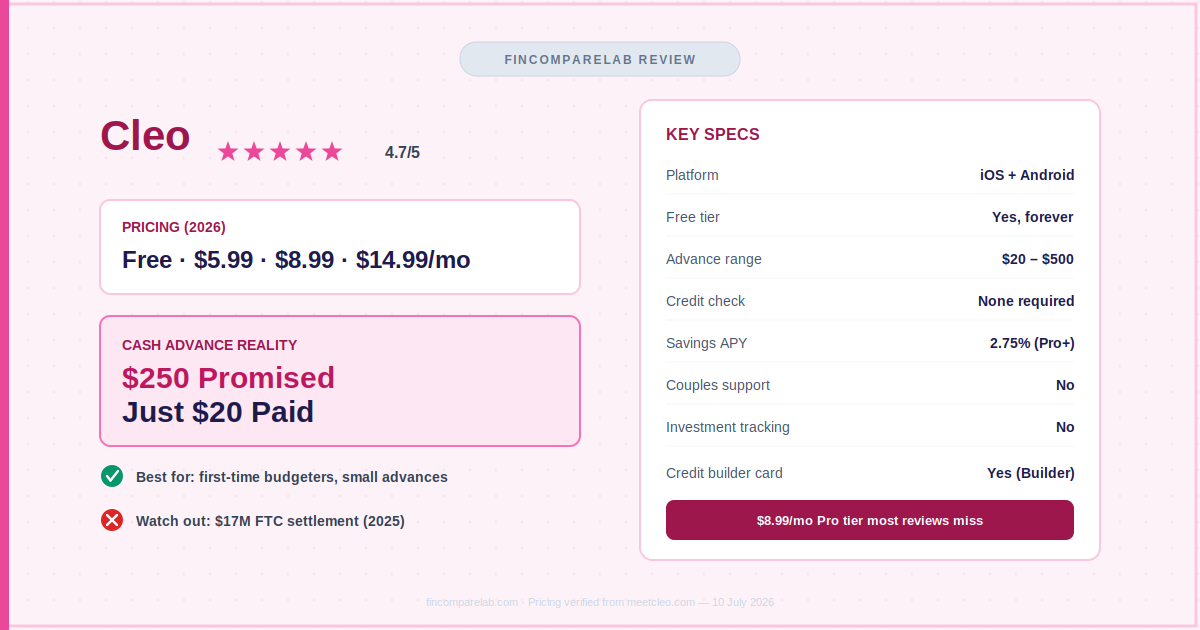
This Cleo review covers what the app actually costs, borrows, and delivers in 2026 — including the Pro tier most competitor sites still miss, the real cash advance numbers, and the $17 million FTC settlement you should know about before you subscribe. If you’ve searched “is Cleo worth it,” the short answer depends almost entirely on which tier you’re comparing and what you actually qualify for.
⚡ Quick Verdict
Cleo is a genuinely fun budgeting app with a snarky AI chatbot — but it’s best understood as a cash advance tool with lightweight spending awareness bolted on, not a structured budgeting app like YNAB or Monarch. The $5.99/mo Plus tier unlocks advances up to $250, but your first advance could be as low as $20. This Cleo review breaks down whether that trade-off is worth it before you subscribe. If you need real zero-based or envelope budgeting, you’ll outgrow Cleo fast.
How We Review Apps · Pricing verified from meetcleo.com — 10 July 2026
📋 What’s in this review
- What is the Cleo app?
- How does Cleo work?
- What is Cleo pricing 2026?
- How much can you actually borrow from Cleo?
- How can you increase your Cleo cash advance limit?
- What happened with Cleo and the FTC?
- What does Cleo do well?
- What should you watch out for?
- What do real users say about Cleo?
- How does Cleo compare to YNAB and Monarch Money?
- Can you use Cleo alongside YNAB or Monarch Money?
- Who should use Cleo?
- What are the most common questions about Cleo?
What Is the Cleo App?
Cleo is an AI-powered money app available on iOS and Android that connects to your bank accounts via Plaid, automatically categorizes your transactions, and lets you chat with an AI assistant about your spending instead of scrolling through a dashboard.
This Cleo review looks at the app from the angle most searches actually care about: is Cleo worth it once you understand its real Cleo pricing 2026 tiers and real cash advance limits, not just its marketing.
The chatbot angle is the whole brand. Ask Cleo how much you spent on food last month, ask it to set a budget, or request a Cleo cash advance.
All of it flows through a conversational interface that talks back somewhere between your funny friend and a slightly sarcastic financial therapist.
The free version handles core budgeting and chat-based insights. Paid tiers unlock cash advances, credit score access, high-yield savings, and a secured credit builder card.
It’s not a zero-based budgeting tool, and it’s not trying to be. Cleo targets 18–25 year olds who are allergic to spreadsheets and occasionally need $40 before payday.
How Does Cleo Work?
Download the app, create an account, and connect your bank through Plaid. Setup takes a few minutes and looks more like a messaging app than a traditional budgeting tool.
Once connected, Cleo reads your transaction history and buckets your spending into categories — food, bills, entertainment — so you can query it conversationally. “How much did I spend on coffee this month?” gets you an actual answer instead of a chart you have to decode.
The AI has two signature modes: Roast Mode calls you out for overspending, and Hype Mode cheers you on when you’re doing well. It’s a gimmick, but an effective one — the conversational interface removes some of the intimidation factor traditional finance apps carry.
Security note: Cleo connects through Plaid with read-only access. It can’t move money around or make changes to your accounts. Deposits are FDIC-insured through Thread Bank. Understanding this security model matters before you commit to any Cleo pricing 2026 tier.
What Is Cleo Pricing 2026?
Cleo pricing 2026 breaks down into four tiers, and this is where the price of Cleo review searches diverge most from what people actually pay. Cleo’s cash advance is the app’s whole reason for being. Cleo runs three paid tiers on top of a free plan: Plus at $5.99/month, Pro at $8.99/month, and Builder at $14.99/month.
| Plan | Price | Key features |
|---|---|---|
| Free | $0/mo | Spending tracking, AI chat, budgets |
| Plus | $5.99/mo | Cash advance up to $250, Debt Reset, credit score insights |
| Pro | $8.99/mo | Everything in Plus + high-yield savings (2.75% APY) + advanced AI coaching |
| Builder | $14.99/mo | Everything in Pro + secured Cleo Card + early paycheck access (up to 2 days) + cash advance up to $500 |
Cleo pricing 2026 verified directly from meetcleo.com’s official pricing page and Cleo’s Terms & Conditions — 10 July 2026.
Pro is a relatively new mid-tier plan, and it’s the gap most other Cleo reviews miss — several older roundups still describe Cleo as a three-tier app (Free, Plus, Builder) or reference a separate $2.99/month “Grow” tier.
As of this Cleo review’s pricing check, Cleo’s own pricing page and Terms & Conditions list only Plus, Pro, and Builder as paid subscriptions, with Grow’s old savings features now folded into Pro. Cleo’s Google Play listing still uses “Grow” in its legal boilerplate text, which looks like an unrefreshed leftover rather than a live pricing option — worth knowing if you see the name mentioned elsewhere.
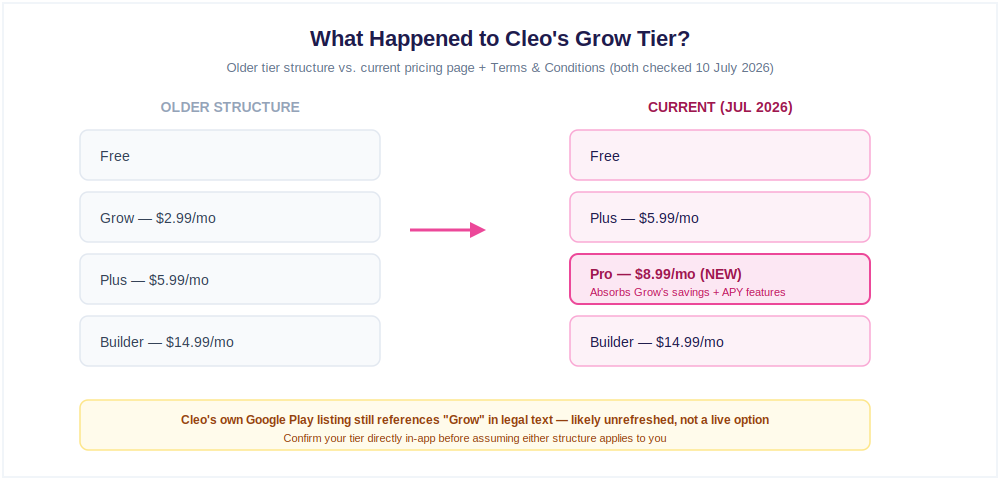
One more wrinkle: Cleo’s own Help Center is inconsistent on whether Builder still offers an annual option. One Help Center article states there’s no longer an annual plan for Builder, while a separate, more recently dated Help Center article lists a $134.99/year Builder option (a 25% discount over monthly). I can’t resolve this conflict from Cleo’s own documentation — check directly in-app before assuming either applies to your account.
How Much Can You Actually Borrow From Cleo?
This is the question that matters most in any honest Cleo review, and where Cleo’s marketing and reality diverge the most. Plus and Pro advertise cash advances up to $250; Builder advertises up to $500. First-time users on any tier get much less — a detail that changes whether Cleo is worth it for someone who needs cash today.
Per Cleo’s own pricing disclosures, Plus and Pro cash advances range from $20–$250 for existing users, but only $20–$100 for first-time users. The daily disbursement cap is $170, so even a $250-eligible user can’t pull the full amount in one transfer.
Builder’s advance range is separately disclosed at $150–$500 for existing users and just $150–$180 for first-time Builder users. Reaching the full $500 requires at least $750 in monthly direct deposits — a threshold Cleo states explicitly in its own pricing footnotes, not something buried in the app.

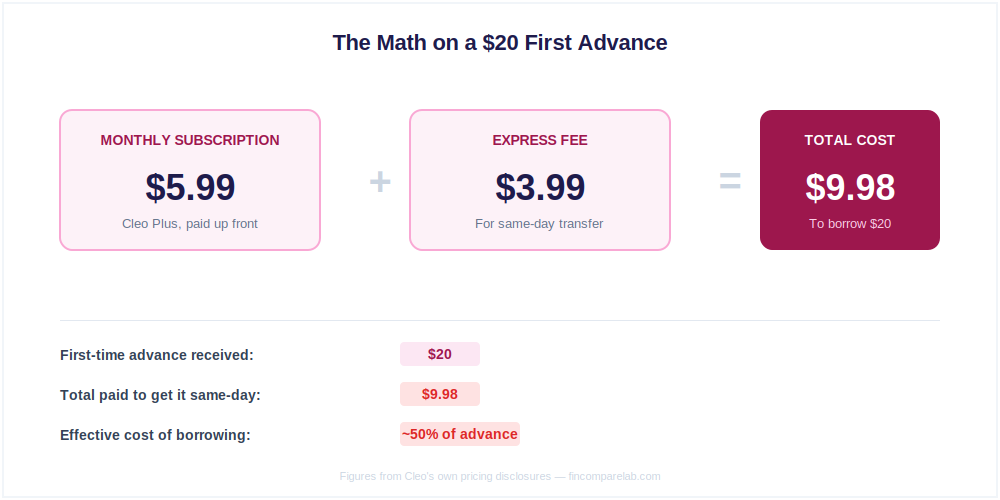
Standard transfers (free) take 3–4 business days. Same-day express transfers cost $3.99–$14.99 depending on the amount, on top of whatever monthly subscription you’re already paying to access advances at all. Factor this into whether Cleo is worth it before you request your first advance.
How Can You Increase Your Cleo Cash Advance Limit?
Cleo doesn’t publish a single public formula, but its own Help Center and Cleo pricing 2026 disclosures make the levers fairly clear. This part of the Cleo review matters most if you’re relying on the advance regularly.
Connect all your income accounts. Cleo’s algorithm looks at your total deposit history across every linked account. One account showing $800/month looks weaker than two accounts showing $1,200/month combined.
Hit the direct deposit threshold for your tier. Builder’s own pricing footnote requires at least $750/month in direct deposits to qualify for the full $500 advance. Plus and Pro don’t have a published deposit minimum, but consistent deposits still drive eligibility.
Repay on time, every time. Cleo’s limit calculation is explicitly tied to repayment history. Miss or delay a repayment and your limit can drop; repay on schedule and it’s more likely to rise on your next request.
Show consistent, regular deposits. A steady biweekly paycheck landing on the same day builds trust with the algorithm faster than irregular freelance deposits totaling the same amount.
Keep spending balanced against income. If your spending consistently runs close to or above your income, the algorithm reads that as repayment risk and caps your limit lower.
Be patient. There’s no shortcut. Users who report reaching $200–$250 on Plus/Pro, or close to $500 on Builder, typically have several months of on-time repayment history behind them.
What Happened With Cleo and the FTC?
This is material — don’t skip it. On March 27, 2025, the FTC announced a $17 million settlement with Cleo AI over alleged deceptive representations about cash advance amounts, transfer speed, and subscription cancellation practices.
The FTC alleged Cleo advertised access to hundreds of dollars in instant cash advances while most consumers received much smaller amounts and were charged additional fees for same-day access. The complaint also alleged Cleo made cancellation difficult, continuing to charge some users despite repeated cancellation requests.
The consent order runs for 10 years. It requires Cleo to clearly disclose subscription terms, get express consent before charging, and provide a simple cancellation process. The $17 million goes toward refunds for affected consumers.
Cleo disputed some findings and settled without admitting liability. Cancellation is reportedly easier post-settlement, but screenshot your confirmation regardless. This history is a meaningful factor in whether Cleo is worth it for you, not a footnote to skip.
What Does Cleo Do Well?
Any fair Cleo review has to credit what actually works, and there’s real substance behind the AI gimmick once you look past the Cleo pricing 2026 headline numbers.
Onboarding is frictionless. Connect your bank, answer a few questions, and you’re in under five minutes — no manual account setup, no category mapping.
The AI chatbot genuinely helps beginners engage. Cleo surfaces personalized spending insights, flags recurring subscriptions, and answers plain-language questions about your money. If traditional finance apps feel like homework, Cleo feels like texting a friend who knows your bank balance.
It works on both iOS and Android. Unlike Copilot, which is Apple-only, Cleo is fully cross-platform — that matters for the 18–28 demo it targets.
The free tier is genuinely useful. Basic budgeting, AI chat, and spending breakdowns cost nothing on the free rung of Cleo pricing 2026. You don’t need to pay to get value.
Credit building for thin-file users. The Builder secured card is a reasonable option for people with little or no credit history — no credit check required, and on-time payments get reported to all three bureaus.
The savings APY is competitive. Cleo’s savings account, available on Pro and Builder, pays 2.75% APY — well above the national average, though not the reason to get Cleo on its own.
What Should You Watch Out For?
This is the section that determines whether Cleo is worth it for your specific situation, so read it before you subscribe to any tier.
The advance reality vs. the promise. Advertised ceilings of $250 (Plus/Pro) or $500 (Builder) are for established, well-qualified users, and new users regularly start at $20–$100. Paying a monthly fee for a $20 advance that takes three days is a bad deal.
Express fees stack fast. Same-day transfer costs $3.99–$14.99 on top of your subscription. On a small advance, fees can cost more than the advance is worth.
The chatbot novelty wears off. What feels fresh at sign-up can feel repetitive after a month of the same roasts.
The FTC settlement is a trust signal worth knowing. Paying $17 million to resolve deception allegations isn’t nothing — worth factoring into whether Cleo is worth it for you before you subscribe.
No couples features. No shared budgeting, no partner access, no joint accounts view. Couples should look at Monarch Money instead.
No investment tracking. If you’re building net worth, Cleo has nothing to offer there — Empower is a free alternative built specifically for that.
Budgeting depth is shallow. Cleo flags spending but isn’t built for envelope or zero-based budgeting. People who graduate from “stop overspending” to “build a real system” tend to outgrow it.
What Do Real Users Say About Cleo?
Cleo’s App Store rating sits at 4.7/5 across 241,000 ratings, and its Google Play rating is also 4.7/5 across 137,000 reviews — both pulled directly from the live listings, not a third-party aggregator. That’s a solidly positive baseline for a Cleo review to start from, but the written reviews tell a more specific story about what people actually run into and whether Cleo is worth it in practice.
The recurring theme across both stores is a gap between the advertised advance ceiling and the real number people get. One Google Play reviewer described being eligible for $300 but capped at $100 per 24 hours, with an $8 fee for same-day transfer stacked on top of the monthly subscription already paid. Another reviewer with a long, on-time repayment history reported their limit dropping from $500 to $160 with no change in income, calling it discouraging enough to consider leaving.
A separate App Store review described the advance feature as inconsistent — approved one moment, reversed seconds later with little explanation. A review aggregator that tracked hundreds of recent Cleo complaints found a similar pattern: typical first advances land around $20–$50, and some users report Cleo splitting one advance into multiple smaller pulls, each carrying its own express fee.
On the positive side, reviewers consistently mention the same three things: the advance lands quickly once approved, customer support responds reasonably fast when contacted directly, and the AI chat genuinely makes people more aware of where their money goes. That balance of pros and cons is the core of what this Cleo review is trying to convey.
How Does Cleo Compare to YNAB and Monarch Money?
No Cleo review is complete without lining it up against the two apps it gets compared to most.
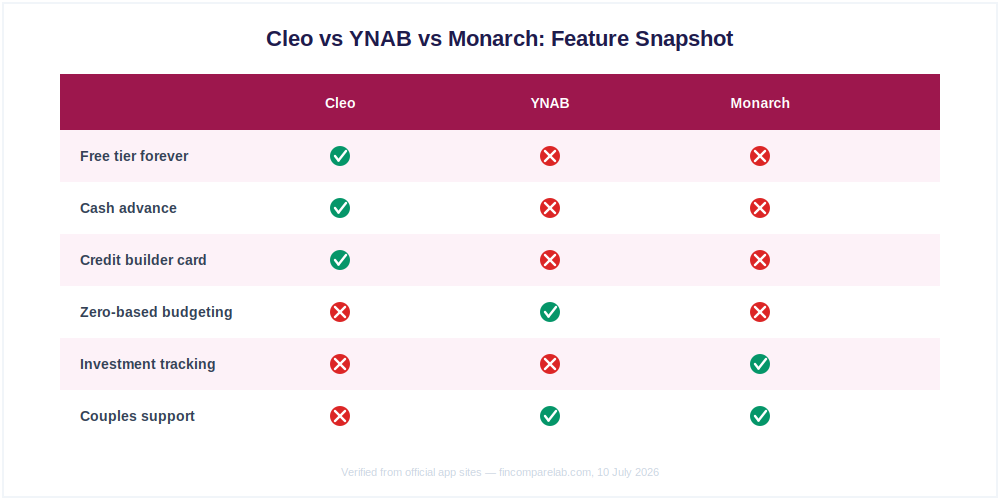
| Cleo | YNAB | Monarch Money | |
|---|---|---|---|
| Price | Free–$14.99/mo | $14.99/mo or $109/yr | $14.99/mo or $99.99/yr |
| Free tier | Yes — forever | 34-day trial only | 7-day trial only |
| Cash advances | Up to $250 (Plus/Pro) or $500 (Builder) | None | None |
| Budgeting depth | Basic | Deep — zero-based | Deep — automated |
| Investment tracking | No | No | Yes |
| Couples support | No | Up to 6 users | Built-in |
| Credit building | Yes — Builder card | No | No |
| Platform | iOS + Android | iOS + Android + web | iOS + Android + web |
Cleo pricing 2026 verified from official websites — 10 July 2026.
Can You Use Cleo Alongside YNAB or Monarch Money?
Yes, and a fair number of people do — this is one of the most common follow-up questions after any Cleo review. Cleo isn’t built to replace a structured budgeting app — it’s built to handle the cash-flow emergencies and chat-based awareness that YNAB and Monarch don’t cover.
A common pattern: use YNAB or Monarch as the primary system for zero-based budgeting, couples’ shared finances, or investment tracking, and keep Cleo’s free tier around for quick spending questions or as a backup cash advance option when an emergency lands between paychecks. Running both means two separate Plaid connections to your bank, which is fine — read-only access doesn’t conflict between apps.
The one thing to avoid is paying for two overlapping paid tiers at once. If you’re already paying $14.99/mo for Monarch, adding Cleo’s $14.99/mo Builder tier for its credit-building card only makes sense if you specifically want that card — otherwise a free secured card elsewhere accomplishes the same thing for less. Weigh that trade-off against Cleo pricing 2026 before doubling up.
Who Should Use Cleo?
The answer to “is Cleo worth it” really comes down to which of these two groups you fall into.
Cleo is a good fit if you…
- Are new to budgeting and hate traditional finance apps
- Occasionally need a small cash advance before payday
- Want to build credit with no credit history
- Use Android — no Copilot for you
- Want a free spending tracker with zero commitment
Look elsewhere if you…
- Want real zero-based or envelope budgeting
- Budget as a couple
- Need investment tracking or a net worth view
- Regularly need advances over $100
- Are building a serious long-term money system
The honest bottom line from this Cleo review: it’s a gateway into personal finance, approachable and low-commitment, with a genuinely useful cash advance feature once you understand what you’ll actually qualify for. Is Cleo worth it? For a first-time budgeter who occasionally needs $20–$100 before payday, yes.
Serious budgeters will outgrow it inside six months. If you’re already past the “I should probably look at my spending” stage, you’ll find more depth in YNAB or Monarch Money.
What Are the Most Common Questions About Cleo?
A few quick answers to round out this Cleo review before you decide.
Is Cleo safe to use?
Yes. Cleo connects via Plaid with read-only bank access, so it can’t move your money. Deposits are FDIC-insured through Thread Bank. The 2025 FTC settlement is worth knowing about before subscribing — screenshot your cancellation confirmation if you decide to leave.
How much can you actually borrow from Cleo?
Plus and Pro range from $20–$250 for existing users and $20–$100 for first-time users. Builder ranges from $150–$500 for existing users and $150–$180 for first-time users, with the full $500 requiring at least $750/month in direct deposits. The daily disbursement cap is $170 regardless of tier.
Does Cleo do a credit check?
No. Neither the cash advance nor the Builder credit card requires a hard credit check, which is a genuine differentiator for people with thin or damaged credit files who need occasional short-term liquidity. It’s one of the strongest points in Cleo’s favor when weighing whether Cleo is worth it against competitors that do run a credit check.
How do you increase your Cleo cash advance limit?
Connect all income-generating accounts, meet your tier’s deposit pattern, and repay every advance on time. Cleo’s algorithm adjusts limits based on repayment history and deposit consistency over several cycles — there’s no instant shortcut.
Does Cleo still have a Grow subscription tier?
Cleo’s current Cleo pricing 2026 page and Terms & Conditions list only Plus, Pro, and Builder as paid tiers — Grow’s old $2.99/mo savings features appear to have been folded into Pro. Some older reviews and Cleo’s own Google Play listing still reference “Grow,” which looks like unrefreshed legacy text rather than a live option. Confirm directly in-app before assuming Grow is still purchasable.
Is Cleo Builder available as an annual subscription?
Cleo’s own Help Center is inconsistent here — one article says there’s no annual option for Builder, while another lists a $134.99/year plan. This is an unresolved conflict in Cleo’s own documentation; check the current in-app pricing screen before assuming either applies.
Can I cancel Cleo easily?
Post-FTC settlement, cancellation is required by court order to be simple and straightforward. The consent order runs for 10 years. Screenshot your cancellation confirmation regardless of what the app shows you.
Who is Cleo best for?
People aged 18–25 who want a low-friction entry into money management, occasionally need a small advance before payday, or want to start building credit without a credit check. This Cleo review’s honest take: it’s not the right tool for dedicated budgeters or anyone with financial complexity beyond paycheck-to-paycheck management.
Is Cleo worth it?
It depends on which tier and what you need. For occasional small cash advances and casual spending awareness, the free tier or Plus at $5.99/mo is worth it. For serious budgeting, investment tracking, or couples’ finances, Cleo isn’t the right fit — YNAB or Monarch Money will serve you better at a similar price point.
What’s the bottom line of this Cleo review?
Cleo is worth it for casual, first-time budgeters who want an occasional small cash advance and don’t mind a shallow feature set. It’s not worth it for anyone who needs couples support, investment tracking, or a genuinely structured budgeting system.
📚 Read Next
