
Albert pricing changed enough over the past year that a lot of the guides currently ranking for “albert pricing” are quoting numbers Albert stopped charging months ago. Here’s exactly what you’d pay today, plan by plan.
⚡ Quick Answer
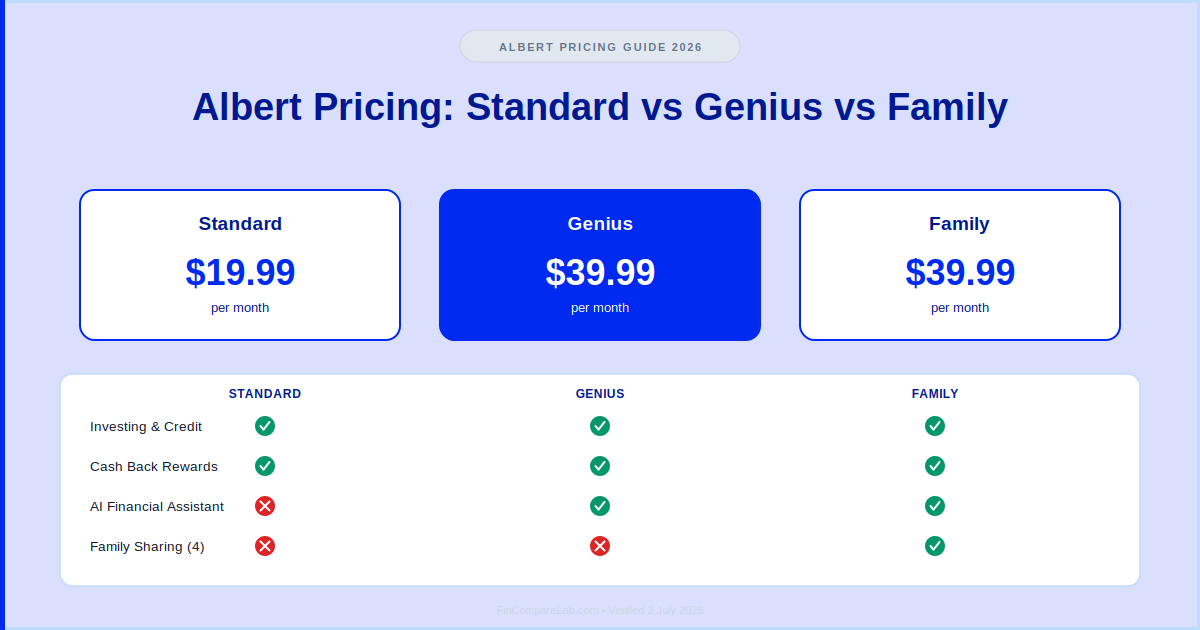
Albert pricing in 2026 has three tiers: Standard costs $19.99/month, and both Genius and Family cost $39.99/month (Family covers up to 4 people). There’s no free paid tier and no working discount code — and most competitor guides online are still showing an outdated, lower price from before Albert’s repricing.
How We Review Apps · Pricing verified from help.albert.com — 7 August 2026
On this page:
- What are Albert’s three pricing plans?
- What does Albert pricing add up to per year?
- Why do most Albert reviews still show a lower price?
- What do you actually get for $19.99 vs $39.99?
- Is your money safe with Albert, regardless of which plan you pick?
- Do you need Genius just for the cash advance?
- Is there a free trial or a discount code?
- How hard is it to cancel Albert?
- Is Albert pricing worth it compared to a dedicated budgeting app?
- Is Albert worth the cost?
- What else do people ask about Albert pricing?
What are Albert’s three pricing plans?
Albert runs three subscription tiers, and the jump between the cheapest and the rest is bigger than most people expect. Here’s the breakdown, verified directly from Albert’s own help center.
| Plan | Monthly Price | Who It’s For |
|---|---|---|
| Standard | $19.99/mo | Investing, credit monitoring, identity protection, debit card cash back |
| Genius | $39.99/mo | Everything in Standard, plus Albert’s AI-powered financial assistant |
| Family | $39.99/mo | Same as Genius, shared across up to 4 people on one account |
Pricing verified from help.albert.com — 2 July 2026.
Notice there’s no gap tier between $19.99 and $39.99 — Genius and Family cost exactly the same. If you’ve got a partner or up to three other people to add, Family gets you Genius-level features for the whole household at no extra cost over a single Genius seat. There’s no separate “Plus” or mid-tier plan despite what some competitor roundups list.
What does Albert pricing add up to per year?
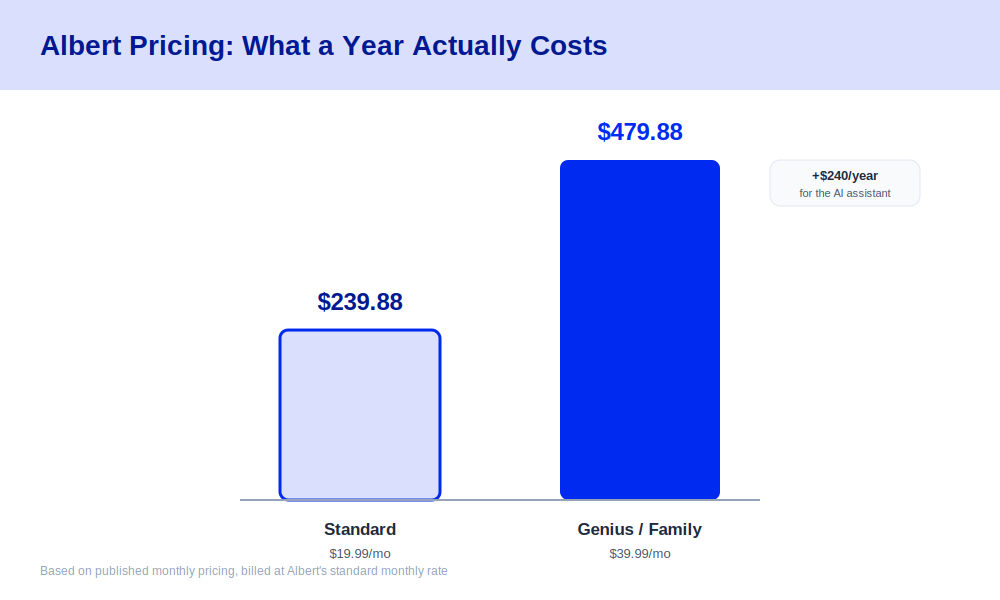
Monthly numbers hide how much this actually costs over twelve months, so let’s do the math. Standard at $19.99/month works out to $239.88/year. Genius or Family at $39.99/month works out to $479.88/year — roughly $40 more per month, or about $1.33/day, than Standard.
Put another way: choosing Genius over Standard costs an extra $240 a year for the AI assistant layer. That’s worth pausing on before you subscribe, especially if you’re mainly interested in the investing and credit-monitoring tools that Standard already includes at less than half the annual price.
Why do most Albert reviews still show a lower price?
Albert repriced its subscriptions during 2025, and a surprising number of still-ranking articles never caught up. While researching this guide, I found multiple recent posts — including reviews published or updated within the last few months — quoting the Albert Genius cost at $14.99/month or less.
Some cite figures as low as $6 to $8.99/month, which reflects Albert’s older “pay what is fair” model: a name-your-own-price structure with a low minimum that Albert has since replaced with flat, fixed monthly fees.
That gap matters if you’re comparing costs before signing up. If a guide is quoting an Albert Genius cost under $39.99/month, or any Standard price under $19.99/month, it’s working from stale data. Always cross-check current Albert pricing against Albert’s own help center before you commit a card number.
What do you actually get for $19.99 vs $39.99?
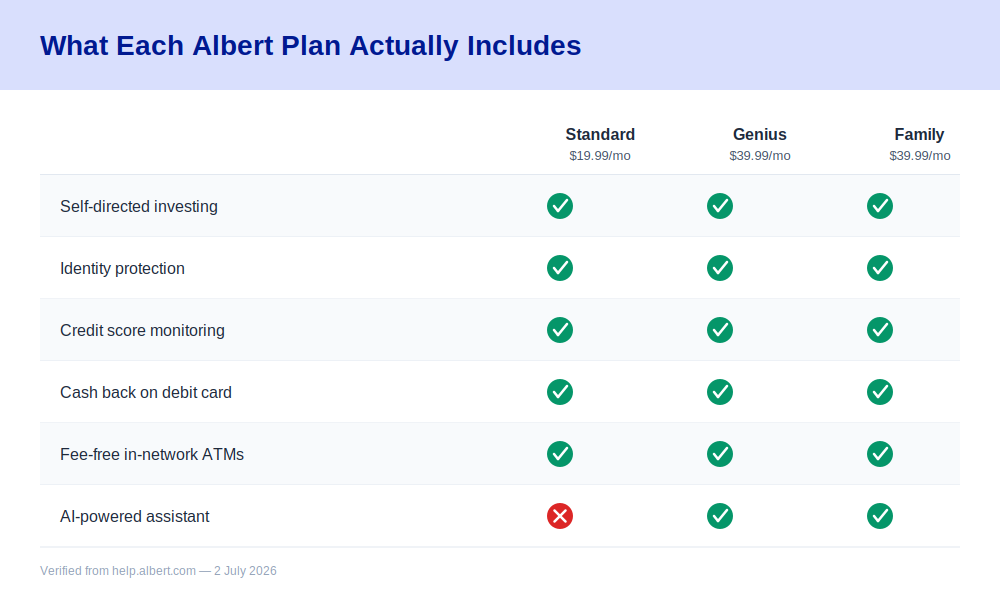
The $20 jump from Standard to Genius buys you one headline feature: Albert now describes Genius as an AI-powered financial assistant that moves money, finds discounts, shops on your behalf, and answers financial questions. That’s a shift from Albert’s older marketing, which leaned heavily on “text a real human financial expert” — a framing a lot of existing reviews still repeat word for word.
Standard ($19.99/mo) already includes:
- Self-directed investing with fractional shares
- Identity protection monitoring
- Credit score tracking
- Cash back rewards on Albert debit card spending
- Fee-free withdrawals at 55,000+ in-network ATMs
Genius and Family add the AI assistant layer on top of all of that — same investing, same protection, same cash back, plus the automated/AI-driven money moves. If you’d only use Albert for basic banking and investing, Standard covers it. If you want Albert actively managing tasks for you, that’s the $39.99 tier.
Picture the difference this way: on Standard, you’re the one checking your accounts, deciding what to invest, and remembering to move money into savings. On Genius, the AI assistant is doing some of that legwork in the background — surfacing discounts, nudging savings transfers, and answering questions about your spending on demand.
Whether that extra layer is worth $240 a year is really the whole question behind Albert pricing at this tier — it comes down to whether you’d actually open that assistant regularly, versus just wanting solid banking and investing basics.
Is your money safe with Albert, regardless of which plan you pick?
Yes, on every tier. Albert’s Cash account and debit card are issued through Stride Bank, N.A., a partner bank that changed within the past year — a number of older reviews still name Sutton Bank, which is outdated.
Savings balances are held with Wells Fargo, Member FDIC. Either way, deposits are FDIC-insured up to $250,000, which is the standard federal limit and applies whether you’re on Standard, Genius, or Family.
The subscription tier you choose affects features, not deposit safety, and that distinction matters when you’re weighing Albert pricing against the sense of security you’re getting for it. Identity protection and credit score monitoring are bundled into every paid plan starting at Standard, so you’re not paying extra for those specifically by upgrading to Genius — the added cost there is entirely for the AI assistant layer.
For what it’s worth, Albert also carries strong App Store ratings across both platforms — 4.6/5 from roughly 312,000 App Store ratings and 4.5/5 from about 154,000 Google Play reviews — though as you’ll see below, pricing and billing complaints are a separate issue from the app’s day-to-day reliability.
Do you need Genius just for the cash advance?
Not anymore, and this is one of the more important pricing changes for 2026. Albert Instant — the cash advance feature, ranging from $25 to $1,000 — no longer requires an active paid subscription to use. That’s a real shift: older reviews and complaint threads describe Albert effectively forcing a Genius subscription onto anyone who wanted advance access, and that criticism shows up repeatedly in older Trustpilot and forum threads.
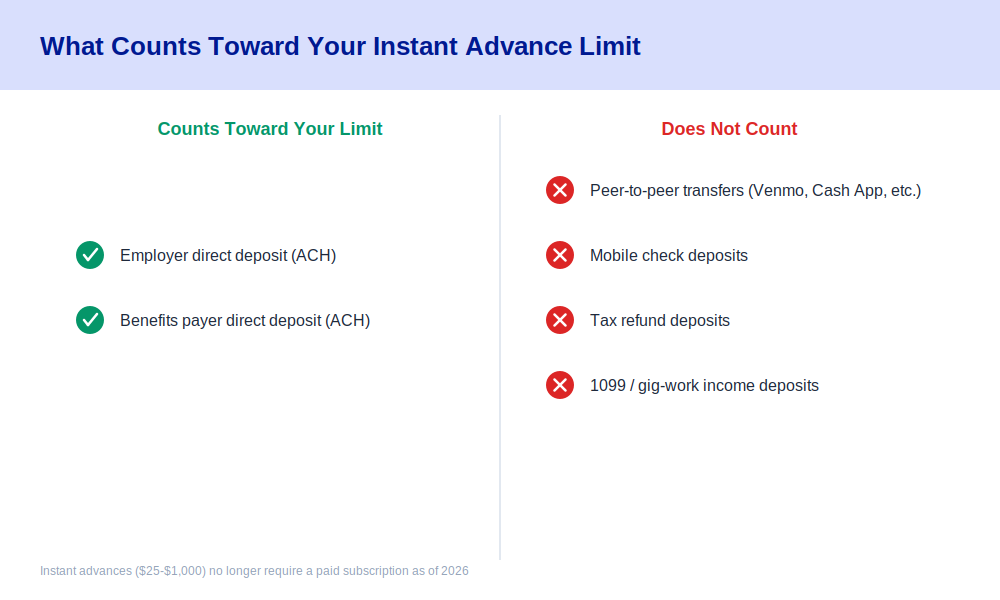
Eligibility still isn’t automatic, though. Advance limits are based on your account history and deposit activity rather than a credit check, and only qualifying direct deposits — employer or benefits payer ACH transfers — count toward raising your limit. Peer-to-peer transfers, mobile check deposits, tax refunds, and 1099 income don’t count, which trips up a fair number of freelancers and gig workers expecting a higher limit than they actually get.
If your main reason for downloading Albert is the advance feature, you may not need to pay a monthly fee for that specific use case anymore. Worth confirming inside the app before you subscribe to anything, since standard delivery to your Albert account carries no extra fee, but instant transfer does.
For context, the average bank overdraft fee runs around $35 per incident, and it’s not unusual for someone to rack up two or three in a single rough week before a paycheck lands. A $25–$1,000 advance with a small instant-transfer fee — and now, no subscription requirement — can work out considerably cheaper than letting a purchase bounce, even before you factor in Albert pricing for the subscription tiers.
If cash advances are actually your main reason for looking at Albert, it’s worth seeing how the fee structure compares to apps built around that one feature — my Albert vs Cleo and Albert vs Rocket Money comparisons both break down which one comes out cheaper if you don’t need Albert’s full banking and investing suite on top.
Is there a free trial or a discount code?
Albert offers a 30-day free trial with no card required upfront, and the subscription auto-renews once the trial ends unless you cancel first. Beyond the trial, there’s no ongoing discount code for the subscription itself — I checked Albert’s referral program directly, and it doesn’t discount your plan at all.
Here’s what the referral program actually does: when you invite a friend and they sign up, meet the requirements, and set up Albert Instant within a set window, they get access to a $50 Instant advance. You don’t get a subscription discount for referring people, and there’s no coupon code that reduces the $19.99 or $39.99 monthly rate.
If you see a site advertising an “Albert promo code” for the subscription price rather than the referral credit, treat it skeptically — it likely isn’t reflecting current Albert pricing.
How hard is it to cancel Albert?
This is worth flagging before you subscribe, not after. Across recent complaint-site reviews — one tracker shows a 1.4-out-of-5 average across 386 rated reviews — the single most consistent theme is billing: people reporting charges continuing after they thought they’d cancelled, or accounts that are difficult to close entirely.
It’s a pattern serious enough that I’d treat it as a real risk factor, not just noise, regardless of whether you’re on the $19.99 or $39.99 tier.
To cancel from inside the app: go to Profile → Menu → Payments → Help Center → Deactivate or close my accounts. Given the complaint pattern, I’d screenshot your confirmation and check your bank statement for the next billing cycle to make sure the charge actually stops.
I walk through the full tap-by-tap flow — plus what to do if a charge slips through after you’ve deactivated — in my how to cancel Albert subscription guide, so it’s worth a look before you subscribe, not just after.
Is Albert pricing worth it compared to a dedicated budgeting app?
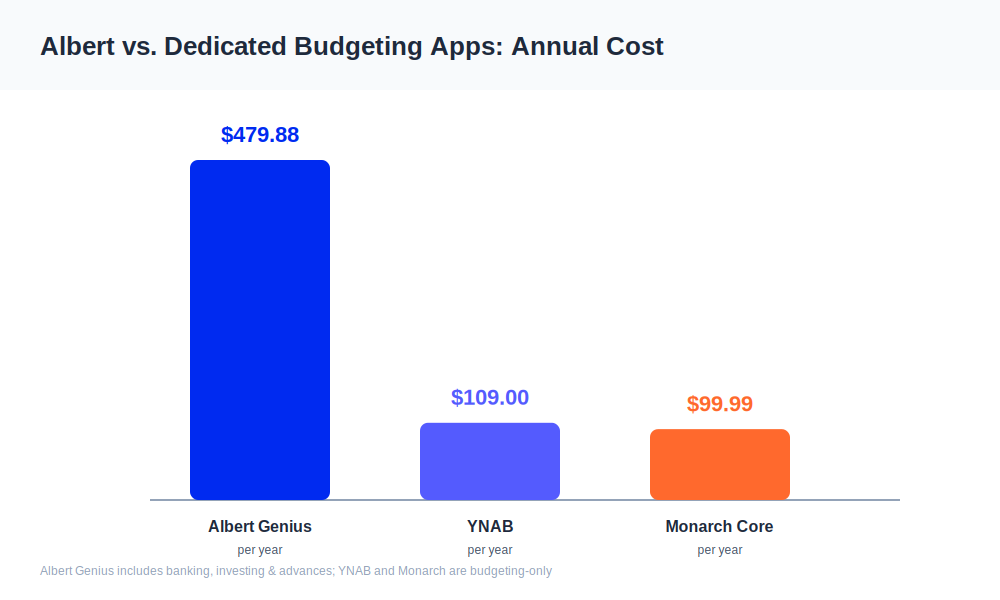
It depends what you actually need. Albert isn’t a pure budgeting app — it’s banking, investing, cash advances, and (on Genius/Family) an AI assistant bundled into one subscription. If envelope-style budgeting and expense tracking are your main goal, a dedicated tool can come in cheaper than Albert pricing on the Genius tier.
YNAB runs $109/year, and Monarch Money’s Core plan runs $99.99/year — both less than half of Albert’s $479.88/year Genius cost, though neither includes Albert’s banking, investing, or advance features.
Albert pricing makes more sense if you specifically want banking, investing, and advance access bundled under one login. If you just want to see where your money’s going each month, it’s worth reading my YNAB review or Monarch Money review before you commit to Albert’s higher tiers.
If the price tag itself is the sticking point rather than the feature set, my best Albert alternatives roundup covers cheaper standalone options worth comparing first.
Where this tends to land in practice: dual-income couples already juggling investments and shared expenses often get more mileage out of Albert’s bundled approach, since Family covers both people under one $39.99 payment.
Someone just starting their first job and building a budget from scratch is often better served starting with a free or lower-cost dedicated budgeting tool first, then revisiting Albert pricing and its banking/investing features once income is more established.
Is Albert worth the cost?
At $19.99 to $39.99 a month, Albert isn’t the cheapest all-in-one finance app on the market, and it’s not trying to be. Standard is reasonable if you want investing, credit monitoring, and cash back bundled into one account. Genius and Family only make sense if you’ll actually use the AI assistant features regularly — otherwise you’re paying double for the same core banking tools Standard already covers.
A few quick scenarios to sanity-check Albert pricing against your own situation:
- Just started your first job and building an emergency fund? Standard’s automated savings and investing tools cover the basics without paying for the AI assistant layer.
- Splitting finances with a partner? Family at $39.99/month covers up to 4 people — cheaper per person than two separate Genius subscriptions elsewhere.
- Focused on paying off debt fast? Albert’s advance feature can help avoid an overdraft in a pinch, but a dedicated payoff plan (see my debt payoff guide) will do more for your balance than any subscription tier.
I go deeper on the day-to-day experience, ratings, and where Albert falls short in my full Albert review, including how it stacks up on customer support and account safety.
Bottom line on Albert pricing: Standard at $19.99/month is a fair price for banking, investing, and credit monitoring in one place. The jump to $39.99/month only pays off if the AI assistant layer is something you’ll actually use week to week — otherwise you’re paying an extra $240 a year for features that may sit idle.
Whichever tier you land on, budget for the 30-day trial converting automatically, and don’t skip confirming your cancellation went through given how often that specific complaint shows up.
What else do people ask about Albert pricing?
A few quick answers to the most common questions I saw while researching current Albert pricing.
Is Albert free?
No. Albert doesn’t offer a genuinely free ongoing plan — every tier, including the entry-level Standard plan, costs $19.99/month after the 30-day trial. Some third-party sites still describe a free version, but that reflects Albert’s older structure, not what’s currently live on its pricing page. So if you’re asking is Albert free before you download it: the honest answer is no, though the trial itself doesn’t require a card upfront.
What is the Albert Genius cost per year?
The Albert Genius cost works out to $479.88 per year at $39.99/month, identical to the Family plan’s annual cost. That’s roughly double what Standard costs annually ($239.88/year), so it’s worth confirming you’ll actually use the AI assistant features before choosing Genius over Standard.
What’s the cheapest way to use Albert?
Standard at $19.99/month is the least expensive paid option, and it already includes investing, credit monitoring, identity protection, and cash back. If you only need the Instant cash advance feature, you may not need a subscription for that at all under Albert’s current terms.
Does Albert have a family or couples plan?
Yes. The Family plan costs $39.99/month — the same price as an individual Genius subscription — and covers up to 4 people with full Standard and Genius benefits.
Can I get an Albert discount code?
Not for the subscription price. Albert’s referral program gives your invited friend a $50 Instant advance credit, not a discount on their subscription, and there’s currently no working promo code that lowers the $19.99 or $39.99 monthly rate.
Will Albert charge me automatically after the free trial?
Yes. The 30-day trial converts to a paid subscription automatically unless you cancel first, and Albert’s help center confirms fee payments renew until you deactivate them. Given the volume of billing complaints tied to this app, mark your calendar before the trial ends.
Is Albert’s pricing the same on iOS and Android?
Yes. Standard, Genius, and Family pricing is set by Albert directly and doesn’t vary by platform, unlike some apps that charge more through the Apple App Store.
Can you switch between Albert’s pricing plans later?
Albert manages billing and plan details through the same screen documented for viewing your payment info — Profile → Menu → Payments in the app. That’s the logical place to look for upgrade or downgrade options if you want to move between Standard, Genius, and Family after signing up, though I’d confirm the current in-app flow directly, since Albert pricing options have shifted more than once in the past year.
Is Albert pricing higher than YNAB or Monarch Money?
Yes, if you compare Albert’s Genius tier to a dedicated budgeting app. Genius runs $479.88/year, versus $109/year for YNAB or $99.99/year for Monarch Money Core — though Albert bundles banking, investing, and cash advances that those apps don’t offer.
How much is Albert a month?
Albert costs $19.99 a month for Standard, or $39.99 a month for both Genius and Family. There’s no cheaper monthly tier and no ongoing free plan — every option converts to a paid subscription once the 30-day trial ends.
What do you get with the Albert Genius app?
There’s no separate download — the Albert Genius app is the same app as Standard, just with the AI-assistant layer unlocked on top. Upgrading to Genius doesn’t change what you install; it changes which features are switched on inside the app you already have.
Do you need an Albert Genius subscription for Instant advances?
No, not anymore. Albert Instant advances are now available to eligible Standard subscribers too — eligibility comes down to account history and qualifying direct deposits, not which paid tier you’re on. An Albert Genius subscription buys you the AI assistant, not advance access.
Is there a way to lower your Albert cost?
Not through a discount code — there isn’t a working one for the subscription itself. The realistic way to lower your Albert cost is to match the plan to what you’ll actually use: stick with Standard unless you know you’ll open the Genius AI assistant regularly, since that’s the only thing the extra $20/month buys you.
