
⚡ Quick Answer
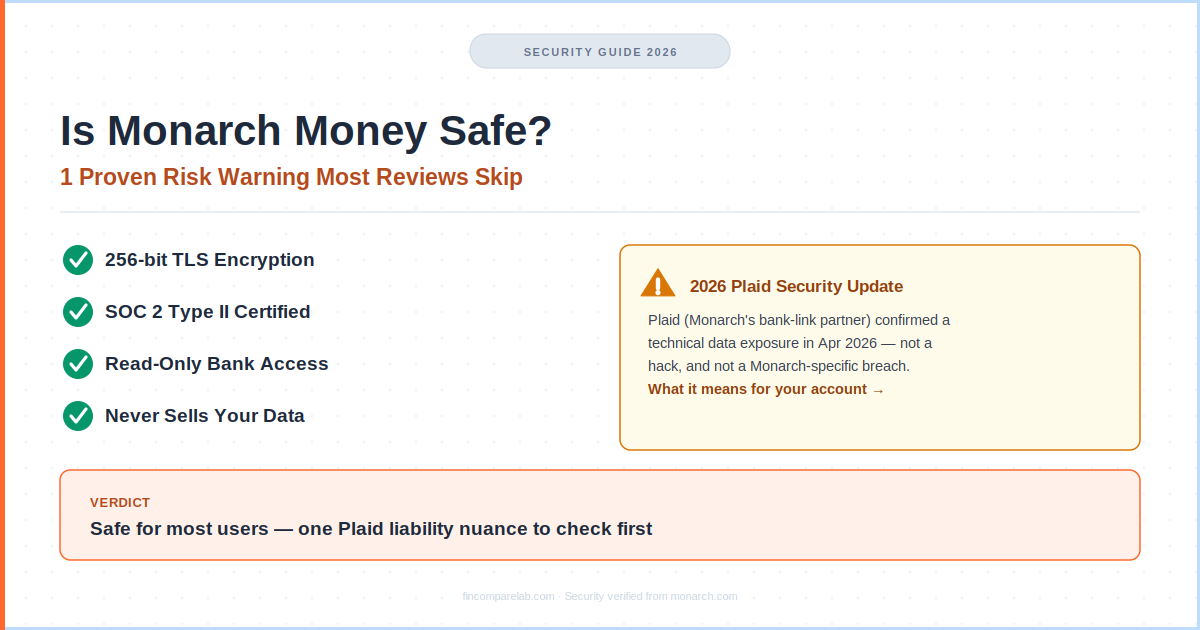
Is Monarch Money safe? Yes, it uses 256-bit TLS encryption, SOC 2 Type 2 certification, and read-only bank access, so it can never move your money. Two things most reviews skip: connecting via Plaid changes how your bank’s fraud liability works, and Plaid itself disclosed a technical data exposure in April 2026 that’s worth understanding, even though it wasn’t a Monarch-specific breach.
How We Review Apps · Security verified from monarch.com — August 23, 2026
What’s in this guide
- What does “safe” actually mean for a budgeting app?
- How does Monarch connect to your bank?
- Can Monarch move your money?
- What does Monarch Money security look like under the hood?
- What is the Plaid liability risk nobody else mentions?
- Was there a Monarch Money security breach in 2026?
- Is Monarch Money FDIC insured?
- Does Monarch sell your data?
- What happens to your data if Monarch shuts down?
- How do you make your Monarch account more secure?
- How does Monarch Money security compare to YNAB and Empower?
- What does Reddit say about Monarch Money security?
- What do people most want to know about Monarch’s safety?
Connecting Monarch Money means handing over read access to every bank account, credit card, and investment account you own. That’s a lot of trust to extend to an app you found in a Google search. So before linking anything, it’s worth asking whether is Monarch Money safe holds up to real scrutiny, not just a marketing page.
I went through Monarch’s official security documentation, the aggregator chain underneath it, the Plaid liability question most “is Monarch Money safe?” articles skip, and a 2026 development in the Plaid ecosystem that’s genuinely new information. My full Monarch Money review covers the features and pricing side; this guide sticks to security, privacy, and legitimacy.
What Does “Safe” Actually Mean for a Budgeting App?
Is Monarch Money safe? Yes, for the vast majority of users in everyday use, Monarch Money security holds up well: bank-grade encryption, read-only account access, and independent SOC 2 Type 2 audits. But “safe” means different things depending on what you’re actually worried about, and the answer gets cleaner once you separate the real concerns.
When someone searches “is Monarch Money safe,” they’re usually asking one of three distinct questions. Can a hacker drain my bank through Monarch, or use my Monarch access to move money? Will Monarch itself misuse my financial data, selling my spending history to advertisers? And what’s my liability if something goes wrong upstream, say if Plaid gets breached rather than Monarch directly? I’ll answer each one directly below, including a fourth question that’s become relevant only in the last few months: has anything actually happened yet?
How Does Monarch Connect to Your Bank?
Monarch Money security starts at the connection layer, and it’s worth understanding upfront that Monarch doesn’t connect to your bank directly. It routes through three specialist financial data aggregators, shown below.
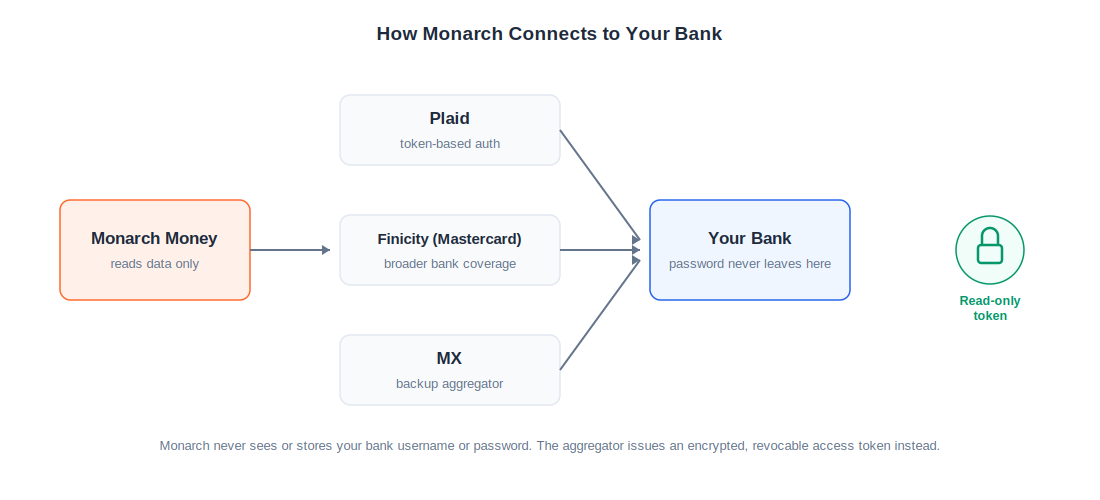
Plaid is the largest US financial data aggregator, also used by Venmo, Robinhood, and Coinbase. Finicity, now branded Mastercard Data Connect, offers broader coverage for smaller institutions. MX serves as a backup for banks the first two don’t reach. Monarch picks whichever provider connects best to your specific institution, though you can sometimes switch manually if a sync keeps failing.
Each of these aggregators authenticates with token-based access rather than storing your username and password. When you link a bank through Plaid, Plaid generates a unique encrypted access token tied to your account, and Monarch receives that token, never your login credentials. Your bank password never touches Monarch’s servers.
This is a meaningful improvement over older screen-scraping methods, where apps literally logged into your bank as you by storing and replaying your credentials. Token-based authentication is a big part of why Monarch Money security compares well even against apps with much larger engineering teams. Even if Monarch’s servers were compromised tomorrow, attackers would find encrypted tokens, not your bank login, and they couldn’t use what they found to access your accounts directly.
Can Monarch Move Your Money?
No, and this is the single most important Monarch Money security fact. Monarch has read-only access to your linked accounts. It can read transaction history, balances, and account metadata. It cannot initiate transfers, schedule payments, or move funds in any direction. The grid below breaks down exactly what that boundary looks like in practice.
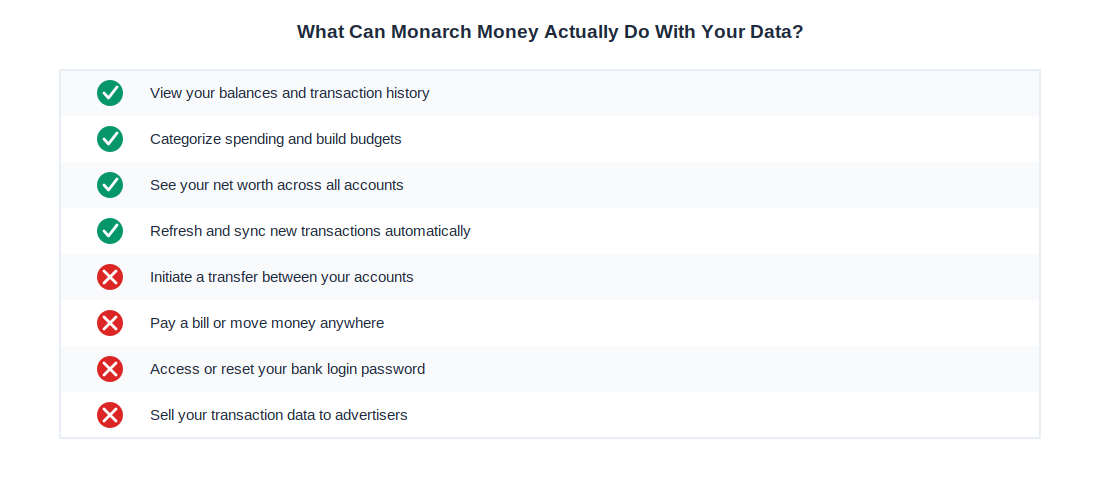
The access token Monarch holds is technically scoped to read operations only. This isn’t a policy promise, it’s a hard architectural limit. Even if your Monarch account were fully compromised, an attacker still couldn’t move a dollar through it. When people ask is Monarch Money safe in the context of theft or fraud, this is the answer: read-only architecture makes fund theft through the app technically impossible, regardless of what happens to your login credentials.
What Does Monarch Money Security Look Like Under the Hood?
Is Monarch Money safe at the infrastructure level? Here’s what their security documentation actually confirms. Monarch uses 256-bit TLS encryption for all data in transit, the same standard major US banks use. Data at rest is also encrypted, meaning stored financial records on Monarch’s servers are unreadable without the correct decryption keys.
The most meaningful Monarch Money security credential is SOC 2 Type 2 certification. This isn’t a self-assessment. It’s an independent audit by a third-party security firm that reviews internal controls, access management, data handling, and incident response over a sustained observation period, and it’s the gold standard for SaaS security compliance.
Monarch’s own privacy and security documentation also confirms multi-factor authentication across SMS, email, an authenticator app, a hardware key, and TOTP. Internal access is role-based, so employees can’t freely browse user data. Third-party researchers run regular penetration tests, and a bug bounty programme rewards responsible disclosure of any flaws found. Data lives on US-based AWS infrastructure with network-level security controls layered on top.
Each aggregator (Plaid, Finicity, and MX) independently holds its own SOC 2 Type 2 certification and runs its own security programme. Monarch Money security isn’t just the app itself, it runs through the entire data chain underneath it. That depth is part of why is Monarch Money safe has a clear yes for most users, at least until you get to the section below.
What Is the Plaid Liability Risk Nobody Else Mentions?
This is the section most “is Monarch Money safe?” articles skip. It’s not a reason to avoid Monarch, but it’s a Monarch Money security nuance worth understanding before you connect, especially if you bank with a smaller institution.
When you link your bank via Monarch’s Plaid connection, you’re technically agreeing to Plaid’s terms of service. Some US banks’ own terms of service include language saying that sharing account access credentials with a third party may reduce their liability for unauthorized transactions. The concern: if a breach occurred at Plaid rather than at your bank, your bank might argue reduced responsibility because you authorized third-party access.
In practice, this concern is largely resolved for major banks. Most large US institutions, including Chase, Bank of America, Wells Fargo, and Fidelity, now support direct OAuth connections through Plaid. With OAuth, you’re issuing a delegated read-only token via your bank’s own interface rather than handing over a password, which is how Monarch Money security at the aggregator level is meant to work and it removes most of the credential-sharing liability concern.
For smaller banks and credit unions still using older credential-based connections, the liability picture is less clear. The CFPB has been pushing for open banking standards that would resolve this, but as of mid-2026 it remains institution-dependent.
Was There a Monarch Money Security Breach in 2026?
Not directly, and this distinction matters. As of this update, no Monarch Money security breach has been reported. But Plaid, the aggregator Monarch defaults to for most banks, disclosed a real incident in 2026 worth understanding on its own terms, because it’s the kind of upstream risk that “is Monarch Money safe?” articles rarely address at all.
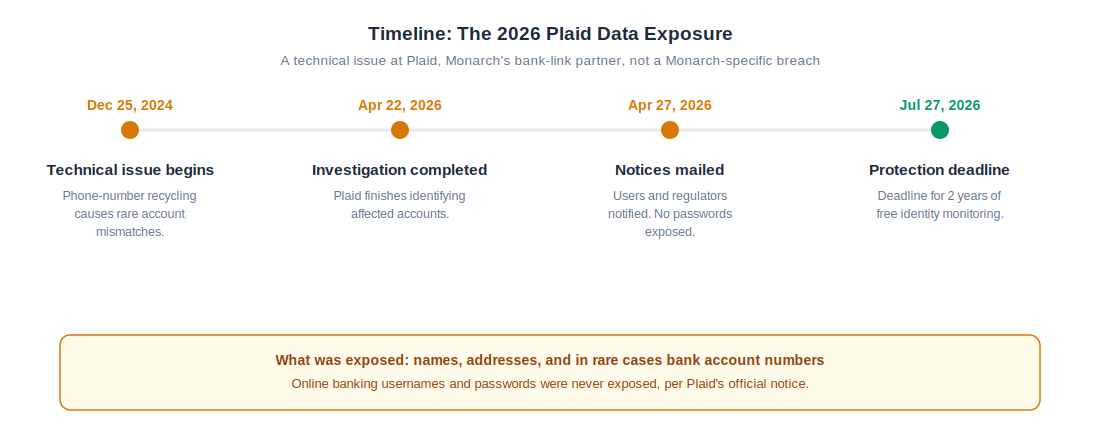
According to Plaid’s own breach notification, filed with state regulators including the Massachusetts Attorney General’s office and the New Hampshire Department of Justice, the issue traced back to a phone carrier practice called number recycling. When a carrier reassigns a disconnected phone number to a new subscriber, Plaid’s system in rare cases mismatched the new number holder with an existing Plaid connection tied to the number’s prior owner. That meant the new holder, or an app they connected through Plaid, could potentially see the prior owner’s account information.
Plaid was explicit that this was a technical issue, not a malicious hack. The affected window ran from December 25, 2024 through April 22, 2026, when Plaid finished its investigation, and notices went out to affected individuals starting April 27, 2026. Per those notices, the information that could have been exposed included names, dates of birth, addresses, driver’s license numbers, Social Security numbers, bank names, and bank account numbers. Online banking usernames and passwords were not exposed at any point. Plaid says it has since corrected the underlying issue, removed the incorrectly connected accounts, and is offering two years of free identity protection through IDX, with an enrollment deadline of July 27, 2026 for anyone who received a notice.
What this means for Monarch users specifically: there’s no indication Monarch users were named or disproportionately affected, and this wasn’t a breach of Monarch’s own systems. But if you use Plaid through any app, not just Monarch, it’s worth checking your email and physical mail from around late April 2026 for a notice, and confirming whether your phone number changed hands with your carrier in the past couple of years. If you never received a notice, you weren’t part of the affected group. This is also a good moment to revisit the account-security checklist further down this page, since revoking unused Plaid connections closes exactly this kind of gap.
Is Monarch Money FDIC Insured?
No, and this is worth clarifying because the question comes up a lot. Monarch Money is not a bank. It doesn’t hold your deposits. FDIC insurance applies to deposits held at FDIC-member banking institutions, and it has no bearing on a read-only financial tracking app.
Your actual money stays in your bank accounts at all times. Those accounts remain FDIC-insured up to $250,000 per depositor per institution, exactly as before you connected Monarch. If you’re still researching whether Monarch Money is legit enough to trust with this kind of access, the relevant check was never “is it FDIC insured?” It’s whether the underlying bank accounts remain protected, and they do.
Does Monarch Sell Your Data?
No. Monarch Money privacy is protected by the business model itself. At $99.99/year or $14.99/month for Core, Monarch makes money from subscribers paying directly, not from selling financial data to advertisers or third parties. This is one of the clearer reasons is Monarch Money safe answers with a straightforward yes: the financial incentive to protect your data is baked into the revenue structure.
This is a meaningful structural advantage over free budgeting apps. Historically, free finance tools monetized through data partnerships and ad targeting, so your spending habits were the product being sold. Monarch’s subscription model flips that relationship. Their documented data practices confirm no data sold to third parties, no in-app advertising or behavioural ad-targeting, AI features that stay contained within the platform rather than shared with outside AI providers, and partner sharing that’s opt-in only, requiring a deliberate action on your end.
If you want a cheaper entry point without sacrificing Monarch Money security or privacy, my discount codes guide covers the verified WELCOME offer. For the full plan breakdown, my Monarch Money pricing guide covers Core vs Plus in detail, and if you’re weighing this against a net-worth-first tool, my best net worth tracking apps roundup is a useful next stop.
What Happens to Your Data If Monarch Shuts Down?
This is a question most Monarch Money security reviews ignore entirely, and it’s a fair one to ask before committing years of financial data to any platform. Here’s what’s confirmed: when you cancel Monarch, your data is retained for 30 days before deletion, which gives you a window to export your transaction history. You can export at any time from Settings, and CSV export is available for transactions, so you’re not locked in.
Monarch raised $75M in Series B funding in 2025, which provides a meaningful runway, but no app is immune to business failure. The practical safeguard is the same as with any financial platform: export your data periodically. Monarch’s CSV export takes about two minutes and gives you a permanent local copy of your transaction history regardless of what happens to the platform.
How Do You Make Your Monarch Account More Secure?
Monarch Money security at the infrastructure level is solid, so the question “is Monarch Money safe?” is well answered by the architecture. Hardening your own account is the last step in completing that picture, since the weakest link in most account compromises is user behaviour, not platform architecture.
Enable MFA immediately, and use an authenticator app like Google Authenticator or Authy rather than SMS, since SMS is vulnerable to SIM-swapping attacks in a way an app-based code isn’t. Use a unique password you’ve never reused elsewhere, ideally through a password manager like 1Password or Bitwarden. Prefer OAuth linking over credential-based connections when your bank supports it. Audit your connected accounts periodically and remove any bank connections you no longer use, since fewer active connections means a smaller attack surface, which is exactly the gap the 2026 Plaid update above illustrates. And when you do cancel a connection, disconnect it inside Monarch first, then also revoke access at plaid.com/consumer-portal to fully clean up the token chain.
The vast majority of finance app security incidents trace back to compromised user accounts from password reuse or phishing, not platform breaches. MFA plus a unique password eliminates most of that risk. If you’re evaluating Monarch for a shared household, my best budgeting apps for couples guide covers how the household sharing feature works and what security that involves.
How Does Monarch Money Security Compare to YNAB and Empower?
Is Monarch Money safe relative to its closest competitors? Yes, all three use industry-standard security architecture, and the meaningful difference isn’t the tech stack, it’s the business model. I’ve covered Empower’s security posture and Copilot’s security separately, along with a similar deep dive on Origin Financial’s safety for anyone comparing across the whole category. This table focuses purely on Monarch Money security against the two most common alternatives.
| Feature | Monarch | YNAB | Empower |
|---|---|---|---|
| Read-only access | Yes | Yes | Yes |
| SOC 2 Type 2 | Yes | Yes | Yes |
| 256-bit encryption | Yes | Yes | Yes |
| MFA supported | Yes, multiple methods | Yes | Yes |
| Sells user data | No | No | Free model, upsells |
| Bank aggregator | Plaid, Finicity, MX | Plaid | Plaid, Yodlee |
| No ads | Yes | Yes | Investment upsells |
| Data retention on cancel | 30 days | 30 days | Varies |
Security details verified from official documentation, August 2026.
YNAB and Monarch are structurally similar on Monarch Money security, both are subscription products with no data monetisation incentive. The comparison that matters more is Empower: free tier, investment upsells, and a revenue model that creates some incentive to use your data for product recommendations. It’s not a Monarch Money security concern exactly, but it’s a different relationship with your financial profile. For a full feature comparison that goes beyond security, see my YNAB vs Monarch breakdown.
What Does Reddit Say About Monarch Money Security?
The security question comes up regularly on r/personalfinance and r/monarchmoney, and the community consensus on whether is Monarch Money safe is consistently positive, with one recurring nuance about the Plaid connection that predates this year’s aggregator news.
“I was skeptical about linking all my accounts to one app. But Monarch uses Plaid, which is the same connector Venmo uses, and read-only means read-only. The worst case is someone sees your transactions, not empties your account.” (r/personalfinance commenter on the Monarch Money security model)
The more nuanced thread is about the Plaid connection itself. Redditors who work in fintech or banking often raise the OAuth versus credential-based linking distinction covered above, and the advice is consistently to check if your bank supports OAuth, connect that way, and you’ve eliminated the main theoretical risk.
“The liability question with Plaid is real but mostly theoretical for Chase and BofA users since they support OAuth. If you’re at a small credit union, worth a quick call to confirm before you link.” (r/monarchmoney thread on the Monarch Money Plaid connection and liability)
No significant complaints about actual security incidents appear in the community as of this update. The frustrations that do surface are about sync reliability, connections dropping and needing re-authentication, which is a usability issue rather than a Monarch Money security concern.
Who Should Use Monarch Money?
Monarch is the right call if you’ve confirmed Monarch Money is legit and safe for your situation:
- You want a full financial dashboard, accounts, budgets, investments, and net worth in one place
- You bank with a major US institution that supports OAuth via Plaid
- You’re comfortable paying $99.99/year for an ad-free, no-data-selling experience
- You’re budgeting as a couple, since Monarch’s household sharing is the best in the category
Look elsewhere if:
- You want zero third-party data aggregator involvement, since manual-only tools like Tiller or YNAB’s manual entry mode fit better
- You bank at a small credit union with no Plaid OAuth support and have real concerns about credential-based connections
- You need strict zero-based budgeting enforcement, where YNAB’s methodology is more rigorous
What Do People Most Want to Know About Monarch Money’s Safety?
These are the exact questions that come up most often once someone’s already read the sections above and wants a quick, direct answer to check against.
Is Monarch Money safe to link to your bank account?
Yes. Monarch Money security at the connection layer relies on read-only, token-based access through Plaid, Finicity, or MX. It can view your balances and transactions but cannot move money, and your bank password is never stored on Monarch’s servers. For most major US banks, direct OAuth linking is available, which removes any credential-sharing concern entirely.
Can Monarch Money steal my money?
No. Monarch Money security architecture makes this technically impossible. Monarch holds read-only access tokens, not bank credentials, and those tokens cannot authorize any financial transaction. Even a complete platform compromise gives an attacker no ability to move funds, so the worst-case breach scenario is unauthorized viewing of your transaction data, not theft.
Was Monarch Money affected by the 2026 Plaid data breach?
Not specifically. Plaid, the aggregator Monarch uses by default for most banks, disclosed a technical data exposure in April 2026 caused by a phone-number recycling issue, not a hack. There’s no indication Monarch users were named or specifically targeted, and no Monarch Money security breach has been reported. If you received a notice from Plaid directly, it applies to whichever apps you’ve connected through Plaid, not just Monarch.
Is Monarch Money legit?
Yes. Monarch Money is a legitimate, well-funded US financial technology company, founded in 2018, SOC 2 Type 2 certified, backed by $75M in Series B funding raised in 2025, and recommended by outlets including the Wall Street Journal, Forbes, and NerdWallet. For anyone comparing Monarch Money legit credentials against YNAB, both companies run subscription businesses with similar security certifications, and the main difference is budgeting philosophy, not trustworthiness.
Does Monarch Money sell your data?
No. Monarch runs a subscription business, earning from user fees rather than data sales or advertising. Financial data isn’t sold to third parties and isn’t used to train outside AI models, and the revenue model itself removes the usual incentive free apps have to monetize your spending behaviour.
Is Monarch Money FDIC insured?
No, but this isn’t relevant to your safety. Monarch isn’t a bank and doesn’t hold your money. Your bank accounts remain FDIC insured normally after connecting Monarch, and the read-only connection doesn’t affect your bank’s FDIC coverage in any way.
What happens to your data if Monarch Money shuts down?
When you cancel Monarch, your data is retained for 30 days before deletion, and you can export your full transaction history as a CSV at any time from Settings. Exporting quarterly gives you a permanent local backup regardless of what happens to the platform.
Read Next
- Monarch Money Review 2026, Full Hands-On Verdict
- Monarch Money Pricing 2026, Plans, Codes and Trial
- Monarch Money Discount Codes 2026
- YNAB vs Monarch Money 2026, Full Comparison
- Honeydue vs Monarch, Couples Budgeting Compared
- Best Budgeting Apps for Couples 2026
- Is Copilot Money Safe? Security Facts Explained
- Is Origin Financial Safe? Security Facts Explained
- Empower Review 2026, Free but Worth It?
- Best Net Worth Tracking Apps 2026
