
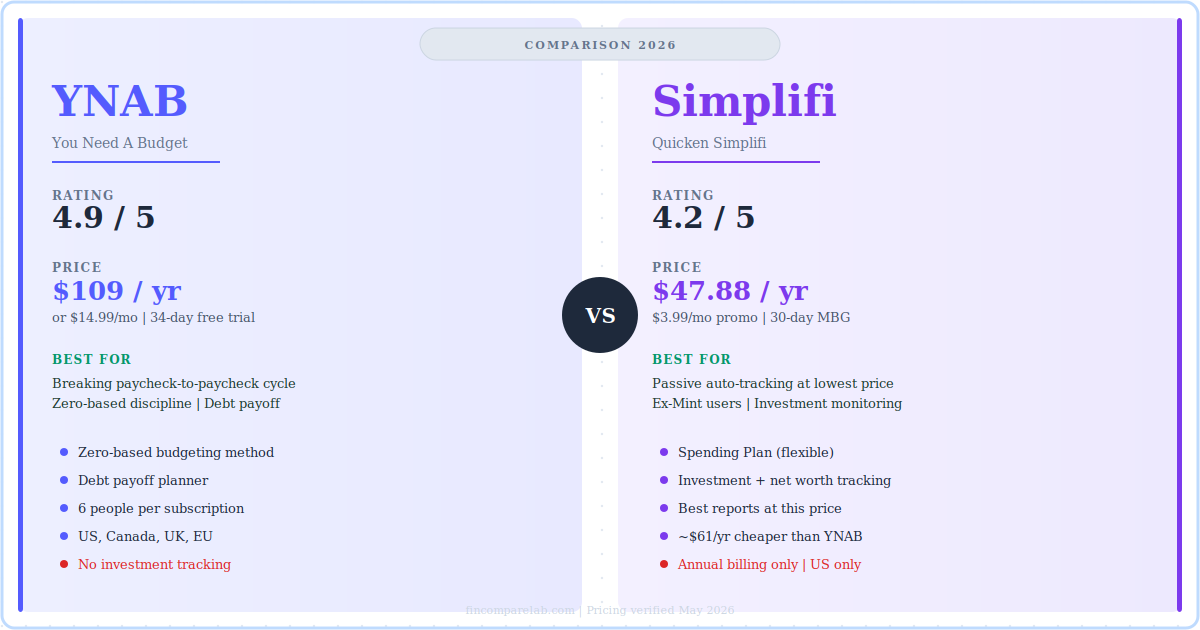
YNAB vs Simplifi is one of the most common budgeting app comparisons in 2026, and one of the most misunderstood. They’re both paid apps that sync to your bank, but they solve completely different problems.
⚡ Quick Verdict
YNAB wins if you need to actively change your relationship with money, break the paycheck-to-paycheck cycle, pay off debt, or build real financial discipline. Simplifi wins if you want clean automatic tracking, investment monitoring, and the lowest price among full-featured paid apps. In the YNAB vs Simplifi decision, that $61 gap is either worth every cent or completely unnecessary, depending on your situation.
YNAB
⭐ 4.9/5 · $109/yr · 34-day free trial
Best: behavior change, debt payoff
Simplifi
⭐ 4.2/5 · $47.88/yr · 30-day MBG
Best: passive tracking, ex-Mint users
How We Review Apps · Pricing verified from ynab.com and quicken.com — August 20, 2026
📋 In This Comparison
- Which App Should You Use: YNAB or Simplifi?
- How do YNAB and Simplifi compare on price?
- What is the core difference between YNAB and Simplifi?
- How do YNAB and Simplifi compare feature by feature?
- What does YNAB actually give you for $109 a year?
- What does Simplifi give you for $48 a year?
- Which app wins for your specific situation?
- Can you use YNAB and Simplifi at the same time?
- What does Reddit say?
- Which budgeting app should you choose?
- What do people most want to know about YNAB vs Simplifi?
I’ve used both budgeting apps with real bank accounts, YNAB for zero-based budgeting and debt payoff, Simplifi for passive tracking and investment visibility. Here’s what I found, starting with the fastest possible answer.
Which App Should You Use: YNAB or Simplifi?
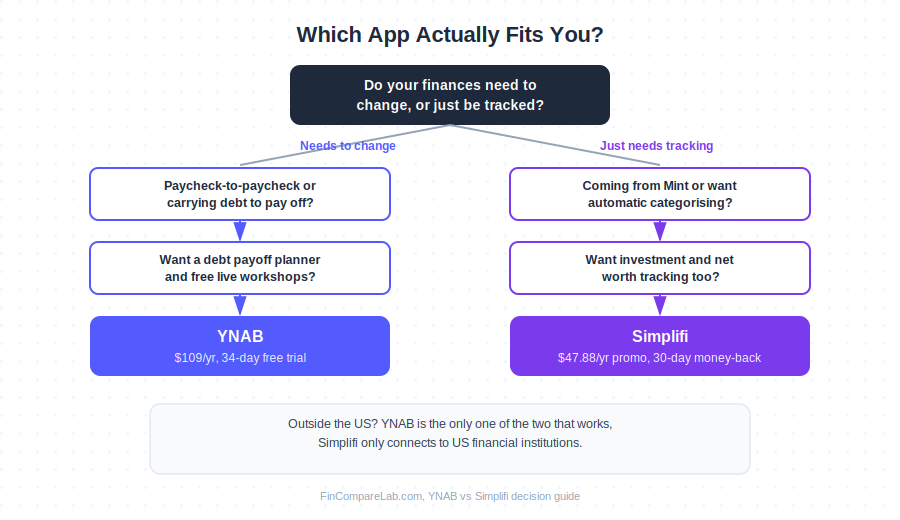
This YNAB vs Simplifi comparison has a lot of ground to cover, but if you can only read one section, make it this one. The right pick comes down to whether you need your finances to change or just be tracked.
Choose YNAB if…
- You live paycheck to paycheck and want to break the cycle
- You’re paying off credit card debt or loans
- You want a structured method, not just transaction tracking
- You’re outside the US (UK, Canada, EU supported)
- You want a long free trial before committing
- You budget with a partner and want shared access for up to 6 people
Choose Simplifi if…
- You moved from Mint and want the closest replacement
- You want automatic tracking with minimal manual input
- You want investment and net worth tracking in one app
- You’re already a decent budgeter and just need visibility
- You want the cheapest full-featured paid app available
- Detailed reports and spending analysis matter to you
How Do YNAB and Simplifi Compare on Price?
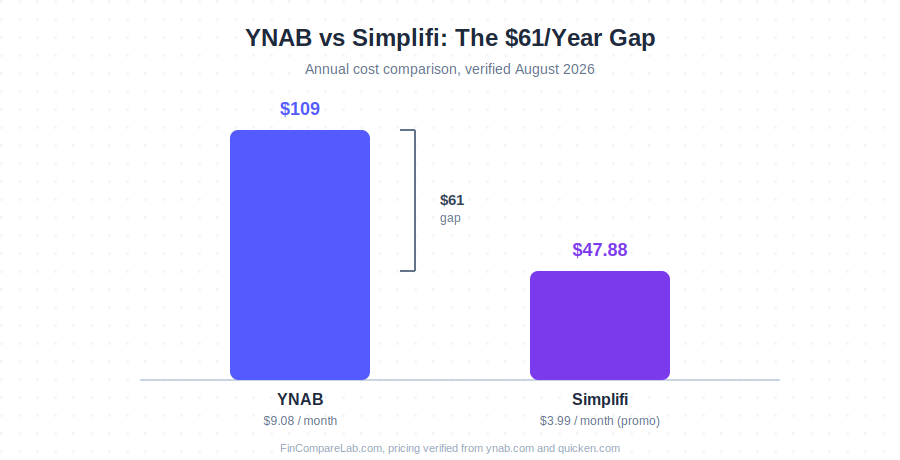
Price is the most obvious difference in any YNAB vs Simplifi comparison. At $109/year vs $47.88/year, the gap is $61. Whether that’s worth it depends entirely on which features you’ll actually use.
| YNAB | Simplifi | |
|---|---|---|
| Annual price | $109/yr | $47.88/yr (promo) |
| Standard annual | $109/yr | $83.88/yr ($6.99/mo) |
| Monthly billing | Yes, $14.99/mo | No, annual only |
| Free trial | Yes, 34 days, no card required | No trial, 30-day money-back guarantee |
| Student discount | Yes, free 1yr for students at ynab.com/college | No |
| Per month (annual) | $9.08/mo | $3.99/mo (promo) |
| Price gap | YNAB costs $61/year more | |
Pricing verified from ynab.com and quicken.com on August 20, 2026. See the Simplifi pricing guide and YNAB pricing guide for full breakdowns. Simplifi’s $3.99/mo promo is confirmed live at quicken.com through September 18, 2026, applied automatically at checkout, no code needed. It reverts to the $6.99/mo standard rate after that window closes, so check the live price before you subscribe.
This YNAB vs Simplifi price gap compounds over several years, which is worth factoring in beyond the first-year promo. At $109/year, YNAB works out to about 2 coffees a month. At $47.88/year, Simplifi is under $1/week. Both are cheap relative to what most people waste through untracked spending, but the $61/year gap is real.
The 34-day free trial with no card required is one of YNAB’s strongest selling points. Simplifi’s annual-only billing with no trial is its biggest friction point. You pay upfront and rely on the 30-day money-back guarantee. Check the Simplifi discount guide before subscribing.
What Is the Core Difference Between YNAB and Simplifi?
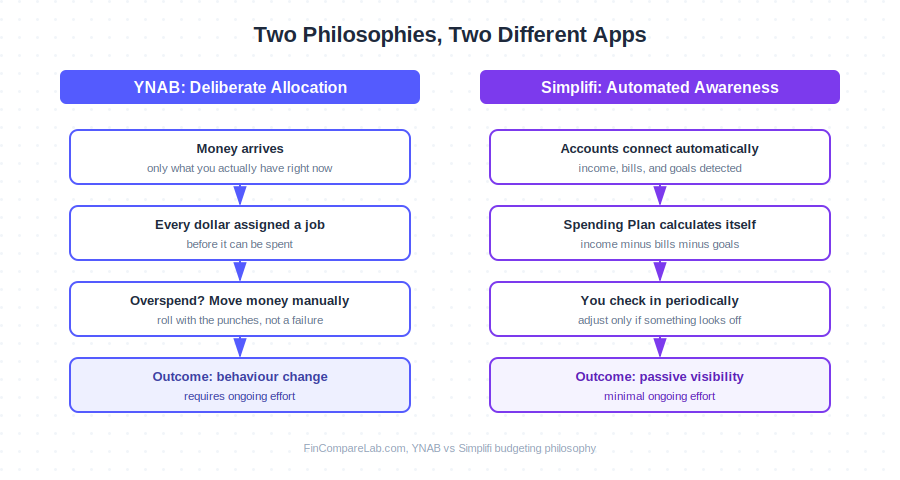
This matters more than any feature table. The YNAB vs Simplifi question is really a question about philosophy: deliberate allocation vs automation. They solve genuinely different problems.
YNAB is built on zero-based budgeting. Every dollar must be assigned a job before you spend it. You don’t budget based on projected income. You budget on what you actually have right now.
When something unexpected happens, you move money between categories rather than treating it as failure. The goal isn’t just to track spending. It’s to change how you think about money entirely.
This works, and it’s why YNAB is worth it to so many people who commit to the method. The r/ynab community is full of dramatic turnarounds, breaking the paycheck-to-paycheck cycle, paying off $20k of debt, building an emergency fund for the first time.
The flip side: this approach requires effort. You assign every dollar, review transactions regularly, and think actively about your money.
People who find this rewarding love YNAB. People who find it exhausting quit within a month. Both reactions are valid.
Simplifi is built on automation. Connect your accounts and it builds a Spending Plan based on your income and recurring bills, then shows what’s left to spend. Transactions categorise automatically. Your job is to check in periodically and adjust.
This is the closest modern replacement for what Mint used to do. The trade-off is accountability: if you never check in, spending gets tracked perfectly while you continue to overspend perfectly.
Choosing between YNAB vs Simplifi is really a question about yourself: do you need a system that forces behavioural change, or do you need better visibility into what’s already happening?
Is It YNAB vs Simplifi or YNAB vs Quicken Simplifi?
Both names point to the same app. “Simplifi” is the product name, but the official brand is Quicken Simplifi, since Quicken owns and builds it. You’ll see the comparison written as YNAB vs Simplifi in casual use and YNAB vs Quicken Simplifi on Quicken’s own marketing pages and in App Store listings. They’re identical for the purposes of this comparison.
How Do YNAB and Simplifi Compare Feature by Feature?
Beyond price and philosophy, this YNAB vs Simplifi feature breakdown shows exactly where the $61/year premium goes and where Simplifi actually pulls ahead.
| Feature | YNAB | Simplifi |
|---|---|---|
| Budgeting method | Zero-based (every dollar assigned) | Spending Plan (automated) |
| Auto bank sync | Yes | Yes |
| Manual entry | Yes, encouraged | Yes, optional |
| Savings goals | Yes, built into budget | Yes, named goals + progress |
| Debt payoff planner | Yes, avalanche + snowball | No |
| Investment tracking | No | Yes, holdings, cost basis, performance |
| Net worth tracking | Yes, basic | Yes, full, auto-updated |
| Bill tracking | Yes | Yes |
| Credit score tracking | No | Yes, monthly VantageScore via Equifax |
| Customisable reports | Yes | Yes, best at this price |
| Subscription tracker | Via categories | Yes, dedicated feature |
| Refund tracker | No | Yes, unique feature |
| Couples / shared access | Yes, up to 6 people | Yes, via Spaces feature |
| Free workshops | Yes, live online | No |
| Platforms | iOS, Android, Web | iOS, Android, Web |
| Availability | US, Canada, UK, EU + more | US only |
| Bank connections | 12,000+ | 14,000+ |
Pricing verified from official websites on August 20, 2026.
What Does YNAB Actually Give You for $109 a Year?
In the YNAB vs Simplifi comparison, YNAB is the older of the two apps, around since 2004, and has an unusually loyal budgeting app user base. The r/ynab subreddit has nearly 200,000 members, more than any other budgeting app community, and the quality of discussion there is consistently high. That loyalty exists because YNAB is worth it when the method genuinely clicks for people who stick with it.
What Are YNAB’s Four Rules?
The zero-based budgeting system runs on four rules that work together as a complete financial method, not just features in an app. See the full YNAB Four Rules breakdown for a deeper walkthrough of each one.
- Give every dollar a job. Every dollar you have right now gets assigned to a category before you spend it.
- Embrace your true expenses. Break annual and irregular costs into monthly contributions so they don’t surprise you.
- Roll with the punches. When you overspend in a category, move money from another rather than treating it as failure.
- Age your money. The goal is to spend money that’s at least 30 days old, meaning you’re living on last month’s income rather than waiting on this week’s paycheck.
How Does YNAB Handle Debt Payoff?
No budgeting app at this price handles debt better. You can view all debt accounts in one place, model payoff timelines with avalanche and snowball methods, and the loan planner tracks progress automatically. For anyone carrying credit card balances, student loans, or car loans, this alone can justify the $61 premium. See the best apps for debt payoff for a full comparison.
Does YNAB Offer Free Training?
Yes, free live online workshops cover budgeting basics, getting out of debt, and specific life situations. No other app at this price offers anything comparable. It’s a meaningful part of the value for new users who want to learn the method properly.
Where Does YNAB Fall Short?
No investment tracking. If you want brokerage accounts alongside your budget, you’ll need a separate tool like Empower (free). There’s also no lower-priced tier after the 34-day trial ends.
→ Full YNAB Review 2026 · YNAB Pricing Guide · YNAB free for students
What Does Simplifi Give You for $48 a Year?
On the other side of the YNAB vs Simplifi comparison, Simplifi launched in 2020 as Quicken’s cloud-first personal finance app, deliberately simpler than Quicken Classic, built for people who want financial awareness without complexity. The Mint shutdown of January 2024 sent millions of users looking for alternatives, and many landed here.
How Does Simplifi’s Spending Plan Work?
The core feature automatically calculates: monthly income minus fixed bills minus savings goal contributions equals what’s safe to spend. That number updates in real time as you spend throughout the month. It’s less rigid than zero-based budgeting but more structured than a simple transaction tracker, and for most people, that’s exactly the right level of friction.
Does Simplifi Track Investments and Net Worth?
This is its clearest advantage over YNAB. Connect brokerage accounts (Fidelity, Schwab, Vanguard, and most others) and it shows holdings, cost basis, performance over time, and net worth in one view. For people in their late 20s and 30s building investment portfolios alongside managing day-to-day spending, having both in one place at $47.88/year is genuinely compelling.
How Good Are Simplifi’s Reports?
The customisable reports are the best of any app at this price point. Filter by category, payee, date range, or tag.
View as numbers or graphs. Export to CSV. For anyone who wants to dig into spending patterns without the overhead of zero-based budgeting, the reporting tools here are real and powerful.
Where Does Simplifi Fall Short?
Annual billing only. This is the single most consistent complaint across Reddit and app store reviews. No debt payoff planner. US-only.
The automation that makes things easy also means nothing will push you to change behaviour. If you overspend, spending gets tracked perfectly but nothing stops it happening again.
→ Full Simplifi Review 2026 · Simplifi Pricing Guide · Simplifi discount codes 2026
Which App Wins for Your Specific Situation?
Feature tables only tell part of the story. The right side of this YNAB vs Simplifi decision usually comes down to a specific situation, not a generic score, so here’s how it breaks down by use case.
Which App Is Better for Breaking Paycheck-to-Paycheck?
Which App Is Better for Paying Off Debt?
Which App Tracks Investments and Net Worth?
Which Budgeting App Is Better for Couples Budgeting?
Which App Is Better for a First-Time Budgeter?
Which App Is the Best Mint Replacement?
Which App Works Better for Variable Income or Freelancers?
Which App Works Outside the US?
Can You Use YNAB and Simplifi at the Same Time?
Technically yes, running both sides of the YNAB vs Simplifi comparison at once is possible, but at $157/year combined, the overlap is significant and the added complexity usually outweighs any benefit. Running two apps simultaneously creates more confusion than clarity for most people.
A smarter combination: use YNAB as your primary tool and pair it with Empower (free) for investment tracking. That covers the investment gap without redundancy. Alternatively, use Simplifi for everything and supplement with the free Debt Payoff Estimator for the planning tools it lacks.
The one scenario where running both makes sense: you’re mid-transition, testing zero-based budgeting during the 34-day free trial while still using Simplifi day-to-day. That’s a reasonable way to evaluate whether the method fits before committing to $109/year.
What Does Reddit Say?
Search “ynab vs simplifi reddit” or “simplifi vs ynab reddit” and you’ll land mostly in two communities: r/ynab and r/personalfinance. The consensus in each is different enough that it’s worth reading both before you decide.
The r/ynab community (~200k members) is one of the most active personal finance communities on Reddit. The consensus is unsurprisingly pro-YNAB, but the reasons are instructive. Almost everyone reports specific, measurable improvements after committing to the method for 2–3 months. Recurring themes: breaking paycheck-to-paycheck cycles, paying off debt faster than expected, building a real emergency fund for the first time.
One r/ynab commenter captured the sentiment well: “I was sceptical about paying for a budgeting app. Two months in I’d already saved more than the annual cost in the first week. The method is what makes it worth it, not the app itself.”
On r/personalfinance and r/budgeting, Simplifi comes up regularly as the recommended Mint replacement, specifically for people who want something that works without a learning curve. Most common praise: reliable bank sync, clean interface, strong reports, and the price. Most common complaint: annual-only billing with no way to test it first.
One r/personalfinance user summed up the choice plainly: “If you need it to work, YNAB will. If you just want Mint to come back, use Simplifi.”
What Do YNAB vs Simplifi Reddit Threads Actually Say?
The honest pattern across both communities: people who bounced off YNAB say the method didn’t fit their lifestyle, not that the app was broken. People who stuck with it for 60+ days rarely go back to a passive tracker. Simplifi gets fewer passionate advocates but also fewer people who quit after a week, since there’s less method to abandon in the first place.
Which Budgeting App Should You Choose?
This YNAB vs Simplifi decision isn’t close once you know which category you’re in. YNAB vs Simplifi is really a question of whether you need change or visibility, and those aren’t the same thing.
YNAB: pick this if you need change
Debt, paycheck-to-paycheck stress, and no savings cushion: these are the problems YNAB was built to fix. At $109/year it’s worth it when you actually use it. The 34-day free trial with no card required makes it risk-free to find out if zero-based budgeting clicks for you.
Try YNAB Free for 34 Days →Simplifi: pick this if you need visibility
Finances basically functional, want better awareness at the lowest price. At $47.88/year with investment tracking, net worth monitoring, and the best reports at this price point, the value is compelling. The 30-day money-back guarantee makes it low-risk.
Try Simplifi Risk-Free →If genuinely torn on YNAB vs Simplifi, take the 34-day free trial first. No card needed, no risk. If zero-based budgeting clicks within two weeks, YNAB is worth it at $109. If you find yourself not logging in or resisting the manual work, the automatic approach in the other app will serve you better long-term at half the price, and is worth it on its own terms.
What Do People Most Want to Know About YNAB vs Simplifi?
These are the questions that come up most before people commit to either app, pulled from the searches and comments this YNAB vs Simplifi comparison sees most often.
Is YNAB worth it compared to Simplifi?
YNAB is worth it over Simplifi if, and only if, you need behavioural change: breaking paycheck-to-paycheck cycles, paying off debt, or building savings discipline. That extra $61 is worth it as long as you actually use it. You’re paying for zero-based budgeting, a debt payoff planner, and free live workshops. If your finances are already stable and you just want visibility, $47.88/year for Simplifi is hard to beat.
Is YNAB or Simplifi better for beginners?
For most people weighing YNAB vs Simplifi as a first budgeting app, Simplifi is easier to start: automatic setup, no method to learn, lower price. The other app has a steeper learning curve but produces better long-term outcomes.
If you’ve never seriously budgeted, the structure it provides gives you more to work with. If you’ve tried apps before and quit, the low-friction option is the better starting point.
How much does YNAB cost compared to Simplifi?
The YNAB vs Simplifi price gap breaks down like this: YNAB costs $109/year or $14.99/month, while Simplifi costs $47.88/year at the current promotional rate ($3.99/month billed annually). That’s a $61/year gap.
Simplifi’s standard rate without the promo is $83.88/year ($6.99/month). Both are effectively annual-only, though YNAB offers a monthly option. See the full YNAB pricing guide and Simplifi pricing guide for complete breakdowns.
Which Is Easier to Use: YNAB or Simplifi?
On ease of use, Simplifi vs YNAB isn’t close: Simplifi is easier to set up and requires less ongoing effort since it’s largely automatic once connected. The other app has a steeper learning curve; most users need 2–4 weeks to feel comfortable. Ease of use isn’t always the right metric: the intentional friction is part of what makes it effective for people who need real behaviour change.
Does YNAB or Simplifi have better bank sync?
Bank sync rarely decides a YNAB vs Simplifi choice on its own, but both have solid coverage. Simplifi’s connection reliability is slightly stronger day-to-day, likely thanks to Quicken’s decades of connectivity experience. It covers 14,000+ institutions vs 12,000+. Neither is perfect and occasional reconnection is normal with both depending on your bank’s security settings.
Is Simplifi a good replacement for YNAB?
In the YNAB vs Simplifi comparison, Simplifi is a different tool, not a direct replacement. If you’re leaving because zero-based budgeting felt like too much work, Simplifi is a natural step down in effort and price.
If the reason is purely cost, you’ll lose the debt payoff tools, the method, and the workshops. For pure spending awareness at a lower price, it works well, but nothing really replaces the zero-based approach for behaviour change.
Does YNAB track investments?
No, it’s strictly a budgeting tool and does not connect to brokerage or investment accounts. If you need investment tracking alongside your budget, Simplifi includes it at the same price, or Empower is free and offers significantly deeper investment analysis.
Which Budgeting App Is Better for Couples: YNAB or Simplifi?
For couples deciding on YNAB vs Simplifi together, both support shared budgeting. YNAB covers up to 6 people on one subscription and creates genuine shared accountability through zero-based budgeting. Simplifi’s Spaces feature allows shared access for visibility.
For couples where both partners actively budget together, the former’s shared method creates better alignment. For couples where one person manages finances and the other just needs to see balances, the latter is simpler. See the best apps for couples for all options.
Is YNAB available outside the US?
For anyone outside the US comparing YNAB vs Simplifi, this one is simple. YNAB supports users in the US, Canada, UK, EU, Australia, New Zealand, and more. The other app is US-only and only connects to US financial institutions. Outside the US, this comparison is already decided.
Simplifi vs YNAB: Which One Actually Saves You Money?
Neither app saves money directly. Both cost money, and neither pays you back on its own. What each one can save you depends on what you actually do with it.
YNAB’s savings come from behaviour change: people who commit to zero-based budgeting for a few months commonly report finding money they didn’t know they were losing to unplanned spending. Simplifi’s savings come from awareness: catching a forgotten subscription, a bill increase, or a spending category creeping up before it becomes a habit.
If you already track spending carefully, Simplifi’s $47.88/year is the cheaper way to keep doing that. If your spending is currently a mystery to you, YNAB’s structure is more likely to pay for itself.
Which Search Is More Common: Quicken Simplifi vs YNAB or YNAB vs Simplifi?
Both phrasings describe the identical comparison, so it makes no real difference which one you search. “YNAB vs Simplifi” is the shorter, more casual version people type from memory. “Quicken Simplifi vs YNAB” shows up more from people who’ve just seen the app’s full name on a pricing page or app store listing and are searching with that exact wording still in mind.
📚 Read Next
- YNAB Review 2026: Full Hands-On Verdict
- Simplifi Review 2026: Full Hands-On Verdict
- YNAB Pricing 2026: Plans, Trial & Student Offer
- Simplifi Pricing 2026: Annual Plans & Discounts
- Simplifi Discount 2026: How to Get the Best Price
- YNAB’s Four Rules Explained
- YNAB vs Monarch Money 2026
- YNAB vs Copilot 2026
- Best Budgeting Apps for Debt Payoff 2026
- Free Debt Payoff Estimator Tool
