
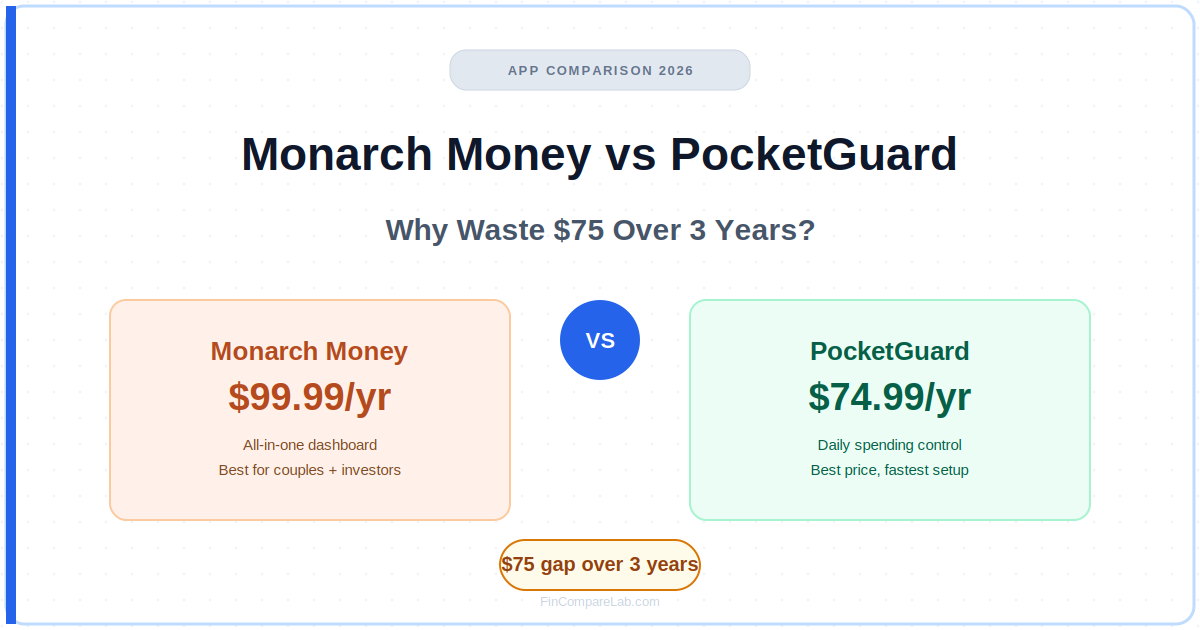
Monarch Money vs PocketGuard comes down to one honest question: if you stick with the cheaper app for three years, is the $75 you save actually worth what you give up, or is it money you’ll end up wasting on a workaround?
⚡ Quick Verdict
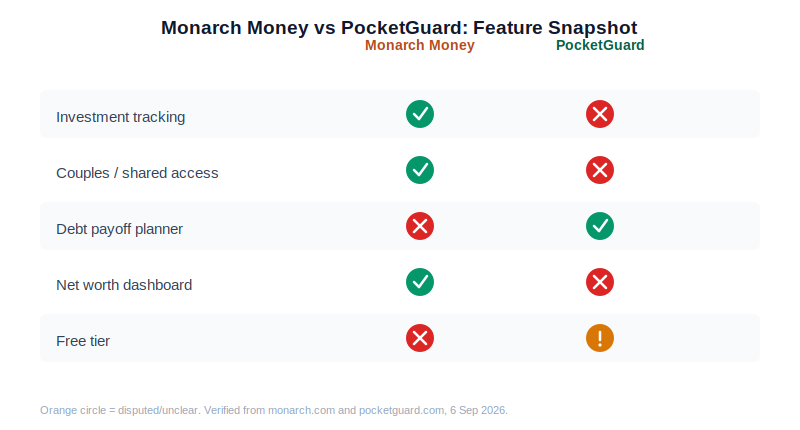
Monarch Money ($99.99/year) is the pick if your money problem is a lack of visibility: you don’t actually know your net worth, your investments live in three different apps, or you’re managing money with a partner.
PocketGuard ($74.99/year) is the pick if your money problem is behavioral: you know exactly what you make, you just keep spending past the point you meant to stop. Over three years that’s a real $75 gap, but it’s not free money either way: pick the wrong one and you’ll pay for a tool that solves a problem you don’t have.
Not sure which $75 you’d actually be wasting? This Monarch Money vs PocketGuard breakdown settles it by matching the app to the problem, not the price tag.
How We Review Apps · Pricing verified directly from monarch.com and pocketguard.com — 6 September 2026
📋 What’s in this comparison
- How much do Monarch Money and PocketGuard actually cost over time?
- What’s the real difference between Monarch Money and PocketGuard?
- Who is Monarch Money actually built for?
- Who is PocketGuard actually built for?
- How do Monarch Money and PocketGuard compare head-to-head?
- Can you use Monarch Money and PocketGuard together?
- Which one should you actually choose?
- What do most people ask about Monarch Money vs PocketGuard?
How Much Do Monarch Money and PocketGuard Actually Cost Over Time?
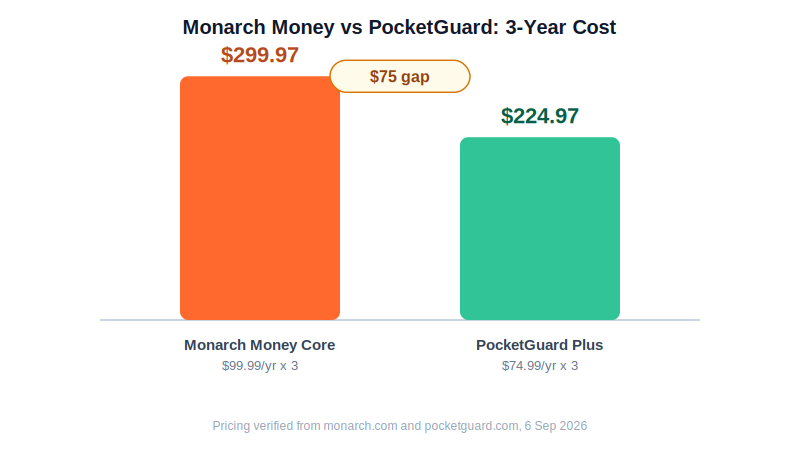
Direct answer: Monarch Money Core costs $99.99/year and PocketGuard Plus costs $74.99/year, a $25/year gap. Over three years that’s $299.97 versus $224.97, a real $75 difference. The gap doesn’t grow or shrink over time since neither app has announced a price change; it just compounds at a flat $25/year for as long as you keep both subscriptions active.
Any honest monarch money vs pocketguard comparison has to start here, because the $75 figure only means something once you know what it’s buying. A monarch money vs pocketguard pricing breakdown really only needs two numbers to start: Monarch Money Core runs $99.99/year, or $14.99/month if you’d rather pay monthly (that costs more overall, $179.88/year, so the annual plan is the better deal if you’re committing either way).
PocketGuard Plus runs $74.99/year, or $12.99/month ($155.88/year on the monthly plan), and it also sells a one-time $149.99 lifetime option that pays for itself against the annual plan in just over two years. Run the pocketguard vs monarch money pricing math either way and PocketGuard comes out cheaper every year.
| Monarch Money | PocketGuard | |
|---|---|---|
| Monthly price | $14.99/mo (Core) | $12.99/mo (Plus) |
| Annual price | $99.99/yr Core · $199.99/yr Plus | $74.99/yr Plus · $149.99 lifetime |
| 3-year total (annual plan) | $299.97 | $224.97 |
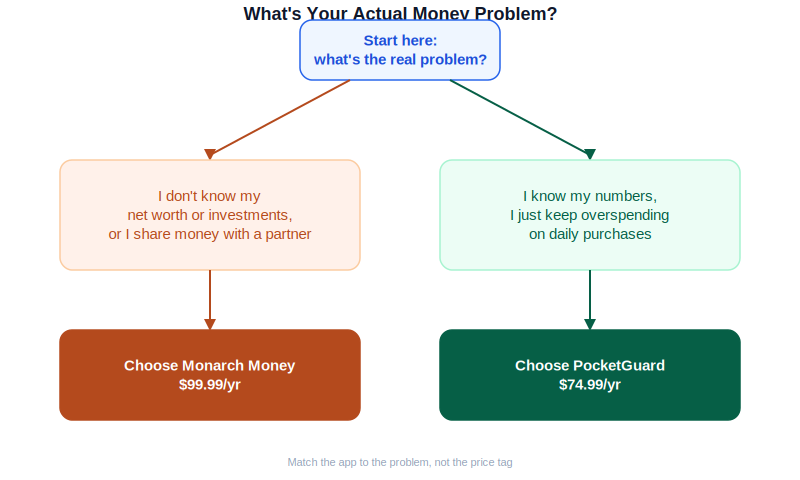
| Free tier | None, 7-day trial only | Disputed, see note below ⚠️ |
| Investment tracking | Yes | No |
| Debt payoff planner | Folded into net worth view | Dedicated avalanche/snowball tool |
| FinCompareLab rating | 4.8/5 | 4.3/5 |
Monarch Money vs PocketGuard pricing verified directly from monarch.com and pocketguard.com, 6 September 2026.
⚠️ Watch out: PocketGuard’s free tier is disputed: PocketGuard’s own marketing copy and several third-party review sites describe a limited free tier, while other reviewers report it’s been folded entirely into the 7-day trial.
As of 6 September 2026, the live pricing page doesn’t settle it either way. The page shows only the Yearly, Monthly, and Lifetime paid tabs, with no separate free option visible. If a free tier matters to your decision, check pocketguard.com/pricing directly before assuming it’s there.
Monarch Money’s situation isn’t disputed at all: there’s no free tier, only the 7-day trial, and Monarch is upfront about that on its own pricing page.
Does Monarch Money Have a Free Plan?
No. Monarch Money doesn’t offer a permanent free plan, only a 7-day free trial with full feature access, and a payment method is required before the trial starts. After the trial, it renews at $99.99/year for Core or $199.99/year for Plus, with no reduced free version available at any tier, one of the clearest differences in the monarch money vs pocketguard free-tier debate.
What’s the Real Difference Between Monarch Money and PocketGuard?
Direct answer: Monarch Money is a financial dashboard. It shows you spending, investments, and net worth so you can make your own decisions. PocketGuard is a decision engine. It does the math for you and hands back one number, your safe-to-spend “Leftover” amount, so you never have to calculate it yourself.
The two apps solve different problems, and that’s really the entire monarch money vs pocketguard decision once you see it clearly. Monarch pulls in every account you connect: checking, savings, credit cards, brokerage, even property value through its Zillow integration, and lays it all out so you can see the whole shape of your finances at once.
It doesn’t tell you what to do with that picture. You look, you understand, and you decide. Frame it that way and the pocketguard vs monarch money debate stops being about which app is objectively better and becomes a question of which problem you actually have.
PocketGuard takes the opposite approach. It takes your balance, subtracts upcoming bills and savings goals using what it calls the “Leftover” method, and gives you a single number that updates as transactions clear through the day. You’re not meant to analyze anything. You’re meant to glance at one number before you buy something and let it make the call for you.
Which Scenario Matches Your Actual Money Problem?
If you just started your first job and you’re splitting rent for the first time, PocketGuard’s Leftover number catches the small daily leaks, another delivery order, a forgotten subscription, before they add up to real money. That’s the scenario where monarch vs pocketguard tilts clearly toward PocketGuard.
If you’re merging finances with a partner for the first time, Monarch’s shared household access shows you both the same numbers in real time, which heads off the “wait, what did you spend on that” conversation before it starts. That’s the scenario where monarch money vs pocketguard tilts clearly toward Monarch.
If you’re actively paying down $10,000 or more in debt, PocketGuard Plus’s dedicated avalanche and snowball planner is more purpose-built for that single job than Monarch’s broader net worth view, another clear pocketguard vs monarch win.
And if you’re the kind of saver who’s been quietly ignoring a 401(k) or brokerage account for years, Monarch is the only one of the two that will actually show it to you next to your everyday spending, not as a separate app you have to remember to open.
Once you frame the monarch money vs pocketguard decision around your actual money problem instead of the price tag, the right pick usually becomes obvious.
Why I made the switch: I ran YNAB for over a decade before switching to Monarch earlier this year, and the reason wasn’t that YNAB failed me: it’s that a single spending number, which is exactly PocketGuard’s whole pitch, stopped being enough information once my finances got more complicated.
Once you’re tracking a brokerage account alongside a mortgage alongside a partner’s paycheck, “how much can I spend today” is the wrong question to be optimizing for.
What actually convinced me to stick with Monarch was the receipt-scanning feature and the browser extension that auto-splits transactions. Small things, but they’re the difference between updating your budget and avoiding it. Read the full Monarch Money review →
Who Is Monarch Money Actually Built For?
Direct answer: Monarch Money is built for people who want one dashboard covering spending, investments, and net worth, especially couples, former Mint users, and anyone with a brokerage account they want to see next to their everyday budget. It’s not built for someone who just wants a single spend-or-don’t-spend number.
Best for: complete financial visibility 4.8/5 $99.99/yr Core 7-day trial
Monarch is the stronger pick in the monarch money vs pocketguard comparison for anyone who wants a genuine all-in-one financial dashboard rather than a single spending number. It became the default Mint replacement when Mint shut down in 2024, and the product has kept building on that base. Core, at $99.99/year, covers budgeting, investment tracking, net worth, an AI assistant, and unlimited household collaborators.
Plus, at $199.99/year, layers on retirement forecasting, Morningstar-powered investment analysis, and business or rental income tracking, worth the upgrade only if you actually have a business, rental property, or retirement plan you want modeled, not as a default. None of this exists on the PocketGuard side of the monarch money vs pocketguard comparison.
Connect your accounts and you’ll have a working dashboard in about 20 minutes: spending by category, a net worth trend line, upcoming bills, and investment performance in one place.
Two discount routes exist for the first year: WELCOME (roughly 30% off Core, confirmed active) and the community-referenced MONARCHVIP code, unconfirmed as currently active. Don’t assume it’ll work at checkout, and check the current Monarch Money discount codes before relying on either.
What Monarch Money Does Well
- Genuinely all-in-one. Spending, investments, net worth, and bills in a single dashboard, not three separate apps, the clearest win in the monarch vs pocketguard feature set.
- Best couples experience on the roster. Unlimited household collaborators at no extra cost, with real-time shared access and per-person transaction tagging.
- Real investment tracking. Connects to Fidelity, Schwab, Robinhood, Vanguard, and most major US brokerages, plus Zillow for home value and Coinbase for crypto.
- AI assistant included in Core: no upsell to Plus required just to use it.
What to Watch Out for With Monarch Money
- No free tier at all, and the trial requires a card upfront, unlike YNAB’s 34-day no-card trial.
- It shows you what you spent. It won’t stop you from overspending the way PocketGuard’s Leftover number is designed to, a real trade-off worth weighing in any monarch money vs pocketguard pricing decision.
- Some users report occasional bank-connection reliability issues, particularly with smaller credit unions, not a monarch money vs pocketguard-specific flaw. It’s a limitation Monarch shares with almost every aggregator-dependent app on this site, including Honeydue.
Who Is PocketGuard Actually Built For?
Direct answer: PocketGuard is built for people whose real problem is daily overspending, not a lack of visibility. Its Leftover number, Pace tracker, and built-in debt payoff planner all exist to stop impulse purchases in the moment, not to explain your finances after the fact.
Best for: daily spending control 4.3/5 $74.99/yr Plus 7-day trial
PocketGuard is the stronger pick in the pocketguard vs monarch money matchup for anyone whose real problem is daily overspending rather than a lack of visibility. It exists to answer one question fast: how much can you actually spend right now.
The Leftover figure takes your balance, subtracts bills and savings goals, and updates through the day as transactions post. You check it the way you’d check a gas gauge, not the way you’d read a financial statement. That single distinction is the heart of the pocketguard vs monarch comparison.
PocketGuard Plus at $74.99/year (or a $149.99 lifetime purchase, which now shows as a standard tab on the main pricing page rather than a hidden checkout option) adds unlimited accounts, custom categories, the avalanche/snowball debt payoff planner, and Pace, a feature that tracks your spending rate against the days left in the month.
Is It Worth Paying for PocketGuard If You Already Budget on Your Own?
Usually not, unless you specifically struggle with impulse spending despite already knowing your numbers. If you can already tell someone your safe-to-spend amount off the top of your head, PocketGuard’s core feature is solving a problem you don’t have. You’d be paying $74.99/year for a calculation you’re already doing manually.
This is one of the few places the monarch money vs pocketguard comparison genuinely isn’t close, since Monarch’s dashboard would cost you $99.99/year for a problem you also don’t have.
What PocketGuard Does Well
- The Leftover number is genuinely more useful day-to-day than anything Monarch offers for interrupting impulse purchases in the moment.
- Fastest setup of the two. A working number in under 15 minutes, versus roughly 20 for Monarch’s fuller dashboard, a real edge in the monarch money vs pocketguard setup comparison.
- Finds forgotten subscriptions automatically. A recurring theme across community discussion of the app is that this feature alone often covers the subscription cost in the first month.
- Dedicated debt payoff planner with both avalanche and snowball calculators built in, which Monarch doesn’t have as a standalone tool, a clear pocketguard vs monarch win.
What to Watch Out for With PocketGuard
- Free-tier availability is disputed: see the note above before counting on it.
- No investment tracking at all, so it can’t do what YNAB vs PocketGuard and this monarch vs pocketguard comparison both flag as Monarch’s clearest structural advantage.
- Built for individual use: there’s no meaningful shared-budgeting feature, so it’s a poor fit for the couples scenario covered in FinCompareLab’s best budgeting apps for couples.
- Community discussion around the app recurringly flags sync issues with specific banks, American Express chief among them, a real caveat in any monarch money vs pocketguard pricing decision. It’s a pattern echoed in the full PocketGuard review‘s coverage of its bank-connectivity list.
Community consensus on PocketGuard: Based on recurring themes across Reddit and app-store discussion rather than firsthand testing, the Leftover number works best for people who’ve never budgeted before, and starts to feel restrictive for anyone who already has a working system.
Several reviewers describe using it for a few months to build the habit, then dropping to checking it only during expensive weeks. That’s a legitimate way to use it, and it’s worth knowing going in rather than assuming you’ll check it daily forever.
How Do Monarch Money and PocketGuard Compare Head-to-Head?
Direct answer: Here’s the full monarch money vs pocketguard breakdown, category by category. PocketGuard wins on price and debt payoff tools. Monarch wins on financial visibility, investment tracking, and couples features. Setup speed favors PocketGuard by about five minutes; bank-sync reliability is roughly a wash between them, since both depend on the same third-party aggregators.
Which Is Cheaper Long-Term: Monarch Money or PocketGuard?
PocketGuard, by $25 every year. On the plain monarch vs pocketguard price question, that’s the whole answer. Over three years, Monarch Core runs $299.97 versus PocketGuard Plus at $224.97: a $75 gap if you stick with both for that long. PocketGuard’s $149.99 lifetime option closes the math even further: it breaks even against the annual plan in a little over two years and becomes outright cheaper after that.
How Reliable Is Bank Syncing on Each App?
Both apps depend on third-party aggregators rather than connecting to banks directly, so neither has a structural sync advantage. PocketGuard uses Finicity and Plaid, covering roughly 18,000 US and Canadian institutions; Monarch primarily uses Plaid, with Finicity and MX as secondary connections for banks Plaid handles poorly.
Reported complaints on both cluster around the same handful of smaller credit unions, and PocketGuard specifically has recurring community reports of trouble with American Express.
Which Has Better Debt Payoff Tools?
PocketGuard, and it’s not close. Its avalanche/snowball calculator inside Plus is purpose-built for paying down debt, while Monarch tracks debt only as part of its broader net worth view (useful for the big picture, but not a dedicated payoff planner).
If debt payoff is your primary goal rather than a side concern, run the numbers yourself with FinCompareLab’s debt payoff estimator before picking either app, since neither replaces doing that math once up front.
On debt payoff specifically, the monarch money vs pocketguard gap flips in PocketGuard’s favor.
Which Has Better Financial Visibility?
Monarch, clearly, and this is really the core of the whole comparison. PocketGuard shows spending and a safe-to-spend number; Monarch shows spending, net worth, investments, savings goals, and debt, all updating together in one place. On the pocketguard vs monarch money financial-visibility question, it isn’t close.
If your actual goal is understanding your complete financial picture rather than controlling daily spending, Monarch is the only one of the two built for that job. On the monarch money vs pocketguard financial-visibility question specifically, this isn’t close. It’s a distinction that also shows up in Monarch vs Empower, where Monarch’s dashboard approach gets compared against a dedicated wealth-tracking tool instead.
Can You Use Monarch Money and PocketGuard Together?
Direct answer: Yes, and a small number of people running the monarch money vs pocketguard comparison genuinely do use both, but it means paying for both apps, so it only makes sense for a specific use case, usually someone actively rebuilding financial habits who wants PocketGuard’s daily guardrail alongside Monarch’s monthly full picture. For most people the overlap is high enough that running both is redundant rather than complementary.
The most common legitimate reason to run both is splitting the two apps by job: PocketGuard for the daily “can I afford this” check, Monarch for the monthly or quarterly full financial review. It’s a niche answer to the monarch money vs pocketguard question, but a real one.
That’s a reasonable setup if you’re recovering from a rough financial year and specifically want both a daily guardrail and a long-term picture at the same time, but it does mean paying roughly $175/year combined, more than either app alone, so it should be a deliberate choice rather than a default.
If you’re genuinely torn, running both for a single billing cycle is one honest way to find out which one you actually reach for. Both offer a 7-day trial, so you can compare them side by side without committing to either past the first week.
Most people find they naturally check one far more than the other within that window, which tends to be a clearer signal than any feature list.
Which One Should You Actually Choose?
Direct answer: The monarch money vs pocketguard decision comes down to this: choose Monarch Money if your problem is visibility, investments, net worth, or a shared household budget. Choose PocketGuard if your problem is behavior: you know your numbers but still overspend. The $75 over three years only counts as “wasted” if you pick the one that doesn’t solve your actual problem.
Choose Monarch Money if…
- You want your full financial picture in one place
- You have investments worth tracking alongside spending
- You’re managing money with a partner
- You came from Mint and want a like-for-like replacement
- You want net worth tracked over time, not just a spending snapshot
Choose PocketGuard if…
- You want to stop overspending on daily purchases
- You want the cheaper option, especially at the lifetime price
- You want the fastest possible setup
- You need a dedicated debt payoff planner
- You budget alone, not with a partner
Still not sure? Start with whichever problem you actually have, not the price tag. If you don’t know what you spent last month, try PocketGuard’s Leftover number for two weeks. If you already know you overspend but want the full picture (investments included), Monarch’s 7-day trial will show you faster, and that single distinction resolves the monarch money vs pocketguard decision for most people.
If neither quite fits, it’s worth widening the search before committing to either: Monarch Money alternatives and PocketGuard alternatives both cover apps built around different trade-offs than the two here, and best net worth tracking apps is worth a look if Monarch’s investment features are the main draw but the couples/budgeting side isn’t something you need.
What Do Most People Ask About Monarch Money vs PocketGuard?
These are the questions that come up once people move past the feature list and start asking about their own specific situation.
Is Monarch Money Better Than PocketGuard for Beginners?
Not necessarily, it depends on what kind of beginner you are. In the monarch money vs pocketguard beginner comparison, PocketGuard sets up faster and gives you one number to check, which suits someone who’s never budgeted at all.
Monarch takes closer to 20 minutes to configure but gives a beginner a complete picture from day one, worth the extra setup time if you also have investments or share finances with a partner. That’s really the whole pocketguard vs monarch money beginner trade-off.
Is PocketGuard’s Free Tier Still Available in 2026?
This is disputed and unconfirmed as of 6 September 2026. PocketGuard’s live pricing page shows only paid Yearly, Monthly, and Lifetime options, with no free tier visible, though some third-party sources still describe a limited free version. Verify directly on pocketguard.com/pricing before assuming a free option is available to you.
Which Is Better for Couples: Monarch Money or PocketGuard?
Monarch Money, without much competition. It supports unlimited household collaborators at no extra cost, with real-time shared access and per-person transaction tagging. PocketGuard has no meaningful shared-budgeting feature and is designed around one person checking one number. For couples specifically, monarch money vs pocketguard isn’t a close call.
Can Monarch Money Track Investments?
Yes. It connects to brokerage accounts at Fidelity, Schwab, Robinhood, Vanguard, and most major US providers, showing portfolio value alongside your net worth and budget in the same dashboard. PocketGuard has no investment tracking at all, one of the starkest gaps in the monarch vs pocketguard feature set. It’s entirely focused on cash flow and spending.
Is the MONARCHVIP Discount Code Still Active?
MONARCHVIP isn’t confirmed as an active discount code as of this post’s last pricing check. Treat any coupon-site code you see for Monarch Money as unconfirmed until you see it apply at checkout yourself, and rely on the WELCOME code or Monarch’s own referral program instead, both of which are confirmed active mechanisms.
Does Switching From PocketGuard to Monarch Money Lose My Data?
Yes, effectively. There’s no direct import path between the two apps, so switching means re-linking your accounts and rebuilding your budget categories from scratch in the new app. Neither app currently offers a migration tool for the other’s data, which is worth factoring in if you’re on the fence and considering a trial run before fully committing.
Which App Is Cheaper: Monarch Money or PocketGuard?
PocketGuard, by $25 a year, $74.99/year versus Monarch Core’s $99.99/year. Anyone searching pocketguard vs monarch pricing specifically is really asking this same question. Over three years that gap widens to $75, though PocketGuard’s $149.99 lifetime option can close it further if you’re confident you’ll stick with the app long-term.
The Verdict on Monarch Money vs PocketGuard
Monarch Money and PocketGuard aren’t really competing for the same job, which is why picking between them on price alone is the wrong approach. Monarch is the stronger app if your goal is understanding your complete financial life: more features, real investment tracking, and by far the better setup for couples.
PocketGuard is the stronger app for one specific problem: stopping yourself from overspending on daily purchases before they add up. On price alone, pocketguard vs monarch money isn’t close either, and that’s exactly why the decision has to be about the problem, not the tag.
If you’re only solving that one problem, PocketGuard’s lower price is $75 well saved over three years, not wasted. If you want the full picture (investments, net worth, shared finances), Monarch’s extra $25 a year buys real functionality you won’t find on PocketGuard at any price, lifetime plan included.
Either way, the honest answer to “why waste $75” in the monarch money vs pocketguard decision is that you won’t, as long as you match the app to the actual problem you have rather than the one you assumed you had.
Monarch Money, 4.8/5
Best all-in-one dashboard. Best for couples and investors.
PocketGuard, 4.3/5
Best for daily spending control at the lower price.
📚 Read Next:
- Monarch Money Review (2026), full verdict on Core vs Plus
- PocketGuard Review (2026), the Shocking $40 Trap breakdown
- YNAB vs Monarch Money: how the two dashboard-style apps compare
- YNAB vs PocketGuard: the other side of the safe-to-spend debate
- Goodbudget vs PocketGuard: a free-envelope alternative to PocketGuard’s Leftover method
- Monarch Money Pricing Guide: every tier and discount explained
- Best Debt Payoff Apps (2026): where PocketGuard ranks against dedicated payoff tools
v3.0
