
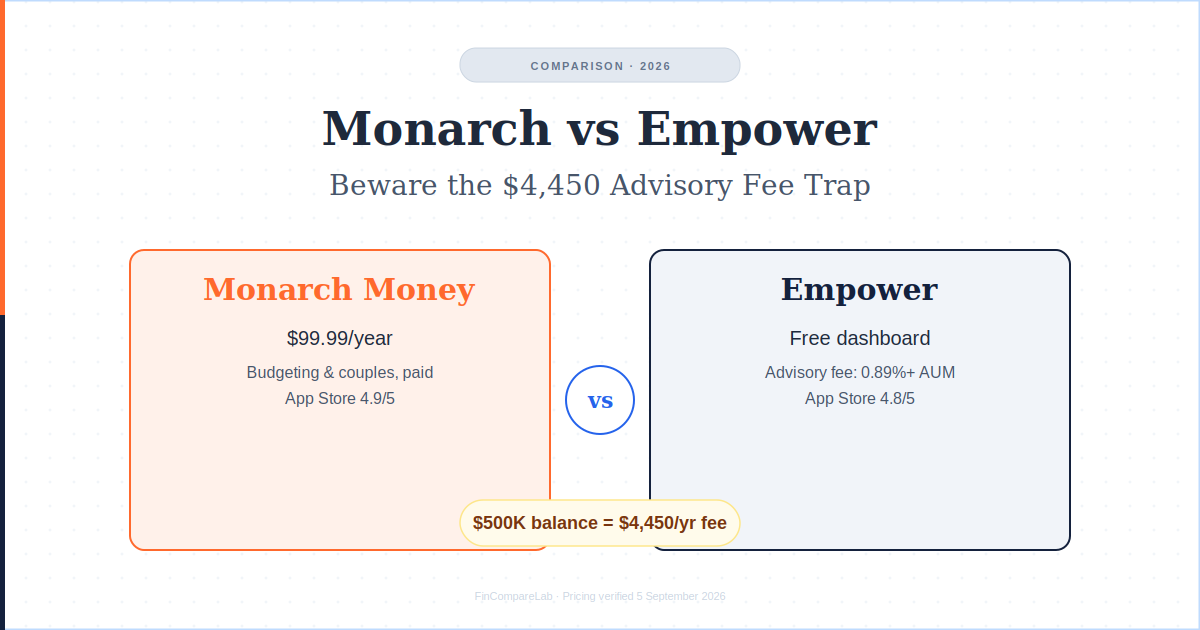
Monarch vs Empower comes down to a single question worth asking before you link a single account: are you paying with dollars, or are you paying with your data and a future advisory call?
⚡ Quick Verdict
Monarch Money is the stronger day-to-day budgeting and couples app at $99.99/year. Empower’s dashboard is genuinely free, but its advisory arm charges 0.89% once your linked assets cross $100,000, which is exactly how a “free” app can end up costing $4,450 a year on a $500,000 balance. Which one wins depends on what you’re actually trying to solve.
App Store: ⭐ 4.9/5 (100,000+ ratings)
Price: $99.99/yr ($14.99/mo)
Trial: 7 days, card required
App Store: ⭐ 4.8/5 (410,000+ ratings)
Price: Free dashboard; advisory optional at 0.89%+ AUM
Trial: none needed, free forever
How We Review Apps · Pricing verified from monarch.com and empower.com — 5 September 2026 · How We Review Apps →
Contents
- What’s the Quick Verdict on Monarch vs Empower?
- What Do Monarch and Empower Actually Cost in 2026?
- How Does Empower’s $4,450 Advisory Fee Actually Work?
- Which App Wins for Budgeting and Couples?
- Which App Wins for Investment Tracking and Retirement Planning?
- How Reliable Is Bank Syncing for Each App?
- What Changed After Empower’s 2026 App Consolidation?
- What Do Real Users Say About Each App?
- Can You Use Both Apps Together?
- Which App Should You Choose?
- What Do People Ask About Monarch vs Empower?
What’s the Quick Verdict on Monarch vs Empower?
Monarch vs Empower isn’t really a budgeting-app-vs-budgeting-app fight, and empower vs monarch searches tend to assume it is. Monarch is a paid, budgeting-first platform built for daily money decisions. Empower is a free, investment-first dashboard built by a wealth management firm that makes money somewhere else entirely.
Monarch Money costs $99.99/year and is built for daily budgeting, spending control, and couples’ shared finances. Empower’s dashboard costs $0, but its advisory arm charges 0.89% of assets under management once you link $100,000 or more, which works out to $4,450/year on a $500,000 balance. Choose based on the job you need done, not the sticker price alone.
If you want a system that actively changes how you spend day to day, Monarch is the better fit, and its full Monarch Money review goes deeper on the budgeting workflow itself.
If you mainly want a free snapshot of your net worth and investment mix, and you can tolerate one advisory phone call, Empower earns its place, and empower vs monarch narrows down to that single tradeoff more often than not. My own Empower review covers what that phone call actually sounds like.
What Do Monarch and Empower Actually Cost in 2026?
Monarch Money’s Core plan is $99.99/year ($14.99/month if billed monthly), confirmed live on monarch.com. Empower’s dashboard, budgeting tools, and retirement planner cost nothing at any balance. The real cost only shows up if you enroll in Empower’s advisory service, which is a separate, optional decision from using the free software.
Anyone researching monarch money vs empower pricing should start here, since the sticker prices alone don’t tell the full story. Monarch’s Core plan runs $99.99/year, or $14.99/month if you’d rather not commit annually, confirmed directly against monarch.com/pricing this week. A Plus tier runs $199.99/year, billed annually only, and adds retirement modeling, small-business tracking, and advanced investment analysis that most everyday budgeters genuinely don’t need.
The WELCOME code still applies roughly 30% off a first-year Core signup made directly on monarch.com, not through the App Store or Google Play. Anyone chasing a bigger discount code circulating on coupon sites should know those haven’t held up under verification.
Empower’s dashboard, cash flow view, budgeting tools, and retirement planner cost nothing, no matter how much you have invested. There’s no free-tier ceiling and no feature locked behind a paywall inside the software itself. That part of Empower’s pitch is completely true, and it’s the half of monarch vs empower that most competitor roundups get right.
Is Empower Really Free?
Yes, the dashboard itself is genuinely free, confirmed directly on Empower’s own FAQ: “the dashboard experience and financial tools are completely free.” The part that isn’t free is optional: Empower’s advisory service, which most users never enroll in, but which exists specifically to convert dashboard users into paying wealth-management clients.
Anyone comparing monarch vs empower on price alone is only seeing half the picture. The next section walks through exactly where that second half kicks in, and it’s the part most quick comparisons skip.
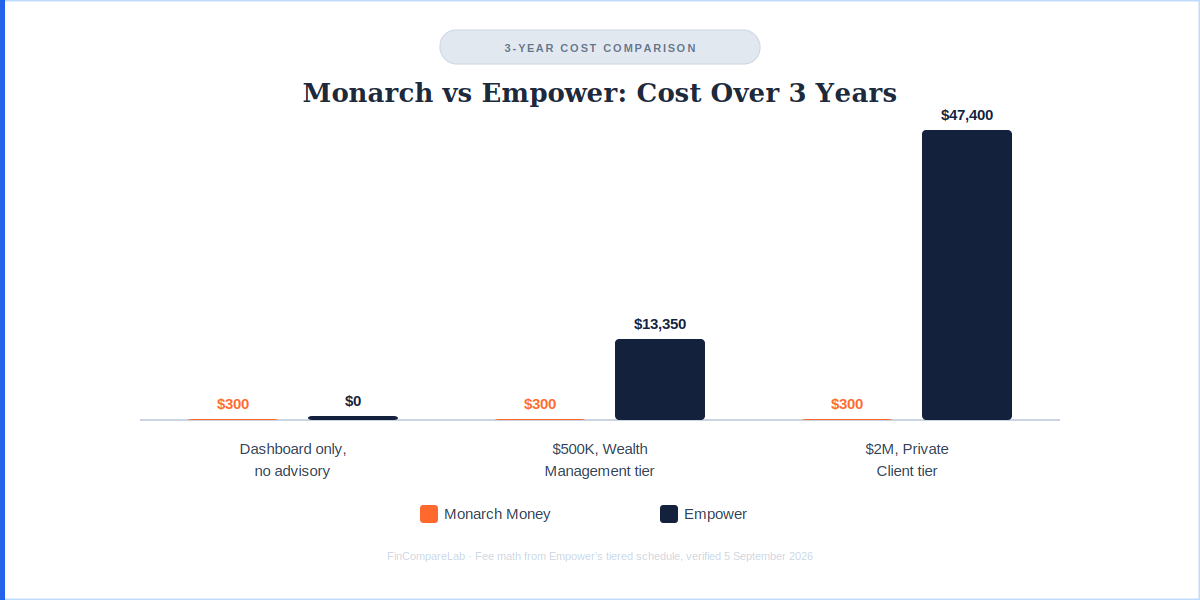
| Cost over 3 years | Monarch Money | Empower |
|---|---|---|
| Dashboard only, no advisory enrolled | $299.97 (3 × $99.99/yr Core) | $0 |
| $500,000 invested, Wealth Management tier enrolled | $299.97 (advisory not offered) | ~$13,350 (0.89%/yr × 3 years) |
| $2,000,000 invested, Private Client tier enrolled | $299.97 (advisory not offered) | ~$47,400 (0.79%/yr × 3 years) |
Pricing verified live from monarch.com and empower.com, 5 September 2026. Advisory fee math uses Empower’s published tiered rate schedule; enrollment is never required to use the free dashboard.
How Does Empower’s $4,450 Advisory Fee Actually Work?
Empower’s advisory fee is tiered, not flat, the part most monarch vs empower comparisons get wrong. Accounts between $100,000 and $999,999 pay 0.89% annually. Private Client, requiring $1 million minimum, starts at 0.79% on the first $3 million and steps down from there. On $500,000, 0.89% works out to exactly $4,450 a year.
Empower’s dashboard is genuinely free, there’s no hidden subscription waiting to appear later. The company makes money differently: it’s a registered investment adviser, and the free dashboard exists to identify users worth calling about paid wealth management. Boiled down, empower vs monarch money is really a question of who profits from your finances, an advisory fee that scales with your assets, or a flat subscription that doesn’t.
Here’s the exact empower fee schedule, confirmed live against Empower’s own Personal Strategy page this week, and it’s more nuanced than a single blended rate:
| Client tier | Assets | Annual advisory fee |
|---|---|---|
| Investment Services | $100,000–$249,999 | 0.89% |
| Wealth Management | $250,000–$999,999 | 0.89% |
| Private Client | First $3 million | 0.79% |
| Private Client | Next $2 million ($3M–$5M) | 0.69% |
| Private Client | Next $5 million ($5M–$10M) | 0.59% |
| Private Client | Above $10 million | 0.49% |
| Family tiered billing | Combined family assets | 0.79% |
Fee schedule verified live from empower.com/products-solutions/personal-strategy, 5 September 2026. Private Client requires a $1 million minimum, so those clients start at 0.79%, not the 0.89% rate that applies below that tier.
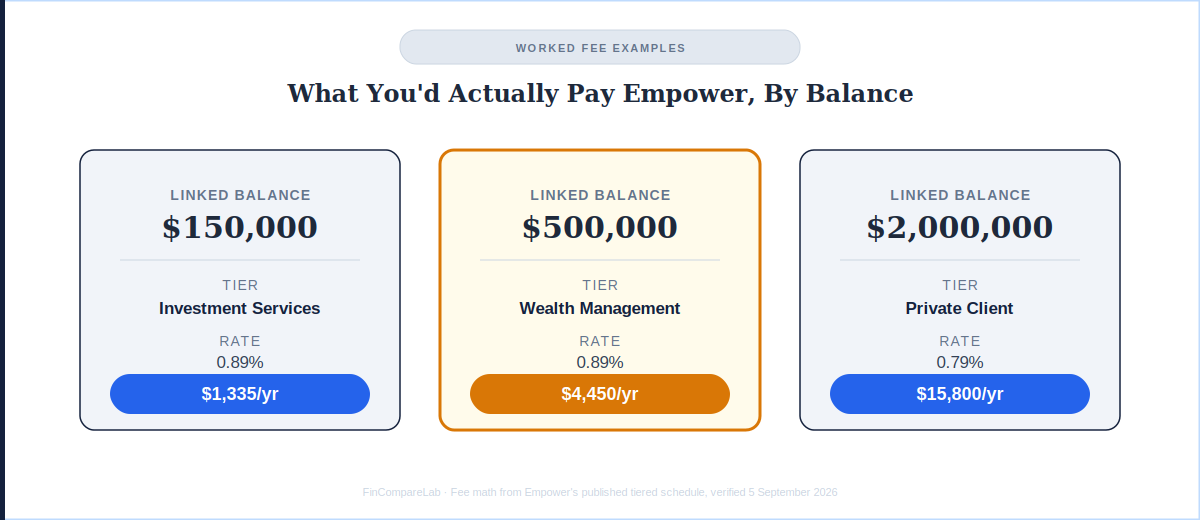
The nuance worth sitting with: Private Client isn’t just a nicer version of the same 0.89% rate applied to a bigger number. Because the minimum to even qualify is $1 million, Private Client accounts skip the 0.89% tier entirely and start at 0.79% on day one.
A blended-average description of “0.89% on the first million, stepping down after that” undersells how much better the effective rate gets once someone actually qualifies for Private Client.
Will Empower’s Advisors Keep Calling Me?
Some users report occasional advisory calls once their linked balance crosses roughly $100,000, particularly around account anniversaries. It’s not universal, and declining doesn’t remove dashboard access, but it’s a documented, commonly reported pattern rather than a rare edge case.
Community discussion on Bogleheads describes a consistent shape to this: some people decline once and hear nothing further, while others field repeat outreach over several years. The free dashboard is the mechanism that gets you the phone call, and nobody at Empower pretends otherwise once you read past the marketing page. It’s the detail every monarch vs empower comparison should lead with, not bury in a footnote.
None of this makes Empower a bad product. The dashboard, fee analyzer, and retirement planner remain genuinely useful whether or not you ever take the advisory call.
Weighing Monarch vs Empower on this point just means staying clear-eyed that “free” describes the software, not the underlying business model, a distinction the Monarch Money safety and privacy guide covers from the opposite angle, since Monarch’s business model is the mirror image of Empower’s.
Which App Wins for Budgeting and Couples?
Monarch built its reputation on budgeting, and daily use makes that obvious fast. For anyone weighing empower vs monarch money purely on day-to-day spending control, this section settles it quickly. Category-based budgets, recurring transaction detection, cash flow analysis, and visual goal tracking are first-class features here, not add-ons bolted onto an investment tool.
I used YNAB from 2011 through earlier this year, and the reason I finally switched to Monarch wasn’t dissatisfaction with zero-based budgeting itself. It was that my finances had gotten more complex than a strict envelope system could track well. I needed a real net worth view, cash flow forecasting, and investment tracking sitting next to my budget, not in a separate spreadsheet.
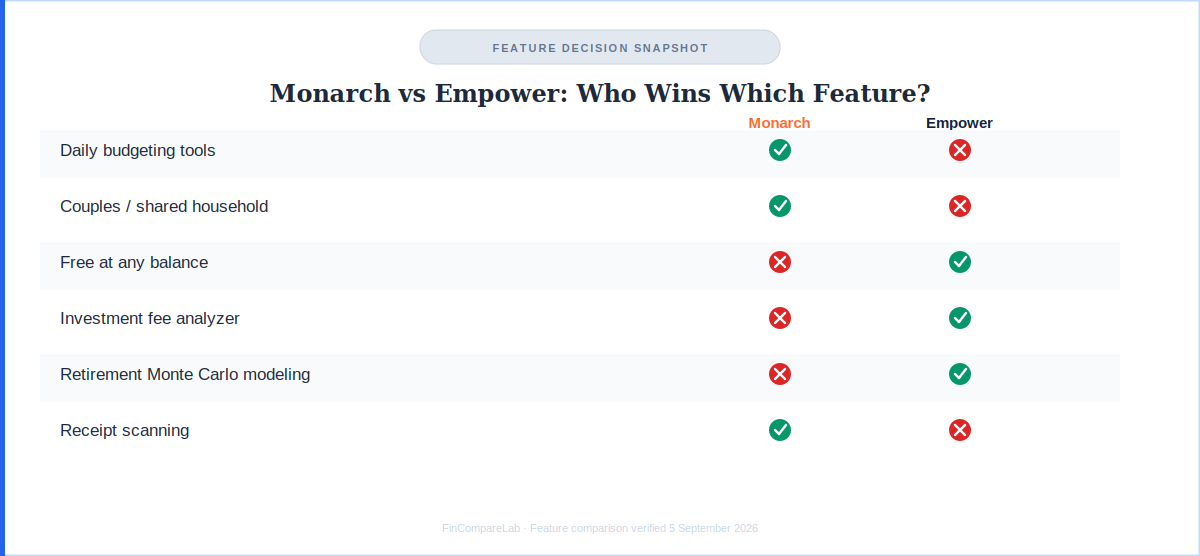
Monarch’s receipt scanning and its browser extension for auto-splitting shared purchases turned out to be the two features that actually stuck, months after the initial switch. Empower could have covered the investment-tracking half of that need for free, but it couldn’t have replaced the budgeting half at all.
That’s the practical reason someone in my exact situation ends up paying for Monarch rather than stacking two free tools.
Couples budgeting is where Monarch pulls further ahead. Shared household access lets both partners see the same accounts, label spending as “Yours,” “Mine,” or “Ours,” and avoid the classic argument over one unexplained charge on a joint card.
Empower is built around a single investor’s view. A partner can log into the same account, but there’s no real second seat and no shared-labeling system, a gap Monarch’s comparison against Copilot covers in more depth. For couples specifically, empower vs monarch isn’t a close call.
Which App Wins for Investment Tracking and Retirement Planning?
For investment tracking specifically, monarch money vs empower isn’t close. Empower’s investment tools go deeper than Monarch’s in almost every direction that matters for a long-term investor. The fee analyzer scans your linked 401(k) and IRA holdings and flags fund expense ratios quietly eating into returns, a feature Monarch doesn’t offer at all, free or paid.
The retirement planner runs scenario-based projections against your actual linked accounts, income, and savings rate, rather than asking you to estimate everything by hand. If fee analysis and retirement modeling are the reason you’re comparing apps in the first place, Empower’s free tools outperform Monarch’s Plus tier, which treats retirement forecasting as a $199.99/year add-on rather than a core feature.
Does Monarch Track Investments as Well as Empower?
Not quite, and it isn’t trying to. Monarch tracks investment balances and folds them into your overall net worth view, but it stops short of Empower’s fee analyzer or Monte Carlo-style retirement modeling. On this point, monarch money vs empower isn’t a close call either.
For someone who mainly wants to see all their accounts in one place, Monarch’s investment view is plenty. For someone actively managing asset allocation or stress-testing a retirement date, Empower’s free tools go further than anything in Monarch’s lineup, including the Plus tier’s advanced analysis add-ons.
Both apps run on iOS, Android, and web, so platform access isn’t the deciding factor either way. The real gap is depth: Empower was built by a wealth management firm around the investment side of the ledger first, and it shows in how far its portfolio and retirement tools go compared with Monarch’s investment tracking.
Monarch’s investment view functions more like a net-worth summary than a full analysis tool. If long-term investment depth is the whole reason you’re shopping, FinCompareLab’s best net worth tracking apps roundup covers a few more free options worth knowing about beyond just these two.
How Reliable Is Bank Syncing for Each App?
Empower vs Monarch also comes down to plumbing most people never think about until it breaks: which company handles the connection between your bank and the app. Neither talks to your bank directly; both rely on third-party data aggregators to pull balances and transactions, a detail that matters as much as anything else in this monarch vs empower comparison.
Monarch uses a mix of aggregator providers and lets you manually swap the connection method for a specific account if one link is acting up, a troubleshooting option Empower doesn’t expose to users the same way. Details on Monarch’s supported connections are listed directly on monarch.com.
Empower, per its own Terms of Use, routes account aggregation through Yodlee’s Fastlink platform, an Envestnet company subject to federal banking-agency oversight. On this specific point, monarch vs empower is closer to a wash than either company’s marketing suggests.
Community reports on Bogleheads describe more frequent manual re-authentication with smaller credit unions and regional brokerages on both platforms. It’s a pattern worth expecting rather than being surprised by if you’re moving from a different budgeting app entirely.
Neither sync setup is inherently unsafe; both are read-only, meaning the aggregator can view balances and transactions but can’t move money or place trades. The practical difference is friction, not risk: expect the occasional re-link no matter which app you pick.
What Changed After Empower’s 2026 App Consolidation?
Empower folded its standalone Personal Dashboard app into one unified Empower app that also serves 401(k), IRA, and HSA plan participants, a change most monarch vs empower comparisons haven’t caught up with yet.
The old standalone listing is gone entirely. The merged app now carries a 4.8/5 rating from over 410,000 App Store reviews, while Google Play currently shows no aggregate rating at all, consistent with a post-merger reset rather than a fetch error.
This is a genuinely new wrinkle worth knowing before you download anything. If you have a workplace 401(k) serviced by Empower as well as a personal Empower dashboard, both now live inside the same app.
Multiple dated App Store reviews describe real friction from that merge: some long-time Personal Dashboard users were redirected to their employer retirement account by default on first login, with no obvious flag prompting them to switch back to their personal credentials. A separate, recurring complaint centers on font size in the redesigned interface, noticeably smaller than the old app and below what several reviewers consider standard accessibility sizing.
None of this is a dealbreaker, and the underlying dashboard functionality hasn’t changed. But if you already use Empower through an employer plan, budget an extra few minutes the first time you log into the new unified app, since the default landing screen may not be the one you’re expecting. It’s a detail most monarch vs empower comparisons miss entirely, since it has nothing to do with Monarch at all.
What Do Real Users Say About Each App?
Community sentiment on Empower is genuinely mixed, and the timing matters. The 2026 app consolidation caused real login confusion for a number of long-time users, and some of that frustration showed up publicly as people switching to alternatives, Monarch included, while working through the transition. This is exactly the kind of real-world friction an empower vs monarch money comparison based only on marketing pages would miss entirely.
Bogleheads forum discussion around Empower’s advisory arm is consistent on one point: the free dashboard itself is well-regarded, but the AUM fee structure and sales outreach are the most commonly cited reasons people decline to convert into paying clients. That’s a very different complaint from app-quality issues, and it’s worth separating the two when you’re reading other reviews online.
Monarch’s community reception centers more on interface polish and the couples experience than on any comparable business-model complaint, since its revenue comes directly from the subscription rather than a downstream advisory pitch. That distinction is the real story behind monarch money vs empower once you look past the feature lists.
If Monarch’s day-to-day polish is the deciding factor for you, the Monarch Money pricing breakdown walks through exactly which tier makes sense for different household setups.
Can You Use Both Apps Together?
Yes, and for a specific type of user, this is genuinely the right answer to monarch vs empower rather than a compromise. Empower’s free dashboard can stay dedicated to investment tracking, fee analysis, and retirement projections, while Monarch handles day-to-day budgeting and couples’ shared spending.
The tradeoff is maintenance: you’re linking accounts twice and checking two apps instead of one. For someone who wants free investment depth alongside paid budgeting polish, and doesn’t mind the extra setup, running both isn’t unreasonable at all.
For anyone who wants a single app and a single login, picking one tool based on your primary goal is the simpler path, the same logic covered in FinCompareLab’s YNAB vs Empower comparison for people weighing a stricter budgeting method against Empower’s free tools.
In practice, the split works best when it’s deliberate rather than accidental. Link your brokerage, 401(k), and retirement accounts in Empower and leave them there, then use Monarch exclusively for checking accounts, credit cards, and shared household spending. Splitting the same account across both apps in a monarch vs empower setup just doubles the sync headaches from the bank-syncing section above, without adding any real benefit.
Which App Should You Choose?
The honest answer to monarch vs empower depends on which problem you’re actually trying to solve: daily spending discipline, long-term investment visibility, or both at once. If you’re still undecided on monarch vs empower after reading this far, the decision boxes below should settle it, and they’re built to work whichever direction you searched, monarch vs empower or empower vs monarch.
Still weighing your options against other apps on the market? Best Monarch Money alternatives and best Empower alternatives both cover ground this comparison doesn’t.
FinCompareLab’s broader personal finance software roundup is a good next stop if neither app ends up being the right fit. If debt payoff, not just tracking, is part of your goal this year, the free Debt Payoff Estimator is worth running alongside whichever app you pick.
One more note on the ratings above: Empower’s 4.8/5 reflects the newly unified app as of this week, and Monarch’s 4.9/5 reflects the same live verification pass as its pricing.
Ratings shift as new reviews come in, so if you’re reading this well after publication on either monarch vs empower or empower vs monarch, a quick check on the App Store or Google Play listing directly is worth doing before treating either number as current.
What Do People Ask About Monarch vs Empower?
These are the questions that come up most once someone has read the full monarch vs empower comparison and is down to specifics: couples access, cancellation, data safety, and what changed with Empower’s rating this year.
Which App Is Better for Couples?
Monarch Money. Its shared household access, “Yours/Mine/Ours” account labeling, and free partner seat were built for two people managing money together. Empower’s tools assume a single investor, and adding a spouse means sharing one login rather than getting a real second seat.
What Happens to Your Data If You Cancel Monarch or Empower?
Monarch retains your data for 30 days after cancellation, giving you time to export via CSV or resubscribe without losing history. Empower’s privacy policy states it generally deletes account data within 30 days of closure too, aside from records it must keep for legal or fraud-prevention reasons. Neither app keeps your data indefinitely once you’ve actually closed the account.
Is My Data Safe With Either App?
Both use bank-level encryption and read-only account access, so neither app can move your money or place trades on its own. The real difference is business model, not security: Monarch’s revenue comes from your subscription, while Empower’s free tier exists partly to identify prospects for its advisory arm. Neither setup is unsafe, but the incentives behind each one are different.
Can I Use Empower Without Ever Getting a Sales Call?
Mostly, yes, and this is one of the most-searched empower vs monarch money concerns for a reason. Empower’s dashboard itself never requires a call, and plenty of users link accounts well under $100,000 and never hear from an advisor. Once your linked balance crosses into the $100,000 to $249,999 range, though, expect at least one outreach attempt, even if you never respond to it.
Does Monarch Money Have a Free Trial?
Yes, 7 days, but a payment method is required upfront and Monarch will bill you automatically once the trial ends unless you cancel first. That’s a real difference from apps like YNAB, which don’t ask for a card until you decide to keep using the product.
What’s the Cheapest Way to Test-Drive Both Apps?
Start with Empower, since it costs nothing and you can walk away the moment a sales call feels like too much. Once you know whether you actually want daily budgeting on top of that investment view, use Monarch’s 7-day trial deliberately, calendar a cancellation reminder for day 6, and decide with real data from your own accounts rather than a demo.
Is Monarch or Empower Better After the Mint Shutdown?
It depends on which half of Mint you actually used, and this is one of the most common empower vs monarch questions since Mint shut down. If Mint was your budgeting tool, Monarch is the closer replacement. If Mint was mostly how you checked your net worth and investment mix, Empower’s free dashboard covers that same ground without a subscription.
Why Did Empower’s App Ratings Change in 2026?
Empower folded its standalone Personal Dashboard app into one unified Empower app that also serves 401(k) and retirement-plan participants. The merged app now shows 4.8 out of 5 from over 410,000 ratings on the Apple App Store, while the Google Play listing shows no aggregate rating yet, consistent with a rating reset after the consolidation rather than a data error.
📚 Read Next
