
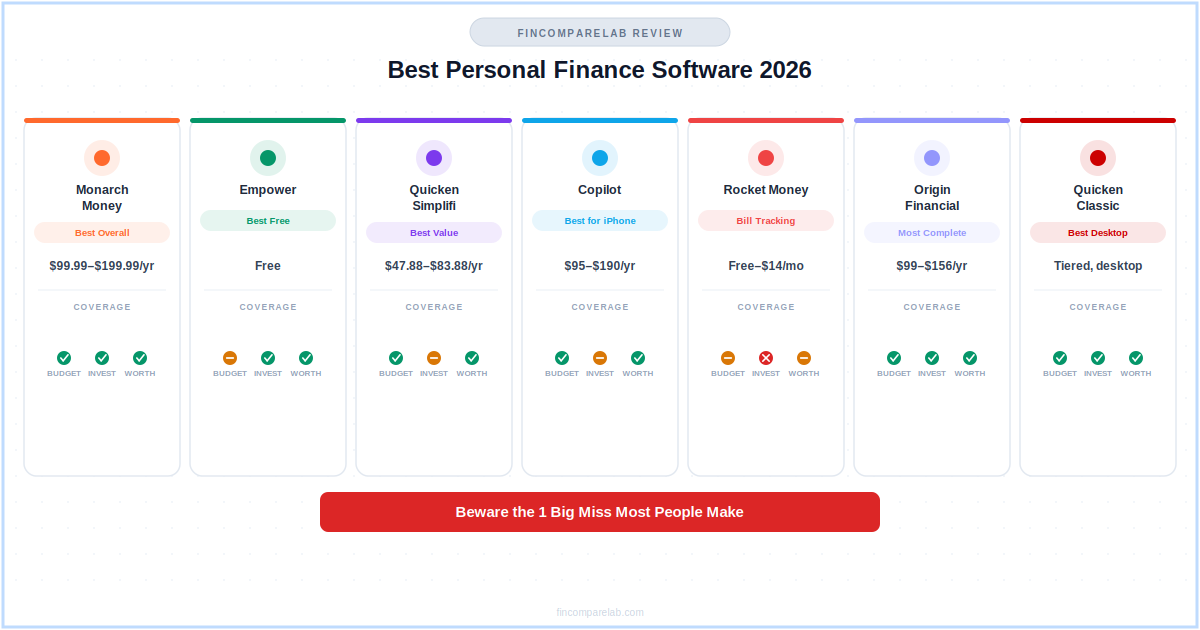
Best personal finance software in 2026 isn’t just another budgeting app roundup — it’s about finding the tool that keeps up once your money gets more complicated than a grocery budget.
⚡ Quick Verdict
Monarch Money is the best all-around personal finance software for most people in 2026 because it handles budgeting, investing, and net worth in one dashboard. If you want something free, Empower covers investment tracking at no cost.
If you’re deciding between a budgeting app and full personal finance software, the difference usually comes down to whether you want to see your net worth in the same place you track your spending.
How We Review Apps · Pricing verified from official app websites — 25 July 2026
Table of Contents
- What Is the Best Personal Finance Software in 2026?
- Why Do Most People Pick the Wrong Personal Finance Software?
- Which Tools Should You Consider?
- How Do These Personal Finance Software Options Compare on Price and Features?
- How Reliable Is Bank Syncing Across These Apps?
- What Does This Software Actually Cost Over 3 Years?
- Which Tool Fits Your Situation?
- What Do Reddit Users Recommend?
- What Are the Most Common Criticisms of This Software Category?
- How Does Customer Support Compare Across These Tools?
- What Should You Do Before Switching Personal Finance Software?
- Frequently Asked: What Else Should You Know?
What Is the Best Personal Finance Software in 2026?
Monarch Money is the best personal finance software overall in 2026 for people who want budgeting, investment tracking, and net worth in one dashboard. Empower is the best free option if investing is your main focus. Quicken Simplifi and Copilot are strong picks if you want lighter, faster daily-use apps.
That’s the short answer. The longer answer depends on what that category actually means for you — and that’s exactly where most people get tripped up.
Why Do Most People Pick the Wrong Personal Finance Software?
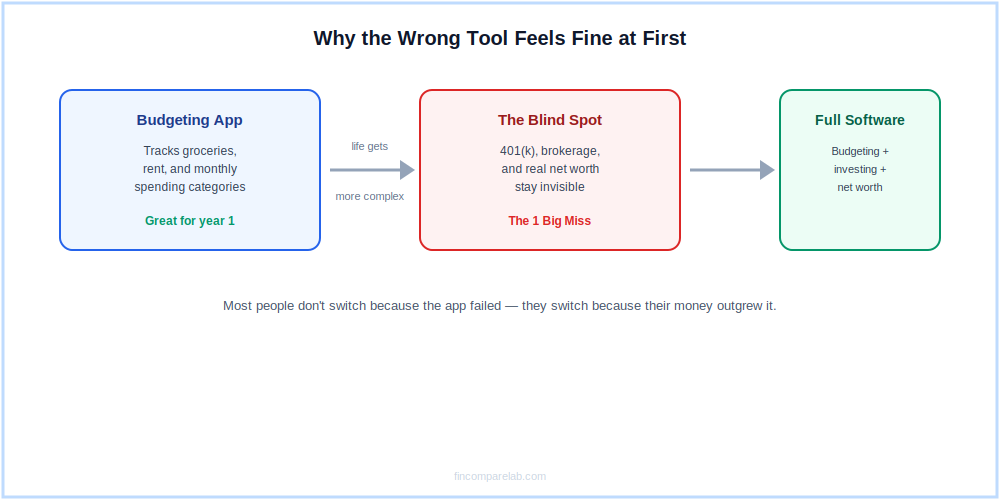
I see this pattern constantly: someone downloads a budgeting app, gets good at tracking groceries and rent, and then six months later realizes they have no idea what their retirement accounts are actually worth. That’s the miss. A budgeting app and personal finance software solve different problems, and most people don’t realize they’ve outgrown the first one until they need the second.
Budgeting apps like YNAB, EveryDollar, and Goodbudget are built around one job: giving every dollar of income a category before you spend it. That’s genuinely useful, especially early on — first job, first apartment, first time actually seeing where your paycheck goes.
But once you’re contributing to a 401(k), holding a brokerage account, or trying to figure out your actual net worth, a pure budgeting app usually can’t show you the full picture.
Personal finance software, by contrast, is built to pull your checking, savings, credit cards, loans, and investment accounts into a single dashboard. You get a real net worth number, not just a monthly spending category.
Some tools, like Monarch and Origin, do both jobs in one app. Others, like Empower, lean almost entirely into the investment side and skip granular budgeting altogether. See my best net worth tracking apps roundup if that’s your main priority.
The mistake isn’t choosing a budgeting app in the first place — it’s staying with one after your financial picture has outgrown it, simply because switching feels like a hassle. If you’re reading this because you’ve hit that wall, you’re not behind. You’re just at the point where the right tool changes.
Which Tools Should You Consider?
Here are the seven tools worth considering in 2026, based on what each one actually does best.
Is Monarch Money the Best Personal Finance Software for Most People?
Monarch Money is the best personal finance software for most people because it combines budgeting, investment tracking, and net worth in a single ad-free dashboard. Core plans run $99.99/year or $14.99/month, with a Plus tier at $199.99/year for households that want deeper collaboration features. Monarch works well for couples who want to see joint and individual accounts side by side without juggling two separate apps.
Read my full Monarch Money review or check current plans at monarch.com.
Is Empower the Best Free Option?
Empower is free forever and remains the strongest no-cost option for tracking investments and net worth. Its Retirement Planner and fee analyzer tools are genuinely useful if you’re trying to understand what your 401(k) is actually costing you in hidden fees. Empower leans light on day-to-day budgeting, so if categorizing your grocery spending matters to you, pair it with a dedicated budgeting app or consider Monarch instead.
See my full Empower review for the details on its wealth management tiers.
Is Quicken Simplifi Good Personal Finance Software for Beginners?
Quicken Simplifi is good personal finance software for people who want something simpler than Monarch but more complete than a pure budgeting app. It’s currently $3.99/month on a new-subscriber promo ($47.88/year), with a standard rate of $6.99/month after that. Simplifi’s Spending Plan and Projected Cash Flow features make it a strong pick if you want to see where your money is headed, not just where it’s been.
My full Quicken Simplifi review covers the current promo pricing in more depth.
Is Copilot the Best Option for iPhone Users?
Copilot is $95/year or $13/month and is iOS and Mac only — there’s no Android version. Its design and AI-driven spending insights are the main draw, and it’s a favorite among people who want something that feels less like a spreadsheet and more like a modern app. Couples should budget for two separate subscriptions ($190/year combined), since Copilot doesn’t currently support a shared household plan.
Check my Copilot review or the current plans at copilot.money.
Is Rocket Money More Than a Bill Tracker?
Rocket Money is free to use, with a Premium tier running $7–$14/month. It started as a subscription-cancellation tool and has expanded into budgeting and net worth tracking, but its core strength is still finding and negotiating recurring bills. Its bill-negotiation fee (35–60% of whatever it saves you) applies even on the free tier, so read the fine print before you let it auto-negotiate anything.
My Rocket Money review breaks down the fee math in detail.
Is Origin Financial the Most Comprehensive Option?
Origin Financial is the most comprehensive option on this list, combining budgeting, investing, tax help, and estate-planning documents in one subscription. It’s $12.99/month or $99/year, with a current promo dropping the first year to $1 for new users. If you want a single tool that also helps with your will or a CFP consultation, Origin is the only one here that covers that ground.
Details are in my Origin Financial review, or check the current promo at useorigin.com.
Is Quicken Classic Still Worth It as a Desktop Tool?
Quicken Classic is the pick for people who specifically want a desktop-first tool rather than a cloud-based app. It’s the oldest name on this list, and its four-tier pricing currently includes a 40%-off first-year promo that expires August 9, 2026 — but renewal rates jump roughly 67% higher in year two, so check the sticker price before you commit. My Quicken Classic review has the full tier breakdown.
How Do These Personal Finance Software Options Compare on Price and Features?
Pricing and feature depth vary more than most people expect across this category. Here’s how the seven stack up side by side.
| App | Price | Budgeting | Investing | Net Worth |
|---|---|---|---|---|
| Monarch Money | $99.99–$199.99/yr | ✅ | ✅ | ✅ |
| Empower | Free | ⚠️ Limited | ✅ | ✅ |
| Quicken Simplifi | $47.88–$83.88/yr | ✅ | ⚠️ Basic | ✅ |
| Copilot | $95–$190/yr | ✅ | ⚠️ Basic | ✅ |
| Rocket Money | Free–$14/mo | ⚠️ Limited | ❌ | ⚠️ Limited |
| Origin Financial | $99–$156/yr | ✅ | ✅ | ✅ |
| Quicken Classic | Tiered, desktop | ✅ | ✅ | ✅ |
Pricing verified from official websites — July 2026.
How Reliable Is Bank Syncing Across These Apps?
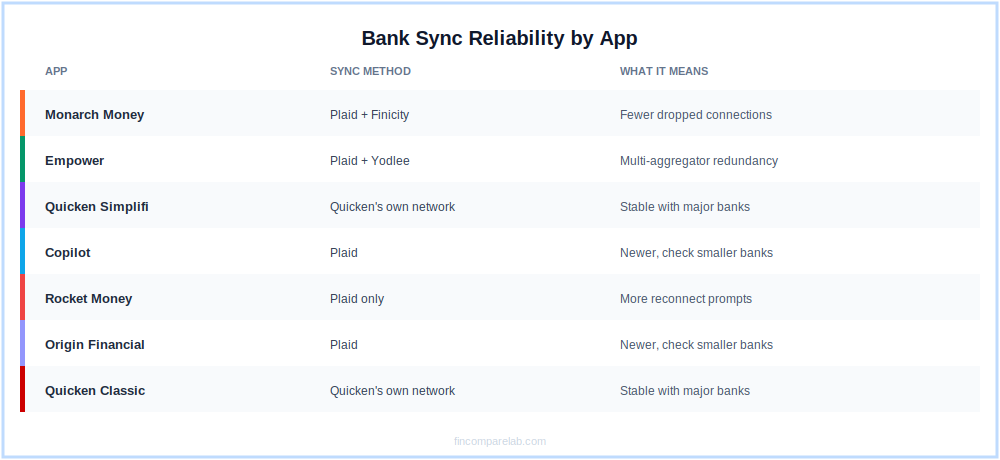
Bank syncing is where a lot of these tools quietly fall short, and it’s worth checking before you commit to an annual plan. Monarch and Empower both connect through multiple aggregators, including Plaid and Finicity, which tends to mean fewer dropped connections than apps relying on a single provider. Rocket Money leans on Plaid alone, which can mean more frequent reconnection prompts with smaller regional banks and credit unions.
Quicken Simplifi and Quicken Classic benefit from Quicken’s long banking-partner history, which generally makes for stable syncing with major institutions. Copilot and Origin are newer entrants, so if you bank with a smaller local credit union, it’s worth checking their supported-institution list before you subscribe.
What Does This Software Actually Cost Over 3 Years?
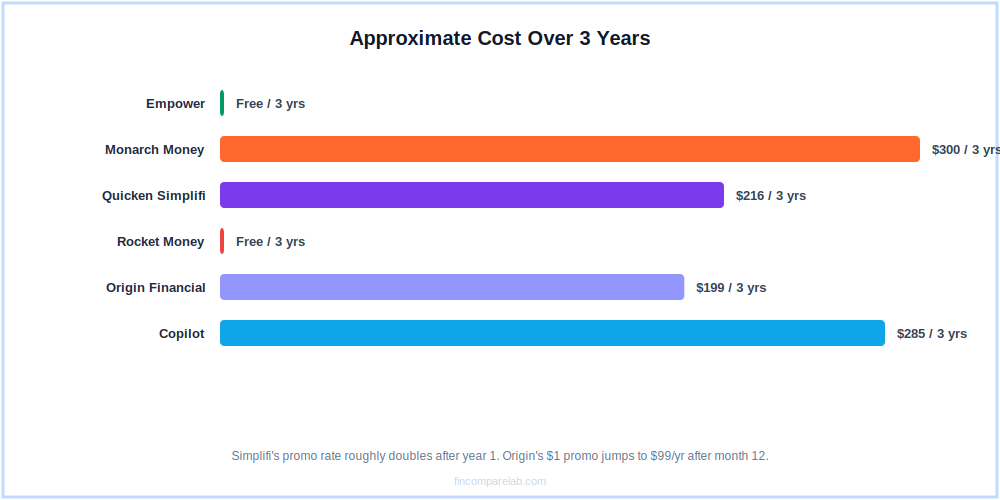
Sticker prices only tell part of the story once you factor in promo pricing that expires and renewal rates that jump. Quicken Simplifi’s promo rate roughly doubles after the first year. Quicken Classic’s 40%-off deal renews about 67% higher in year two. Origin’s $1 first-year promo jumps to the full $99/year after month twelve.
Empower stays free the whole time, which is a real advantage if you mainly want investment tracking and don’t need deep budgeting categories. Monarch’s pricing stays flat year over year unless you upgrade tiers, which makes it easier to budget for long-term.
Which Tool Fits Your Situation?
If you’re early in your career and mostly want to see net worth grow without paying anything, Empower is the easiest starting point. If you’re managing money as a couple and want shared visibility without shared logins, Monarch is built for that.
If your finances have gotten complicated enough that you’re thinking about a will or a financial advisor, Origin covers more ground than anything else on this list. And if you just want something fast and good-looking on your iPhone, Copilot fits that niche well.
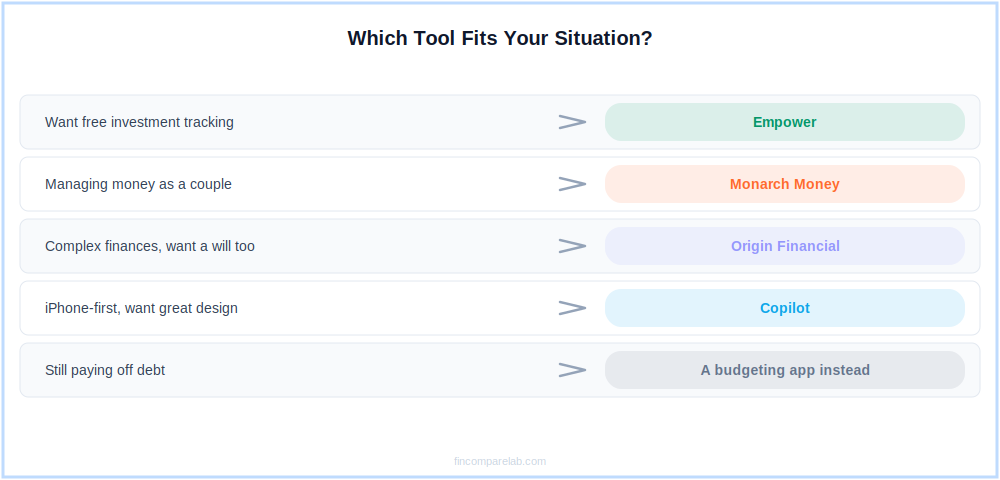
If you’re still focused on paying down debt rather than growing investments, none of these seven are actually your best starting point — a dedicated budgeting app with strong debt-payoff tools, like EveryDollar or YNAB, will serve you better until your balances are under control.
Check my best budgeting apps for debt payoff roundup instead, and come back to this list once investment tracking and net worth actually matter to your day-to-day decisions.
What Do Reddit Users Recommend?
YNAB still comes up constantly in r/personalfinance threads, but that’s specifically for budgeting — once the conversation shifts to net worth tracking or investment visibility, Monarch and Empower are the two names that keep recurring.
Community sentiment on Rocket Money is more mixed: people appreciate the subscription-cancellation feature but frequently warn newcomers about the bill-negotiation fee before they enable it. Quicken Simplifi and Origin get fewer mentions overall, but the threads that do exist tend to be positive, usually from people who switched over after Mint shut down and wanted something more complete than a basic tracker.
What Are the Most Common Criticisms of This Software Category?
Even the best-reviewed apps in this roundup have recurring complaints worth knowing about before you subscribe. Subscription fatigue is the most common one — once you’re paying for a budgeting app, a net-worth tracker, and maybe a bill-negotiation service, the combined monthly cost can quietly exceed what any single all-in-one tool would have cost.
Automatic transaction categorization is another sore spot: every tool on this list occasionally miscategorizes a purchase, and the ones with looser rule customization mean more manual cleanup on your end.
A third complaint shows up specifically around free tools: because Empower’s core dashboard is free, it also comes with periodic outreach from its wealth management advisors once your linked balances cross a certain threshold. That’s not a bug, it’s the business model, but it catches some users off guard who expected a purely self-serve experience.
How Does Customer Support Compare Across These Tools?
Support quality varies more than most people expect for software handling something as sensitive as your full financial picture. Quicken has the longest track record here, with phone support available for Classic subscribers — a rarity in this category. Monarch and Empower both rely on email support backed by active user communities and help-center documentation, which tends to be fast for common issues but slower for anything account-specific.
Copilot and Origin, as newer entrants, currently support users through in-app chat rather than phone lines, and response times can stretch longer during peak tax season when support volume spikes across the board. Rocket Money’s support quality tends to track with your plan tier — Premium subscribers report faster responses than free-tier users.
What Should You Do Before Switching Personal Finance Software?
Switching is easier if you plan the handoff instead of doing it cold. Export at least a year of transaction history from your current app before you cancel anything — most budgeting apps make this harder to do after you’ve closed the account than while it’s still active.
Keep both tools running for a full billing cycle if you can afford the overlap, so you can confirm the new software is categorizing things the way you expect before your old data becomes unreachable.
Timing matters too. Avoid switching in the last few weeks of the year if net worth tracking or tax prep is part of why you’re making the change — most of these tools handle historical data imports better at the start of a new tax year than mid-cycle.
And if you’re moving from a spreadsheet rather than another app, budget extra time for manually entering opening balances, since automatic imports only work between supported software.
Frequently Asked: What Else Should You Know About Personal Finance Software?
Here are quick answers to the questions I hear most often about choosing and switching personal finance software.
What Is the Best Free Personal Finance Software?
Empower is the best free personal finance software in 2026 if your priority is investment tracking and net worth visibility. It doesn’t charge for its core dashboard, though it does offer optional paid wealth management for larger portfolios.
What Makes Good Personal Finance Software Different From a Budgeting App?
Good personal finance software pulls together your full financial picture — checking, savings, credit, loans, and investments — into one net worth view, rather than just tracking monthly spending categories the way a pure budgeting app does.
What Is the Best Rated Personal Finance Software Overall?
Monarch Money is the best rated personal finance software overall on FinCompareLab, based on how completely it covers budgeting, investing, and net worth tracking in a single dashboard.
What Are the Top Personal Finance Software Picks for Investors?
The top personal finance software picks for investors are Empower and Monarch Money, since both surface portfolio performance and fee analysis alongside net worth tracking.
Can You Use More Than One Tool at Once?
Yes. Plenty of people pair a dedicated budgeting app like YNAB with a net-worth-focused tool like Empower, using each for what it does best rather than expecting one app to do everything.
Is It Safe to Connect These Tools to My Bank Accounts?
The apps on this list connect through established aggregators like Plaid and Finicity, which use read-only, encrypted connections rather than storing your banking credentials directly. That said, always confirm two-factor authentication is enabled on your bank account itself.
Does This Software Work for Self-Employed Income?
Yes, though some tools handle irregular income more gracefully than others. If your income varies month to month, prioritize software with flexible budget categories over rigid monthly targets.
Do I Need This If I Already Use a Budgeting App?
Not necessarily — it depends on whether you need to see investments and net worth in the same place you track spending. If a budgeting app is covering everything you need, there’s no reason to add another subscription.
How Often Should I Check My Dashboard?
Once a week is usually enough to catch spending drift or a missed bill, with a deeper monthly check-in for net worth trends and investment performance.
What Happens to My Data If I Cancel My Subscription?
Most of these tools retain your data for a limited window after cancellation, typically 30 days, before deleting it. Export your transaction history and net worth reports before you cancel, since you usually can’t retrieve them afterward once that window closes.
Choosing the right tool isn’t about finding the one with the most features — it’s about matching the tool to where your money actually is right now. If a pure budgeting app still covers everything you need, there’s no rush to switch. But if you’ve been quietly wondering what your accounts add up to, that’s usually the sign it’s time to look at something built to show you.
