
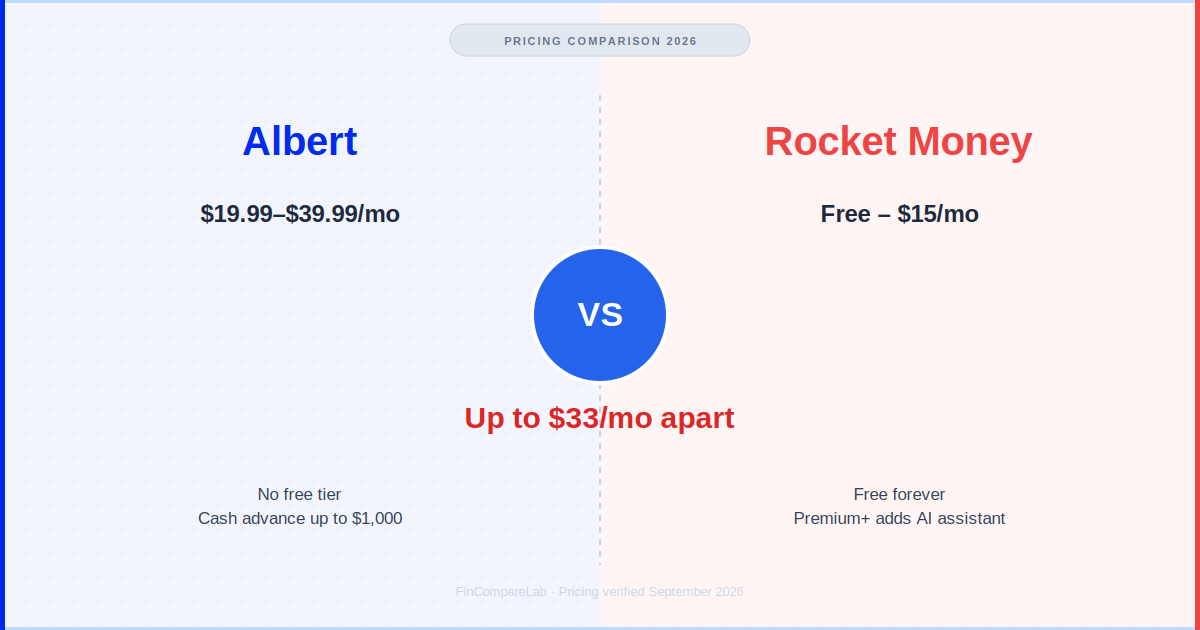
Albert vs Rocket Money comes down to one blunt fact: Albert has no free plan at all, while Rocket Money is free forever, and if you land on Albert’s top tier while sitting on Rocket Money’s cheapest Premium price, the gap between them can hit $33 a month.
I checked Albert vs Rocket Money pricing straight from help.albert.com and rocketmoney.com, dug into how Rocket Money’s newer Premium+ tier changes the math, and pulled Trustpilot and Better Business Bureau complaints to see where the overpay risk is real and where it’s overblown. If you’re deciding between the two, or wondering whether you need both, this breaks down exactly where your money goes with each one.
⚡ Quick Verdict
Albert is a paid all-in-one app (banking, savings, investing, cash advance) with zero free tier. Standard runs $19.99/mo, Genius or Family jumps to $39.99/mo. Rocket Money is free forever, with Premium at $7–$14/mo and a newer flat-rate Premium+ tier at $15/mo.
The “$33/mo” figure in this post’s title compares Albert’s $39.99 ceiling against Rocket Money’s $7 Premium floor, the widest realistic gap between the two, not a comparison against Premium+.
If you only need to track and cancel subscriptions, Rocket Money’s free plan probably covers it. If you want a cash advance, automated saving, or investing in the same app, Albert does things Rocket Money simply doesn’t, but you’ll pay for all of it, every month, no exceptions.
How We Review Apps · Pricing verified from help.albert.com and rocketmoney.com — 2 September 2026
On this page, everything you need to compare Albert vs Rocket Money:
- What’s the real price gap between Albert and Rocket Money in 2026?
- Why does Albert have no free tier at all?
- What do you get with Rocket Money’s Free, Premium, and Premium+ plans?
- Is Albert’s cash advance really better than Rocket Money’s approach?
- Which app is worse to cancel?
- Can you use both?
- Which one fits your situation?
- What’s the Albert vs Rocket Money Reddit consensus?
- How do the ratings and trust signals compare?
- Albert vs Rocket Money: What Should You Know Before You Decide?
What’s the real price gap between Albert and Rocket Money in 2026?
Albert costs $19.99–$39.99/mo with no free option, while Rocket Money is free forever with Premium at $7–$14/mo or a flat $15/mo Premium+ tier. The realistic price gap ranges from about $6/mo to as much as $33/mo, depending on which tiers you’re comparing.
Most Albert vs Rocket Money comparisons stop at “one’s free and one isn’t,” which misses the more useful question: which two tiers are you actually choosing between? And if you searched this the other way around, Rocket Money vs Albert, the numbers are identical, just flipped: only which side of the comparison table you read first changes.
See my full Albert pricing breakdown for every tier in detail.
Albert charges a fixed subscription: pick a tier, pay that exact amount every month, no flexibility. Rocket Money lets you set your own Premium price within a range and, as of this year, also offers a flat-rate Premium+ option, so two Rocket Money users can legitimately be paying different amounts for different feature sets, not just different amounts for the same thing.
Albert vs Rocket Money pricing at a glance:
| Tier | Albert | Rocket Money |
|---|---|---|
| Free tier | ❌ None | ✅ Full free tier, no time limit |
| Entry paid tier | Standard, $19.99/mo | Premium, user-picks $7 to $14/mo |
| Flat-rate upper tier | Genius / Family, $39.99/mo | Premium+, flat $15/mo |
| Trial | 30-day, no card required upfront | 7-day free trial of Premium |
| Family/sharing | Family plan covers up to 4 members, $39.99/mo total | Account sharing on Premium/Premium+, one login shared, no separate family pricing |
Pricing verified from official websites, 2 September 2026.
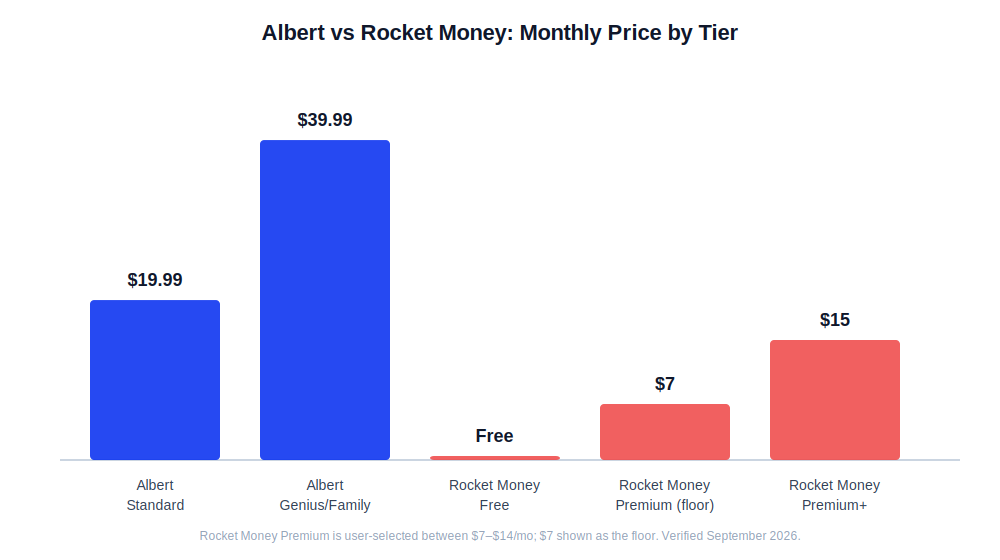
A word on that $33/mo figure: that’s Albert’s ceiling (Genius or Family at $39.99/mo) against Rocket Money Premium’s floor ($7/mo minimum), not against Premium+. If you’re weighing Albert Standard ($19.99) against Rocket Money’s flat Premium+ ($15), the realistic gap shrinks to about $5/mo. Same two apps, very different-sounding number, depending on which tiers you’d actually pick.
Why does Albert have no free tier at all?
This is the single biggest structural difference in the Albert vs Rocket Money decision. Albert used to let you poke around for free before nudging you toward Genius. That’s gone. Every meaningful feature (budgeting, savings automation, cash advance, investing) sits behind a paid subscription starting at $19.99/mo, with a 30-day trial as the only way to test it without paying.
You can download the app and look at the interface, but you can’t use it as a free budgeting tool the way you can with Rocket Money, Empower, or Honeydue.
Rocket Money takes the opposite approach in the Albert vs Rocket Money split, and it’s worth understanding exactly where the line sits rather than assuming “free” means “full.” Its free plan includes account linking, subscription detection, up to three category budgets, and basic net-income tracking, real features, not a stripped demo.
What it doesn’t include is real-time sync, net worth tracking, or the ability to actually have Rocket Money’s team cancel a subscription for you; that specific action requires Premium or Premium+. The free tier shows you what you’re paying for; it just doesn’t act on it.
What do you get with Rocket Money’s Free, Premium, and Premium+ plans?
Rocket Money premium cost breaks down three ways: Free is $0/mo with capped budgeting, Premium is a self-set $7 to $14/mo, and the newer Premium+ tier is a flat $15/mo. Each step unlocks distinct features rather than just “more” of the same, Premium+ specifically adds an AI assistant and fee-free bill negotiation that no other tier includes at any price.
Rocket Money’s three-tier structure is easy to misread as “free vs. paid,” but the real split is Free vs. Premium vs. Premium+, and each step unlocks something distinct rather than just “more.” The full breakdown, including how the Rocket Money Premium cost compares against Albert tier-by-tier, is in my Rocket Money pricing guide.
Free caps you at three budget categories and no real-time account sync. Premium ($7–$14/mo, your choice within that range) removes those caps, adds subscription-cancellation concierge service, unlimited custom categories, transaction rules, net worth tracking, and web access.
Premium+ ($15/mo flat) adds two things Premium doesn’t have at any price: Rowan, an AI-powered financial assistant you text like a person, and bill negotiation with zero success fee. That last point matters more than it sounds.
On Free and Premium, if Rocket Money’s team successfully negotiates your cable or phone bill down, you owe 35% to 60% of the first year’s savings. On Premium+, that fee disappears entirely: you keep 100% of what gets negotiated off.
If you already know you have a couple of bills worth negotiating, running the math on Premium+’s flat $15/mo against a 35–60% cut of your savings is worth doing before you pick a tier.
Does Rocket Money do cash advances?
No. None of Rocket Money’s three tiers (Free, Premium, or Premium+) offer a cash advance feature. Rocket Money’s entire design centers on finding money you’re already spending unnecessarily and negotiating bills down, not lending against your next paycheck. If a cash advance is a requirement, Albert is the only one of these two apps that has it, full stop.
Is Albert’s cash advance really better than Rocket Money’s approach?
On the cash-advance front, Albert vs Rocket Money isn’t close, because only one of them plays in that space at all. Albert Instant offers advances of $25 to $1,000, and as of this year it no longer requires a paid Genius subscription, a real change from Albert’s older model, though a lot of third-party comparison content still incorrectly shows the advance as Genius-gated with a $250 ceiling.
If you’re reading an Albert comparison that caps the advance at $250, it’s working from stale data; $250 is closer to what most users are actually approved for based on Albert’s internal eligibility algorithm, not the advertised ceiling.
Rocket Money doesn’t have a cash advance feature at all, at any tier, which is the clearest single differentiator between these two apps. If your primary need is emergency cash before payday, this comparison has a clear winner, and it’s Albert, though it’s worth pairing that decision with a look at my Albert alternatives roundup if the $19.99–$39.99/mo floor feels steep for advance access alone.
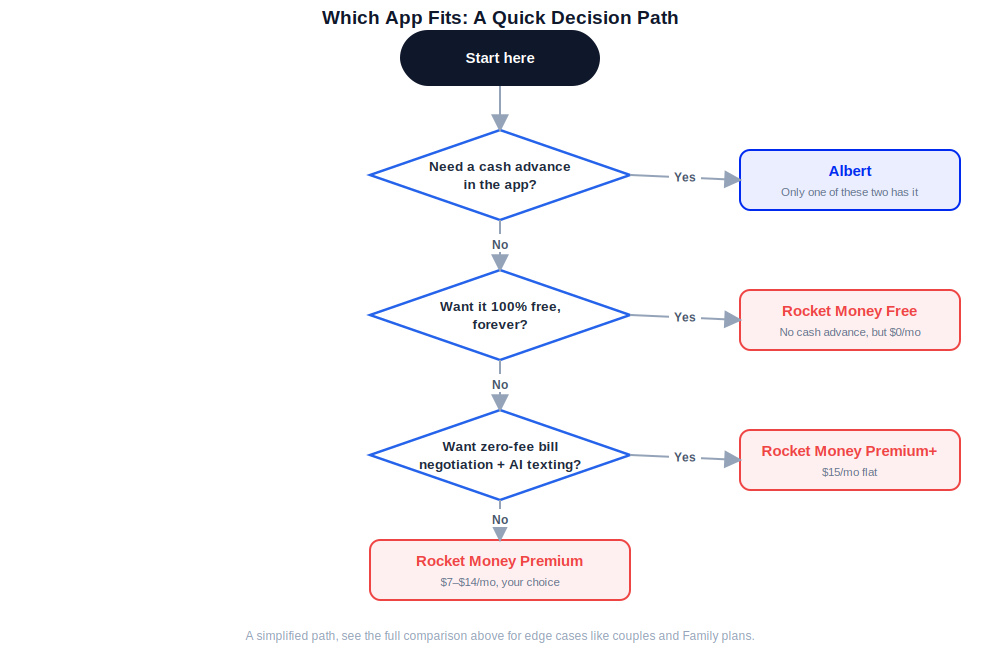
Albert vs Rocket Money decision box: Need a cash advance in the same app you budget with? Pick Albert. Only need to see and cancel subscriptions? Rocket Money’s free tier already does that, no subscription required.
Which app is worse to cancel?
Cancellation friction is the one area where Albert vs Rocket Money complaints look almost identical in tone, even though the mechanics differ. Neither is a clean, one-tap cancellation, and it’s worth going in with realistic expectations for both.
Albert requires you to zero out every linked balance (Savings, Instant advance repayment, anything sitting in the app) before your Standard, Genius, or Family membership will actually deactivate; canceling the subscription itself doesn’t automatically release your money. Full walkthrough here: how to cancel an Albert subscription.
Rocket Money’s most consistent complaint pattern, visible across Trustpilot, the Better Business Bureau, and app store reviews, involves confusion around in-app cancellation steps and reports of continued charges after users believed they’d successfully canceled. Official guidance: cancel through Settings → Premium Membership → Manage Membership, and dispute any lingering charge directly with your bank if it recurs. I go through the exact steps in canceling a Rocket Money subscription.
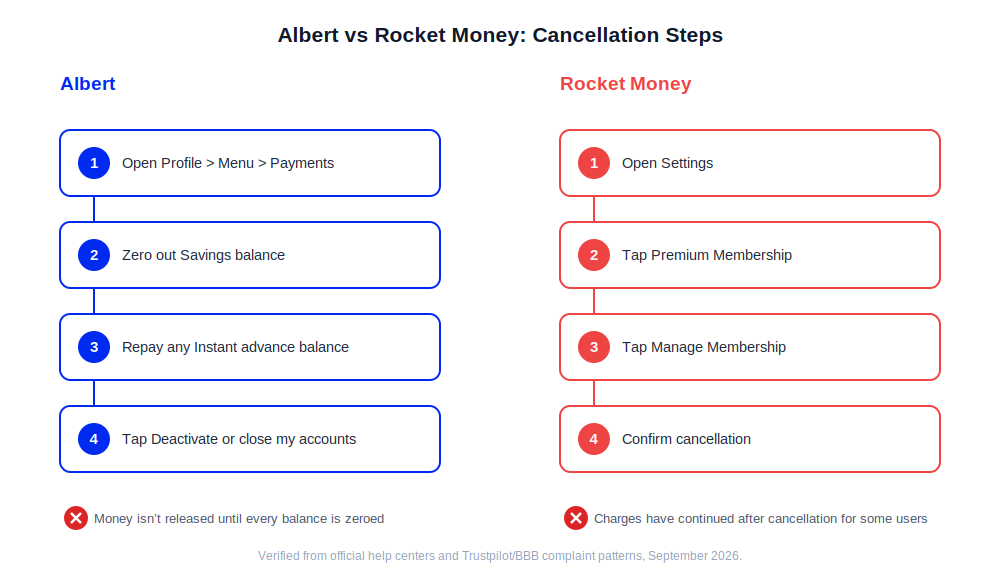
Albert vs Rocket Money decision box: Screenshot your cancellation confirmation for either app, and check your next statement. Both have a documented pattern of users needing a second attempt, or a bank dispute, to make it stick.
Can you use both?
Yes, and plenty of people already do, because Albert and Rocket Money solve different problems rather than competing head-to-head. Albert handles the “what should I do with my money” side: automated saving, investing, cash advance, an AI-powered assistant through Genius.
Rocket Money handles the “why am I still paying for this” side: subscription discovery, cancellation, and bill negotiation. If you’re also weighing Albert against a similar all-in-one app, see my Albert vs Cleo comparison.
Running both means paying Albert’s subscription ($19.99–$39.99/mo) plus, optionally, Rocket Money Premium or Premium+ ($7–$15/mo), a combined cost of roughly $27 to $55/mo if you pay for everything at the top end. That changes the whole Albert vs Rocket Money math once you’re budgeting for both apps at once rather than picking just one.
Many people get by using Albert’s paid tier alongside Rocket Money’s free plan, since the free plan alone will surface every subscription you’re paying for even if you don’t pay for the cancellation concierge or Premium+’s zero-fee bill negotiation.
Can I use Albert and Rocket Money at the same time?
Yes, there’s no conflict between the two: they link to your bank accounts independently and don’t interfere with each other. The only real cost of running both is the combined subscription price, not any technical limitation.
Which one fits your situation?
Here’s how the Albert vs Rocket Money decision breaks down by scenario:
Want cash advance + investing + an AI financial assistant: Albert. It’s the only one of the two that offers any of these.
Want subscription cleanup and a real free tier: Rocket Money. You can use it indefinitely without paying anything, and Premium+ is there if you eventually want zero-fee bill negotiation.
Couples or families: Albert Family covers up to 4 members for a flat $39.99/mo. Rocket Money has no dedicated family tier. Account sharing on Premium or Premium+ works for two people, but there’s no per-member pricing structure.
Is Albert or Rocket Money better for beginners?
Rocket Money is the gentler starting point, since you can use it free indefinitely and only pay once you know which paid feature you’d actually use. Albert requires a subscription from day one after the 30-day trial ends, which is a bigger commitment for someone still figuring out whether an all-in-one app is worth it.
What’s the Albert vs Rocket Money Reddit consensus?
Search any Albert vs Rocket Money thread on Reddit and a pattern shows up quickly: people recommending Rocket Money for the subscription-cancellation use case specifically, and a more mixed reaction to Albert once the conversation turns to Genius pricing.
The community shorthand worth knowing is that r/personalfinance regulars tend to treat “I just want to see my subscriptions” and “I want an all-in-one money app” as two different questions with two different answers: Rocket Money for the first, and Albert, Monarch Money, or Copilot for the second, depending on budget.
The most consistent Reddit criticism of Albert isn’t the price itself, it’s people feeling nudged toward Genius when they only wanted the cash advance, then discovering the subscription auto-renews regardless of whether they used the advance that month.
For Rocket Money, the recurring Reddit theme is less about price and more about the bill-negotiation fee catching people off guard the first time it’s applied, even though the terms disclose it upfront. Neither pattern is unique to this comparison. I paraphrase rather than quote specific threads here, since individual posts get deleted and edited constantly and a paraphrased consensus holds up better over time than a screenshot.
How do the ratings and trust signals compare?
Trust signals are one more place Albert vs Rocket Money isn’t a close call in every category. Both apps score well in app stores, but the volume, complaint pattern, and banking structure behind each one differ in ways worth knowing before you link a bank account.
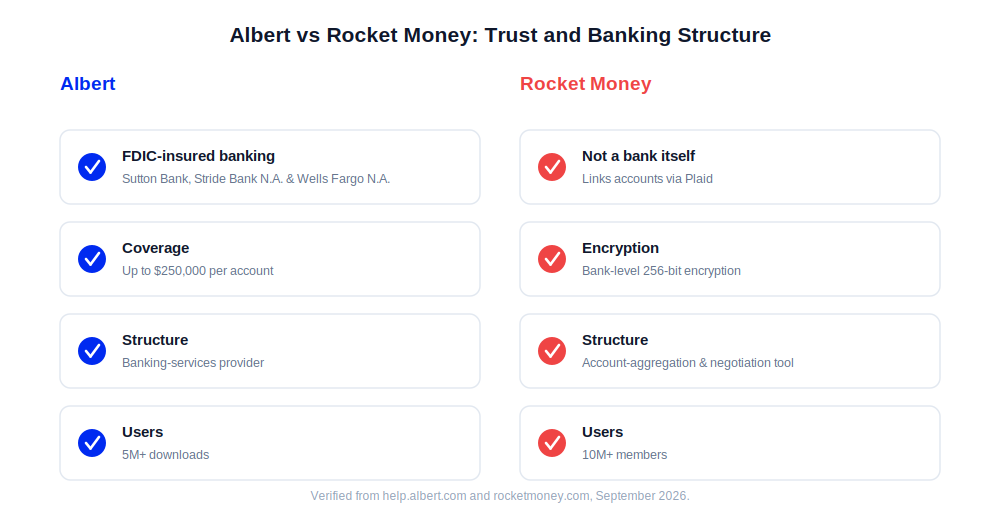
Albert’s cash and checking balances are FDIC-insured through three banking partners (Sutton Bank, Stride Bank, N.A., and Wells Fargo, N.A.) up to $250,000, with Wells Fargo specifically handling the Savings product. Rocket Money isn’t a bank itself; it links your existing accounts through Plaid and uses bank-level 256-bit encryption, so your money stays at your own bank rather than moving into a Rocket Money-held account.
That’s a meaningfully different trust model, and it’s one more axis where Albert vs Rocket Money isn’t a symmetrical comparison: Albert is a banking-services provider, Rocket Money is an account-aggregation and negotiation tool.
Albert vs Rocket Money ratings at a glance:
| Albert | Rocket Money | |
|---|---|---|
| App Store rating | 4.6/5 (312K ratings) | 4.5/5 (361K ratings) |
| Google Play rating | 4.5/5 (~154K reviews) | ~4.5–4.6/5 (~111K–127K reviews, third-party aggregated) |
| Members / users | 5M+ downloads | 10M+ members |
| Banking structure | FDIC-insured via Sutton Bank, Stride Bank, N.A., Wells Fargo, N.A. | Not a bank, links accounts via Plaid |
| FinCompareLab rating | 3.9/5, see my full Albert review | Not yet published, see my full Rocket Money review |
App Store and Google Play figures confirmed from live listings and official help center pages, 2 September 2026. Google Play figure for Rocket Money is a range aggregated from recent third-party sources, since the live listing didn’t return an exact star figure at time of writing.
Neither company disputes that cancellation friction exists. Rocket Money’s official cancellation instructions explicitly acknowledge that charges can continue if the in-app steps aren’t followed exactly, and Albert’s help center confirms that linked balances must be cleared first. In fairness to both, the app-store ratings above suggest most day-to-day users don’t hit these issues; the complaints concentrate specifically around cancellation and billing, not core functionality.
For a broader view of where both apps sit against the rest of the category, my best personal finance software roundup covers a wider set of options, and my best net worth tracking apps guide is useful if net worth tracking specifically is what’s pulling you toward Rocket Money Premium.
Albert vs Rocket Money: frequently asked, how do I decide?
Here are the questions I hear most often about Albert vs Rocket Money, answered straight.
Does Rocket Money do cash advances on any tier, including Premium+?
No, this comes up often enough that it’s worth restating plainly: Rocket Money doesn’t do cash advances on Free, Premium, or Premium+. Adding a paid tier doesn’t unlock one, because the feature simply isn’t part of Rocket Money’s product at any price point.
What’s the maximum cash advance amount from Albert?
Albert advertises Instant advances up to $1,000, but most users are approved for less based on Albert’s internal eligibility algorithm; many land closer to $250. There’s no equivalent Rocket Money feature to compare it against, since Rocket Money doesn’t offer cash advances at all.
Does Albert have a free version like Rocket Money?
No. Albert has no free tier. Every plan starts at $19.99/mo after the 30-day trial. Rocket Money’s free plan has no time limit and includes real budgeting features, including bill negotiation.
Are there any Albert vs Rocket Money coupon codes or promos?
Neither app runs a public discount code as of this writing. Albert’s only real price break is the 30-day trial before billing starts; Rocket Money’s is the 7-day Premium trial plus the fact that the free tier itself never expires. Be skeptical of any third-party “Albert vs Rocket Money promo code” claim that isn’t confirmed directly on help.albert.com or rocketmoney.com.
Why do some Albert vs Rocket Money comparisons show different prices?
A lot of older content online still cites Albert’s pre-repricing figures, sometimes as low as $6–$14.99/mo, and doesn’t account for Rocket Money’s newer Premium+ tier at all. Always check help.albert.com and rocketmoney.com directly. Pricing on both apps has shifted more than once this year.
Is Albert’s Instant cash advance still gated behind a subscription?
Not anymore. Albert removed the subscription requirement for its Instant advance, so you no longer need a paid plan just to access the $25–$1,000 advance range.
Who are Albert’s banking partners?
Albert’s checking and savings balances are FDIC-insured through Sutton Bank, Stride Bank, N.A., and Wells Fargo, N.A., all three currently active, not a single partner. Some older reviews describe this as a straightforward switch from one bank to another, which understates the current structure.
Does Rocket Money charge for bill negotiation even without Premium?
Yes, bill negotiation is available to Free, Premium, and Premium+ users alike, but only Premium+ waives the success fee entirely. On Free and Premium, the fee is 35–60% of your first year’s savings, and only if the negotiation succeeds.
Which app is harder to cancel, Albert or Rocket Money?
Both have documented cancellation friction. Albert requires zeroing out all linked balances first. Rocket Money has more reports of charges continuing after a cancellation attempt, according to Trustpilot and Better Business Bureau complaints.
Can couples use Albert or Rocket Money together?
Albert Family covers up to 4 people for $39.99/mo total. Rocket Money doesn’t have a dedicated family tier, Premium and Premium+ both support account sharing for two people, but there’s no per-member pricing the way Albert Family has.
Is it worth paying for both Albert and Rocket Money?
Only if you actually use both feature sets. Paying $19.99–$39.99/mo for Albert plus $7–$15/mo for Rocket Money Premium or Premium+ adds up to $27–$55/mo, worthwhile if you’re using the cash advance, investing, savings automation, subscription cancellation, and bill negotiation, but overkill if you’re only touching one or two of those.
How do I decide between Albert and Rocket Money if I’m price-sensitive?
Start with Rocket Money’s free tier. It costs nothing and immediately shows you every subscription you’re paying for. Only move to a paid option, Albert or a Rocket Money paid tier, once you know specifically which paid feature you’d actually use every month.
Do either Albert or Rocket Money support joint bank accounts?
Both apps can link to a joint checking or savings account the same way they link any individual account through Plaid or a similar connection service, but neither is built specifically around shared household budgeting the way Monarch Money or Honeydue are. Albert Family lets up to 4 people use separate logins under one $39.99/mo subscription, but each person sees their own linked accounts rather than a merged household view.
Ready to try one of these?
Whichever way you land on Albert vs Rocket Money, the smartest next step is the same one I’d give any reader: try the free option first, keep an eye on your bank statement during any trial period, and only upgrade once a specific paid feature (the cash advance, the subscription concierge, or Premium+’s zero-fee bill negotiation) has already earned its place in your monthly budget.
If neither quite fits, my Rocket Money alternatives and Albert alternatives roundups cover the closest substitutes for each.
