
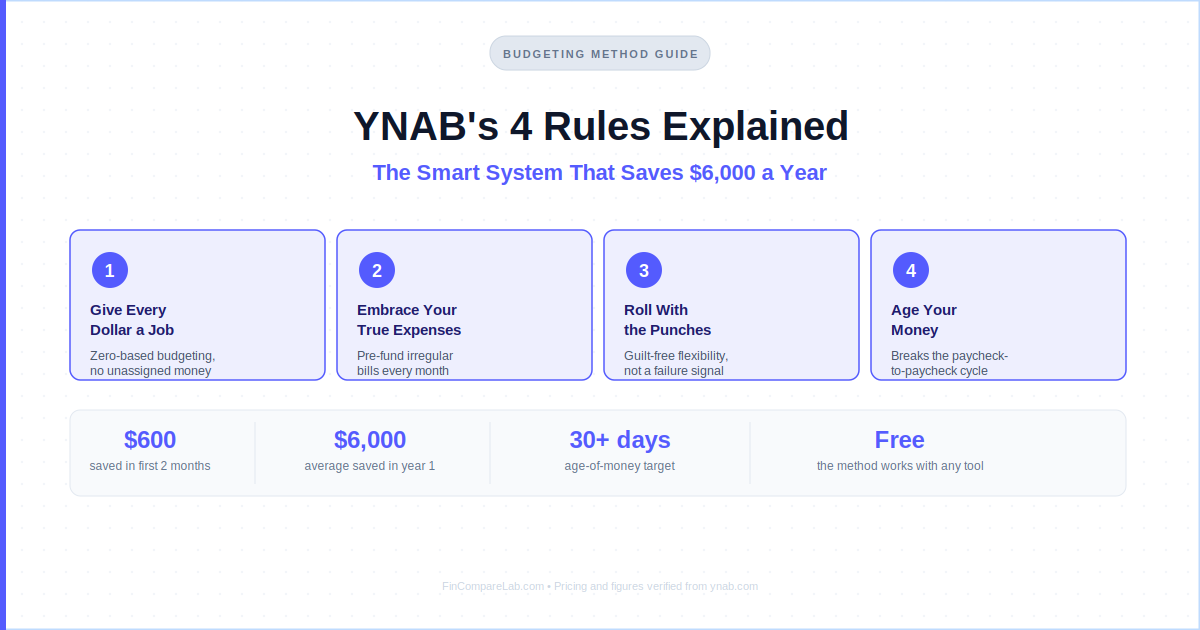
The YNAB 4 rules — Give Every Dollar a Job, Embrace Your True Expenses, Roll With the Punches, and Age Your Money — are the four-step method behind You Need a Budget, and they’re the reason YNAB users report saving an average of $600 in their first two months and $6,000 in their first year.
⚡ Quick Answer
The YNAB 4 rules are: Give Every Dollar a Job, Embrace Your True Expenses, Roll With the Punches, and Age Your Money. Together they form a zero-based budgeting system built to break the paycheck-to-paycheck cycle — and they work whether you use the YNAB app or not.
Table of Contents
- What are the YNAB 4 rules?
- What does “give every dollar a job” mean in YNAB?
- What is a YNAB true expenses category?
- What does “roll with the punches” actually mean?
- What does age of money YNAB tracking actually mean?
- Do the YNAB rules only work inside the YNAB app?
- How long does it take to see results with the YNAB rules?
- Which YNAB rule is hardest for beginners?
- What does the YNAB community say about these rules?
- Who should use the YNAB method?
- FAQ
- Read next
What are the YNAB 4 rules?
The YNAB 4 rules are the budgeting philosophy behind You Need a Budget, built by founder Jesse Mecham from a spreadsheet he made in college when he and his wife were flat broke. The system has since helped hundreds of thousands of people get out of debt, save more, and stop dreading their bank balance.
They’ve stuck around for two decades because they solve real behavior problems, not just math problems.
Here’s the full list at a glance:
| Rule | Name | What it does for you |
|---|---|---|
| 1 | Give Every Dollar a Job | Zero-based budgeting — no unassigned money |
| 2 | Embrace Your True Expenses | Kills “surprise” bills by pre-funding them monthly |
| 3 | Roll With the Punches | Guilt-free flexibility when life changes mid-month |
| 4 | Age Your Money | Breaks the paycheck-to-paycheck cycle permanently |
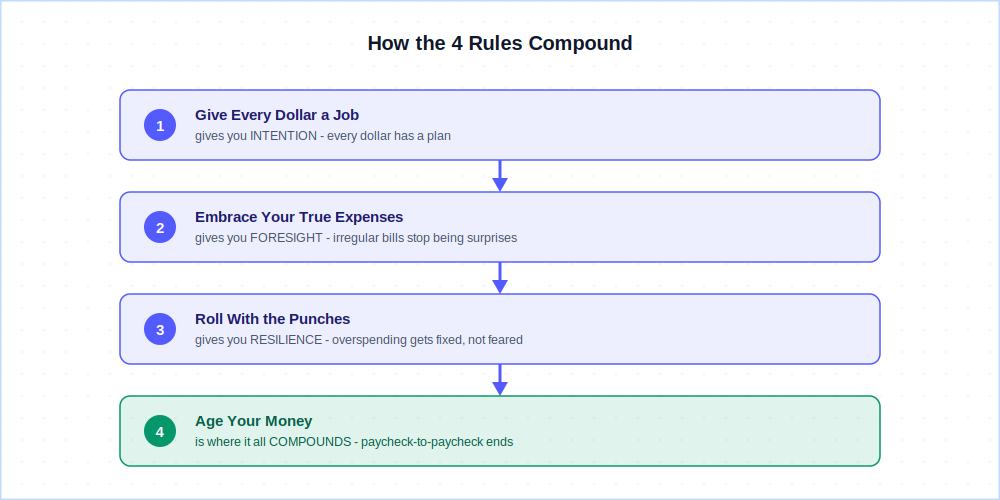
The YNAB 4 rules aren’t independent — they build on each other. Rule 1 gives you intention, Rule 2 gives you foresight, Rule 3 gives you resilience.
Rule 4 is where it all compounds into real financial breathing room. Skip one and the whole system wobbles.
The part most people miss: Rule 3 is not a failure mode — it’s a built-in feature. Most budgeting systems shame you for going over. YNAB’s rules build the adjustment in by design, which is a big part of why the method has stuck around for two decades while so many budgeting apps have come and gone.
What does “give every dollar a job” mean in YNAB?
Give Every Dollar a Job means assigning every dollar you currently have to a specific category before you spend it — not future income, what’s actually in your account right now. Rent, groceries, car maintenance, subscriptions, fun money: every dollar gets a purpose before it has a chance to disappear.
This is zero-based budgeting in practice. The goal is income minus all category assignments equals $0. Every dollar employed, unemployment rate zero.
How it works step by step:
- Step 1 — Check your real balance. Not your next paycheck, not a pending transfer. What’s in the account today.
- Step 2 — Cover immediate needs first. Rent, utilities, groceries, minimum debt payments come before anything else.
- Step 3 — Fund your true expenses. This feeds directly into Rule 2 below — set aside a slice for irregular costs now.
- Step 4 — Assign the rest to goals. Emergency fund, vacation, new laptop, whatever moves your life forward.
- Step 5 — Get to zero. Leftover unassigned money still needs a job, even if that job is just “slush fund.”
The psychological shift here is bigger than it sounds. Most people think budgeting means tracking where money went. Rule 1 flips that: you decide where money goes before you spend it. You’re not reviewing history, you’re writing it in advance.
One edge case beginners often miss: you budget what you have, not what you expect. If you’re paid biweekly and rent is due before your next paycheck, you need enough assigned today to cover it. That’s uncomfortable at first — it’s also exactly what forces the behavior change.
Real example: You have $2,400 in checking. Rent is $1,200, groceries are $400, and car insurance is $120 — that leaves $680.
You assign $200 to an emergency fund, $180 to fun money, $200 to true expenses (see Rule 2), and $100 to a vacation fund. Zero unassigned dollars — budget complete.
What is a YNAB true expenses category, and how does it work?
True expenses are the large, infrequent costs that feel like surprises but really aren’t. Car registration isn’t a surprise — it happens every year. An $800 annual insurance renewal isn’t a surprise either. The problem is most people don’t fund these monthly, so the bill blows up the budget when it lands.
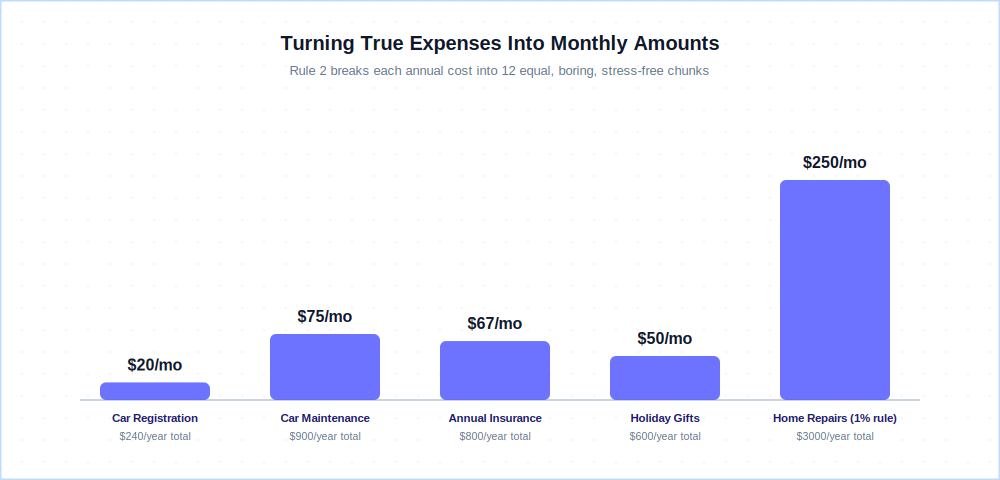
Rule 2 fixes this by treating every irregular expense like a monthly subscription: break it into 12 equal chunks and set a little aside each month until the bill arrives. No drama, no scrambling.
Common true expenses people miss:
- Car maintenance and repairs — $50–$100/month is reasonable for most cars
- Annual insurance premiums — auto, renters, life; divide by 12
- Holiday gifts and travel — costs about the same every year, so start funding it in January
- Medical costs — co-pays, dental, vision; these add up even with insurance
- Home repairs — a rough rule of thumb is 1% of home value per year
- Subscription renewals — annual software, streaming, or gym plans
- Pet care — vet visits, vaccines, and the inevitable emergency vet trip
- Clothing — not fashion, just replacing worn-out basics once or twice a year
The counter-intuitive part: Rule 2 isn’t about saving, it’s about honesty. A $600 car repair isn’t extra spending — it’s a real cost of owning a car you’ve been mentally pretending doesn’t exist. YNAB calls these “true expenses” because they’re the real price of your life, not just what happens to hit your card this month.
For beginners, start with 5–6 categories. Most people underestimate how many true expenses they actually have. A starter YNAB true expenses list usually covers car maintenance, annual insurance, and holiday spending first — add more categories as you discover them. After three months, you’ll have a far more honest picture of what your life actually costs.
Real example: Car registration is $240/year. You create a “Car Registration” category, set a target of $20/month, and let it build. When the bill lands in August, the money’s already there — no credit card, no stress.
What does “roll with the punches” actually mean?
Roll With the Punches means: when you go over in one category, you move money from another instead of abandoning the budget entirely. That’s the whole rule. No guilt, no shame spiral, just a deliberate reallocation.
This is the rule that separates YNAB from most other budgeting systems. Most apps just track overspending and flash a red number at month’s end. YNAB’s rule prompts you to fix it in real time by moving money — the budget stays balanced, it just looks different from what you planned.
What rolling with the punches looks like in practice:
- Groceries over by $60? Pull $60 from dining out.
- Unexpected vet bill? Pull from the pet care sinking fund first, then fun money if needed.
- Car repair blew the budget? If Rule 2 is working, that money’s already there. If not, pull from whichever category is least painful to shrink this month.
The mechanics are simple; the psychology is deeper. Most people quit budgeting because they overspend and feel like they’ve failed. YNAB’s rules reframe overspending as information, not failure — you didn’t break the budget, you learned something real about what your life costs. Adjust and move on.
One clarification worth making: Rule 3 doesn’t mean spend freely and patch it up later. It means be intentional when you adjust — you’re making a conscious trade-off, less fun money this month so the car gets fixed. That deliberate act of moving money is what builds the habit.
What does age of money YNAB tracking actually mean, and how long does it take?
Age of money is a measure of how long the dollars in your budget sit before you spend them, and Rule 4 — Age Your Money — is about deliberately growing that gap. The goal is spending money you earned at least 30 days ago, so you’re effectively living on last month’s income while this month’s paycheck sits untouched until next month.
That’s the paycheck-to-paycheck escape hatch. When rent is due, you’re not waiting on Friday’s paycheck — the money is already there, aged, and ready.
YNAB tracks this with an age-of-money metric in the app: the average number of days between earning a dollar and spending it. The age of money YNAB displays on your dashboard is the single clearest signal of how close you are to breaking the paycheck-to-paycheck cycle.
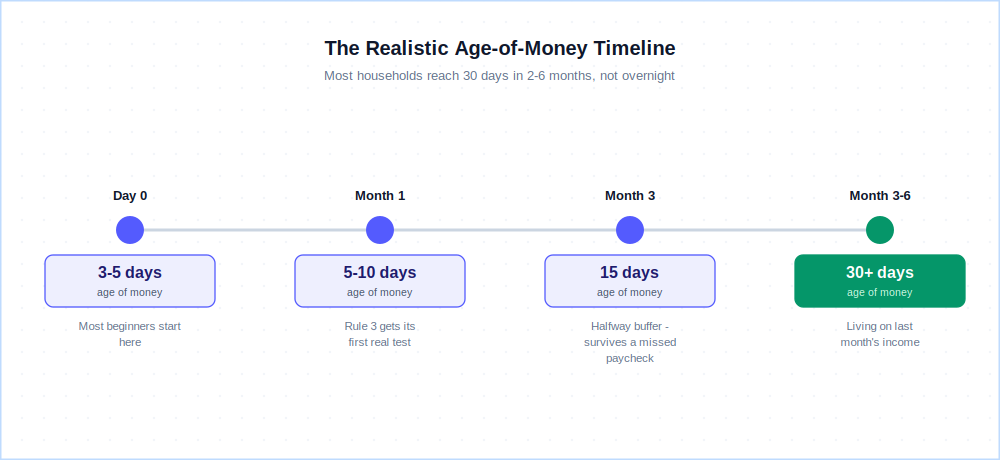
YNAB’s own explanation of the four rules puts the average new user’s savings at $600 in the first two months. Most people start around 3–5 days, and the target most YNAB users aim for is 30+ days.
How to increase your age of money faster:
- Spend less than you earn — the foundation. Every surplus dollar ages.
- Don’t tap savings unnecessarily — let balances accumulate in your budget categories instead.
- Assign windfalls to next month — a tax refund, bonus, or gift should fund next month’s expenses, not this month’s wants.
- Apply Rules 1–3 consistently — the discipline compounds; fewer overspending corrections means more money staying put.
The realistic timeline: most people don’t reach 30 days overnight. It typically takes 2–4 months of consistent use for a typical household, and 6–12 months for people living closer to the edge. Even going from 3 days to 15 days is meaningful — it’s enough buffer to survive a missed paycheck without an overdraft.
The milestone moment: the first time you assign this month’s paycheck to next month’s rent — and don’t touch it — is usually when the method clicks. That’s when the background financial anxiety most people carry starts to actually lift.
Do the YNAB rules only work inside the YNAB app?
No. The YNAB 4 rules are a budgeting philosophy that works with any tool, including a spreadsheet, pen and paper, or a competing app. The rules predate the YNAB subscription product and are documented in Jesse Mecham’s book of the same name.
- YNAB app: purpose-built for the method — categories, goals, and age-of-money tracking all support the rules natively. See my full YNAB review, or YNAB’s own help center for setup documentation.
- Tiller Money: Google Sheets-based, so you can build all four rules manually with full control. $79/yr — see my Tiller Money review, or how it stacks up in YNAB vs Tiller.
- Goodbudget: an envelope-method app that aligns directly with Rules 1 and 2, with a free tier. See YNAB vs Goodbudget.
- Spreadsheet: totally viable — plenty of people apply the four rules by hand without ever paying for software.
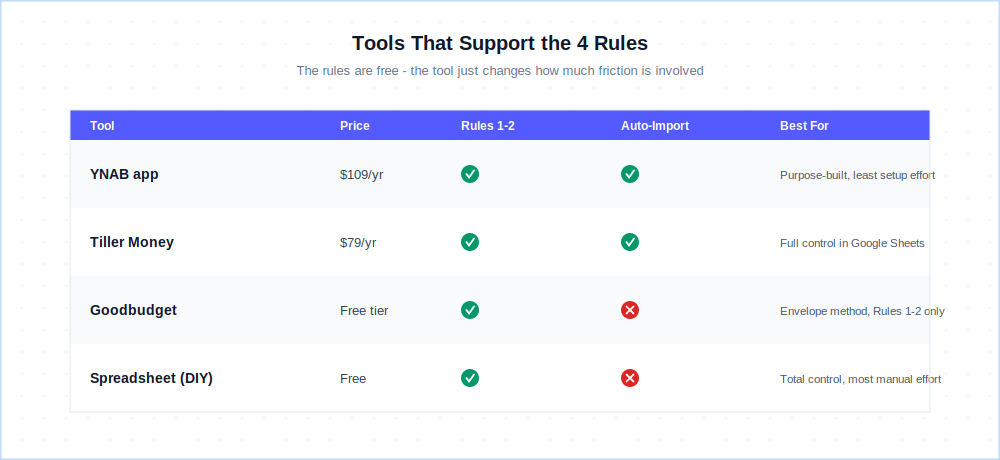
That said, YNAB’s $109/year subscription is purpose-built for this exact method, and if you’re going to commit to all four rules, the friction reduction alone tends to pay for itself. Full pricing breakdown is in my YNAB pricing guide.
How long does it take to see results with the YNAB rules?
Most people feel a meaningful difference within 30–60 days and see measurable financial results within about three months. The exact timeline depends on how consistently all four rules get applied.
- Week 1–2: setup and the first full budget. Assigning every dollar is itself clarifying — most people spot “mystery spending” they couldn’t previously account for.
- Month 1: Rule 3 gets tested for the first time when a category runs short. This is the learning moment.
- Month 2–3: true-expense categories start accumulating real balances — small, tangible wins.
- Month 3–6: age of money starts climbing. Some people hit 30 days by month three; others take six months, and both are fine.
- Year 1: YNAB’s own data puts the average new user’s first-year savings at $6,000.
Which YNAB rule is hardest for beginners?
Rule 1 is the hardest to start, Rule 4 is the hardest to reach, but the rule most beginners quit on is Rule 3 — because they treat a budget adjustment as failure instead of normal operation.
- Rule 1 difficulty: the zero-based mindset feels uncomfortable at first, especially with less money than bills require. Start by covering necessities only — don’t try to fund every category on day one.
- Rule 2 difficulty: most people underestimate how many irregular expenses they actually have. Expect to discover 3–5 new true-expense categories in the first 60 days.
- Rule 3 difficulty: the psychological trap is shame — moving money feels like cheating. It isn’t; it’s the mechanism the whole system depends on.
- Rule 4 difficulty: this is the long game. Don’t obsess over age of money in month one — focus on Rules 1–3 first and let Rule 4 happen on its own.
What does the YNAB community say about these rules?
A recurring theme across r/ynab and Jesse Mecham’s book is that Rule 2 is the one that catches people off guard in a good way. The first time a true-expense category actually gets used — a car repair or annual bill that would have derailed the whole month — it gets paid without touching anything else.
Among people who’ve stuck with the YNAB 4 rules for more than a year, this is consistently the moment they point to as when the method felt “real” rather than theoretical.
The other consistent pattern is around Rule 3. New budgeters often describe quitting past budgeting attempts specifically because overspending felt like personal failure. The community consensus is that reframing an overspent category as “move money, don’t panic” is what actually keeps people budgeting past the first rocky month — it removes the all-or-nothing trap that sinks most budgeting attempts.
On Rule 4, the common thread is patience: people consistently report that age of money is the slowest rule to build and the one that finally makes the paycheck-to-paycheck cycle feel over, once it clicks. If you’re dealing with variable pay on top of this, my guide to budgeting with irregular income covers how Rule 1 adapts when your paychecks aren’t the same size every month.
Who should use the YNAB method?
The YNAB 4 rules aren’t a fit for every budgeting style, so here’s a quick gut check before you commit to the method.
This method is built for you if:
- You’re living paycheck to paycheck despite earning a decent income
- You have vague money anxiety but can’t explain where it goes
- You want to break free from debt without a strict no-spend lifestyle — my debt payoff guide pairs well with these rules
- You’ve tried budgeting before and quit, especially if shame was the reason
The method might frustrate you if:
- You want passive, zero-effort tracking (Monarch Money or PocketGuard are better fits — see YNAB vs Monarch)
- You have highly irregular income with no predictable floor (still workable, just harder)
- You’re unwilling to check your budget more than once a month
Are there more questions about the YNAB 4 rules?
Here are a few more things people ask about the YNAB 4 rules before deciding whether to use the method.
Is the YNAB method the same as zero-based budgeting?
Mostly yes. Rule 1 — Give Every Dollar a Job — is zero-based budgeting in practice. The difference is YNAB layers three more rules on top that address the most common failure points of zero-based budgeting: irregular expenses (Rule 2), real-world flexibility (Rule 3), and long-term cushion building (Rule 4).
Can I apply the YNAB rules if I have irregular income?
Yes — Rule 1 actually works well for variable income, because you only budget what you currently have and never overpromise money that hasn’t arrived yet. In a big month, assign the surplus to true expenses and savings first; in a lean month, pull from those pre-funded categories. It takes a few months to build the buffer, but the system is designed for exactly this kind of volatility.
What’s the difference between true expenses and an emergency fund?
They’re related but distinct. An emergency fund covers genuinely unpredictable events like job loss or a major medical emergency. True expenses (Rule 2) cover predictable-but-infrequent costs you already know are coming — car registration, annual subscriptions, holiday gifts. YNAB recommends having both: the emergency fund lives in savings, true expenses live in budget categories.
How do I get started with the YNAB 4 rules?
Start with Rule 1 on day one: add your current account balance and assign every dollar to a category. Don’t try to build every true-expense category in week one — add one or two obvious ones and let Rule 2 expand naturally over the first 60 days.
Rules 3 and 4 tend to happen on their own once the first two are in place. My YNAB for beginners guide walks through the first-budget setup in more detail.
Is YNAB worth $109/year for a method I could do in a spreadsheet?
It depends on how much friction matters to your consistency. The four rules themselves are free and publicly documented — YNAB’s app just removes the friction of manual tracking with automatic imports, goals, and real-time category updates.
If you know you’ll actually use a spreadsheet daily, that route works fine. If you know you won’t, $109/year works out to about $9/month, and users report saving an average of $6,000 in year one. Use my YNAB ROI calculator to run your own numbers.
Do I need YNAB’s app to follow the 4 rules?
No. The four rules are a philosophy, not a software requirement — you can apply them in Tiller Money, Goodbudget, a spreadsheet, or pen and paper. YNAB’s app is simply built around the rules, so every feature maps back to one of the four, which reduces the cognitive load of learning a new system and a new mindset at the same time.
Do I need to track age of money YNAB style from day one?
No — trying to optimize age of money YNAB reports in your first month usually backfires. Focus on Rules 1 and 2 first: assign every dollar and build out your YNAB true expenses categories. Age of money climbs on its own as a side effect of the first three rules working, so checking it daily in month one just adds pressure without changing the outcome.
Read next
- YNAB Review 2026: Critical $109 Renewal Warning
- YNAB Pricing 2026: Every Plan, Trial, and Discount Explained
- YNAB for Beginners: How to Set Up Your First Budget
- YNAB vs Monarch Money 2026: Which One Fits You?
- YNAB vs Simplifi 2026: Proven Honest $61 Overpay
- Tiller Money Review: The Spreadsheet Budgeting Alternative
- Best Budgeting Apps for Beginners 2026
- How to Budget With Irregular Income
