
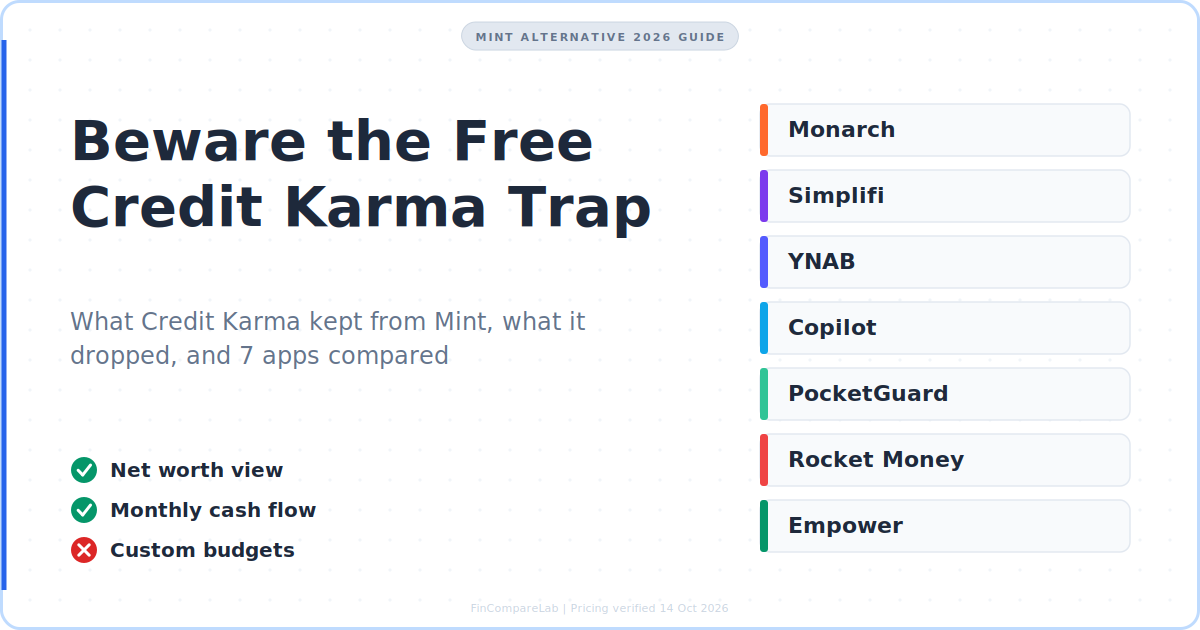
The best mint alternative in 2026 depends on which Mint job you miss, because Credit Karma kept the net worth view and left the budgets behind.
⚡ Quick Answer
For most people, Monarch is the closest mint alternative at $99.99 a year. Simplifi is the cheapest paid budgeting app at $47.88 in year one (new orders by 13 November 2026), YNAB is the strict budgeter at $109 a year, and Empower is the free net worth dashboard.
How We Review Apps, Pricing verified from official app websites — 14 October 2026
Table of Contents
- What Is the Best Mint Alternative in 2026?
- Why Doesn’t Credit Karma Replace Mint’s Budgets?
- Which Mint Alternatives Cost the Least Over Three Years?
- What Are the Best Alternatives to Mint, App by App?
- Are There Free Apps Like Mint?
- Which Mint Replacement Fits Your Situation?
- How Do You Move From Mint to a New App Without Your Old Data?
- What Else Do People Ask About Mint Alternatives?
What Is the Best Mint Alternative in 2026?
Monarch is the closest mint alternative for most people. It combines category budgets, a net worth view and bill reminders for $99.99 a year. Simplifi costs less at $47.88 in year one, and Empower is free for net worth tracking but weaker on monthly budgets.
The right pick changes with the job you gave Mint. A net worth glance, a monthly category budget and a subscription cleanup are three different jobs, and no app wins all three at the lowest price. Find your job in the table, then read that app’s section below.
| If you used Mint to… | Best fit | The catch |
|---|---|---|
| Watch net worth across accounts | Empower (free) or Monarch | ⚠️ Empower’s budgeting is its lighter side, and Monarch has no free tier |
| Set category budgets and catch overspending | Simplifi or Monarch | ⚠️ Simplifi bills annually only, and Monarch needs a card for its 7-day trial |
| Control spending with zero-based budgeting | YNAB | ⚠️ Steepest learning curve, $109 a year |
| Catch forgotten subscriptions and bills | Rocket Money | ⚠️ Cancellation help is Premium only |
| See what is safe to spend today | PocketGuard | ⚠️ No free tier, 7-day trial |
| Use a polished Apple-first app | Copilot | ❌ No Android app |
Pricing verified from official websites, October 2026.
Why Doesn’t Credit Karma Replace Mint’s Budgets?
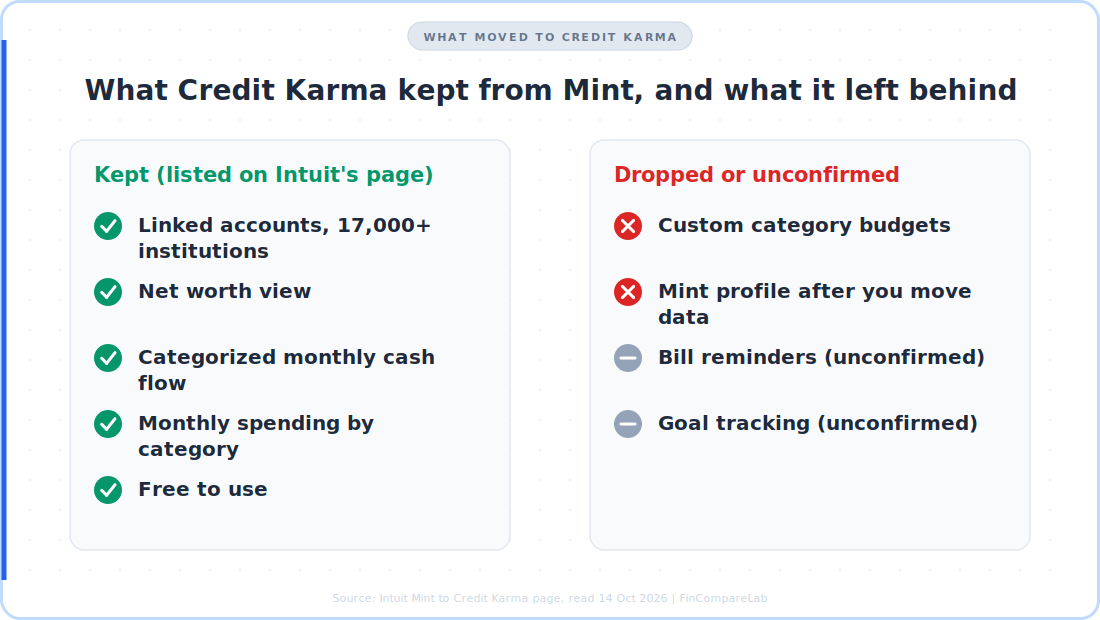
Intuit’s own page lists what moved from Mint to Credit Karma, including linked accounts from 17,000+ institutions, net worth, categorized monthly cash flow and monthly spending insights. Custom budgets are not on that list, and bill reminders and goal tracking are unconfirmed on Credit Karma’s Mint page as of 14 October 2026.
Mint ended on 23 March 2024 after Intuit pushed the date back from 1 January. Credit Karma could carry over account balances, net worth history and up to three years of transactions, and moving your data ended your Mint profile, according to the footnote on Intuit’s page.
The trap sits in the word free. A free app still pays for bank connections, and Monarch’s CEO, who was Mint’s first product manager, says Mint covered those costs with referral fees from card and loan offers and never fully did. He sells a subscription app, so read that as a biased but informed account of why ad-funded budgeting drifted away from budgets.
Credit Karma still works for free credit monitoring beside a budgeting app, and pairing it with a mint alternative costs nothing extra on the Credit Karma side. The mistake worth avoiding is waiting for Credit Karma to grow budgets that Intuit’s own page never promised. Every mint alternative below fills that gap in a different way.
Which Mint Alternatives Cost the Least Over Three Years?
Simplifi costs the least of the paid apps over three years at $215.64, assuming its $6.99 standard rate applies after the promo year. Empower is $0 for the dashboard. YNAB is the most expensive fixed-price budgeting app at $327, and Rocket Money Premium ranges from $252 to $504 because you set the price.
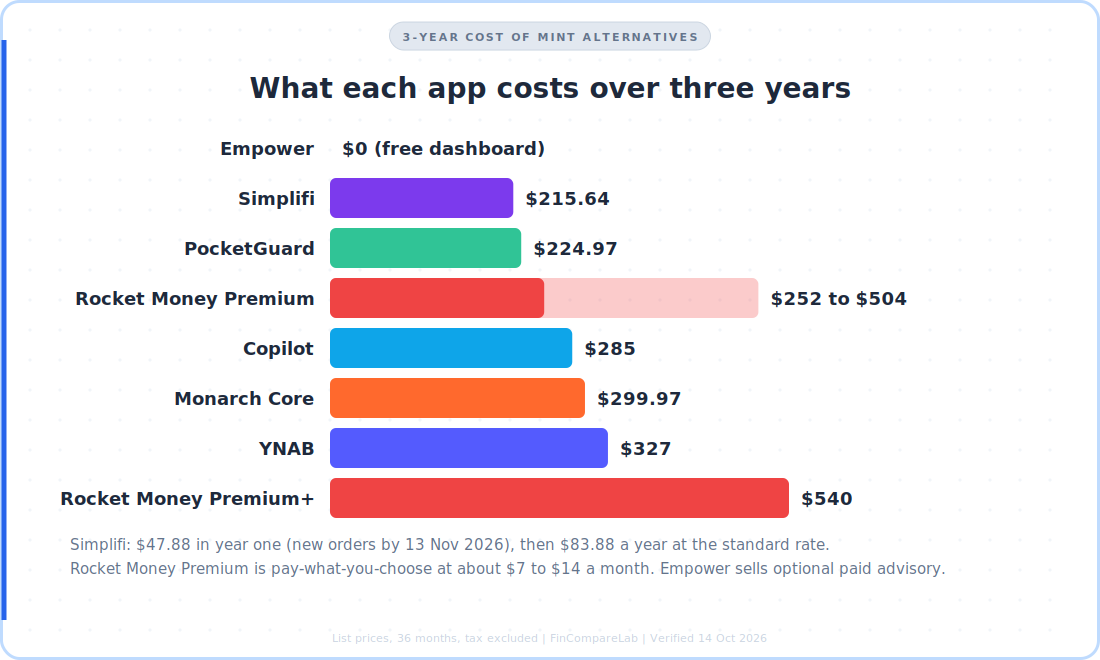
The chart uses list prices and ignores tax. Monarch’s site currently advertises 30% off the first year of annual Core with code WELCOME for new users, which would trim Core’s three-year total by about $30.
Simplifi’s $3.99 monthly rate is a first-year offer for new orders placed directly with Quicken by 13 November 2026, 11:59 PT, and it renews at the then-current rate. Quicken lists the standard price at $6.99 a month. The gap to Monarch Core is about $52 in year one and about $16 in year two.
Rocket Money is the hardest app here to price in advance. Premium is whatever you choose between roughly $7 and $14 a month, and Premium+ is a flat $15 a month plus tax. Premium+ adds Rowan, an AI assistant, and bill negotiation without the success fee.
Free has its own price tags. Empower’s dashboard is free, and its homepage notes that advisory services are provided for a fee. Rocket Money’s free tier tracks subscriptions, but cancellation help, net worth and web access sit behind Premium.
What Are the Best Alternatives to Mint, App by App?
These seven apps cover the Mint jobs in the table above, ordered by how closely each mint alternative reproduces the Mint experience.
Is Monarch the Closest Mint Replacement?
Yes for most people, because Monarch matches Mint’s layout of accounts, budgets, net worth and bill reminders in one dashboard. Core costs $14.99 a month or $99.99 a year, Plus adds retirement forecasting and business tracking for $199.99 a year, and the trial lasts seven days with a card required.
I used YNAB for 15 years before moving to Monarch this year, and the adjustment was mental, not technical. Monarch tracks forward-looking cash flow, so it doesn’t hand every dollar a job. Mint was a tracker, so a Mint user has less envelope habit to unlearn than I did. For sinking funds, I switched on Category Budgeting mode and the Rollover toggle on those categories.
An August 2024 r/mintuit thread shows the usual split: one long-time Mint user rated Monarch above Mint except for missing credit card bill tracking, then in development (status unconfirmed as of 14 October 2026). Monarch also built a Mint data importer, which only helps if you saved a Mint export, and it is unconfirmed as still active.
The Monarch Money review covers the full feature list, the Monarch Money pricing guide breaks down Core versus Plus, and is Monarch Money safe covers how bank connections work. New users can compare current Monarch Money discount codes before paying. For matchups, see YNAB vs Monarch, Monarch vs Copilot and Monarch vs Simplifi.
Try Monarch Money with its 7-day trial. That makes Monarch the mint replacement I’d shortlist first.
Is Simplifi the Cheapest Mint Alternative That Still Budgets?
Yes for new customers who order before 13 November 2026, at $3.99 a month billed annually, which is $47.88 for year one against $6.99 standard ($83.88 a year). Quicken’s page says it shows what’s left to spend and save, and r/mintuit users often describe Simplifi as the app that most resembles Mint’s flexible categories.
The limits are billing and renewal. Simplifi bills annually only, the promo applies to the first year, and the plan renews at the then-current rate. Quicken’s support pages describe no free trial and a 30-day money-back window (unconfirmed on the pricing page as of 14 October 2026).
Read the Quicken Simplifi review, the Simplifi pricing guide and the Simplifi discount page for how the offer stacks. Compare it with Simplifi vs Copilot and YNAB vs Simplifi.
Try Simplifi before the promo closes. For a cheap mint alternative that still budgets, this is the one to price first.
Is YNAB Worth It for Former Mint Users?
Only if Mint’s budgets never changed your spending and you want something that does. YNAB charges $109 a year ($9.08 a month) or $14.99 monthly, gives 34 days free with no card, and has you assign every dollar before you spend it.
A recurring r/mintuit view says YNAB suits people serious about budgeting and feels like overkill if you only want tracking and net worth. I ran the method for 15 years and agree with the second half, because once your finances stabilize, daily reconciliation turns into busywork.
The YNAB review, YNAB pricing guide and YNAB for beginners walk through setup, and the four YNAB rules explain the method. Use the is YNAB worth it tool to check the math, and see zero-based budgeting for how it differs from Mint’s tracking.
Try YNAB free for 34 days. If it sticks, you’ve found a mint replacement that changes behavior instead of recording it.
Is Rocket Money a Good Mint Alternative?
Yes if Mint’s main value for you was catching subscriptions and bills. The free app tracks subscriptions, budgets and credit score, while cancellation help, unlimited budgets, net worth and web access need Premium at a price you choose between about $7 and $14 a month.
Bill negotiation costs Free and Premium members 35% to 60% of first-year savings, paid once when it succeeds. Rocket Money’s terms effective 2 October 2026 point to negotiation moving to Premium+ only from 2 November 2026, and the rollout scope is unconfirmed as of 14 October 2026. Free-tier budget categories are capped, and the pricing page shows both three and two custom categories.
The App Store rating is 4.5 across 398K ratings (11 October 2026). Start with the Rocket Money review and Rocket Money pricing, check is Rocket Money safe, and see how to cancel a Rocket Money subscription before you subscribe. Alternatives live in best Rocket Money alternatives, with Monarch vs Rocket Money for the budgeting tradeoff.
Try Rocket Money free first. It’s the app to pick when you want bills handled, not a monthly budget built.
Is Copilot Worth It Without an Android App?
Yes if your household is on Apple devices, since Copilot lists Web, iPhone, iPad and Mac but no Android app. It costs $95 a year ($7.92 a month) or $13 monthly (checked 8 October 2026), and its App Store rating is 4.75 across 30,583 ratings as of 8 October 2026.
Partner sharing runs through a Magic Link on one subscription, so a couple doesn’t pay twice (verified 30 September 2026). The trial length is unconfirmed on the homepage as of 14 October 2026, so check it before you sign up.
The Copilot Money review, Copilot Money pricing and is Copilot Money safe cover the details, and the Copilot Money referral code guide explains the trial extension. Compare it in YNAB vs Copilot and Monarch vs Copilot.
Try Copilot if every phone in the house is an iPhone. Otherwise a different mint alternative will serve you better.
Is PocketGuard Enough After Mint?
Yes if you only need to know what is safe to spend today. PocketGuard’s pricing page lists one Premium plan at $74.99 billed yearly ($6.25 a month) or monthly, with a 7-day trial.
The feature list includes rollover budgeting, subscription tracking, a debt payoff plan, Apple Card support, import and export, and bill lowering. It doesn’t mention net worth tracking, so Mint’s net worth glance is not what you’re buying here.
Read the PocketGuard review and PocketGuard pricing, then weigh best PocketGuard alternatives. Two matchups help, YNAB vs PocketGuard and PocketGuard vs Rocket Money.
Try PocketGuard for the simplest mint replacement on this list.
Is Empower the Best Free Mint Alternative?
Yes for net worth and investment tracking, because Empower says its dashboard and financial tools are completely free. Budgeting and cash flow is one of its tools, but reviewers consistently rate it below Monarch or YNAB for monthly budget control.
Empower’s homepage also notes that advisory services are provided for a fee, so the free dashboard sits beside a paid business. Treat the dashboard as a net worth and retirement view, and add a budgeting app if you want category limits.
The Empower review covers the tools in detail, and best Empower alternatives lists budgeting-first options. See Monarch vs Empower and YNAB vs Empower.
Try Empower if net worth was the only thing you opened Mint for.
Are There Free Apps Like Mint?
Yes, but each free option drops something Mint had. Empower is free for net worth, Rocket Money is free for subscription tracking, Credit Karma is free for credit and cash flow, and Actual Budget is free software you host yourself.
The Actual Budget review explains the self-hosting cost and bank sync add-ons, and the Goodbudget review covers a free plan capped at 20 envelopes. Both ask more manual work than Mint did.
If you’d rather skip apps entirely, a spreadsheet never expires, and this comparison of a Google Sheets budget tracker versus apps shows where it falls short. For app options, start with best free budgeting apps and best envelope budgeting apps.
No free mint alternative matches Mint’s old category budgets, because a free tier works for glancing at your money and fails at controlling it. Control costs $48 to $109 a year across the paid apps here, and apps like Mint that stay free rarely include category budgets.
Which Mint Replacement Fits Your Situation?
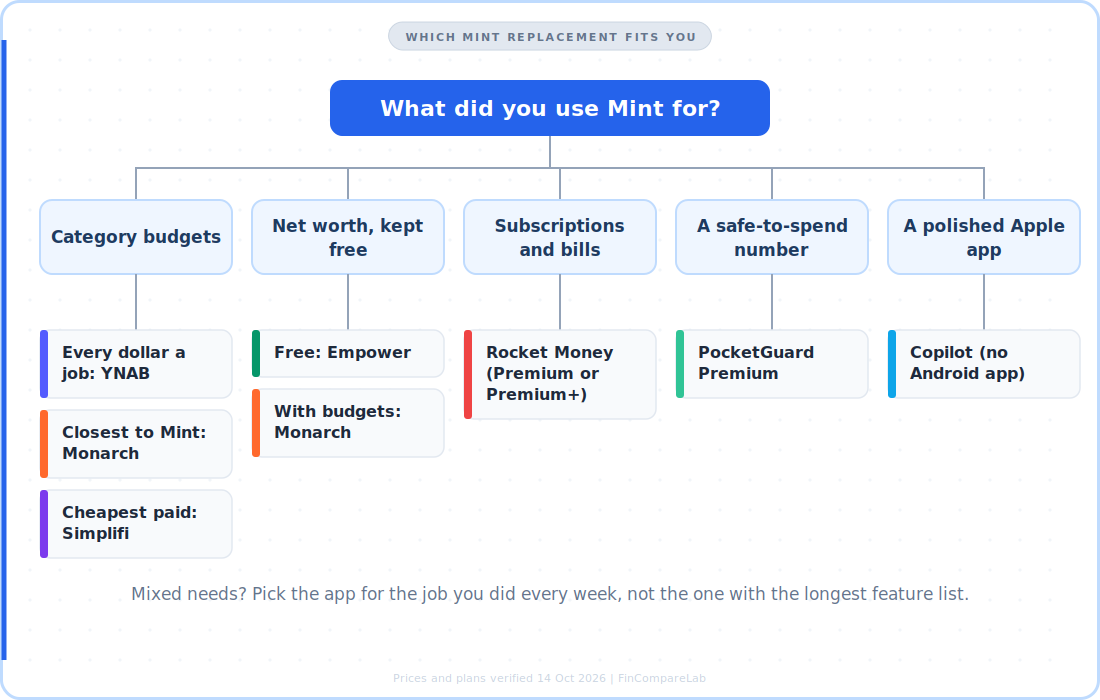
Pick the mint alternative for the job you did every week in Mint. Budgets point to YNAB, Simplifi or Monarch, net worth points to Empower or Monarch, bills and subscriptions point to Rocket Money, and a quick spendable number points to PocketGuard.
Couples have two sensible paths. Monarch adds a partner for free, and Copilot shares through a Magic Link on one subscription. The best budgeting apps for couples guide covers joint accounts in more depth.
Irregular income favors the envelope method, because you budget from money already in the account. Start with budgeting on irregular income and the best zero-based budgeting apps.
Debt payoff favors apps with a payoff plan, like PocketGuard and YNAB. See best budgeting apps for debt payoff and the free debt payoff estimator to size the timeline first.
If net worth and investments were the draw, compare best net worth tracking apps. If you’re starting from scratch, best budgeting apps for beginners ranks the easiest setups. Leaving Monarch later? Best Monarch Money alternatives and best YNAB alternatives cover the next move, and best personal finance software covers desktop options.
How Do You Move From Mint to a New App Without Your Old Data?
Start clean unless you saved a Mint export before 23 March 2024. Link your accounts, set opening balances and rebuild budgets from your last three bank statements, because Mint itself no longer runs.
- Link every account first, so the app can show a net worth number to check.
- On day one, compare that net worth with your bank and card balances. Any gap above $0 means a missing or duplicate account, so fix it before you trust a report.
- Set opening balances as of the last full month end. I did this leaving YNAB with prior-month balances only and no imported history, because credit card transfers in the old file would have distorted my cash flow reports.
- Build category budgets from the average of your last three statement months, rounded to the nearest $10, then trim one category per week instead of cutting everything at once.
- Add annual charges by hand, since an app can’t see a yearly renewal until its month arrives, and review recurring-bill detection after two billing cycles.
If you kept a Mint CSV, check it for credit card payments counted as spending before you import. Monarch’s blog and Simplifi’s help center both described Mint import paths, and neither is confirmed as still active as of 14 October 2026. History depth after linking varies by bank and app (unconfirmed as a fixed figure as of 14 October 2026).
Moved your data to Credit Karma? You can still see balances, net worth history and transactions there, and keep it for credit monitoring. Export options from Credit Karma to a new app are unconfirmed as of 14 October 2026.
What Else Do People Ask About Mint Alternatives?
In short, Credit Karma has no custom budgets, Monarch is the closest mint alternative, and Empower is the free pick.
Is Credit Karma a good Mint alternative?
Not for budgeting. Intuit’s own Mint page lists net worth, linked accounts, categorized cash flow and spending insights, and custom budgets are not among them. It still works for free credit monitoring beside a real budgeting app.
What is the closest app to Mint in 2026?
Monarch is the closest for most people. It combines category budgets, net worth, bill reminders and 13,000+ institutions for $99.99 a year, and its CEO was Mint’s first product manager.
Is there a free Mint alternative?
Yes. Empower is free for net worth tracking, and Rocket Money’s free tier covers subscriptions and limited budgets. Neither gives Mint’s full category budgeting without paying.
Why did Mint shut down?
Intuit consolidated Mint into Credit Karma, which it bought in 2020, and ended Mint on 23 March 2024. Monarch’s CEO says Mint’s referral-fee model never covered its data connection costs.
Can I still get my old Mint data?
Only if you saved an export or moved it to Credit Karma before Mint ended on 23 March 2024. Intuit’s current retention terms for unmoved data are unconfirmed as of 14 October 2026.
Which Mint alternative works on iPhone and Android?
Monarch and Rocket Money both have iOS and Android apps. Copilot lists Web, iPhone, iPad and Mac, so Android households should pick another mint replacement.
Is it worth paying for a Mint alternative when Mint was free?
For budgeting, usually yes. Monarch Core works out to $8.33 a month, and a subscription app has no ad model to serve, which Mint did.
Link your accounts to one mint alternative this week, run it beside Credit Karma for a month, and use the three-year totals to decide whether to stay, with Simplifi’s 13 November deadline as the one date that can’t wait.
📚 Read Next
