
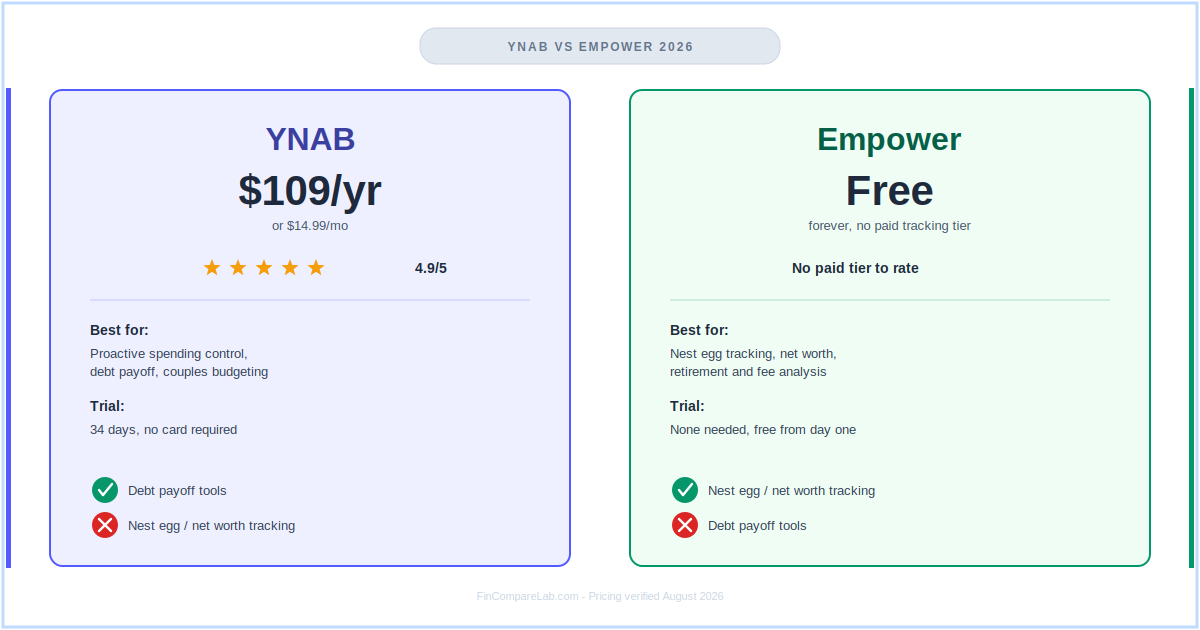
YNAB vs Empower is one of the most misunderstood comparisons in personal finance, because these two apps aren’t actually fighting for the same job — one changes how you spend, the other shows you what you’re quietly building.
⚡ Quick Verdict
YNAB ($109/yr) makes you decide where every dollar goes before you spend it. Empower (free forever) quietly tracks the nest egg you’re building on the side — net worth, investments, retirement — without asking you to lift a finger. Most people searching “YNAB vs Empower” don’t actually need to choose. They need to know which job each app is doing.
How We Review Apps · Pricing verified from ynab.com and empower.com — 10 August 2026
- What does YNAB vs Empower actually mean in 2026?
- How does YNAB work as a budgeting app?
- Is the Empower budgeting app actually worth using?
- How do YNAB and Empower compare on features?
- Which app actually builds your nest egg?
- Which app wins for active budgeting?
- Which app is better for paying off debt?
- Which app is better for couples?
- Is Empower the best YNAB free alternative to pair with YNAB?
- What are the real watch-outs before you sign up?
- What should you know about Empower’s rebrand from Personal Capital?
- What does Reddit say about YNAB vs Empower?
- What are the most common questions about YNAB vs Empower?
What does YNAB vs Empower actually mean in 2026?
YNAB and Empower are both personal finance apps, and that’s where the similarity ends. YNAB is a proactive budgeting tool built to change spending behavior for $109/yr. Empower is a free wealth dashboard that tracks your net worth and investments in the background. Picking one over the other only makes sense if you understand which job you actually need done.
Think of it like a personal trainer versus a bathroom scale. YNAB pushes you to act differently with your money every week. Empower just shows you, accurately and for free, what all that acting (or not acting) has added up to. That distinction is really the whole empower vs ynab story in one sentence.
Most FinCompareLab readers in their late 20s and early 30s end up needing both at different points — YNAB while they’re fixing spending habits, Empower once there’s an actual nest egg worth watching.
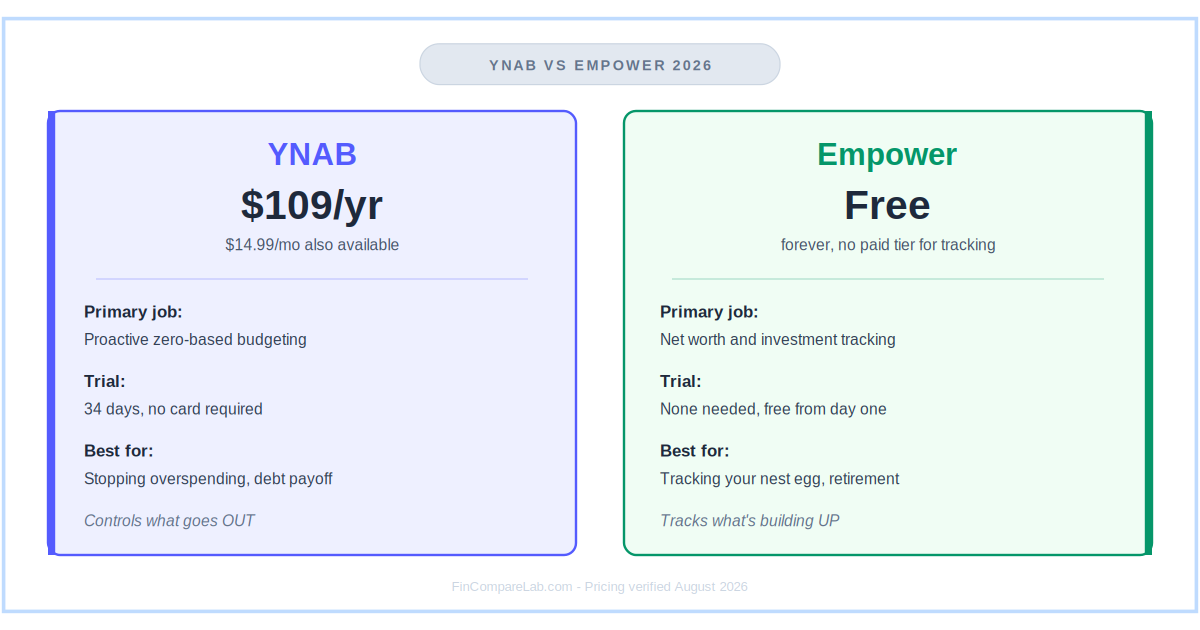
YNAB vs Empower at a glance: $109/yr proactive budgeting vs a free net-worth and nest-egg dashboard.
How does YNAB work as a budgeting app?
YNAB runs on zero-based budgeting: every dollar of income gets assigned to a category before you spend it. You’re not reviewing the past, you’re planning the future — and that proactive mindset is what separates YNAB from every passive tracker on the market, Empower included.
The app is built around four rules: give every dollar a job, embrace your true expenses, roll with the punches, and age your money. YNAB’s own marketing cites an average first-month savings figure, though that’s a self-reported number worth treating as a marketing claim rather than a guarantee — your actual results depend entirely on whether you stick with the method.
The r/ynab community, with roughly 200,000 members, is one of the more engaged corners of personal finance, which at least says something about long-term retention.
Here’s what a $109/yr YNAB subscription includes:
- Zero-based budgeting with category-level planning and spending targets
- Bank sync across checking, savings, and credit cards, or manual entry if you prefer
- Loan planner to model debt payoff timelines and interest saved
- Up to 6 users on one subscription, couples and families included
- Live workshops and an extensive library of budgeting education
- iOS, Android, web, and Apple Watch access
- 34-day free trial, no credit card required
What YNAB deliberately skips: investment tracking, net worth dashboards, retirement planning. It stays in its lane on purpose. For the full cost breakdown, see my YNAB pricing guide, and if you’re still weighing whether the method suits you, my YNAB review covers what the subscription actually gets you month to month. If YNAB feels like overkill, my YNAB alternatives roundup covers cheaper and simpler options.
Is the Empower budgeting app actually worth using?
Empower is a free financial dashboard, and calling it a true “budgeting app” is a bit of a stretch. It connects every account you own in one place: checking, credit cards, brokerage accounts, IRAs, 401(k)s, and even an estimated home value. The investment and net worth tools are genuinely strong. The budgeting layer is thin by comparison, which is the core tension every empower budgeting app review runs into eventually.
Empower Budgeting App Review: Quick Verdict
This empower budgeting app review comes down to one thing: Empower’s dashboard is free forever, syncs fast, and gives you a real-time net worth number without asking you to categorize a single transaction. But it won’t tell you where to spend next month, and it doesn’t stop you from overspending today. It’s a mirror, not a map.
Here’s what shapes every empower budgeting app review out there, including this one, and what Empower gives you at zero cost:
- Net worth tracker, every account type pulled into one real-time number
- Investment dashboard, portfolio allocation, performance, and hidden-fee analysis
- Retirement planner, models whether you’re on track for your target date
- Cash flow tracking, income and spending categorized automatically
- iOS, Android, and web access
There are no spending categories to assign, no envelope system, and no per-category targets. It’s a financial rear-view mirror, not a windshield — useful for watching your nest egg grow, not for deciding what to do about next week’s grocery bill. Any honest empower budgeting app review has to lead with that limitation rather than bury it.
The upsell reality worth knowing: Empower’s free dashboard exists to feed its paid wealth management arm. Link $100,000 or more and expect advisor outreach — community reports describe roughly 1 to 2 calls per month once you cross that threshold, with an AUM fee between 0.49% and 0.89% if you engage.
You can use every free tool indefinitely without ever taking that call. Just know it’s the trade for a genuinely free product. For the full picture, see my Empower review.
How do YNAB and Empower compare on features?
| YNAB | Empower | |
|---|---|---|
| Price | $109/yr or $14.99/mo | Free forever |
| Free trial | 34 days, no card required | Free forever, no trial needed |
| Budgeting method | Zero-based (proactive) | Cash flow tracking (reactive) |
| Category planning | Yes, full envelope system | No, spending is reported, not planned |
| Investment tracking | No | Yes, full portfolio dashboard |
| Nest egg / net worth tracking | Basic, manual entry only | Yes, real-time, every account type |
| Retirement planner | No | Yes, scenario modeling included |
| Debt payoff tools | Yes, loan planner and goal tracking | Minimal, no strategy or snowball |
| Shared accounts | Up to 6 users, one subscription | Individual-focused |
| Fee analyzer | No | Yes, hidden investment fee detection |
| Advisor upsell | No | Yes, expect outreach past $100K linked |
Pricing verified from official websites — August 2026.
Which app actually builds your nest egg?
Empower, and it isn’t close. YNAB has zero investment features by design, so any “nest egg” tracking there is a manually updated placeholder at best. Empower pulls in brokerage accounts, retirement accounts, real estate estimates, and debt into one live dashboard, and its fee analyzer alone can save you real money by surfacing hidden fund expense ratios you’d otherwise never notice.
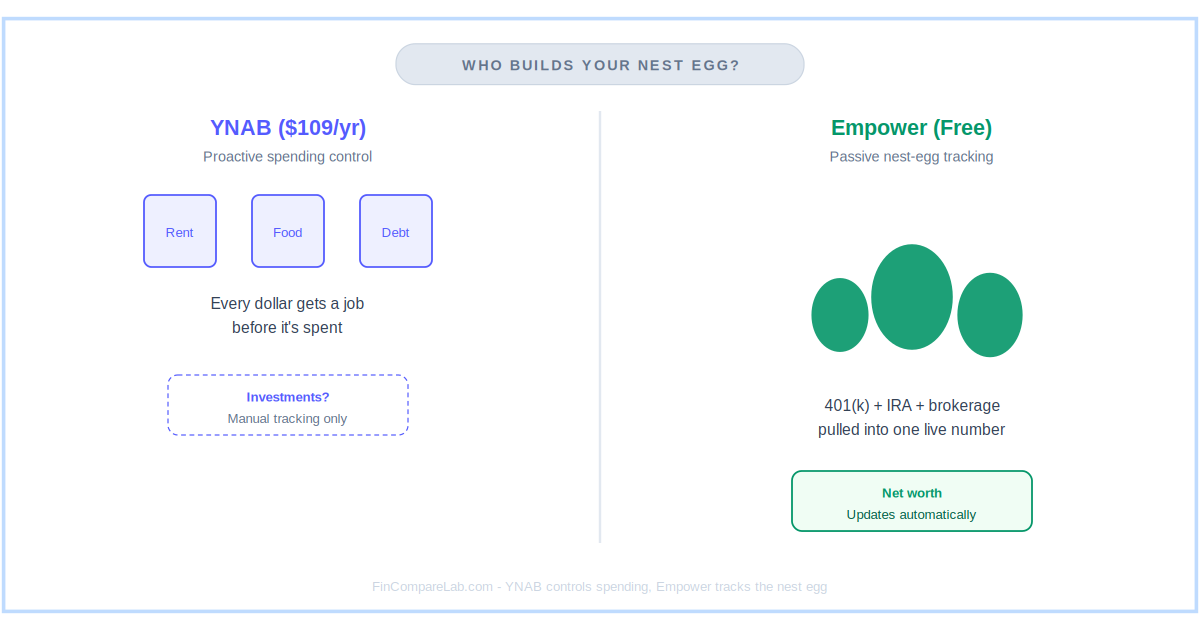
The nest egg comparison: YNAB controls what goes out, Empower tracks what’s building up, at no cost.
If you’ve got a 401(k), an IRA, or any brokerage account you want to monitor without lifting a finger, Empower is the strongest free option available. The retirement planner lets you model real scenarios: retire at 60 instead of 65, save $500/month more, or see what a 20% market drop does to your timeline, all at zero cost.
For a wider view of tools built specifically for this, see my best net worth tracking apps roundup, and my best personal finance software guide if you want more investing depth than a budgeting app typically offers. Monarch Money also covers some of this ground; see how it stacks up in my Monarch Money review.
Which app wins for active budgeting?
YNAB, clearly. Empower’s cash flow tracker shows you where money went after it already left your account. YNAB makes you decide where it’s going before you spend it, which is a fundamentally different relationship with money, and the one that actually changes behavior.
If you’re trying to stop overspending, build an emergency fund, or figure out why your account is always low three days before payday, YNAB is the tool. Empower won’t fix that, because the Empower budgeting app was never designed to.
My best budgeting apps for beginners roundup covers other tools that share YNAB’s active-engagement approach, and my YNAB ROI calculator can help you run your own break-even math before committing to $109/yr.
Which app is better for paying off debt?
YNAB wins here without much argument. The loan planner lets you model exactly how much interest you’ll save by adding $50/month to a payment, or what happens when you throw a tax refund at a student loan. You watch your debt-free date shift in real time, which is motivating in a way a passive tracker can’t replicate.
Empower has a debt section, but it treats debt as a line item in your net worth, not something to actively pay down faster. There’s no snowball or avalanche strategy, no what-if scenarios, no link between your balance and a monthly plan. My best budgeting apps for debt payoff guide covers a dedicated approach, and my debt payoff estimator tool can show you the numbers before you pick a method.
Which app is better for couples?
YNAB is stronger for couples who want to actively manage money together. One subscription covers up to 6 users with real-time sync, so both partners see the same budget instantly. You can set shared targets, split categories, and have real conversations about spending without one person defaulting to money-watcher duty. My YNAB vs Monarch comparison covers the couples angle in more depth if that’s your primary concern.
Empower can be used by couples, but it’s built for individual use. There’s no shared dashboard for joint active budgeting. It’s fine if one partner wants to monitor total household net worth quietly in the background, less useful if you’re trying to coordinate day-to-day spending across two incomes.
Is Empower the best YNAB free alternative to pair with YNAB?
Yes, and for a lot of people in personal finance communities, running YNAB and Empower together is the smartest setup available. YNAB handles day-to-day spending control. Empower handles the big-picture nest egg. They don’t overlap in any meaningful way, and the combined cost is still just $109/yr.
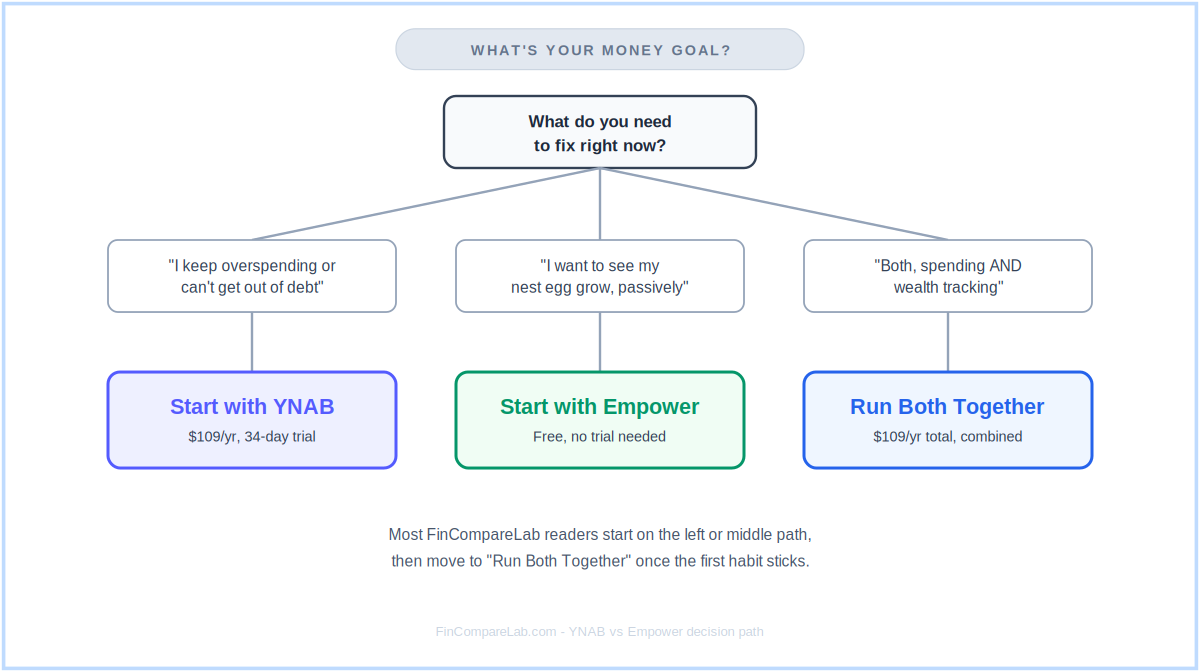
If your goal is stopping overspending, start with YNAB. If it’s watching your nest egg grow, start with Empower. If it’s both, run them together.
This pairing works especially well if you’re simultaneously paying down debt with YNAB’s loan planner while watching early investments compound on Empower’s dashboard. You get proactive control over today’s spending and a real-time view of tomorrow’s nest egg. The only ongoing management required is Empower’s advisor outreach — set a firm “not interested” once and move on.
If you’re weighing which YNAB free alternative pairs best with the full YNAB experience, Empower is the answer, since it adds investment and retirement tracking at zero incremental cost. For a broader look at other free options, my best free budgeting apps guide covers the field, and for how YNAB stacks up against another paid rival, my YNAB vs Rocket Money comparison covers that matchup.
What are the real watch-outs before you sign up?
Watch out: YNAB
- The learning curve is real. YNAB takes 2 to 4 weeks to click for most people. If you won’t engage with it regularly, you won’t get the value.
- No investment tracking. YNAB won’t show your 401(k), brokerage, or full net worth. You’ll need a separate tool, like Empower, for that.
- It costs $109/yr. Worth it for committed users, not worth it if you’ll check it twice and forget about it.
- Credit cards need extra attention. YNAB’s credit card method is powerful but unintuitive at first. Budget time for initial setup.
Watch out: Empower
- Advisor calls are persistent. Link $100K+ and expect regular outreach, roughly 1 to 2 calls per month by most accounts. Ignore them; the free tools stay excellent regardless.
- Budgeting is shallow. If changing spending behavior is your actual goal, the Empower budgeting app experience will disappoint you. Use YNAB or a similar planning-first tool instead.
- Sync issues happen. Bank connections occasionally drop and need re-authentication. Not unique to Empower, but worth knowing before you rely on it daily.
- It’s not a spending planner. Empower tracks wealth. Expecting it to manage your grocery budget is the wrong use of the tool.
What should you know about Empower’s rebrand from Personal Capital?
Empower was originally launched as Personal Capital in 2009, acquired by Empower Retirement in 2020, and fully rebranded to Empower by 2023. If you’ve seen “Personal Capital vs YNAB” or “Empower vs Personal Capital” content floating around from before 2023, the product it’s describing is the same one now called Empower, just under the old name.
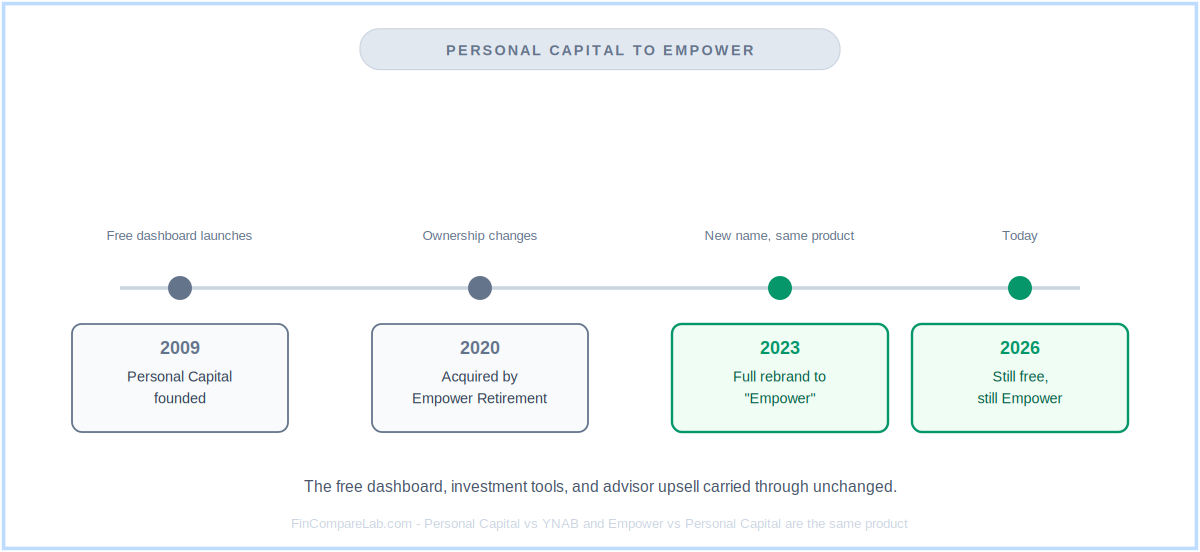
Whether you’re reading up on personal capital vs ynab or empower vs personal capital, it’s the same free dashboard under a new name since 2023.
Personal Capital vs YNAB: does the old name change anything?
No. Every comparison point in this guide holds whether you search “Personal Capital vs YNAB” or “Empower vs YNAB” — the free dashboard, the investment tools, and the advisor upsell all carried over unchanged through the rebrand. The only real difference is the app icon and the name in your app store search results.
Empower vs Personal Capital: what changed after the rebrand?
Functionally, very little. Empower kept the free dashboard, the net worth tracker, and the wealth management upsell exactly as they were under Personal Capital. What changed is mostly cosmetic — new branding, a refreshed app interface, and closer integration with Empower Retirement’s broader financial products.
If you used Personal Capital years ago and haven’t opened the app since, logging back in under the Empower name will feel familiar within a few taps. Any empower vs personal capital comparison you find today, ours included, is really just confirming a name change, not a product change.
What does Reddit say about YNAB vs Empower?
The community consensus on YNAB vs Empower is unusually consistent: these are complementary tools, not competitors. Across r/personalfinance, r/ynab, and r/budgeting, the most common take is that YNAB handles day-to-day spending while Empower handles the bigger nest-egg picture. People who search “ynab vs empower” expecting to pick a winner often end up running both.
Older personal capital vs ynab threads from before the rebrand read almost identically to today’s discussions, which is a good sign the underlying comparison has stayed stable.
The recurring theme in budgeting-focused threads is that YNAB’s discipline and Empower’s passive net worth view solve two different problems well enough that switching between them, or using both, beats forcing either one to do the other’s job. That’s the throughline in nearly every empower vs ynab thread you’ll come across, regardless of which app name gets mentioned first.
On finance-adjacent forums, the most consistent criticism of Empower is the advisor outreach once you link significant assets, while the most consistent YNAB criticism is the cost and the time it takes to build the habit. Neither is framed as a dealbreaker, more like a known trade-off you go in expecting.
Choose YNAB if…
- You’re living paycheck to paycheck and want to break the cycle
- You’re actively paying off debt and want a strategy, not just a tracker
- You’re a couple who wants to budget together on one subscription
- You want to build the discipline to save deliberately
- You’re willing to spend 10 to 15 minutes a week engaging with your money
Choose Empower if…
- You’ve got debt under control and are now focused on building wealth
- You want one free dashboard for every investment and retirement account
- You need to see your total nest egg across every account type
- You want to check whether investment fees are eating your returns
- You’re happy with passive tracking and don’t need a spending plan
Use both if…
- You want proactive spending control AND a full nest-egg and net worth view
- You’re simultaneously paying down debt and growing early investments
- You want the smartest free-plus-paid stack available, $109/yr total, nothing more
What are the most common questions about YNAB vs Empower?
Is Empower Good Enough to Replace YNAB?
No, not if active budgeting is your goal. Empower tracks where money went; YNAB helps you decide where money goes before you spend it. If you want to break overspending habits, pay down debt, or stop living paycheck to paycheck, YNAB’s zero-based method is the right tool.
Someone who has already paid off debt, has a solid savings rate, and wants to monitor their nest egg passively may find Empower satisfying on its own. But anyone needing real behavioral change around spending will find Empower too passive to make a dent. See my full Empower review for a complete breakdown of where it works and where it doesn’t.
Why Does YNAB Cost Money When Empower Is Free?
YNAB charges $109/yr because it’s a standalone software product with no other revenue stream. Empower is free because its real product is the wealth management arm — the dashboard attracts users with investable assets and converts a portion of them into paid advisory clients.
You can use Empower’s free tools indefinitely without ever engaging their advisors. That trade-off is how the free product gets funded — your data and attention are the entry cost. YNAB has no upsell; what you pay is what you get. My YNAB pricing breakdown works out to roughly $9/month, about two coffees, which is the honest framing for whether it’s worth it.
Does Empower Actually Help You Budget or Just Track Spending?
Empower primarily tracks spending. It categorizes transactions and shows cash flow automatically, but it doesn’t help you build a spending plan before money leaves your account. There’s no envelope system, no category targets, and no proactive income allocation.
If budgeting means knowing where money went, Empower handles that well at zero cost, which is exactly why it’s the most common YNAB free alternative for investment tracking specifically. If budgeting means deciding where money goes before you spend it, you need YNAB or a similar planning-first tool.
My best budgeting apps for beginners roundup covers your full range of options, and my best Monarch Money alternatives guide is worth a look if you want a middle ground between the two.
Is Empower vs YNAB the Same Question as YNAB vs Empower?
Functionally, yes. Whether you search “empower vs ynab” or “ynab vs empower,” you’re asking the same question, and the answer doesn’t flip depending on which app name comes first. The comparison only changes if your priority does: lead with YNAB if spending control is the goal, lead with Empower if nest-egg visibility is.
What’s the Difference Between Personal Capital and Empower?
None functionally. Personal Capital was the product’s name before its 2023 rebrand to Empower, following a 2020 acquisition by Empower Retirement. If a review or forum post you’re reading mentions Personal Capital, it’s describing the same free dashboard now sold under the Empower name. In practice, an empower vs personal capital search today should point you to the exact same product review.
However you landed on this YNAB vs Empower comparison, the next step is small: open YNAB’s 34-day trial if spending control is the gap, or link one account to Empower’s free dashboard if you just want to see your nest egg in one place for the first time. You can always add the other app later once you know which problem you’re actually solving.
📚 Read Next
