
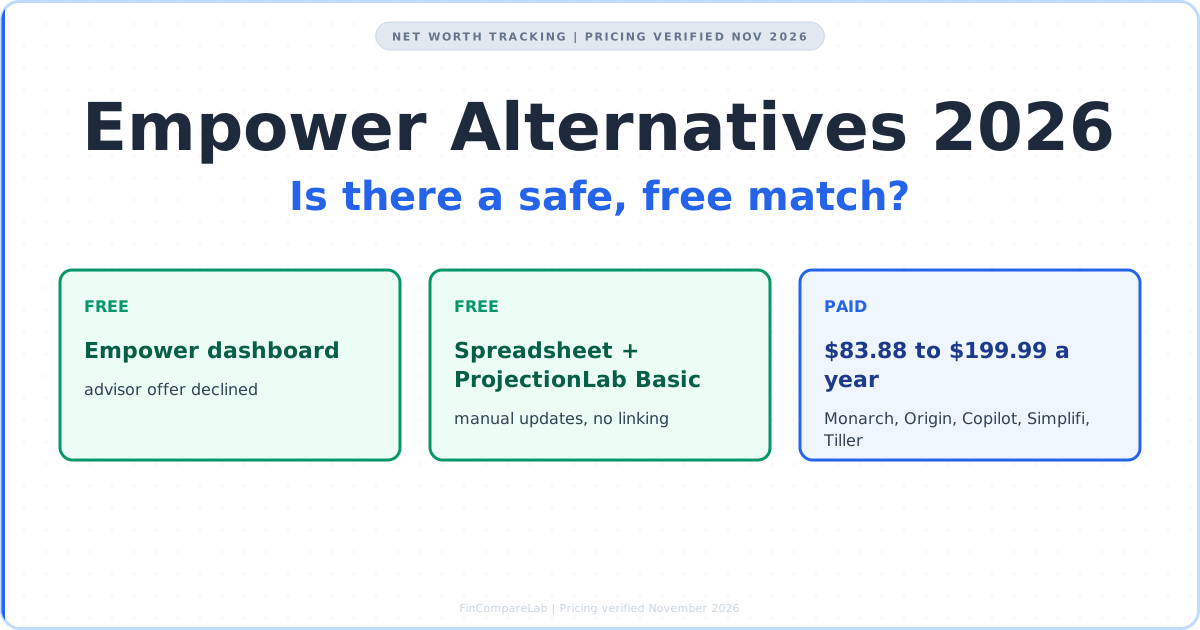
No free tool matches Empower’s net worth and investment tracking, so the realistic Empower alternatives are a paid app at $83.88 to $199.99 a year at regular prices or a free stack with gaps.
⚡ Quick Verdict
Monarch Money is the best net worth tracker among paid Empower alternatives if you also want budgeting. Origin Financial fits best if you also want planner sessions and tax filing under one subscription. Neither is free, so the only safe, free match is Empower’s own dashboard with the advisory offer declined, plus a spreadsheet for the gaps.
How We Review Apps, Pricing verified from empower.com and each app’s official site — 8 November 2026
What’s in this guide?
- Is there a safe, free match among Empower alternatives?
- What do you lose when you leave Empower?
- What does Empower’s advisory fee actually cost?
- Which paid app replaces the most of Empower?
- How do you build a free replacement from free tools?
- Which replacement fits couples, debt payoff, or heavy investors?
- Is it safe to link your accounts to an Empower alternative?
- What do people ask before leaving Empower?
Is there a safe, free match among Empower alternatives?
No free app among the Empower alternatives matches Empower’s linked net worth and investment tracking. The safe, free route is staying on Empower’s dashboard, declining the advisory pitch, and filling gaps with a spreadsheet. A single app with linked accounts costs $83.88 to $199.99 a year at regular prices.
Empower does three jobs for free. It shows net worth across linked accounts, checks your investments, and projects retirement. Replacing it starts with deciding which of those you actually opened the app for. Most people come for the net worth number, and that’s the piece that costs money or manual typing everywhere else.
It’s also why so many apps like Empower turn out to be budgeting apps with no net worth screen. Check each pick’s net worth row before you trust its marketing, and don’t assume a linked balance means a real investment view.
The word safe needs a definition too. Empower’s dashboard is free because Empower earns money from its advisory arm, which charges a percentage of assets only after you hire it. Declining costs nothing. For many readers, the free match is Empower itself with the sales pitch ignored.
If the pitch is the reason you’re leaving, a paid app fixes it. The best net worth tracker among the Empower alternatives depends on your accounts, and the shortlist is Monarch Money, Origin Financial, Copilot Money, Quicken Simplifi and Tiller.
Searches for personal capital alternatives and personal capital competitors land on the same list, because Empower is the renamed Personal Capital. My best net worth tracking apps roundup covers the wider field, and the table below shows which job each pick replaces.
| Job Empower does | Free replacement | Paid replacement | Gap you accept |
|---|---|---|---|
| Net worth across linked accounts | ⚠️ Spreadsheet, balances typed monthly | ✅ Monarch, Simplifi, Copilot, Origin | Free route has no automatic sync |
| Investment checkup | ✅ Empower dashboard itself | ⚠️ Monarch Plus, Copilot, Simplifi | No paid app is confirmed equal to Empower’s analysis |
| Retirement what-if | ✅ ProjectionLab Basic, $0, no account linking | ✅ Monarch Plus forecasting | Free planner needs manual entry |
| Budgeting and cash flow | ⚠️ Goodbudget, EveryDollar free manual | ✅ Any paid app on this list | Free budgeting apps skip net worth |
Pricing verified from official websites, November 2026.
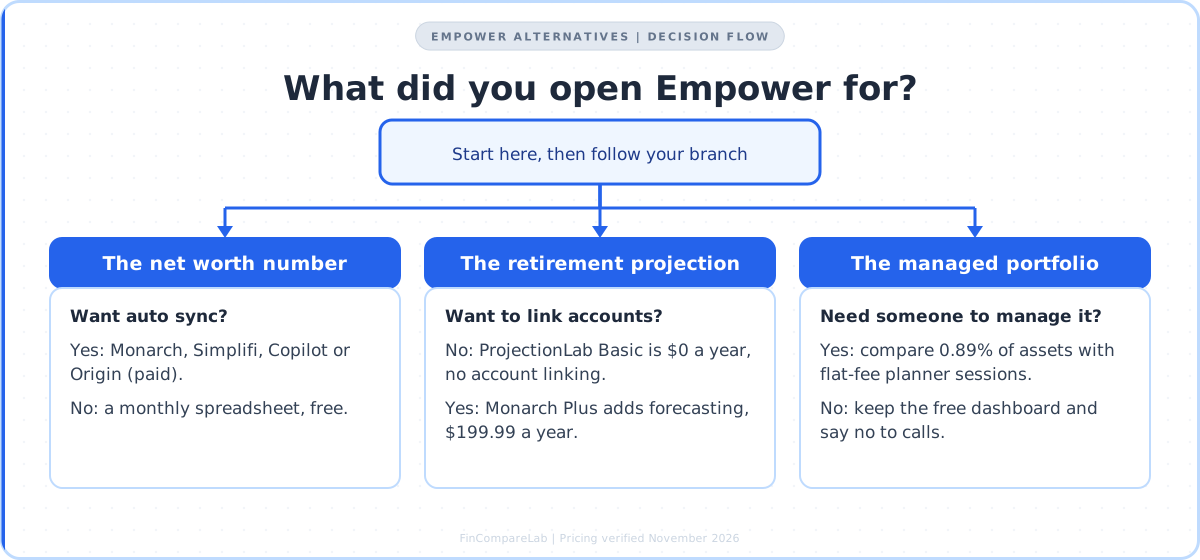
The free column works, but it costs you manual updates and a second source of truth. The paid column removes the manual part and adds a subscription. Neither column replaces the advisor, so if you were paying Empower for portfolio management, skip ahead to the fee section.
What do you lose when you leave Empower?
You lose the history first. Switching means re-linking every account, and one competitor’s write-up reports that Empower’s CSV export carries date, account, description, category, tags and amount, with no ticker, quantity or price (unconfirmed as of 8 November 2026). Treat your transaction history as portable and your holdings history as gone. I haven’t confirmed that any of the best net worth tracking apps imports holdings from Empower.
I made the same call when I moved from YNAB to Monarch after 15 years. I wanted net worth, investments and cash flow on one screen, which is exactly the job Empower does. I didn’t import a single YNAB file, because credit-card transfers would have wrecked the cash flow reports. I archived the old budgets and started from prior-month balances.
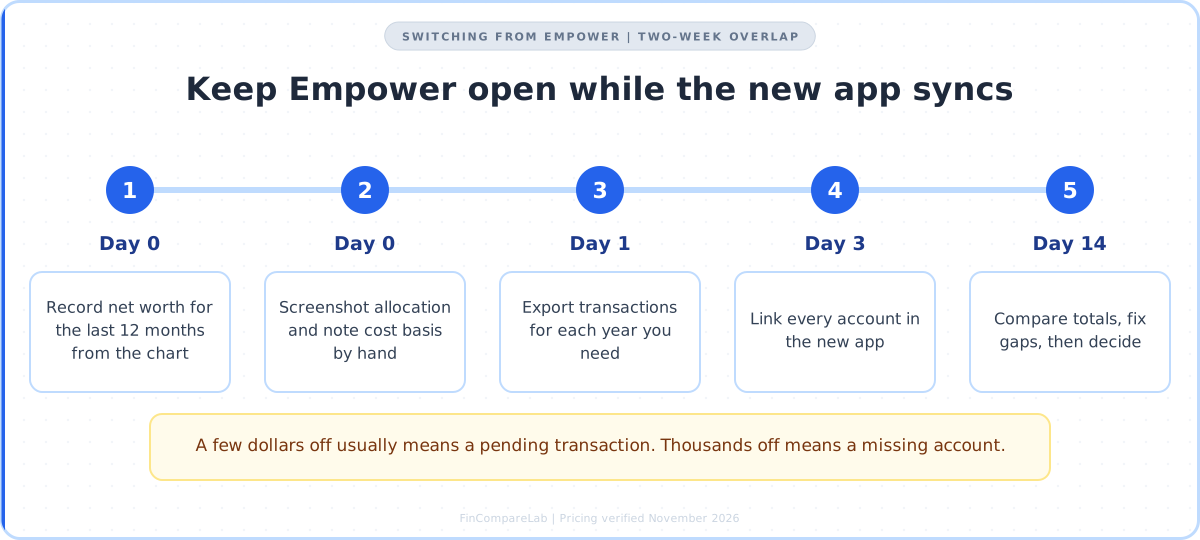
Whichever best net worth tracker you pick, write down your net worth for the first of each of the last twelve months from the chart before you close anything. Screenshot the investment allocation page, and export transactions for every year you care about. Note each account’s cost basis by hand, since a balance screenshot doesn’t carry it.
Keep Empower open for two weeks while the new app syncs. Compare the totals on day 14, and fix any account that’s off before you cancel or stop logging in. A mismatch of a few dollars usually means a pending transaction, while a mismatch of thousands means a missing account.
Community write-ups, which I read secondhand through GummySearch summaries and a ChooseFI forum thread, split in a predictable way. Minimalists call Empower free and good enough, and one ChooseFI poster reported losing past data after the rebrand. One report isn’t proof, but it’s the reason for the two-week overlap.
What does Empower’s advisory fee actually cost?
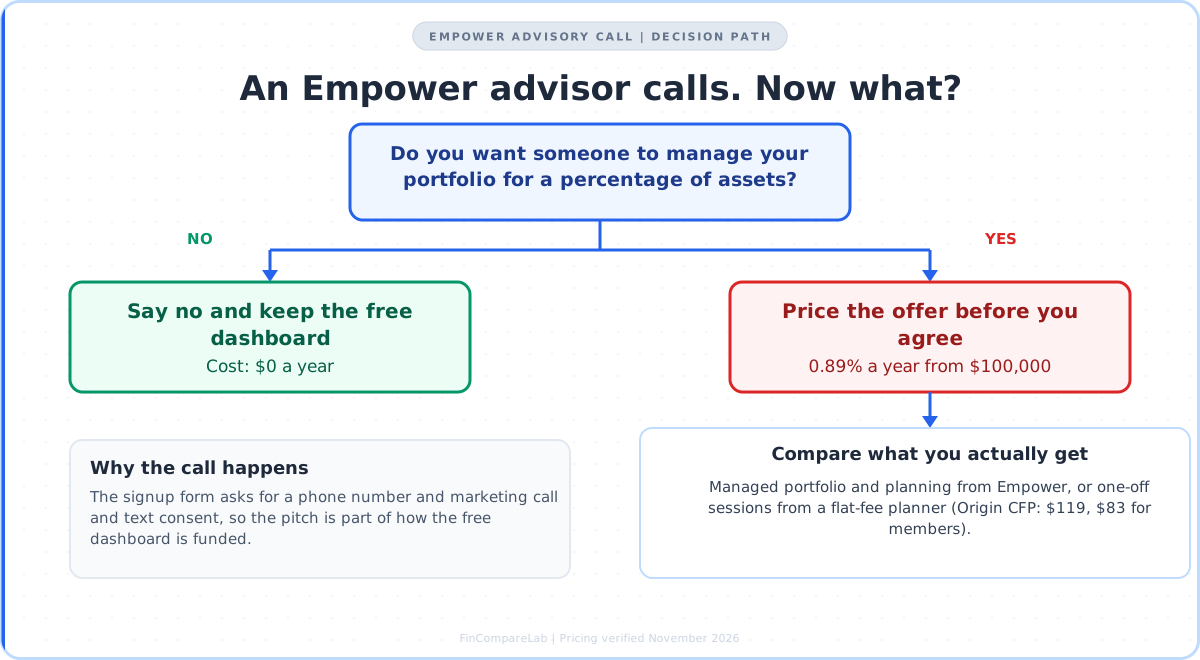
Empower’s Personal Strategy page lists 0.89% a year for balances from $100,000 to $999,999. Private Client starts at $1 million with 0.79% on the first $3 million, then 0.69%, 0.59%, and 0.49% above $10 million. The 0.49% rate you see quoted applies only to the very top tier.
| Managed balance | Rate | Advisory fee per year |
|---|---|---|
| $100,000 | 0.89% | $890 |
| $250,000 | 0.89% | $2,225 |
| $500,000 | 0.89% | $4,450 |
| $1,000,000 | 0.79% | $7,900 |
Advisory fees from Empower’s Personal Strategy page, read 8 November 2026. Empower says its average ETF expense ratio is 0.06%, which comes on top.
On $500,000, that ETF cost adds roughly $300, so the all-in bill lands near $4,750 a year. Over three years the advisory fee alone is $13,350. A paid replacement app runs $199 to $599.97 over the same stretch, but it doesn’t manage your money, and that difference matters.
This is the math I’d run before shopping for personal capital alternatives. If ongoing management is what you’d pay for, price a flat fee against it. Origin sells CFP sessions at $119 each, or $83 for members (last confirmed 3 November). That isn’t portfolio management, but it covers one-off planning questions without a percentage of your assets.
If you never planned to hire Empower, the fee is irrelevant and the dashboard stays free. The fee only becomes the deciding factor when you want the managed portfolio, and then a replacement app doesn’t solve the problem.
Which paid app replaces the most of Empower?
Apps like Empower fall into three types: net worth first, budgeting first, and spreadsheet first. The table shows verified pricing and where each one is thinner than Empower, which is what people hunting personal capital alternatives mostly want to know. I rank these Empower alternatives by how much of Empower’s net worth job survives the switch, not by feature count.
| App | Price | Free tier | Net worth and investing | Skip it if |
|---|---|---|---|---|
| Monarch Money | $99.99/yr Core, $199.99/yr Plus | ❌ 7-day trial, card required | ✅ Net worth and investments, deeper on Plus | You need a permanent free tier |
| Origin Financial | $99/yr or $12.99/mo, $1 first year for new users | ❌ Trial suspended during the promo | ✅ Budgeting, investing, planner sessions | You hold a Schwab 401(k) |
| Copilot Money | $109/yr limited time, $18/mo | ❌ Trial length unconfirmed | ⚠️ Benchmarks and allocation views | Anyone on Android needs access |
| Quicken Simplifi | $47.88 first year, then $83.88/yr list | ❌ 30-day money-back, no trial | ⚠️ Monitoring, not deep analysis | You want allocation modeling |
| Tiller | $99/yr | ❌ 30-day trial | ✅ Whatever you build in the sheet | You won’t maintain a spreadsheet |
Pricing verified from official websites, November 2026.
| Option | Year 1 | Three years |
|---|---|---|
| Empower dashboard, no advisor | $0 | $0 |
| Origin ($1 promo, then $99) | $1 | $199 |
| Quicken Simplifi (renewal at list unconfirmed) | $47.88 | $215.64 |
| Monarch Core | $99.99 | $299.97 |
| Tiller | $99 | $297 |
| Copilot Money ($109 limited-time offer) | $109 | $327 |
| Monarch Plus | $199.99 | $599.97 |
Three-year totals are my own arithmetic from the listed prices, with no promos assumed after year one.
Is Monarch Money the closest match to Empower?
Yes for most people: Monarch shows net worth and investments next to budgets and cash flow in one app, and Plus adds retirement forecasting and fund analysis. Core costs $99.99 a year after a 7-day trial that needs a card, and the WELCOME code showed 30% off Core for year one on the pricing page on 8 November.
As the best net worth tracker for people who also budget, Monarch earns the top spot. Plus is where Empower’s retirement planner gets replaced, since forecasting, scenario modeling and Morningstar fund analysis sit in that tier. A partner joins free on both tiers, based on my last read of Monarch’s help center on 28 October.
I moved to Monarch for the single-screen net worth view. The envelope mindset needed rewiring, and sinking funds need Category Budgeting mode with Rollover switched on.
The catch is cost, because there’s no permanent free tier. Read my Monarch Money review, the Monarch Money pricing guide, or the direct Monarch vs Empower comparison. Is Monarch Money safe covers the data side. Try Monarch Money
Is Origin Financial worth it if you want planner sessions?
Yes if you’d otherwise pay a planner: Origin costs $99 a year, with the first year at $1 for new users, and sells CFP sessions at $119 or $83 for members. The $1 offer suspends the free trial, renews at $99, and my review flags that nothing warns you before the renewal.
Among apps like Empower, Origin is the only one that bundles planner sessions. Its own FAQ blog admits friction linking some Schwab 401(k) accounts and Webull, which matters if your retirement money sits there (read 2 November). The budget also resets monthly with no rollover.
Whether the $1 checkout needs a card is unconfirmed as of 8 November 2026. I rate it 4.4 out of 5 in my Origin Financial review.
The Origin Financial pricing guide has the add-on fees, Origin vs Monarch Money is the head-to-head, and is Origin Financial safe answers the security question. Try Origin Financial
Is Copilot Money good for investors who live on iPhone?
It’s strong for iPhone and Mac households, with index benchmarking and allocation views on Copilot’s own feature list (read 22 October), but there’s no native Android app. The pricing page showed $109 a year as a limited-time offer against a $119 list price, and $18 a month, with no end date shown on 8 November.
The partner invite is marked “coming this fall” on that page. An earlier help-center read described sharing through a Magic Link on one subscription, which I couldn’t re-confirm on 8 November. Among Empower alternatives, it’s the best looking and Apple-only. For couples on mixed phones, the sharing uncertainty alone is a reason to start with Monarch.
See the Copilot Money review, Copilot Money pricing, Monarch vs Copilot and is Copilot Money safe. Try Copilot Money
Is Quicken Simplifi the cheapest Empower alternative?
Yes at list price: $83.88 a year, or $47.88 for year one ($3.99 a month billed annually) on new orders placed directly with Quicken by 29 November 2026, 11:59 PT. Origin’s $1 first-year promo undercuts it. Simplifi renews at the then-current rate, and offers don’t stack.
As a net worth tracker app, Simplifi has the lowest regular price here. Its investment view covers holdings, cost basis, performance and quotes, which is a monitoring screen and not Empower-style allocation analysis, in my read of Quicken’s feature page. Quicken lists a 30-day money-back window and no trial.
Read the Quicken Simplifi review, the Simplifi pricing guide, and Monarch vs Simplifi. Try Quicken Simplifi
Is Tiller worth it if you like spreadsheets?
Yes if you’d rather own the data: Tiller costs $99 a year with a 30-day trial and feeds bank data into a Google Sheet or Excel file you control. Your card isn’t charged until the trial ends, and sales tax is added afterward where your state requires it.
Tiller publishes its own net worth spreadsheet for Google Sheets, so the net worth view is yours to shape. Of all the Empower alternatives here, Tiller needs the most work from you.
There’s no native Tiller iOS app, so you work in the Sheets app on your phone. See the Tiller Money review, Tiller pricing and YNAB vs Tiller. Try Tiller
Do Albert, PocketGuard, Goodbudget or EveryDollar replace Empower?
No, they’re budgeting apps, so they replace Empower’s spending side and drop the net worth view. Albert’s Genius tier is $39.99 a month and is an AI assistant, not human guidance, while Standard is $19.99. Read my Albert review before paying either.
None of these apps like Empower track net worth the way the paid picks do. PocketGuard lists $12.99 a month or $74.99 a year, and its free tier is unconfirmed as of 8 November 2026 because its own blog posts disagree. Goodbudget and EveryDollar both have free versions built for spending, not net worth. See the PocketGuard review, Goodbudget review, EveryDollar review and best free budgeting apps.
How do you build a free replacement from free tools?
Keep Empower’s dashboard for the linked net worth and investment view, as long as you never hire the advisory arm. Then add a spreadsheet for what it can’t see, a free planner for retirement what-ifs, and a free budgeting app for spending. Each piece covers one job and leaves one gap, and among the free Empower alternatives this stack is the closest match.
For the spreadsheet, the free net worth tracker Google Sheets template from my sister site keeps balances in your own Drive with no bank login, and it includes a 12-month trend chart. For retirement what-ifs, ProjectionLab’s Basic plan is $0 a year and doesn’t link accounts, while Premium is $129 a year.
The trade-off is two sources of truth that drift apart. Pick Empower’s linked total as the number of record and use the sheet only for history and for assets Empower can’t see, like a car or a private loan. Update the sheet on the first of each month, which takes about one number per account.
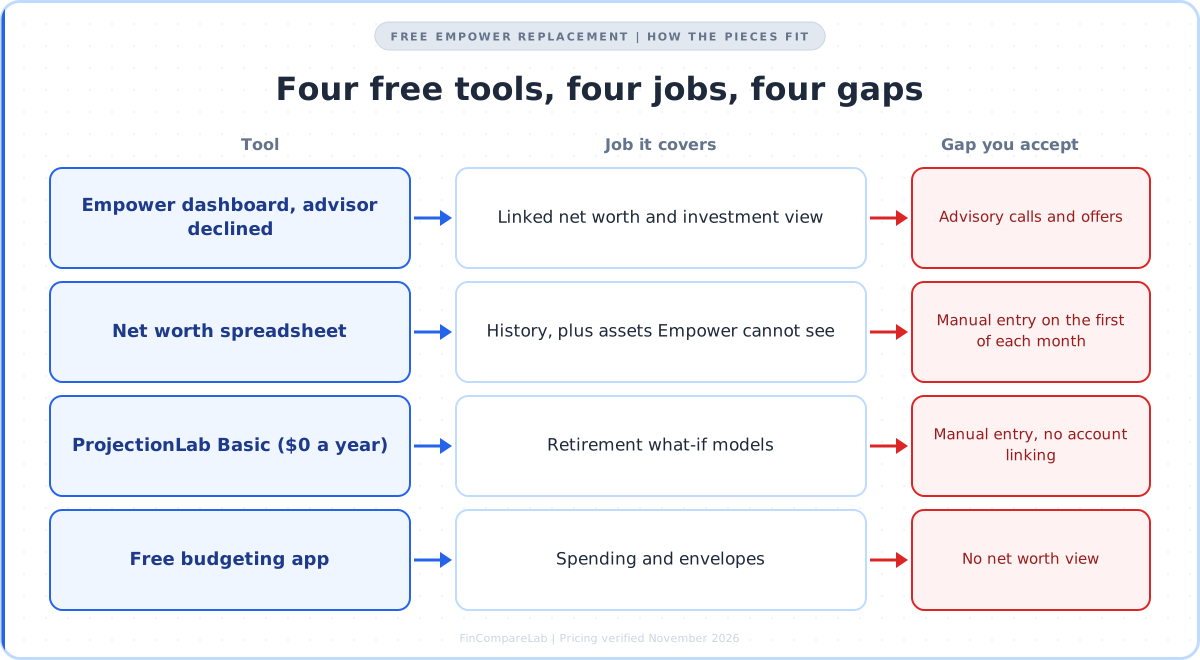
This stack has one real weakness: nothing in it syncs your 401(k) cost basis for you. If that’s your main need, the free route loses to a paid app, and Simplifi at $47.88 is the cheapest fix. Anyone who wants the best net worth tracker for free with automatic sync is really asking for Empower again.
Among the best net worth tracking apps, Empower’s dashboard is the only free one with linked accounts that I can confirm.
Which replacement fits couples, debt payoff, or heavy investors?
Couples comparing Empower alternatives should start with Monarch, since a partner joins free on both tiers per Monarch’s help center, while Copilot’s partner invite is still marked coming this fall. Honeydue is the budget-only option, with reliability caveats covered in Honeydue vs Monarch and my best budgeting apps for couples guide.
Debt payoff is the weakest fit across this whole list. None of these Empower alternatives is built around a payoff plan the way a dedicated planner is. Run your balances through my debt payoff estimator, then read how to get out of debt fast and the best debt payoff apps.
Heavy investors should compare Monarch Plus and Origin, the two best net worth tracker options among Empower alternatives for serious portfolios. Monarch Plus adds unrealized gains and fund analysis, and Origin bundles planner sessions. If your assets include crypto, property or private funds, a dedicated net-worth tool like Kubera covers more, though third-party pages list its price anywhere from $150 to $250 a year (unconfirmed as of 8 November 2026).
Is it safe to link your accounts to an Empower alternative?
Every one of the Empower alternatives here links through an aggregator, so the answer is reasonably yes, if the app is read-only, supports two-factor authentication, and names its data providers. A best net worth tracker that can’t name its data providers isn’t worth connecting. Nobody can promise zero risk, and I won’t. What you can check is what each app says about how it connects to your bank.
Monarch lists its providers as Plaid, Mastercard Data Connect (formerly Finicity) and MX, and it runs a public status dashboard (help center, read 6 November). Copilot added authenticator-app two-factor sign-in on 18 March, though coverage on Mac and web is unconfirmed as of 8 November 2026. Read the individual safety guides linked above before you connect a brokerage login.
Use a unique password, switch on two-factor authentication before linking the first account, and unlink accounts you’ve closed. Test sync for two weeks before you cancel anything. One recurring complaint in community write-ups about Empower itself is accounts that need reconnecting, so test sync in whatever you pick before you cancel anything.
What do people ask before leaving Empower?
Is Empower really free?
Yes, Empower’s dashboard is free to use, including net worth tracking and the retirement planner. The paid part is Personal Strategy, which charges 0.89% a year on balances from $100,000 and only applies if you hire it.
Why does Empower keep calling me?
The signup form asks for a phone number and marketing call and text consent (read 24 October). Reviewers describe more outreach once linked balances pass roughly $100,000, though that threshold is user-reported and unconfirmed as of 8 November 2026. Use the call as information, and say no if you don’t want managed investing.
Is Empower the same as Personal Capital?
Yes, Empower acquired Personal Capital in 2020 and had completed the rebrand by 2023. The free dashboard people knew as Personal Capital is now Empower’s dashboard, which is why personal capital alternatives and Empower alternatives are the same search.
Is Empower the same company as Empower Finance?
No. Empower (empower.com) is the net worth and investment dashboard in this guide. Empower Finance was a separate cash-advance company that rebranded to Tilt, so a cash-advance search needs a different guide.
Can I keep Empower’s dashboard and add a budgeting app?
Yes, and plenty of people do. Keep Empower for the net worth and investment view, then run spending through YNAB, EveryDollar or Goodbudget, and you’ll just manage two logins. My best personal finance software guide explains how to split the jobs.
How much does it cost to replace Empower with a paid app?
Expect $83.88 to $199.99 a year at regular prices, from Simplifi’s list price to Monarch Plus, and the best net worth tracking apps sit inside that range. Promos cut year one to as little as $1 at Origin or $47.88 at Simplifi. Even the top price sits far below the $4,450 a year that 0.89% costs on $500,000, and apps like Empower for budgeting alone cost less still.
Where can you find more sites like Personal Capital?
Start with my best Monarch Money alternatives and best Mint alternatives lists. Both cover apps like Personal Capital and more Empower alternatives that this guide skips, and the Empower review has the full breakdown of what the dashboard does.
Your next move is small: write down your current net worth from Empower today, pick one paid app or the free stack, and start the two-week overlap before you touch a single account.
📚 Read Next
