

Quicken Simplifi’s $3.99/month promo rate renews at $6.99/month after year one, a $36 jump most competitor content leaves out. This quicken simplifi review checked that exact renewal math directly at quicken.com on 15 September 2026.
⚡ Quick Verdict
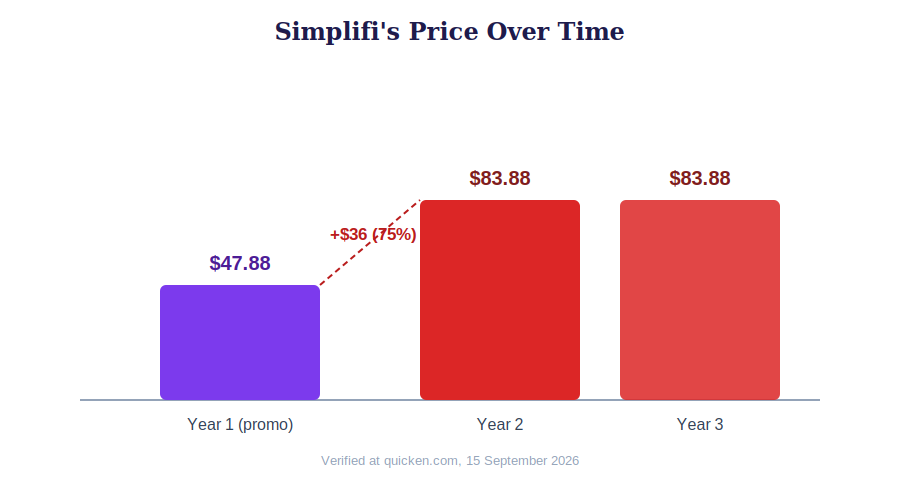
Quicken Simplifi’s $3.99/month new-subscriber rate ($47.88/year) is real, and it still undercuts YNAB and Monarch Money on price. What most simplifi review posts skip is the renewal: the standard rate is now $6.99/month ($83.88/year), a $36 jump that’s roughly 75% higher than what you paid in year one.
That renewal price lands above PocketGuard and Goodbudget’s plans too, so the “cheapest paid app” claim only holds for exactly one year. The Spending Plan, bank sync, and Retirement Planner are still genuinely good. Budget for year two before you sign up.
Price: $47.88/yr promo ($3.99/mo) · renews $83.88/yr
Trial: No free trial, 30-day money-back guarantee
Best for: Solo budgeters who want automated tracking, not envelope discipline
How We Review Apps · Pricing verified from quicken.com — 15 September 2026
📋 In This Quicken Simplifi Review
- What Is Quicken Simplifi?
- How Much Does Quicken Simplifi Cost in 2026?
- What Happens When the Simplifi Promo Ends?
- What Features Does Simplifi Include?
- How Does the Spending Plan Actually Work?
- Is Quicken Simplifi Available Outside the US?
- What Are Simplifi’s Biggest Trade-offs?
- How Reliable Is Simplifi’s Bank Syncing?
- How Much Does Simplifi Cost Over 3 Years?
- Who Should Use Quicken Simplifi?
- Who Should Not Use Quicken Simplifi?
- How Does Simplifi Compare to Monarch, YNAB, and PocketGuard?
- Is Quicken Simplifi Worth It in 2026?
- What Do People Ask About Quicken Simplifi?
Quicken runs an almost constant new-subscriber discount, and that discount is the number every other site quotes. The number that actually determines whether Simplifi is a good deal is the one nobody leads with: what you pay starting in month thirteen.
I checked pricing directly at quicken.com on 15 September 2026, and the gap between year one and year two is bigger than it’s been in past cycles. That renewal jump changes the calculus on a couple of comparisons this review used to make confidently, so I’ve rebuilt the numbers from scratch rather than repeat last year’s math.
Simplifi is built by Quicken, a company that’s been writing personal finance software since the 1980s, and that heritage shows up mainly in one place: bank-connection reliability across 14,000+ institutions. As a simplifi budget app, it launched in 2020 as a mobile-first alternative to Quicken’s legacy desktop software, aimed at people who want automated tracking rather than a budgeting methodology to learn.
What Is Quicken Simplifi?
Quicken Simplifi is a cloud-based budgeting and net-worth app that connects your bank accounts, credit cards, loans, and investments, then uses a flexible Spending Plan instead of strict budget categories to show what’s safe to spend. It costs $3.99 a month for new subscribers, renewing at $6.99 a month after year one.
Simplifi runs entirely on web and mobile with no desktop install, doesn’t share data with Quicken Classic, and isn’t a stripped-down version of it. It’s a separate product, built for people who want automated visibility over their money without Quicken Classic’s depth, its Schedule C/E/F tax exports, or its desktop-only workflow. If you’re an existing Quicken Classic user weighing a switch, our Quicken Classic review breaks down what you’d be giving up.
On the Apple App Store, Simplifi holds a 4.5/5 rating from over 11,000 reviews, confirmed directly on 15 September 2026. Google Play ratings for the same app vary by source, from 4.3 to 4.7, and I wasn’t able to independently reconfirm one figure this session, so treat any single Google Play number with some caution until it’s rechecked directly.
| Price | $47.88/year ($3.99/mo) first-year promo · renews at $83.88/year |
| Trial | No free trial. 30-day money-back guarantee instead |
| Platforms | iOS, Android, Web |
| Availability | United States and Canada |
| Bank connections | 14,000+ financial institutions via Plaid |
| Budgeting method | Spending Plan (flexible), also works for zero-based or 50/30/20 styles |
| Investment tracking | Yes, cost basis, performance, holdings (monitoring, not analysis) |
| Retirement Planner | Yes, mobile + web, 15 adjustable variables |
| Debt payoff planner | Not available |
| Ads | None, subscription-funded |
How Much Does Quicken Simplifi Cost in 2026?
Quicken Simplifi costs $3.99 a month ($47.88 a year) for new subscribers, confirmed directly at quicken.com on 15 September 2026, with a 42% discount badge attached to the checkout page. Billing is annual only. There’s no month-to-month plan at any price.
The badge is accurate, but it measures the discount against the wrong baseline for planning purposes. The 42% is calculated against the current $6.99/month sticker price, not against what you’ll actually be billed after your first year, which is the number that matters for real quicken simplifi pricing planning.
Here’s how Simplifi’s price stacks against the paid competition FinCompareLab covers most often, at both the promo rate and the standard renewal rate:
| App | Promo year | Standard annual | Monthly option |
|---|---|---|---|
| Simplifi | $47.88 | $83.88 | Annual only |
| PocketGuard | $74.99 | $74.99 | $12.99/mo |
| Goodbudget | $80 (Premium) | $80 | Annual only paid tier |
| Monarch Money | $99.99 | $99.99 | $14.99/mo |
| YNAB | $109 | $109 | $14.99/mo |
Pricing verified from official websites, 15 September 2026.
For the full Simplifi pricing breakdown across every promo cycle Quicken has run since 2024, see the dedicated pricing guide linked at the end of this post.
Notice what happens to Simplifi’s ranking once the promo ends. In year one it’s the cheapest option on this list by a wide margin. By year two, PocketGuard and Goodbudget have both quietly overtaken it. That’s the comparison most quicken budget app review posts never run, because they only quote the promo figure.
Does Quicken Simplifi Have a Free Trial?
No. Anyone searching quicken simplifi free trial options should know upfront that Simplifi does not offer one. Instead, it comes with a 30-day money-back guarantee: you pay for the annual plan upfront, and if it’s not a fit, you can request a full refund within 30 days through Quicken directly, the Apple App Store, or Google Play.
What Happens When the Simplifi Promo Ends?
Your Simplifi subscription renews automatically at $83.88 a year once your first-year promo period ends, a 75% increase over the $47.88 you paid to start. Quicken’s own terms and conditions state the subscription renews “at the then-current rates,” and nothing in the checkout flow flags the size of that jump in dollar terms.
Seventy-five percent is a bigger jump than the renewal increases on most of the apps this site tracks. For comparison, Quicken Classic’s own renewal increase runs around 67% on its Deluxe tier, and that one’s already flagged as a trap in FinCompareLab’s Classic coverage. Simplifi’s jump is worse in percentage terms, just smaller in absolute dollars because the base price is lower.
The practical fix is simple and doesn’t require canceling: put a calendar reminder on your renewal date, and re-run the simplifi pricing table above before it hits. Quicken frequently runs a similar new-subscriber promo for a second year if you contact support and ask, though that isn’t guaranteed and isn’t advertised anywhere on the pricing page.
What Features Does Simplifi Include?
Featured snippet: Simplifi includes automatic bank sync across 14,000+ institutions, a flexible Spending Plan, investment monitoring, a mobile-and-web Retirement Planner with 15 variables, monthly credit score tracking, a refund tracker, and Spaces sharing for one additional person, but no debt payoff planner and no import from Quicken Classic.
| Feature | Available | Notes |
|---|---|---|
| Spending Plan | Yes | Core feature. Income minus bills equals safe to spend |
| Automatic bank sync | Yes | 14,000+ institutions via Plaid, highly reliable |
| Investment tracking | Yes | Cost basis, performance, holdings. Monitoring only |
| Retirement Planner | Yes | Mobile + web, 15 variables across Basic/Advanced tabs |
| Credit score tracking | Yes | Monthly VantageScore 3.0 via Equifax |
| Refund tracker | Yes | Tracks expected refunds, alerts on receipt |
| Spaces (shared access) | Yes | 1 additional person per space |
| Debt payoff planner | No | Gap versus YNAB and PocketGuard |
| Import from Quicken Classic | No | Separate product, start fresh |
How Does the Spending Plan Actually Work?
Simplifi’s Spending Plan starts with your monthly income, subtracts your bills and savings goals, and shows what’s genuinely safe to spend for the rest of the month, updating automatically as you spend with no manual category allocation. That’s the actual mechanism behind the feature, and it explains both why people like Simplifi and where it breaks down.
Three buckets do the actual math:
- Bills and subscriptions, fixed recurring costs, auto-detected from your transaction history
- Savings goals, committed amounts deducted before anything else
- Flexible spending, what’s left over for discretionary categories
The calculation assumes a monthly income pattern. If you’re paid biweekly, Simplifi’s Spending Plan will show a distorted number in the two months a year you get three paychecks instead of two, because it’s still dividing by a flat monthly figure rather than tracking your actual pay cadence. The workaround is to manually average your income across the year and enter that as your baseline rather than letting Simplifi calculate it from your most recent paycheck.
Freelancers and commission-based earners hit the same issue in a more pronounced way. Simplifi has no separate mode for irregular income, unlike YNAB, which is built around exactly that problem. If your income varies by more than about 20% month to month, budget for extra manual adjustment or look at our irregular-income budgeting guide before committing to Simplifi specifically.
Is Quicken Simplifi Available Outside the US?
Quicken Simplifi is available in the United States and Canada. It is not limited to the US, and it does not extend beyond those two countries. Quicken’s own terms state its products “are not designed to function outside the U.S. and Canada.”
This corrects a claim that circulated in older budgeting-app roundups, including an earlier version of this simplifi review, describing Simplifi as US-only. If you’re in the UK or EU, Simplifi won’t connect to your banks at all. Monarch Money has the same US-and-Canada limit. YNAB has the widest reach among the apps FinCompareLab covers, working across the US, Canada, the UK, and parts of the EU, which is worth knowing if you split time between countries.
What Are Simplifi’s Biggest Trade-offs?
Simplifi’s main trade-offs are the year-two price jump, no debt payoff planner, and annual-only billing with no way to test drive it beyond a refund window. None of these are dealbreakers for a solo budgeter who mainly wants spending visibility, but each one changes the calculation depending on your situation.
The renewal price erases the value case for price-sensitive buyers. This is the trade-off that changed the most since FinCompareLab last reviewed Simplifi. At $83.88 a year, Simplifi is no longer the cheapest paid app in this category.
PocketGuard’s flat $74.99/year and Goodbudget’s $80 Premium tier both undercut Simplifi’s standard rate, by $8.89 and $3.88 respectively. If price is your main filter and you’re not planning to cancel before renewal, run the comparison against Simplifi’s year-two number, not its promo number.
No debt payoff planner. If you’re carrying credit card debt and want a structured avalanche or snowball plan, Simplifi doesn’t build one. It tracks debt balances as part of net worth, but there’s no tool to model payoff timelines. YNAB and PocketGuard both do this well. Pair Simplifi with the free Debt Payoff Estimator if you want to stay on Simplifi anyway.
Annual billing only, with no monthly fallback. You commit to a full year upfront. The 30-day money-back guarantee softens this, but it’s still a bigger up-front ask than YNAB or Monarch’s monthly plans, and it’s a real factor in any honest simplifi pricing comparison.
Investment features are monitoring, not analysis. You can see portfolio value, holdings, and performance, but there’s no allocation modeling or stock screening. Active investors get more depth from Empower’s free tier or from Monarch, which is worth weighing alongside simplifi cost if investing is your priority.
Spaces caps sharing at one additional person. You can invite a partner or advisor, but it’s one person per space, not Monarch Money’s more flexible household setup, another point in the simplifi vs monarch decision.
How Reliable Is Simplifi’s Bank Syncing?
Simplifi connects to over 14,000 financial institutions through Plaid, and bank-sync reliability is one of its most consistently praised features across the simplifi review sources checked for this piece. Quicken’s decades of aggregation experience translate into fewer dropped connections than some newer, smaller competitors manage.
Monarch Money spreads its connections across Plaid, Finicity, and MX, which gives it a slight edge in redundancy if one aggregator has an outage. Simplifi’s single-aggregator setup means a Plaid-wide outage affects every Simplifi user simultaneously, though in practice these outages are short and infrequent. All three apps use bank-grade 256-bit encryption and read-only connections, so none of them can move money on your behalf.
How Much Does Simplifi Cost Over 3 Years?
Over three years, Simplifi costs $215.64 total once the year-two renewal is factored in, a savings of $111.36 against YNAB and $84.33 against Monarch Money’s Core plan. That’s a real gap even after the promo expires, but it’s a smaller gap than the promo-year comparison alone suggests. This simplifi review treats the 3-year total as the fairest way to compare simplifi cost against the competition, since it smooths out any single year’s promo noise.
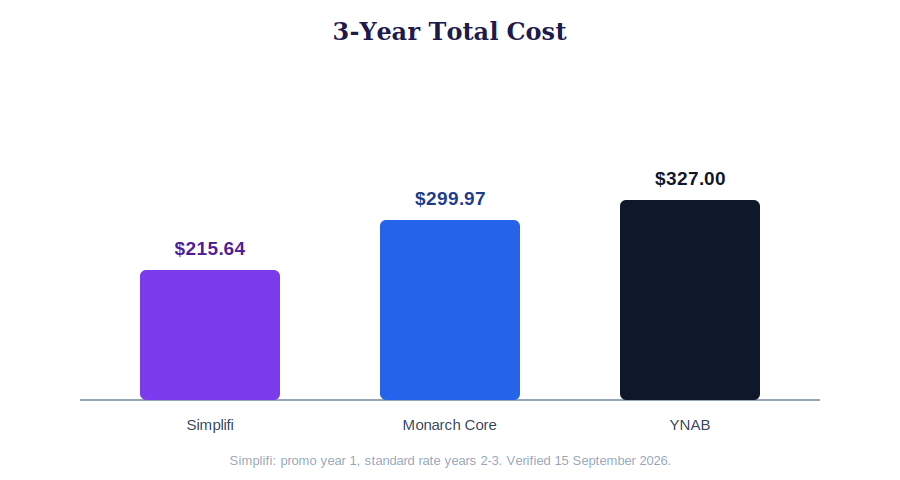
| Year | Simplifi | YNAB | Monarch Core |
|---|---|---|---|
| Year 1 | $47.88 (promo) | $109 | $99.99 |
| Year 2 | $83.88 (renewal) | $109 | $99.99 |
| Year 3 | $83.88 | $109 | $99.99 |
| 3-year total | $215.64 | $327 | $299.97 |
Assumes no further promo applied in years 2-3. YNAB and Monarch held flat at published annual rates. Every figure in this quicken simplifi review’s 3-year model comes from each app’s own pricing page, not a third-party aggregator. Pricing verified from official websites, 15 September 2026.
Who Should Use Quicken Simplifi?
Based on the pricing, features, and trade-offs covered in this Quicken Simplifi review, and on the simplifi cost math run throughout this piece, Simplifi tends to fit best for:
- You want automatic tracking without YNAB’s zero-based discipline or Monarch’s higher renewal price
- You have steady, monthly income rather than freelance or commission-based earnings
- You’ll actually set a renewal reminder and re-evaluate at the $83.88 price point
- You want dependable bank sync backed by a company with decades of aggregation experience
- You want investment and retirement monitoring without paying Monarch’s price for it
- You’ve read this quicken simplifi review’s renewal math and are comfortable paying $83.88 starting year two
Who Should Not Use Quicken Simplifi?
Simplifi isn’t the right fit if you have irregular income, want a structured debt payoff plan, or are choosing an app purely on lowest ongoing price. Each of those needs is better served elsewhere, and this quicken simplifi review would be incomplete without naming them plainly.
You have irregular or biweekly income. The Spending Plan’s monthly-income assumption creates real distortion in three-paycheck months. YNAB handles this natively.
You’re optimizing purely for lowest year-two price. At $83.88/year, the real simplifi cost is no longer the lowest in this category: PocketGuard and Goodbudget both come in cheaper. If price is the whole decision, compare against those two directly, not against Simplifi’s promo number.
You want to pay off debt with a structured plan. Simplifi tracks balances but doesn’t model payoff order or timelines. If that’s your priority, our debt payoff guide and the free Debt Payoff Estimator cover that gap regardless of which app you land on.
You’d rather not link a bank account at all. If manual entry with no bank connection matters to you, a spreadsheet-based approach may fit better than any of the apps on this site. Our sister site’s Google Sheets budget tracker vs. apps comparison walks through that trade-off.
How Does Simplifi Compare to Monarch, YNAB, and PocketGuard?
The table below pulls together every price and feature this Quicken Simplifi review has covered, lined up against the three apps readers ask about most.
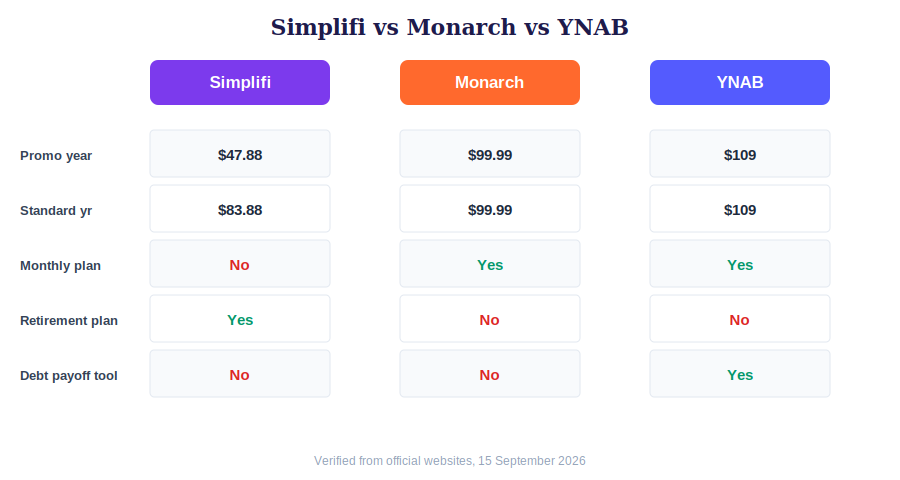
| Simplifi | Monarch Money | YNAB | PocketGuard | |
|---|---|---|---|---|
| Promo year | $47.88 | $99.99 | $109 | $74.99 |
| Standard annual | $83.88 | $99.99 | $109 | $74.99 |
| Monthly billing | Annual only | $14.99/mo | $14.99/mo | $12.99/mo |
| Budgeting approach | Spending Plan | Flex + Category | Zero-based | In My Pocket |
| Retirement planner | Yes, 15 vars | No | No | No |
| Debt payoff planner | No | No | Yes | Yes |
| Shared access | 1 person/space | Unlimited | Up to 6 | Not built for sharing |
| Availability | US + Canada | US + Canada | US, CA, UK, EU | US, CA, UK |
Pricing and features verified from official websites, 15 September 2026.
If you’re weighing Simplifi vs Monarch specifically, the year-one gap ($47.88 vs $99.99) is the widest split on this table, and it narrows to $16 by year two once Simplifi’s renewal kicks in. Framed as quicken simplifi vs monarch, the decision really comes down to whether you need Monarch’s unlimited household sharing badly enough to pay the difference.
→ YNAB vs Simplifi, full head-to-head
→ Monarch vs Simplifi, which is the smarter save
→ Best PocketGuard Alternatives 2026
Is Quicken Simplifi Worth It in 2026?
Yes, for solo budgeters with steady income who want automated tracking and will budget for the $83.88 renewal rate rather than assuming the promo price is permanent. That’s a narrower yes than this quicken simplifi review gave Simplifi a year ago, and the renewal jump is the reason why.
The value case still holds up: reliable bank sync, a genuinely useful Spending Plan, a Retirement Planner most competitors in this price range don’t offer, and a 3-year total that beats YNAB by over $111 even after the price increase. What’s changed since the last quicken simplifi review update is that Simplifi no longer wins on price alone past year one. PocketGuard and Goodbudget both undercut its renewal rate, so if lowest ongoing cost is your only filter, this isn’t automatically the cheapest option anymore.
If steady bank sync, investment monitoring, and a Retirement Planner matter more to you than shaving the last few dollars off an annual bill, Simplifi remains a solid pick. If you’re deciding purely on simplifi cost and plan to keep the app past year one, run the numbers against PocketGuard first.
Try Quicken Simplifi, 30-Day Money-Back Guarantee
Sign up directly at quicken.com to see the current promotional rate this quicken simplifi review verified, and set a renewal reminder before year two.
What Do People Ask About Quicken Simplifi?
This quicken simplifi review answers the ones that come up most often, with sourcing noted where it matters.
How did this quicken simplifi review verify pricing?
Every price in this quicken simplifi review was checked directly at quicken.com on 15 September 2026, using the live checkout page’s discount badge and math, not carried over from an older post. The renewal figure specifically was confirmed against the current $6.99/month sticker price shown at checkout, since that’s the number that changed most since this review was last updated.
How much does Quicken Simplifi cost after the first year?
Quicken Simplifi renews at $6.99 a month, or $83.88 a year, once the first-year promotional rate ends. That’s a 75% increase over the $3.99/month ($47.88/year) new-subscriber price, confirmed directly from quicken.com on 15 September 2026. Annual billing only, no monthly option.
Is Quicken Simplifi available outside the United States?
Quicken Simplifi is available in the United States and Canada only. It does not support banks outside those two countries, so users elsewhere will need an alternative like YNAB, which has broader coverage across the US, Canada, the UK, and parts of the EU.
Is Quicken Simplifi better than Monarch Money?
In the simplifi vs monarch decision, it depends on your time horizon more than the sticker price. Simplifi is cheaper than Monarch in year one ($47.88 vs $99.99) and stays cheaper in year two ($83.88 vs $99.99), so the price gap narrows but doesn’t disappear.
Monarch has deeper investment tracking, unlimited household sharing, and monthly billing. For solo budgeters who mainly want spending visibility, Simplifi remains the better value. For couples or active investors, Monarch’s extra features justify the higher cost, and monarch money vs simplifi comes down to whether that sharing feature matters to you.
Is Quicken Simplifi better than YNAB?
They serve different purposes. Simplifi is a flexible spending-awareness tool, while YNAB is a strict zero-based budgeting system that requires assigning every dollar a job. Simplifi stays cheaper than YNAB even after renewal, by about $25/year, and adds investment monitoring and a retirement planner that YNAB doesn’t have. YNAB offers a longer trial, monthly billing, and covers up to 6 people on one subscription, and it’s the stronger choice if you need active debt-payoff tools or irregular-income support.
Does Quicken Simplifi track investments?
Yes. Simplifi connects to major brokerage accounts and shows holdings, cost basis, and portfolio performance over time. These features are monitoring-focused rather than analytical: there’s no stock screening, allocation modeling, or benchmarking. Active investors wanting that depth should consider Empower’s free tier or Monarch Money instead.
Is Quicken Simplifi safe to use?
Yes. Simplifi uses 256-bit encryption and read-only bank connections through Plaid, and it’s built by Quicken, a company with over 40 years of financial data management experience. The app cannot move money or initiate transactions. Two-factor authentication is available.
Does Simplifi have a debt payoff planner?
No. This remains one of Simplifi’s clearest gaps. The app tracks debt balances automatically as part of net worth, but there’s no dedicated tool to model payoff timelines or compare avalanche versus snowball strategies. For structured debt payoff planning, YNAB and PocketGuard Premium are stronger picks, or pair Simplifi with the free Debt Payoff Estimator.
📚 Read Next
- YNAB vs Simplifi 2026, Full Head-to-Head Comparison
- Monarch vs Simplifi 2026, The Smarter Save?
- YNAB Review 2026, The Stricter Alternative
- PocketGuard Review 2026, Now Cheaper Than Simplifi at Renewal
- Quicken Classic Review 2026, Beware the 67% Trap
- Simplifi Pricing 2026, Full Breakdown
- Free Debt Payoff Estimator, Use Alongside Simplifi
Full disclosure →
