
⚡ Quick Verdict
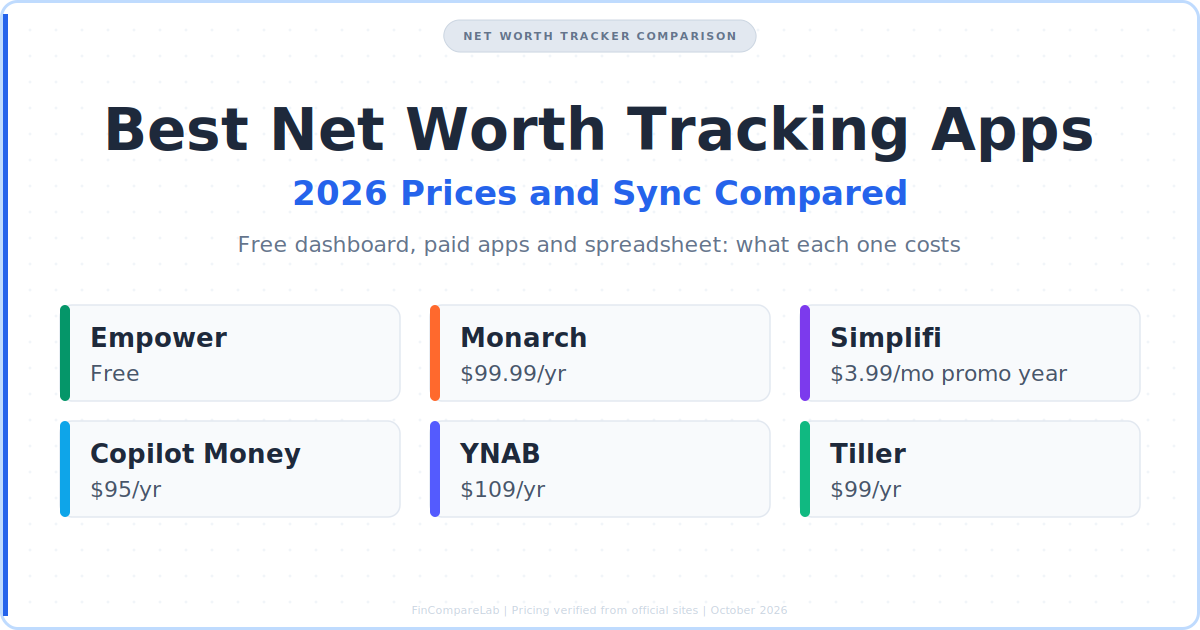
Empower is the only free pick and the best starting point for most people comparing the best net worth tracking apps. Monarch adds budgeting and shared household access for $99.99 a year, Simplifi is the cheapest paid option, and Tiller suits anyone who wants the data in a spreadsheet they own. Tiller still links your banks, so a manual sheet is the only no-link route.
How We Review Apps, Pricing verified from official app websites — 24 October 2026
On this page
- What are the best net worth tracking apps in 2026?
- How do net worth tracking apps calculate your net worth?
- Which net worth numbers sync automatically and which do you type by hand?
- Is Empower the best free net worth tracker?
- Is Monarch worth paying for as a net worth app?
- Is Simplifi the cheapest paid way to track net worth?
- Is Copilot Money worth it for tracking net worth on Apple devices?
- Can YNAB track net worth?
- Is Tiller a net worth tracker without an app?
- Is a net worth tracker the same as the best portfolio tracker?
- Should you track net worth in a spreadsheet instead?
- How do you track net worth, and how often should you check it?
- Is it safe to link your accounts to a net worth tracker?
- Which net worth tracker fits your situation?
- What else do people ask about net worth tracking apps?
What are the best net worth tracking apps in 2026?
Empower is the best free pick, Monarch is the best paid all-in-one, Simplifi is the cheapest paid option, and Tiller suits spreadsheet owners. Copilot fits Apple users, while YNAB treats net worth as a bonus chart. Of these best net worth tracking apps, only Empower costs nothing.
The table puts each price next to its weak spot, because the weak spot usually decides the purchase. Prices are for the plan most people choose, checked on official sites on 24 October 2026.
| App | Price | Net worth strength | Weak spot |
|---|---|---|---|
| Empower | Free | Bank, card, loan and investment accounts in one view, plus a retirement planner | Thin budgeting, phone number and marketing-call consent at sign-up |
| Monarch | $99.99/yr or $14.99/mo, 7-day trial | Net worth, budgeting and shared household access | No free tier, Plus price unconfirmed |
| Simplifi | $3.99/mo first year, then $6.99/mo | Include or exclude accounts, Zillow home value, manual assets | History starts when you add an account, no trial |
| Copilot Money | $95/yr or $13/mo, 1-month trial | Zillow home value, polished iPhone and Mac apps | No native Android app |
| YNAB | $109/yr or $14.99/mo, 34-day trial | Net Worth report on web and mobile | Investments entered by hand |
| Tiller | $99/yr, 30-day trial | Spreadsheet you own, fed by your banks | Setup time, no dedicated mobile app |
Pricing verified from official websites, October 2026. The Simplifi promo applies to new orders through 13 November 2026.
The list is limited to the apps FinCompareLab covers, so Kubera, a paid tracker aimed at crypto and other unusual assets, gets only a mention in the Tiller section below.
How do net worth tracking apps calculate your net worth?
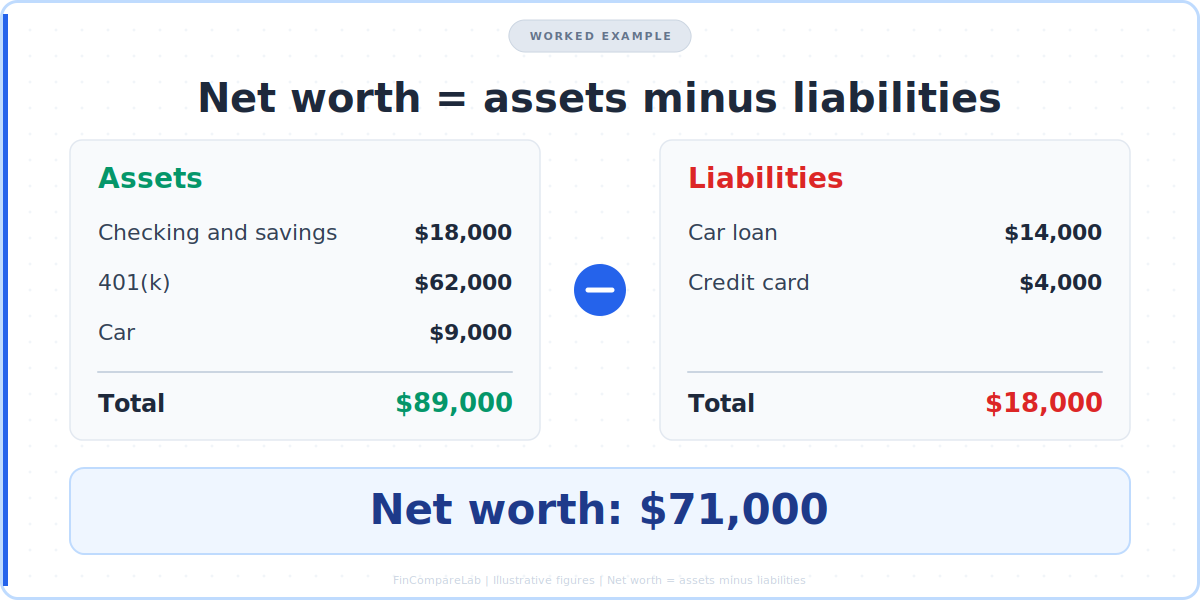
Net worth is everything you own minus everything you owe. A tracker adds up the balances of the accounts you connect, subtracts the debts, and redraws the line whenever a balance changes.
Take someone with $18,000 in checking and savings, a $62,000 401(k) and a car worth about $9,000. Assets come to $89,000. A $14,000 car loan and $4,000 of card debt make liabilities $18,000, so net worth is $71,000. Every one of the best net worth tracking apps runs this same subtraction, so they differ only in how the inputs get collected.
The mistake that distorts the number most is a half-linked house. If an app syncs a $320,000 mortgage but the $400,000 home is missing, net worth drops by the full $400,000. When a new app shows a figure that looks wrong, check the home value line first.
Which net worth numbers sync automatically and which do you type by hand?
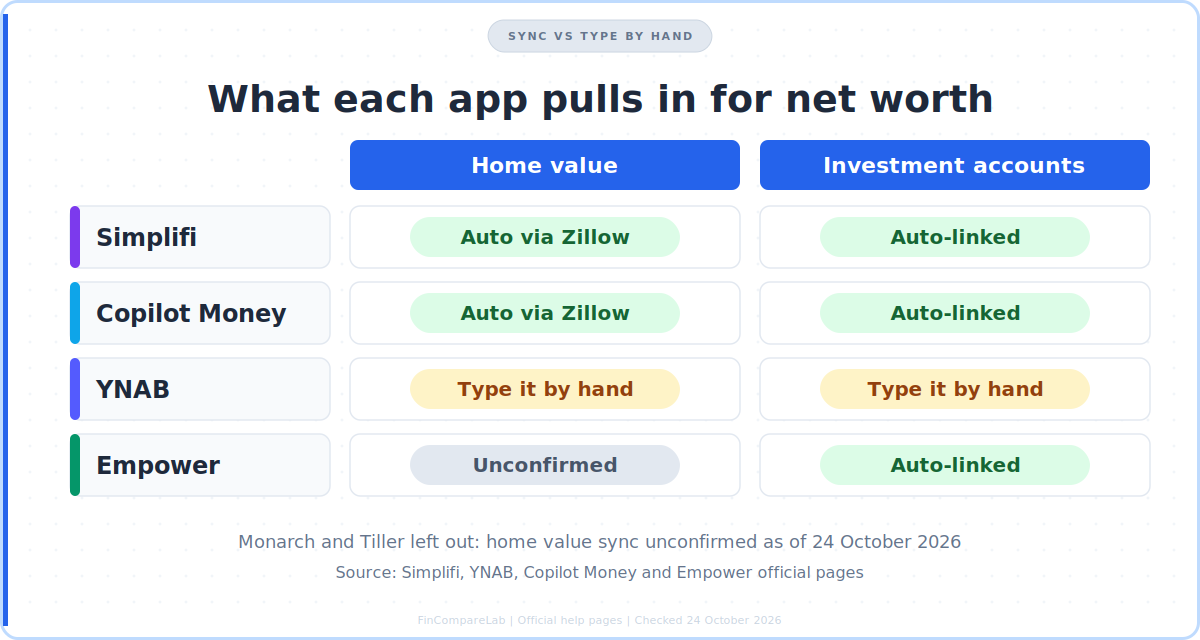
Linked bank, card and loan accounts sync in all six apps. The split among the best net worth tracking apps is in home value and investments, where some pull the number in and others make you type it.
Simplifi pulls a home value from Zillow, tracks a car or collectibles as manual accounts, and starts its net worth history on the day you add each account, according to its own net worth help article. Past months do not backfill, which matters if you are switching apps.
YNAB has you add a 401(k) or IRA as an unlinked Asset account with today’s value as the starting balance, then press Reconcile when the balance changes. Tracking accounts show up in the Net Worth report but stay out of spending and income reports. One retirement account takes seconds to update, while five becomes a monthly chore.
Copilot Money also uses Zillow for home value and links brokerage accounts. Empower links investment accounts too, but whether it pulls a home value automatically is unconfirmed as of 24 October 2026.
Put numbers on it. A typed home value that is 10% stale on a $400,000 house is a $40,000 swing, which dwarfs any subscription here. Set a quarterly reminder to update it, and use Simplifi’s include or exclude toggle to see net worth with and without the house. For a wider look at software that handles this, see the best personal finance software roundup.
Is Empower the best free net worth tracker?
Empower is the best free net worth tracker for most people because its dashboard costs nothing and pulls bank, credit, loan, retirement and investment accounts into one net worth line. It also includes a retirement planner and portfolio tools, so it covers more ground than a plain balance chart.
The free price has a sales motive behind it. Empower’s sign-up form asks for a phone number and consent to marketing calls and texts, including autodialed ones, and its paid product is an advisory service priced by assets managed. You can skip the advisor pitch, but expect the follow-up.
That fee is where the money is. Last checked, the tier for $250,000 to $999,999 was 0.89% a year, about $4,450 on $500,000, and the current schedule is unconfirmed as of 24 October 2026.
Two limits matter before you rely on it. Budgeting is thin next to Monarch or Simplifi, so many people pair Empower with a second app. And history can be fragile when a service changes hands, since one ChooseFI forum poster reported losing years of Personal Capital data in the move to Empower (a single report, unconfirmed). Export or screenshot your net worth chart every quarter whatever app you pick.
For a free net worth tracker, that sign-up is the whole cost.
Full details are in the Empower review, and the Empower alternatives roundup covers what to use if the marketing calls bother you. Weighing it against a paid app? Compare Monarch vs Empower and YNAB vs Empower.
Is Monarch worth paying for as a net worth app?
Monarch is worth paying for if you also want budgeting and shared household access in the same app. Core costs $99.99 a year or $14.99 a month, and the net worth view sits next to budgets, goals and investments.
Every new account starts with a 7-day trial that needs a card, and Monarch states a money-back guarantee on its subscriptions. Monarch itself recommends signing up on the web instead of through the App Store or Google Play, because web subscriptions are easier to manage. The WELCOME code takes 30% off Core’s first year on annual plans for new users, and the page says it may expire.
Household members join free under one subscription, which is why couples default to Monarch. Plus was $199.99 a year when last confirmed on monarch.com on 31 August, and its current price is unconfirmed as of 24 October 2026. It adds forecasting, small-business income tracking and deeper investment analysis.
I moved from YNAB to Monarch this year after 15 years because I wanted net worth, investments and cash flow on one screen. I skipped the CSV import and entered prior-month balances only, since YNAB’s credit-card transfers would have distorted the cash-flow reports. Maintenance now takes minutes a week.
The adjustment is mental. Monarch forecasts cash flow and does not give every dollar a job, so I use Category Budgeting mode with the Rollover toggle on sinking-fund categories to get envelope behavior. There is no free tier either, which makes the trial worth using on a real month of data.
As a paid net worth app, Monarch earns its fee mainly through the household features.
Read the Monarch Money review, the Monarch pricing breakdown and the Monarch discount guide before you start the trial. Safety questions are covered in is Monarch Money safe, and the Monarch alternatives page helps if the price is too high. Couples can also check the best budgeting apps for couples and YNAB vs Monarch.
Is Simplifi the cheapest paid way to track net worth?
Yes, until the promo ends. Simplifi costs $3.99 a month billed annually ($47.88) for the first year on new orders placed by 13 November 2026, then $6.99 a month ($83.88 a year).
Its net worth screen charts one-month, three-month, six-month, one-year, five-year, quarter-to-date, year-to-date and all-time ranges. It flips between total net worth and assets versus debt, and it shows a debt-to-asset ratio. You can also exclude any account from the total, which helps with a joint account you do not control.
Simplifi has no free trial. Quicken charges up front and backs the purchase with a 30-day money-back window, including after an auto-renewal. The promo is first-year only, for new members, and cannot stack with other offers.
Over three years the gap is clear. Simplifi’s promo year plus two renewals totals $215.64, against $285 for Copilot Money, $297 for Tiller, $299.97 for Monarch and $327 for YNAB. Third-party sites list lower Simplifi renewal prices, which is unconfirmed as of 24 October 2026, so the chart uses the $83.88 list rate.
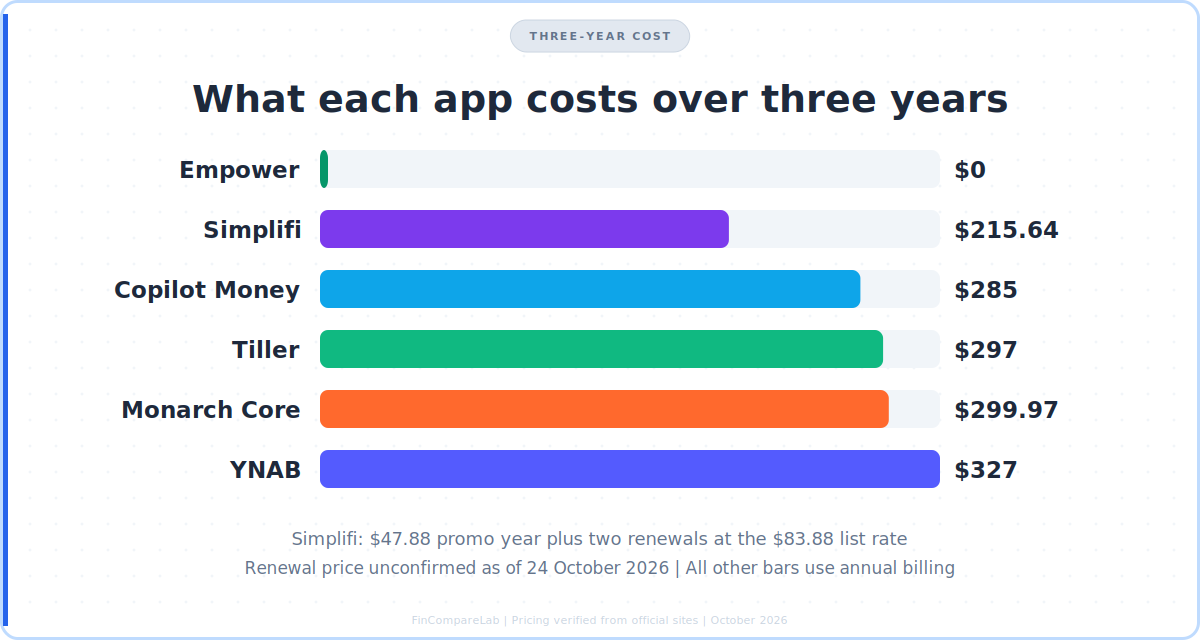
At $47.88 for year one, it is the cheapest paid net worth tracker on this list.
The Quicken Simplifi review and Simplifi pricing guide cover billing in detail, and the Simplifi discount page explains why no coupon stacks with the promo. See Monarch vs Simplifi, Simplifi vs Copilot and YNAB vs Simplifi for head-to-heads.
Is Copilot Money worth it for tracking net worth on Apple devices?
Copilot Money is worth it if you live on iPhone, iPad or Mac and want a polished app. It costs $95 a year or $13 a month with a one-month trial, and it has no native Android app.
Copilot lists a web app next to its Apple apps, but how closely the web version matches them is unconfirmed as of 24 October 2026. Android users can sign in on the web and should treat it as a companion.
For net worth, Copilot pulls home value from Zillow, links brokerage accounts and shows allocation and index benchmarks. Simplifi does the Zillow part too, so home value alone is no longer a reason to choose Copilot.
Sharing runs through a Magic Link on a single subscription, or a shared login, and the extra device gets full control with no view-only setting. If you only want the trial month, turn auto-renew off under Settings, then Subscription.
As a net worth tracker for Apple users, it is the best-looking option here.
The Copilot Money review, Copilot pricing guide and is Copilot Money safe cover the details, and the Copilot referral code page explains the trial extension. Compare it in Monarch vs Copilot or YNAB vs Copilot.
Can YNAB track net worth?
Yes, YNAB can track net worth, and the Net Worth report is available on both web and mobile. The catch is that investments only appear if you add each one as an unlinked asset account and reconcile it yourself.
Tracking accounts count in Net Worth but stay out of spending and income reports, so a 401(k) never disturbs your budget. YNAB’s own guide suggests adding the account as an Asset type with today’s value as the starting balance, then using Reconcile when the number changes.
YNAB costs $109 a year or $14.99 a month with a 34-day trial that needs no card. Paying $109 for a net worth chart you update by hand makes sense only if you already budget in YNAB, which makes it the honest non-fit on this list for pure wealth tracking.
If you only want a net worth app, the other five fit better.
Start with the YNAB review and YNAB pricing guide, or take the is YNAB worth it quiz first. New to the method? Read YNAB for beginners and zero-based budgeting, and see YNAB alternatives if you are leaving it.
Is Tiller a net worth tracker without an app?
Tiller is a spreadsheet service, so you own the file, but it still connects your banks. It feeds balances into Google Sheets or Excel for $99 a year after a 30-day free trial.
The live pricing page says the card is not charged until the trial ends, and a refund window runs 30 days after that, up to 60 days risk-free. Sales tax is added where your state requires it.
Tiller’s price rose from $79 to $99 on 1 August 2026, which puts it only about $10 a year under YNAB, so price no longer separates them. The reasons to pick Tiller are data ownership and a net worth sheet you can shape. Expect setup time and no dedicated mobile app.
If your wealth includes crypto wallets or other unusual assets, reviewers point to Kubera, which is not on the FinCompareLab roster and which I have not reviewed. Its price is unconfirmed as of 24 October 2026, with third-party listings ranging from $19 a month to about $249 a year.
Tiller costs $99, so it is not a free net worth tracker.
Read the Tiller Money review and Tiller pricing guide, then compare it in YNAB vs Tiller.
Is a net worth tracker the same as the best portfolio tracker?
No. A net worth tracker reduces everything to one assets-minus-liabilities number, while the best portfolio tracker tools go deep on holdings, allocation and performance.
Empower sits in both camps. Its App Store listing describes tracking a portfolio alongside net worth, and it is the only free option here.
Decide by where your money sits. If a 401(k) and a brokerage account hold most of your net worth, the allocation and fee views matter more than a budget screen, and Empower or Copilot Money fit better. If cash and debt dominate, a budgeting-led app like Simplifi or Monarch shows more.
Budgeting-first readers can start with the best free budgeting apps and treat net worth as the add-on.
Should you track net worth in a spreadsheet instead?
Yes, if you would rather never link a bank. A manual spreadsheet is the only route here with no connection to your accounts, and it keeps credentials off every third-party server.
The cost is discipline. Pick one fixed date each month, copy every balance into a new row, and compare it with last month’s total. Manual tracking works only while the habit lasts, which is the problem Tiller automates.
My sister site ToolsWithoutCode has a Google Sheets net worth tracker layout if you want a ready-made sheet. Couples who track jointly can share a sheet, though a Monarch household is less work, as the couples app roundup explains.
How do you track net worth, and how often should you check it?
To track net worth, list every asset and debt in one place and update the balances on a fixed date each month. Apps automate the balances, so your only decision is how often to look.
Monthly suits anyone paying down debt, because each payment shows up in the line. Quarterly suits investors. A $62,000 401(k) that moves 2% in a day shifts net worth by $1,240, which is market noise and says nothing about your progress.
Tracking net worth right after payday keeps the balances fresh. If debt is the goal, run the numbers in the debt payoff estimator and follow the snowball or avalanche steps in how to get out of debt fast.
Is it safe to link your accounts to a net worth tracker?
Linked accounts are read through data aggregators, and the risk depends on each vendor’s security controls and how it earns money. Check the privacy page of any app before connecting.
Business model is the clearest difference. Monarch’s pricing page says it never sells financial data and runs no ads, Empower pairs a free dashboard with a paid advisory service, and Copilot Money’s marketing site passes hashed email or IP data to ad platforms, with an opt-out form.
Copilot Money links accounts through Plaid and Mastercard Data Connect. A $58 million Plaid class settlement received final approval on 20 July 2022, and Plaid denies wrongdoing.
In Copilot Money, turn on authenticator-app two-factor sign-in, added in version 7.2.1 on 27 March 2026, and use Global Sign-out if a device goes missing. Whether it applies on Mac and web is unconfirmed as of 24 October 2026. Deeper breakdowns are in is Copilot Money safe and is Monarch Money safe.
Which net worth tracker fits your situation?
Pick among the best net worth tracking apps by how much you are willing to type. Empower or Simplifi need the least typing, Monarch suits shared finances, and a manual sheet suits anyone who will not link a bank at all.
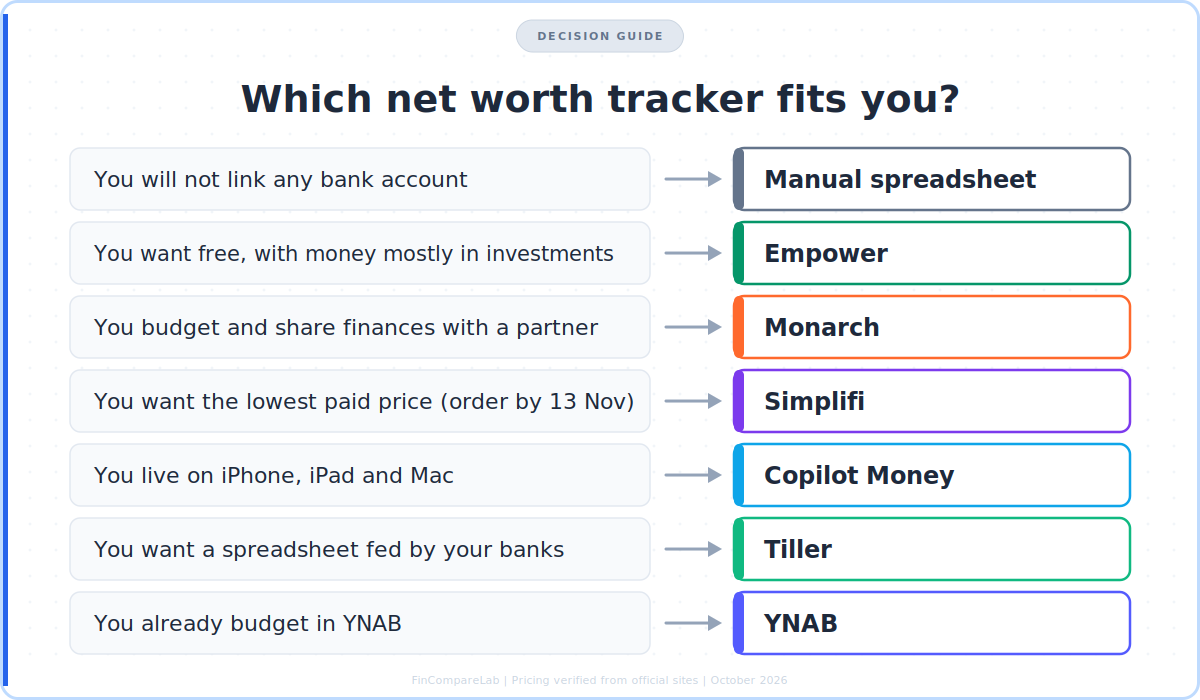
Empower fits free tracking with money mostly in investment accounts, if you can ignore advisor follow-ups. Monarch fits people who budget, share finances with a partner and will pay $99.99 a year. Simplifi wins on price if you order before 13 November.
Copilot Money fits Apple devices, Tiller fits spreadsheet fans, and YNAB belongs on the shortlist only if you already budget in it.
If a full budget is the real goal, start with the best budgeting apps for beginners and treat net worth as the add-on. Coming from Mint? The Mint alternatives roundup shows which of these replaced it best.
What else do people ask about net worth tracking apps?
These are the questions people ask most before picking one of the best net worth tracking apps.
Which net worth tracking apps show a line graph of net worth over time?
Simplifi charts net worth across ranges from one month to all-time, and YNAB shows month-by-month asset and debt bars. The other apps chart it as well, but their date ranges are unconfirmed as of 24 October 2026.
Which app tracks my home’s value alongside my net worth?
Simplifi and Copilot Money both pull a home value from Zillow into net worth. YNAB makes you enter the home as an unlinked asset account, and Empower’s automatic home value is unconfirmed as of 24 October 2026.
Which app shows my credit score and net worth together?
Simplifi shows a VantageScore credit score next to net worth, according to Quicken’s product page. Copilot Money says it is not a credit monitor.
Is Empower really a free net worth tracker, not just a free trial?
Yes, the dashboard is free, and Empower’s sign-up form asks for no card. Its paid product is a separate advisory service charged as a percentage of assets managed.
Is it worth paying for a net worth app when Empower is free?
Only if you want something Empower lacks, usually budgeting depth, shared household access or a spreadsheet you own. If you only want the net worth line, Empower already covers it.
Can couples track net worth together?
Monarch lets household members join free under one subscription, and Simplifi lets you share with one other person. Copilot Money shares through a Magic Link on one subscription, and YNAB allows up to six people on a plan.
What if I do not want to link any bank account?
Use a manual spreadsheet, because Tiller still links your banks through its feeds. A manual sheet keeps credentials off every third-party server but depends on you updating it.
Do these apps track crypto and other non-bank assets?
Monarch links Coinbase natively and needs manual entry for other exchanges, while Copilot Money links Coinbase directly. Simplifi tracks other assets as manual accounts, and the rest are unconfirmed as of 24 October 2026.
What is the difference between a budgeting app and a net worth tracker?
Budgeting apps follow monthly spending and cash flow, while a net worth tracker follows assets minus liabilities over months and years. Monarch, Simplifi, Copilot Money and YNAB do both to different degrees, and Empower leans toward net worth and investments.
Link two accounts to Empower this week, note which numbers need typing, and decide whether any of the best net worth tracking apps earns a paid fee. If Simplifi is on your shortlist, order before 13 November.
📚 Read Next
