
Zero based budgeting is the method behind almost every “give every dollar a job” app on the market, and it genuinely works, right up until real life gets in the way of a spreadsheet.
⚡ Quick Answer
Zero based budgeting assigns every dollar of income to a category until income minus expenses equals exactly zero. Most beginners do not fail because the method is flawed. They fail because they copy last month’s numbers forward, skip sinking funds, or try to run it on an irregular paycheck with no buffer category.
What Is Zero Based Budgeting?
Zero based budgeting is a method that assigns every dollar of income to a specific category, savings goal, or debt payment before the month starts, so that income minus expenses equals zero. It is often shortened to ZBB, though almost nobody outside an accounting textbook actually calls it that out loud.
“Zero” does not mean your bank account hits zero. It means the unassigned column does. Every dollar has a destination decided in advance, whether that destination is rent, a Roth IRA contribution, or genuinely guilt-free spending money.
The method traces back to corporate finance in the 1970s, where managers had to justify every line item from scratch instead of inflating last year’s totals. The personal-finance version strips out the corporate jargon but keeps the core discipline: nothing gets funded just because it was funded last month.
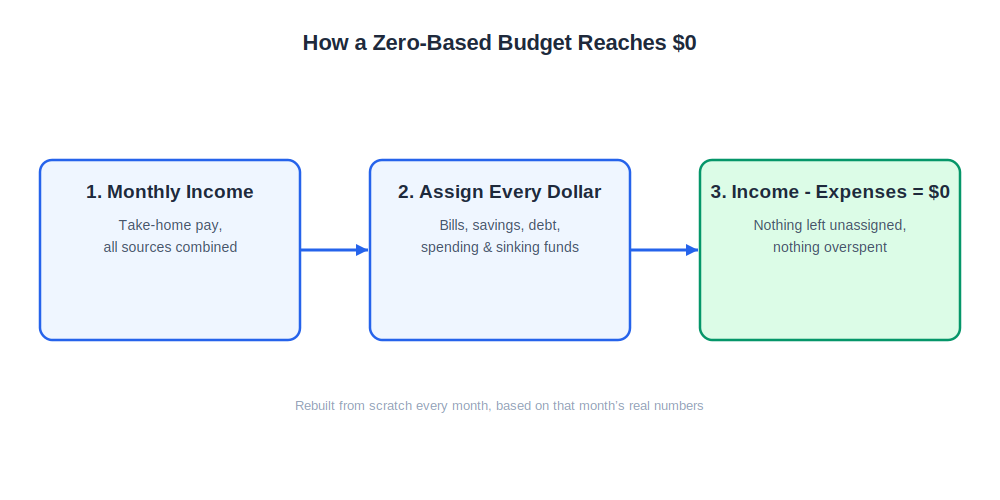
How income moves through a zero based budget each month.
How Does Zero Based Budgeting Actually Work?
You start each month by listing total take-home income, then subtract categories one at a time (rent, groceries, debt, savings, sinking funds, fun money) until nothing is left unassigned. Whatever is left after covering bills does not sit idle. It gets a job too, usually extra debt payoff or a specific savings goal.
The budget gets rebuilt every single month, not adjusted once and forgotten, a step most beginner guides gloss over. Income changes, a category runs short, a subscription renews. The zero-based method expects that and treats the rebuild as routine maintenance rather than a sign something went wrong.
Practically, that means picking a rebuild day (the day before payday works well for biweekly earners), listing every dollar coming in, and working down a fixed category order. Fixed bills first, then variable necessities, then debt and savings, then discretionary spending last.
The Consumer Financial Protection Bureau’s own budgeting steps follow this same income-first, expenses-second order, even though its worksheets are not zero-based specific. Irregular income changes this order slightly, more on that further down.
A workable starter list, before anyone customizes it, runs about twelve lines: rent or mortgage, utilities, groceries, transportation, minimum debt payments, extra debt payoff, an emergency fund contribution, retirement, a car and home sinking fund, subscriptions, personal spending money, and a miscellaneous buffer for the inevitable category nobody planned for. That is enough structure to catch real overspending without turning the first month into a category-naming project.
Is Zero Based Budgeting the Same as Zero-Sum Budgeting?
Yes. “Zero-sum budgeting” and “zero based budgeting” describe the same personal-finance method, just with different branding depending on which app or author is explaining it. Some communities also call it “give every dollar a job,” which is really just a plain-English restatement of the same rule.
What Does a Zero Based Budgeting Example Look Like?
Numbers make this concrete faster than definitions do. Take a single earner bringing home $4,200 a month after tax, no kids, one car loan, and a goal of building an emergency fund while still paying down debt.
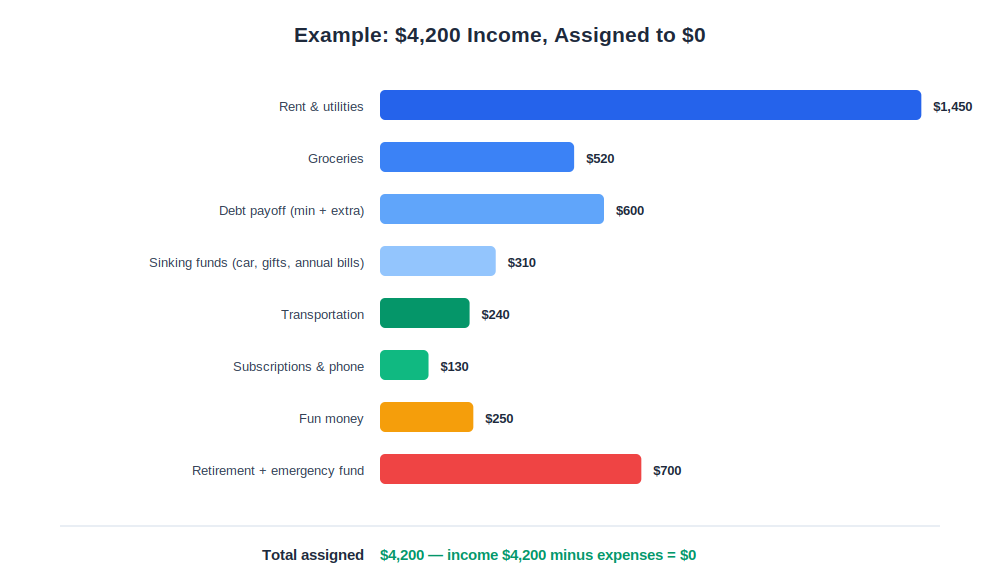
A real zero based budgeting example: every dollar of a $4,200 paycheck assigned somewhere.
Rent and utilities take the largest single bite at $1,450. Groceries get $520, sized off three months of actual receipts rather than a guess. Minimum plus extra debt payments take $600. A $310 sinking fund covers the car’s next repair, annual renewals, and holiday gifts, split evenly across twelve months so no single month gets blindsided.
Transportation, subscriptions, and fun money round out day-to-day life at $620 combined. The remaining $700 splits between an emergency fund and retirement, treated as a bill to yourself rather than whatever happens to be left. Total assigned: $4,200. Nothing floats.
Swap in a different income or household size and the categories barely change, only the dollar amounts do. That consistency is a big part of why the method scales from a first post-college budget up to a household juggling two incomes and a mortgage.
What Are the 5 Rules Beginners Get Wrong?
Most people who “try zero based budgeting and quit” did not actually fail at the method. They skipped one of five rules that rarely get spelled out clearly, and the whole system quietly stopped working as a result.
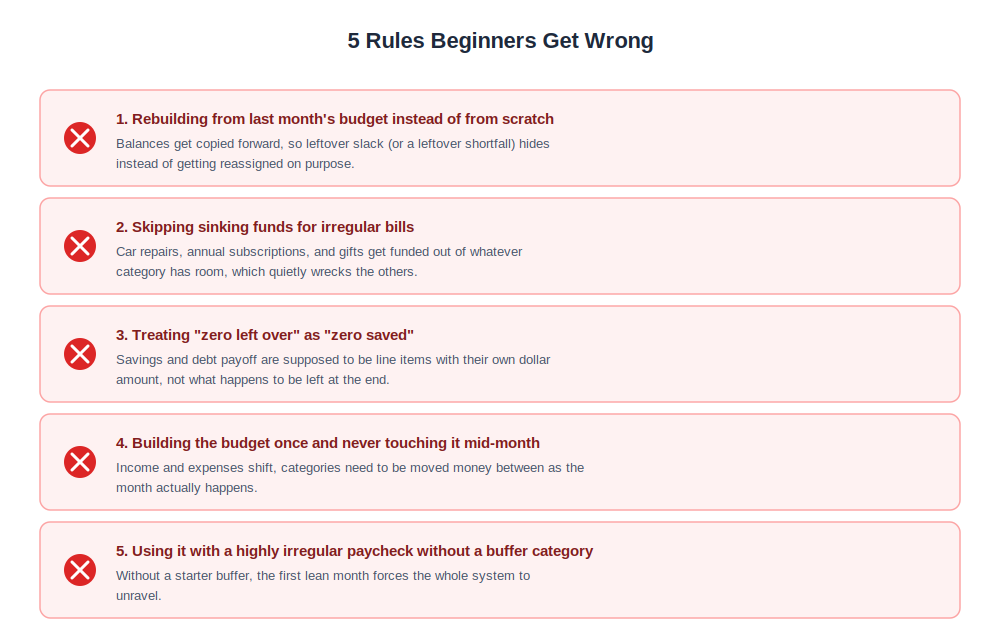
The five most common zero based budgeting mistakes beginners make in month one.
Are You Rebuilding Last Month’s Budget Instead of Starting From Zero?
Copying last month’s numbers forward defeats the entire point. Leftover slack in one category, or a shortfall in another, needs to be reassigned on purpose every month, not inherited by accident. Rebuilding from scratch is what actually forces the honest conversation about what changed.
Are You Skipping Sinking Funds for Irregular Bills?
Car repairs, annual subscriptions, and December gifts do not arrive monthly, so they get left out of the budget entirely, then paid for by raiding whatever category still has room. That one habit is behind most “zero based budgeting doesn’t work for me” complaints. A dedicated sinking-fund category, funded a little every month, fixes it.
Are You Treating Zero Left Over as Zero Saved?
Reaching zero unassigned dollars only means something if savings and debt payoff were already assigned their own line item earlier in the process. Treat them as bills you owe yourself, budgeted before discretionary spending, not as whatever happens to survive to the end of the list.
Are You Setting the Budget Once and Never Touching It Mid-Month?
A zero based budget is a living document. Groceries run over, a category comes in under, and the fix is moving money between categories as it happens, not waiting until next month to notice. Most budgeting apps built around this method exist specifically to make that mid-month shuffle fast.
Are You Using It With an Irregular Paycheck and No Buffer Category?
Freelancers and commission earners who try to assign next month’s bills against this month’s variable paycheck usually get burned the first lean month. A one-month buffer, built before optimizing anything else, is what actually makes this approach survive contact with an unpredictable income.
What Are the Zero Based Budgeting Pros and Cons?
Weighing the zero based budgeting pros and cons honestly matters more than picking a side before trying it. The genuine advantages: total visibility into where every dollar goes, a built-in nudge to fund savings and debt payoff before spending money disappears, and a structure that adapts month to month instead of assuming every month looks the same.
Time and discipline are the real cost. Assigning every category by hand takes longer than glancing at three percentage buckets, and it can quietly become its own chore.
Morgan Chen, FinCompareLab’s founder, ran a strict envelope-style zero based budget in YNAB for 15 years and eventually found the daily category reconciliation starting to feel like busywork rather than useful management. Not because the numbers stopped adding up, but because the maintenance cost outpaced the insight it was still providing.
That trade-off is worth weighing honestly before committing. Expect the method to take real weekly attention, even after the habit is built, and treat that time cost as part of the price, not a hidden flaw.
A second limitation worth naming: this method assumes a level of category-level engagement that not every household member wants. It works best when at least one person in a household genuinely enjoys the process, or is willing to own it, rather than being split evenly by default.
How Is Zero Based Budgeting Different From the 50/30/20 Rule?
The 50/30/20 rule splits income into three broad buckets, needs, wants, and savings, and does not require tracking individual categories. This more detailed approach goes further, assigning a specific dollar amount to every category until nothing is left.
The trade-off is precision against maintenance. 50/30/20 takes less time to run, while the category-by-category method hides less overspending inside broad buckets. Plenty of people start with 50/30/20 and graduate to zero based budgeting once they want tighter control, particularly around debt payoff.

Zero based budgeting versus the 50/30/20 rule, side by side.
Can Zero Based Budgeting Work With an Irregular Income?
Yes, zero based budgeting works with an irregular income. Build the budget off your lowest realistic monthly income, not an average, the one adjustment most beginner guides leave out. Anything earned above that floor becomes the first thing assigned once it actually arrives, rather than being spent in advance on the assumption it will show up.
A recurring workaround inside budgeting communities, r/ynab and r/budgeting among them, is building a one-month buffer specifically so this month’s budget always runs off last month’s already-earned income. Once that buffer exists, biweekly and freelance paychecks stop dictating which bills get paid when.
The money funding this month’s categories already landed before the month began. See the full irregular income budgeting guide for the exact category order that works best once the buffer is in place.
Community sentiment on this is fairly consistent: people who fund the buffer first, before optimizing categories or chasing a perfect percentage split, report far fewer month-to-month budget blowups than people who try to zero-base a variable paycheck directly.
Which Apps Actually Support Zero Based Budgeting?
Not every budgeting app is built around this method, and using a passive-tracking app to run a ZBB-style budget usually ends in frustration. A handful of apps in FinCompareLab’s roster are built specifically for zero based budgeting.
YNAB is the closest thing this method has to a reference implementation, built entirely around its own four rules for giving every dollar a job (see the full YNAB four rules breakdown for how closely those map to zero based budgeting proper). It costs $109/year, includes rollover categories for sinking funds out of the box, and gives students a full free year through its own student program.
EveryDollar is Dave Ramsey’s take on the same method, drag-and-drop categories with a debt-snowball focus, at $79.99/year, detailed further on Ramsey Solutions’ own EveryDollar page. It is the most beginner-friendly on-ramp of the group, largely because it does not try to do anything besides zero based budgeting.
Actual Budget covers the same territory for free under an MIT open-source license, self-hosted, with a real (if steeper) learning curve in exchange for owning your own data.
Goodbudget applies the same logic through a digital envelope metaphor rather than raw categories, which some beginners find more intuitive to picture. For a side-by-side of all four plus the rest of the roster, the best zero based budgeting apps roundup breaks down pricing and free tiers in full.
Apps built around net worth and cash-flow tracking, Monarch Money among them, are not zero-based by design. They are built for a different job, tracking the big picture across accounts and investments.
Forcing this specific workflow onto them tends to feel clunky rather than native. That is a reason to pick the right tool for the job, not a knock on either approach.
Do You Need a Special App for Zero Based Budgeting, or Does a Spreadsheet Work?
A spreadsheet works fine, and plenty of people run this method that way indefinitely. The trade-off is manual bank reconciliation versus an app’s automatic transaction import, which matters most for anyone with a high volume of small daily transactions to categorize. Anyone weighing that specific trade-off can see how a template-based approach compares directly in this spreadsheet-versus-app breakdown on FinCompareLab’s sister site.
Is Zero Based Budgeting Worth It?
For anyone carrying debt, dealing with an irregular paycheck, or who has never actually tracked where a paycheck goes category by category, yes, it is worth the setup cost. The visibility alone tends to surface the one or two categories quietly draining a budget every month.
For someone with a stable paycheck, low debt, and no appetite for monthly category maintenance, a simpler framework like 50/30/20 or a couples-focused net worth tracker will get followed more consistently. A budget that gets followed beats a perfect one that gets abandoned by March.
The honest answer is that zero based budgeting is worth trying for a real 60 to 90 days before judging it, since the first month is disproportionately the hardest one. Most of the friction disappears once the categories stop needing constant renaming and resizing.
What Do People Also Ask About Zero Based Budgeting?
A handful of practical questions come up over and over once someone actually starts building a budget, mostly around category count, sharing a budget with a partner, and what happens the moment real spending drifts from the plan.
What does ZBB stand for?
ZBB stands for zero based budgeting, the shorthand most commonly used in corporate finance and occasionally borrowed by personal-finance writers. In everyday conversation, most people just say “zero based budgeting” or “zero-sum budgeting” in full.
How much time does zero based budgeting take each month?
Building the initial budget usually takes 30 to 60 minutes. After the first month or two, ongoing maintenance drops to somewhere between 10 and 30 minutes a week, mostly spent moving money between categories as real spending happens.
Is zero based budgeting good for beginners?
It can be, provided a beginner starts with a manageable number of categories, somewhere around 10 to 15, rather than trying to track 40 categories in month one. Beginner-friendly budgeting apps generally handle this by suggesting a simplified starter category set.
Can two people share one zero based budget?
Yes, and several apps in this space are specifically built for shared category ownership between partners, though it requires both people to agree on category definitions up front to avoid one partner quietly overriding the other’s assignments.
What happens if I overspend a category mid-month?
The category runs negative, and the fix is moving money from a category with room, not waiting until next month to correct it. This is exactly the mid-month rebuild habit covered above, and skipping it is one of the five most common beginner mistakes.
Is envelope budgeting the same as zero based budgeting?
They are close cousins. Envelope budgeting is a specific style of zero based budgeting that uses discrete “envelopes” (physical or digital) per category instead of open-ended category balances. Anyone who prefers that metaphor can compare dedicated options in the best envelope budgeting apps guide.
What is the biggest reason people quit zero based budgeting?
Skipping sinking funds is the single most common reason, based on recurring community sentiment across budgeting forums. One uncovered irregular expense wrecks two or three other categories at once, and the whole budget starts to feel broken when the real problem was one missing category.
How many categories should a zero based budget have?
Somewhere between 10 and 15 categories for a first attempt, expanding only once each existing category has proven itself too broad to be useful. Categories that get split too early, “restaurants” broken into five different cuisine types, for instance, tend to get abandoned within a month because the upkeep outweighs the insight gained.
Does zero based budgeting work for saving toward a big goal, like a house down payment?
Yes, and it tends to work especially well for a single large goal, since the goal simply becomes its own category with a fixed monthly contribution. The visibility that makes zero based budgeting effective for debt payoff applies just as directly to a savings target with a real deadline attached.
📚 Read Next
