
If you’re weighing the best debt payoff apps on the market, the free tier looks like the safe first move, until it won’t tell you when your last payment lands. I tested YNAB, PocketGuard, EveryDollar, Empower, and Goodbudget on one thing: does the app build a real payoff plan, or just show a shrinking number. Two apps fail that test completely, and they’re not the ones most people expect.
⚡ Quick Picks
The short list of the best debt payoff apps I tested, ranked by how each one actually gets you to zero.
- Best overall: YNAB, loan planner plus zero-based budgeting, avalanche and snowball both supported. $109/yr, 34-day trial, no card.
- Best debt payoff planner app, automatic: PocketGuard, connects to your accounts and builds the schedule for you on the Plus plan.
- Best for the Baby Steps and the debt snowball: EveryDollar, snowball built in as the default, free tier included.
- Best free debt management app, with a catch: Empower, free forever, shows your debt clearly, builds no payoff plan.
- Best manual, envelope-based: Goodbudget, free envelope budgeting, same planning gap as Empower.
How We Review Apps · Pricing verified from official app websites — 4 September 2026
📋 In This Guide
- Why isn’t the free option always the best choice for debt payoff?
- Which debt payoff app is truly the best overall?
- Should you use the debt snowball or the debt avalanche method?
- What should you look for in a debt management app?
- Why does YNAB rank as the best debt payoff app overall?
- Why is PocketGuard the strongest automatic debt payoff planner?
- Why does EveryDollar fit the Baby Steps and the debt snowball best?
- Is Empower the best free debt management app?
- Is Goodbudget’s envelope method good for paying off debt?
- How do these 5 apps to pay off debt compare side by side?
- Which app fits your specific debt situation?
- What are the most common questions about debt payoff apps?
Why Isn’t the Free Option Always the Best Choice for Debt Payoff?
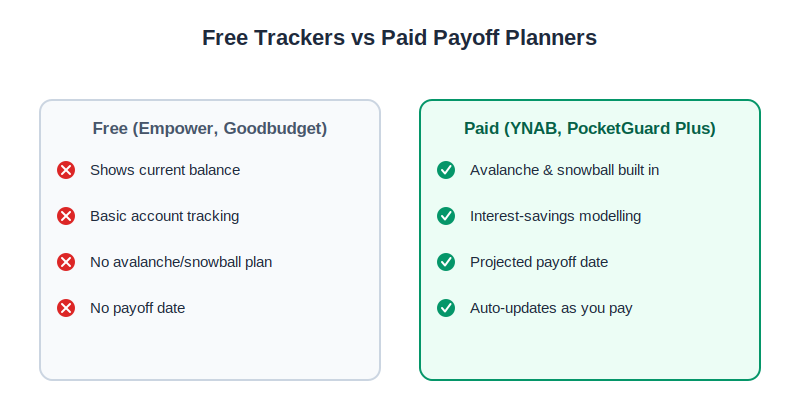
Empower and Goodbudget are the only fully free apps in this roundup, and neither one builds a debt payoff plan. No avalanche or snowball schedule, no interest-savings math, no payoff date. They’re free trackers, not free planners, so pairing one with a dedicated calculator gets you the missing piece without paying for a subscription.
That’s not a flaw in either app, and it doesn’t disqualify either from a list of apps to pay off debt on a budget. It’s a scope decision. Empower was built to show your whole financial picture, and Goodbudget was built to make you feel every dollar you move through an envelope. Debt payoff planning was never the job either app signed up for.
Among the best budgeting apps for debt payoff, that gap shows up constantly: people search for the best free debt management app assuming free also means it’ll tell them when they’re debt-free. It usually doesn’t. If a structured plan matters more than the price tag, YNAB or PocketGuard’s paid Plus tier gets you there faster, even after the subscription cost.
If cost is the deciding factor either way, run your numbers through the free Debt Payoff Estimator first. It gives you the exact math a paid planner would show, without asking for a card. And if getting out of debt fast matters more than which app you use to do it, the how to get out of debt fast guide covers the strategy independent of software.
Which Debt Payoff App Is Truly the Best Overall?
Ranking the best debt payoff apps overall, YNAB comes out on top because it’s the only one that pairs a dedicated loan planner with zero-based budgeting, the combination most likely to surface extra money and show you exactly what that money does to your payoff date. PocketGuard is the strongest runner-up if you’d rather the app build the schedule for you automatically.
That answer changes depending on what you’re optimizing for, though, since the best debt payoff apps on this list aren’t interchangeable. If your priority is a completely free debt management app, that’s Empower for full financial visibility or Goodbudget for envelope-based control, with the tradeoff that neither plans the payoff itself.
If you’re following Dave Ramsey’s Baby Steps specifically, EveryDollar’s built-in debt snowball beats a general-purpose app every time, since the framework and the software were built together.
Should You Use the Debt Snowball or the Debt Avalanche Method?
Most of the apps below support both methods, but each one defaults to a different philosophy, and that default matters more than people expect when picking between the best debt payoff apps on this list.
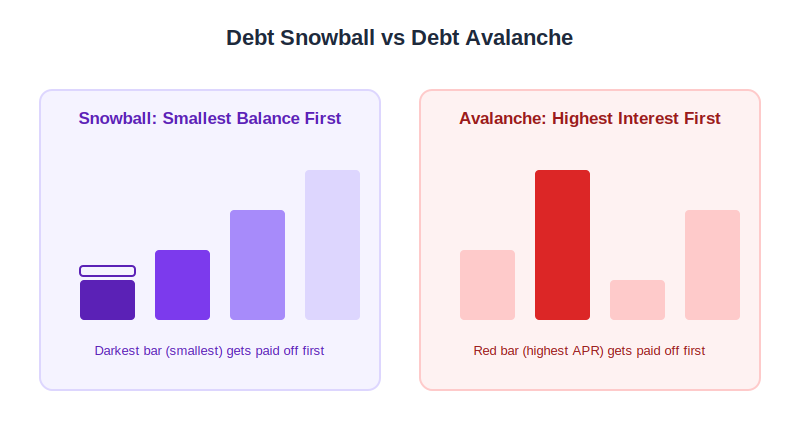
Debt snowball
Pay minimums on everything. Every extra dollar goes to the smallest balance first. When it clears, roll that payment into the next smallest.
Best for: Anyone who’s quit a payoff plan before. Quick wins keep the habit alive even though it costs more in total interest.
Debt avalanche
Pay minimums on everything. Every extra dollar goes to the highest interest rate first. This is the mathematically cheaper route.
Best for: Disciplined payoff where the total interest saved outweighs the slower early wins.
A recurring theme in budgeting forums, r/personalfinance especially, is that people who pick avalanche on paper switch to snowball within a few months because the math stopped feeling motivating. That’s worth knowing before you commit to a method your app then locks you into. YNAB and PocketGuard both let you change strategy mid-plan without starting over, which EveryDollar’s snowball-only structure doesn’t allow.
What Should You Look For in a Debt Management App?
Four things separate the strongest best budgeting apps debt payoff picks from the ones that just display a balance and leave the planning to you.
Avalanche and snowball support, not just one. EveryDollar follows Ramsey’s snowball-first philosophy exclusively. YNAB and PocketGuard both let you pick, which matters if your priorities change once you’re a year into paying off debt and the initial motivation problem has already been solved.
Interest-savings modelling with real numbers, not a static chart. The strongest planners let you type in a balance, an interest rate, and a payment, then show the payoff date shift in real time as you adjust the monthly amount. YNAB’s loan planner does this directly. PocketGuard automates the same math once your accounts are connected.
Budgeting and debt in the same view. A standalone debt payoff planner can’t tell you where the extra $150 a month is supposed to come from. The apps that combine a monthly budget with a debt plan show you that connection directly, which is the difference between a tracker and a plan.
An honest read on what “free” actually gets you. You don’t need to pay to start paying off debt. Empower and Goodbudget prove that. But calling either one the best free debt management app only holds up if you’re also willing to run the payoff math somewhere else, since neither builds it in.
Put those four checks together and that’s exactly how I ranked the best debt payoff apps and the other apps to pay off debt in this roundup, rather than by star rating alone. A real debt payoff planner earns its spot on this list only when it clears all four.
Why Does YNAB Rank as the Best Debt Payoff App Overall?
YNAB tops this list because the loan planner and the zero-based method work on the same problem from two directions at once. The loan planner shows what an extra payment does to your timeline. Zero-based budgeting is what actually finds that extra payment, since every dollar gets assigned a job before you spend it, which is where the “spare” $150 a month usually turns up.
How YNAB handles debt specifically:
- Loan planner: Enter each debt’s balance, interest rate, and minimum payment. YNAB calculates the payoff date and total interest, and updates both live as you change the monthly payment.
- Avalanche and snowball, your choice: YNAB doesn’t default to either strategy. You pick, and the planner models whichever one you’re running.
- Credit card handling: Charging a card moves the money to a payment category the same moment, so the statement never arrives as a surprise.
- Every account in one place: Connect checking, savings, and debt accounts together so the link between spending less and paying down faster stays visible.
Where YNAB actually falls short: the learning curve runs two to four weeks before the method clicks, the single biggest reason people quit in month one. The free live workshop in week one shortens that curve, but doesn’t remove it. YNAB also won’t build the debt plan automatically like PocketGuard does, so you’re setting up the loan planner by hand.
Community threads on debt payoff consistently return to the same two complaints about YNAB: the setup takes longer than any competitor, and the “true expenses” concept for irregular bills, insurance, car repairs, is confusing until the third or fourth month of using it. Both are real friction points, not exaggerations.
Pricing: $109/year ($9.08/mo, YNAB’s own “$70 Savings!” badge) or $14.99/month · 34-day free trial, no card required · Students get a full year free through ynab.com/college, verified via SheerID (see the YNAB student discount guide).
→ Full YNAB review · YNAB pricing guide · The 4 Rules of YNAB explained
Why Is PocketGuard the Strongest Automatic Debt Payoff Planner?
PocketGuard’s debt payoff planner is listed as a Premium-only feature directly on its own pricing page, alongside “best-in-class connectivity” across US and Canadian banks. Connect your debt accounts, and PocketGuard pulls live balances and interest rates, then builds the payment schedule for you instead of asking you to enter each debt by hand the way YNAB does.
How PocketGuard handles debt specifically:
- Connected accounts pull live APRs and balances automatically, no manual entry per debt
- Choose avalanche, snowball, or a custom priority order
- PocketGuard generates a month-by-month schedule showing which debt gets the extra payment and when each one clears
- The “In My Pocket” number factors in debt payments, so you always know what’s actually safe to spend that day
The catch, and it’s a real one: among the best debt payoff apps on this list, PocketGuard’s planner sits behind the $74.99/year Plus plan, not the free tier. The free version gives basic account tracking, useful on its own, but it’s not one of the apps to pay off debt with a structured plan until you upgrade.
That’s worth knowing before you pick PocketGuard specifically for its debt features and land on the free tier by default.
Pricing: Free (limited) · Plus $74.99/year ($12.99/month) · 7-day free trial. See the PocketGuard pricing guide for the full plan breakdown.
→ Full PocketGuard review · PocketGuard alternatives · YNAB vs PocketGuard compared
Why Does EveryDollar Fit the Baby Steps and the Debt Snowball Best?
EveryDollar is Dave Ramsey’s app, built around his debt snowball philosophy specifically, and its January 2026 relaunch added a Margin Finder tool that flags spending categories where you’re likely sitting on unused budget. That’s a genuine addition for debt payoff, since finding an extra $80 a month in an overlooked category is exactly the kind of edge case a static budget misses.
How EveryDollar handles debt specifically:
- Debt snowball built in as the only method, smallest balance first, no avalanche option
- Debt-free date calculator updates the moment you log a payment
- Margin Finder (added January 2026) surfaces categories with unused budget you can redirect to debt
- Live group coaching on Premium adds human accountability alongside the software
Community sentiment around EveryDollar splits cleanly along one line: people who’ve bought into the Baby Steps framework rate it highly, and people using it as a neutral budgeting tool find the anti-credit-card stance and debt-before-investing sequencing actively unhelpful if they disagree with the underlying philosophy. That’s not a bug, it’s the app being honest about who it’s built for.
Where it genuinely falls short: no avalanche option exists at all, so if minimizing total interest paid matters more to you than momentum, EveryDollar can’t do that math. Apple Card can’t be linked, and American Express connections break often enough that it’s a documented, recurring complaint rather than a rare edge case.
Pricing: Free forever (manual entry) · Premium $79.99/year ($17.99/month) · 14-day trial · debit card required for subscription, Ramsey Solutions doesn’t accept credit cards
→ Full EveryDollar review · EveryDollar vs YNAB · EveryDollar pricing guide
Is Empower the Best Free Debt Management App?
Empower connects checking, savings, credit cards, loans, and investment accounts into one real-time net worth dashboard. As a debt management app, it’s the strongest fully free option here for anyone who wants to see debt sitting alongside everything else they own, not in isolation.
What Empower won’t do is build you a payoff strategy. There’s no avalanche or snowball modelling, no interest-savings calculator, no projected payoff date, just the number itself, without a plan attached to it. That’s why calling it the best free debt management app needs a caveat: pair it with the free Debt Payoff Estimator for the planning piece it doesn’t include.
One edge case worth flagging before you connect all your accounts: Empower’s paid wealth-management arm charges 0.49% to 0.89% in assets under management, and multiple user reports describe increasingly frequent advisory outreach once linked assets cross roughly $100,000 to $250,000. The dashboard itself stays free regardless, but the sales contact isn’t something the marketing mentions upfront.
→ Full Empower review · Best net worth tracking apps
Is Goodbudget’s Envelope Method Good for Paying Off Debt?
Goodbudget’s envelope system works for a specific kind of person: someone who finds that automatic bank sync makes it too easy to lose track of spending. Manually moving money into a “debt payment” envelope each month creates friction that automated apps remove, and for some people that friction is exactly what surfaces extra cash for debt.
Among apps to pay off debt with manual entry, this is the clearest example: set a debt-payment envelope at the start of the month, fund what you can, and when it’s full you’ve paid exactly what you planned toward debt, no surprises and no automatic sync smoothing the number over.
The gap is the same one Empower has: no avalanche or snowball calculator, no interest-savings modelling, no projected payoff date. Premium at $80/year adds automatic bank sync and unlimited envelopes, useful if manual entry is the reason you’d abandon the habit, but it still doesn’t add debt planning. Pair it with the free Debt Payoff Estimator if the plan itself matters to you.
Pricing: Free (20 envelopes, manual entry) · Premium $80/year ($10/month) · no trial, refund available shortly after subscribing instead. See the Goodbudget pricing guide for the full breakdown.
→ Full Goodbudget review · Best envelope budgeting apps
How Do These 5 Apps to Pay Off Debt Compare Side by Side?
Here’s how YNAB, PocketGuard, EveryDollar, Empower, and Goodbudget stack up on the features that actually separate the best budgeting apps debt payoff picks from general budgeting polish.
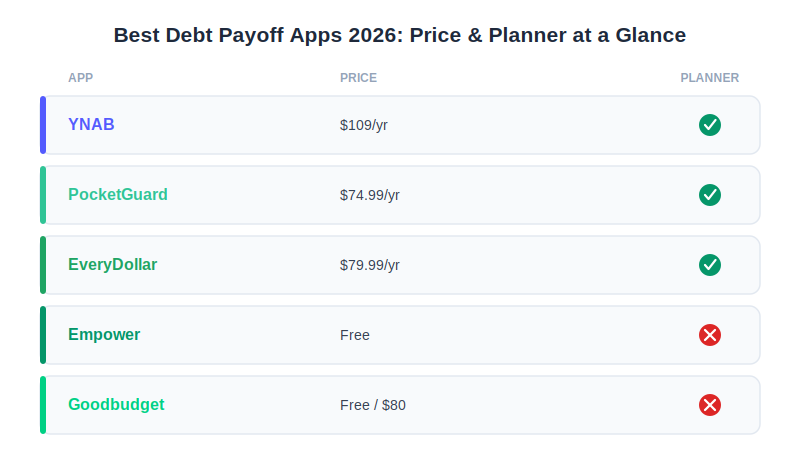
| YNAB | PocketGuard | EveryDollar | Empower | Goodbudget | |
|---|---|---|---|---|---|
| Annual price | $109/yr | $74.99/yr | $79.99/yr | Free | Free / $80 |
| Debt payoff planner | Yes, loan planner | Yes, Plus only | Yes, debt-free date | No | No |
| Avalanche method | Yes | Yes | No, snowball only | No planner | No planner |
| Snowball method | Yes | Yes | Yes, default | No planner | No planner |
| Auto-builds the schedule | No, manual entry | Yes | No, manual entry | n/a | n/a |
| Investment tracking | No | Yes | No | Yes, best free | No |
| Free trial | 34 days, no card | 7 days | 14 days | Free forever | Free forever |
Pricing verified from official websites, 4 September 2026.
Which App Fits Your Specific Debt Situation?
Five common situations, matched to the best debt payoff apps built for each one.
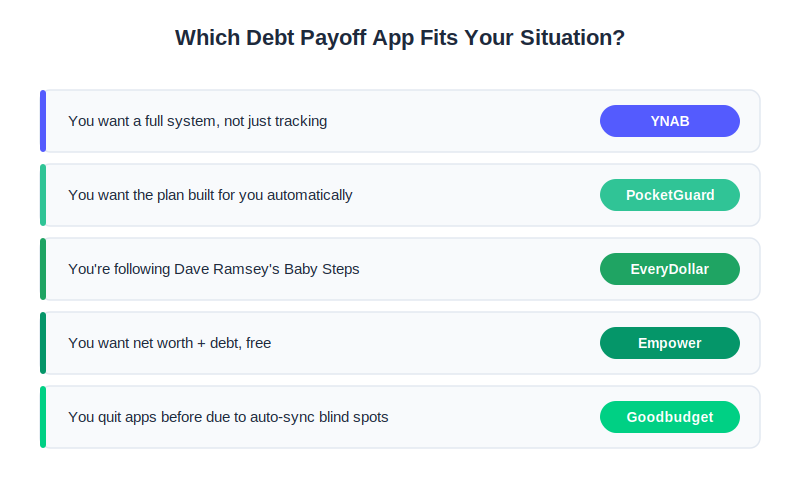
You have credit card debt spread across several cards and want a system, not just tracking.
→ YNAB. Enter each balance into the loan planner, pick avalanche or snowball, and watch the payoff date move as you add extra payments. The zero-based method is what finds that extra money in the first place.
You want the plan built for you, without much manual setup.
→ PocketGuard Plus. Connect your debt accounts, set a monthly payment budget, and let PocketGuard generate the schedule. Less behavioral change required than YNAB, more automation than any competitor here.
You’re following Dave Ramsey’s Baby Steps and want software built around that exact framework.
→ EveryDollar. The debt snowball, Baby Steps tracker, and debt-free date calculator are purpose-built for this path. Start free and add Premium once bank sync earns its keep.
You’re paying off debt and want to watch net worth rise at the same time, without a subscription.
→ Empower plus the Debt Payoff Estimator. Empower shows debt next to investments and net worth for free. The Estimator fills in the payoff math Empower leaves out.
You’ve quit budgeting apps before because automatic sync made it too easy to stop paying attention.
→ Goodbudget. Manual envelope entry rebuilds the awareness automation removed. It won’t plan the payoff for you, so pair it with the Estimator too.
What Are the Most Common Questions About Debt Payoff Apps?
Quick answers to the questions that come up most when people compare the best debt payoff apps on the market, starting with the one everyone actually wants answered first.
What is the best budgeting app for paying off debt fast?
YNAB is the fastest path for most people because the zero-based method actively finds extra money each month instead of waiting for you to notice it. PocketGuard is the closest automatic alternative if manual budgeting isn’t something you’ll stick with.
Can a budgeting app actually help you pay off debt faster, or does it just track balances?
It depends entirely on whether the app includes a payoff planner. YNAB, PocketGuard, and EveryDollar all build a schedule and show a payoff date. Empower and Goodbudget only show the balance, which means the app itself won’t accelerate anything without a separate calculator.
Is it better to use a free app or pay for a debt payoff app?
Free apps like Empower and Goodbudget are the right call if you’re comfortable running the payoff math yourself or with a free calculator. Paid apps earn their subscription cost back quickly for most people once the built-in planner finds even one missed payment opportunity a month.
What are the best debt payoff apps overall?
YNAB leads on loan planning and zero-based budgeting. PocketGuard is the strongest automatic option on its Plus plan. EveryDollar suits Ramsey’s Baby Steps specifically. Empower and Goodbudget are the strongest free choices, best paired with the free Debt Payoff Estimator for the planning piece they don’t include.
Which app is best for paying off credit card debt specifically?
YNAB’s loan planner supports both avalanche and snowball with real interest-savings modelling, which matters most on credit cards carrying a high APR. PocketGuard Plus is the strongest automatic alternative for the same reason.
Should I use the debt snowball or avalanche method?
Avalanche minimizes total interest paid by targeting the highest rate first. Snowball has a higher completion rate because clearing a small balance early keeps people motivated. If you’ve abandoned a payoff plan before, snowball’s psychology is usually worth the extra interest cost.
Does YNAB help with student loan payoff specifically?
Yes. Enter the loan balance, interest rate, and current payment into YNAB’s loan planner, and it calculates the payoff date and total interest, updating both as you adjust the monthly payment. Verified students also get a full year free through SheerID at ynab.com/college.
What’s the actual difference between a budgeting app and a debt payoff app?
A budgeting app allocates income across spending categories. A debt payoff app builds a structured plan for eliminating specific balances. YNAB and PocketGuard do both at once, which is more effective because you can see exactly how spending less in one category speeds up debt payoff in another.
Whichever one of the best debt payoff apps you land on, the app matters less than opening it every week and actually following the plan it builds. Set up your first debt in the planner today, and check the balance again in a month.
📚 Read Next
- Free Debt Payoff Estimator: Avalanche vs Snowball Calculator
- How to Get Out of Debt Fast 2026: Step-by-Step Guide
- YNAB Review 2026
- PocketGuard Review 2026
- EveryDollar Review 2026
- Empower Review 2026
- Goodbudget Review 2026
- EveryDollar vs YNAB 2026
- YNAB vs PocketGuard 2026
- Best Budgeting Apps for Beginners 2026
- How to Budget on Irregular Income 2026
Full disclosure →
