
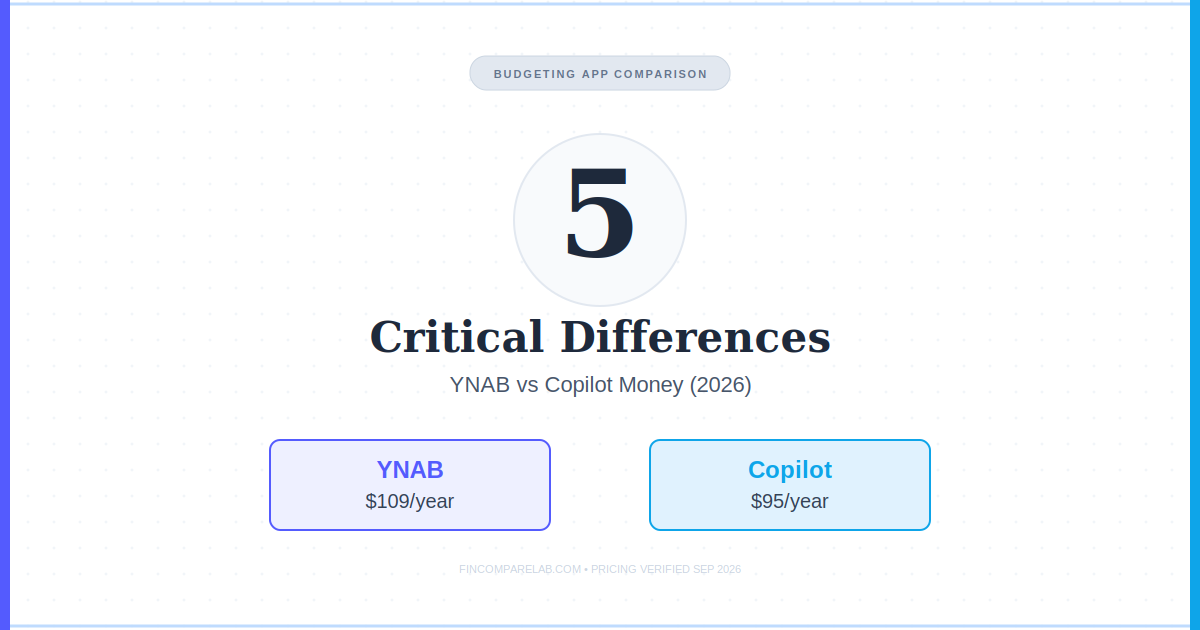
YNAB vs Copilot usually gets reduced to a $14-a-year price gap, but that number hides the five differences that actually decide which app is right for you: how each one changes your behavior, what it costs a couple, which platforms it runs on, how it handles debt, and how it tracks your investments.
⚡ Quick Verdict
YNAB ($109/yr)
Forces a plan for every dollar before you spend it. Wins on debt payoff, couples pricing, and cross-platform support.
Copilot ($95/yr)
Automates tracking and shows you where money already went. Wins on design, investment tracking, and setup speed.
The $14/year price gap is close to irrelevant. The 5 differences below are what actually decide a ynab vs copilot pick.
How We Review Apps · Pricing verified from ynab.com and copilot.money — 14 September 2026
📋 In This Comparison
- What’s the Real Difference Between YNAB and Copilot?
- Which App Actually Changes How You Spend?
- Which App Costs Less If You’re Budgeting as a Couple?
- Can You Use Copilot Money on Android?
- Which App Actually Helps You Pay Off Debt?
- Which App Tracks Your Investments Better?
- Which App Fits Your Situation Right Now?
- Can You Use Both YNAB and Copilot Together?
- What Does the Community Actually Say About YNAB and Copilot?
- What’s the Final Verdict on YNAB vs Copilot?
- What Do People Also Ask About YNAB vs Copilot?
What’s the Real Difference Between YNAB and Copilot?
YNAB and Copilot solve the same problem in opposite directions. YNAB makes you assign every dollar a job before you spend it, which builds discipline over months. Copilot watches your spending after the fact and hands you a polished picture of where it went. The $14/year sticker gap between them is real, but it’s rarely what should decide a ynab vs copilot pick.
The five differences below matter far more than the price tag: which one actually changes your habits, what each costs once a partner is involved, which platforms they run on, how they handle debt, and how seriously they take investment tracking. Work through those and the “which app should I pick” question mostly answers itself.
Most people land on a ynab vs copilot search already leaning one way, usually after outgrowing a free tracker or getting displaced by Mint’s shutdown. The real value of comparing them side by side isn’t crowning a universal winner, since neither app is objectively better than the other across every category. It’s confirming which specific trade-off actually matches your situation before paying for a year upfront.
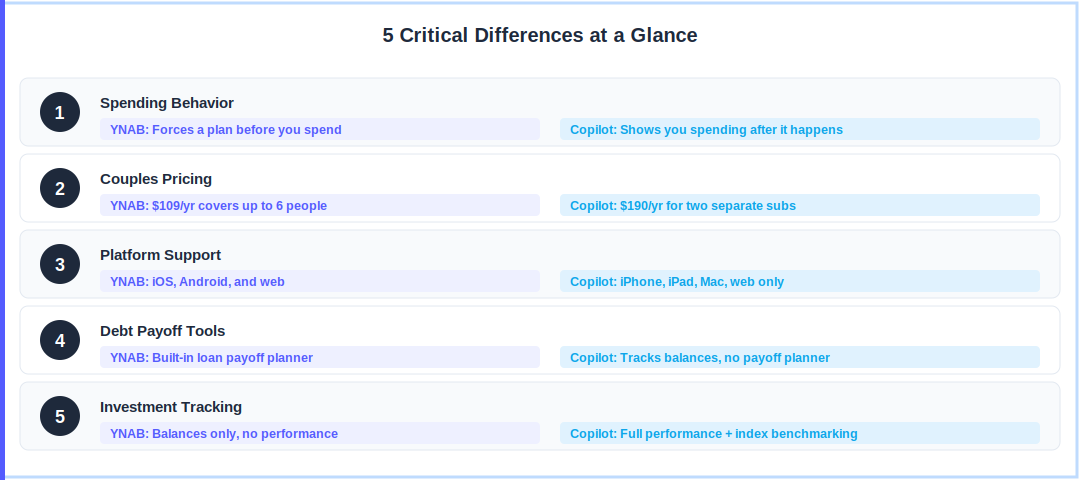
Difference #1: Which App Actually Changes How You Spend?
YNAB requires you to plan every dollar before you spend it, which is a proven way to break an overspending habit. Copilot categorizes transactions automatically after the money is already gone, which suits someone who wants visibility, not a behavior change.
YNAB’s four rules underpin the whole system: give every dollar a job, embrace your true expenses, roll with the punches, and age your money. None of that happens passively: you open the app, assign income to categories, and check a category’s balance before you spend from it. That friction is the point, not a design flaw.
YNAB’s fourth rule, “age your money,” has an actual numeric target worth knowing: the goal is to spend money that’s at least 30 days old rather than living paycheck to paycheck. Once your Age of Money metric, shown right on the YNAB dashboard, crosses that 30-day mark, a full pay cycle of real buffer exists between when income arrives and when it gets spent.
I ran that exact zero-based method for 15 years, and the thing nobody warns you about going in is that its biggest strength and its most common failure mode are the same habit: the weekly reconciliation. Skip it for a busy month and the whole plan drifts out of sync.
Catching back up after that drift feels almost like starting over, and that specific burnout point, not the method itself, is exactly what eventually pushes some long-time YNAB users toward a more automated system instead of quitting budgeting altogether.
Copilot’s AI does the opposite: connect your accounts and it starts tagging transactions immediately, getting sharper as you correct it over the first few weeks. Community discussion threads about switching off Mint bring up Copilot’s Venmo and shared-expense splitting specifically and repeatedly as a standout, since it handles reimbursements between friends more cleanly than most competitors, which matters if you’re the person who always fronts dinner.
Difference #2: Which App Costs Less If You’re Budgeting as a Couple?
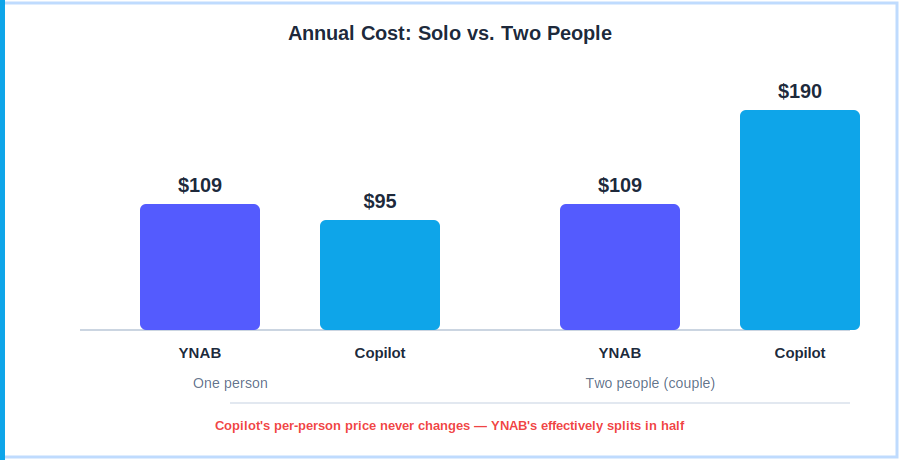
For one person, Copilot is $14 a year cheaper than YNAB. For a couple, that flips hard: YNAB’s $109/year plan covers up to six people on one subscription, while Copilot has no shared plan at all: two people means two separate $95/year subscriptions, or $190/year combined.
Run the copilot money vs ynab numbers specifically for two people and YNAB’s effective per-person cost drops to about $54.50/year, while Copilot’s stays flat at $95 each no matter how many people in the household are using it. That’s the actual number worth comparing, not the $14 headline gap.
It’s also the number that should decide a copilot money vs ynab pick for anyone budgeting jointly, not the solo price alone.
If a subscription of any size feels like the wrong trade-off, our sister-site guide comparing a Google Sheets budget tracker against paid apps walks through the free spreadsheet route, which some couples prefer specifically to avoid this exact math.
For couples who want built-in shared-household features rather than a workaround, it’s also worth comparing both apps against Monarch Money, which was purpose-built for two-person budgeting at $99.99/year total. For anyone already running a mental ynab vs monarch vs copilot bracket, the couples math above is exactly why Monarch tends to win that particular round. Our best budgeting apps for couples roundup breaks down all three side by side.
Can You Use Copilot Money on Android?
No. Copilot Money runs on iPhone, iPad, Mac, and the web, but there’s no Android app and no confirmed release date. YNAB runs on iOS, Android, and the web, so it’s the only one of the two that works if you or a partner carries an Android phone.
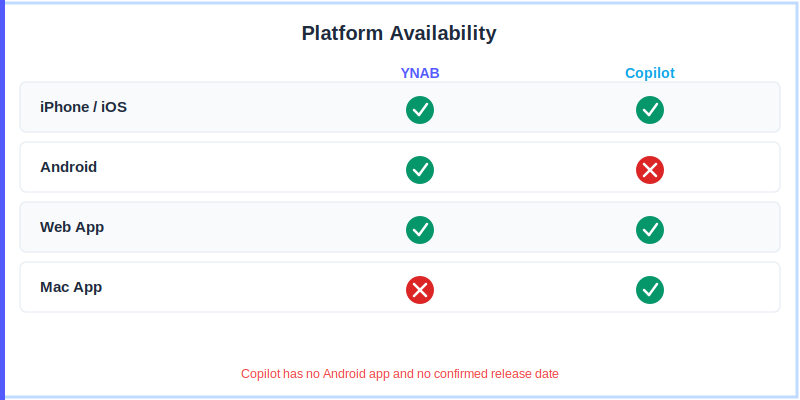
This one difference eliminates Copilot outright for a lot of households before price or features even enter the ynab vs copilot conversation. If a mixed iOS/Android household is the actual situation, YNAB or Monarch Money are the only two apps in this comparison that work on both.
Our full Copilot Money review and YNAB review go deeper on setup and day-to-day use on each platform. Our Copilot Money security guide covers how it handles bank-linking data if platform trust, not just platform availability, is also a concern.
Both apps connect to your bank the same way underneath, which surprises a lot of people comparing YNAB vs Copilot on features alone. YNAB is a registered agent of Plaid, the account-data provider that also powers Copilot’s own bank connections. In practice, sync reliability comes down to your specific bank’s relationship with Plaid, not which app you picked, a genuine parity point once the Android question is settled.
Difference #4: Which App Actually Helps You Pay Off Debt?
YNAB, and it’s not close, which is one of the clearest-cut answers in this whole ynab vs copilot comparison. It has a built-in loan planner that shows exactly how extra payments shorten your payoff date and cut total interest, and its zero-based method turns debt payoff into a weekly decision instead of a passive intention. Copilot tracks debt balances but has no structured payoff planning of its own.
That structural gap matters more than it sounds. Watching a debt balance shrink is motivating, but it doesn’t tell you whether an extra $50 this month should go toward the credit card or the car loan. YNAB’s loan calculator answers that question directly. Copilot simply doesn’t try to.
None of this shows up if you only skim a generic ynab vs copilot roundup that treats every feature as equally weighted.
If debt payoff is the actual goal here rather than budgeting in general, run the numbers first with our free Debt Payoff Estimator. Our guide to getting out of debt fast and the broader best budgeting apps for debt payoff roundup both cover apps built specifically around this use case.
Difference #5: Which App Tracks Your Investments Better?
Copilot, by a wide margin. It benchmarks your portfolio against market indexes, tracks crypto and real estate alongside your bank accounts, and shows live performance estimates you can check whenever you want. YNAB only displays investment account balances, with no performance tracking and no index comparison at all.
Copilot’s benchmarking isn’t just a percentage sitting next to your balance. It tracks your actual portfolio return against a comparable market index, like the S&P 500, over the same period, so a “+4.2%” quarter reads very differently if the index was up 7% than if the index was up 2%. YNAB has no equivalent metric anywhere in the app.
This is one of the few places in a ynab vs copilot comparison where the answer isn’t close at all.
If investment tracking is actually the priority and budgeting discipline is secondary, it’s also worth comparing both apps against Empower’s free dashboard, which was built specifically around net worth and portfolio tracking rather than budgeting. Our Empower review and best net worth tracking apps guide cover that angle directly.
Which App Fits Your Situation Right Now?
Match your own situation to the list below rather than to a feature table. This is usually where a real ynab vs copilot decision actually gets made, not in a spec sheet.
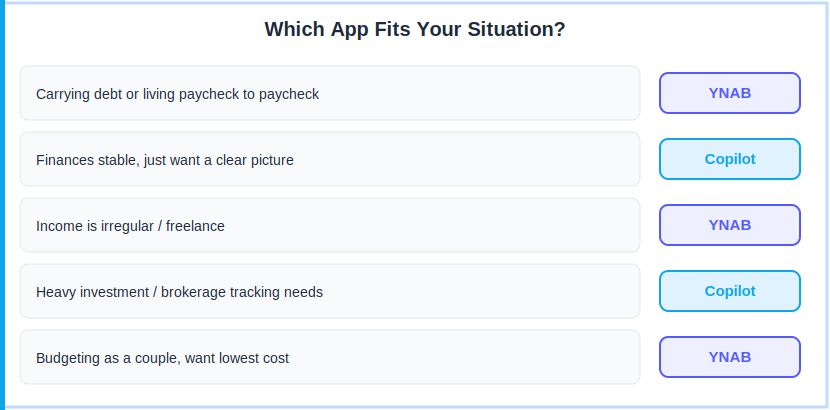
💸 Carrying debt or living paycheck to paycheck
→ YNAB. The loan planner and forced category assignments make ignoring debt genuinely difficult, in a good way. Pair the 34-day no-card trial with our Debt Payoff Estimator before committing.
📊 Finances are already stable, you just want clarity
→ Copilot, if you’re on iPhone or Mac. No enforcement needed if the habits are already solid. You just want the picture.
💰 Income is irregular or freelance
→ YNAB. The “age your money” rule means budgeting off last month’s income, which stops feast-and-famine cycles from derailing the plan. See our full guide to budgeting on irregular income.
📱 Heavy brokerage or crypto tracking needs
→ Copilot (iPhone/Mac only). Index-benchmarked performance tracking is a genuine standout here, and YNAB has no equivalent.
🎓 Budgeting for the first time, or as a student
→ YNAB, free for a year. A full 365 days with a valid .edu email via ynab.com/college. See our YNAB for students guide. Copilot has no student program.
Can You Use Both YNAB and Copilot Together?
Technically yes, but it defeats the purpose for most people. Running both isn’t really a ynab vs copilot decision at all. Running the copilot money vs ynab math for a shared household already answered most of this question in the couples section above. It’s paying twice, $204/year combined, for a problem either app already solves on its own.
The one situation where it makes sense is a short transition period: keep Copilot open for its investment dashboard while trialling YNAB free for 34 days to see if zero-based budgeting sticks, then drop whichever one loses.
If the actual goal is one app that does both jobs reasonably well instead of running two, that’s the specific gap Monarch Money is built to fill. See our full YNAB vs Monarch Money comparison for how it stacks up against both.
What Does the Community Actually Say About YNAB and Copilot?
Search ynab vs copilot reddit and the same split shows up thread after thread: people trying to fix a habit recommend YNAB, and people who just want a clean automatic dashboard recommend Copilot. Neither side is really disagreeing about quality. They’re answering a different question than the one being asked.
On the YNAB side, a recurring and fair complaint is bank-sync delay. A transaction not posting for over a week isn’t rare, and long-time users learn to reconcile manually rather than wait.
On the Copilot side, community threads about switching off Mint mention a small number of user-shared referral codes, 2MFREE being one commonly cited example, that reportedly unlock a couple of extra free months. Copilot doesn’t officially publish or guarantee these, so treat any code you find as a maybe, not a plan, and check our Copilot Money referral code guide for what’s actually confirmed working.
What’s the Final Verdict on YNAB vs Copilot?
Boiled down, ynab or copilot comes down to one honest question: do you need to change a habit, or do you need to understand one better? If you’re carrying debt or don’t know where your money goes, YNAB’s friction is the actual feature, and the 34-day no-card trial costs nothing to test.
If your finances are basically under control and you want effortless clarity plus real investment tracking, Copilot on iPhone or Mac is hard to beat. Either way, a ynab vs copilot decision comes down to what needs to change, not which app has the longer feature list.
What Do People Also Ask About YNAB vs Copilot?
These are the exact questions people search alongside a ynab vs copilot comparison, answered directly.
Is Copilot Available on Android?
No. Copilot Money is iPhone, iPad, Mac, and web only, with no Android app and no confirmed release date. If you or a partner uses Android, YNAB or Monarch Money are the practical cross-platform alternatives.
Is YNAB or Copilot Better for Paying Off Debt?
YNAB. Its built-in loan planner shows exactly how extra payments change your payoff date and interest cost, and zero-based budgeting turns debt payoff into a weekly decision instead of a passive intention. Use our free Debt Payoff Estimator alongside either app.
Is Copilot Better Than YNAB on Reddit?
It depends who’s asking. Search ynab vs copilot reddit and you’ll find automation-focused threads recommending Copilot for Apple users, while threads about debt or overspending consistently point to YNAB’s structure instead. The split tracks financial situation, not app quality.
What About YNAB vs Monarch vs Copilot?
Monarch sits between the two: largely automatic like Copilot, but available on iOS and Android like YNAB. Anyone comparing ynab vs monarch vs copilot directly will also find Monarch is the strongest of the three for couples, at $99.99/year for both partners. See our full YNAB vs Monarch Money comparison.
Which Is Cheaper, YNAB or Copilot, for Couples?
YNAB, by a wide margin. One $109/year subscription covers up to six people. Copilot requires two separate $95/year subscriptions, $190/year combined, since it has no shared-household plan at all.
Does YNAB Track Investments?
Not really. YNAB can display investment account balances but doesn’t track performance or benchmark against market indexes. Copilot does both, which is one of the clearest gaps in this whole comparison.
Can You Switch From Copilot to YNAB Without Losing Data?
You can export Copilot’s transaction history and import it into YNAB, but category structure, budget targets, and savings goals don’t transfer automatically. They need rebuilding by hand. Most switchers treat it as a clean-slate setup rather than a straight migration.
How Does Bank Syncing Compare Between YNAB and Copilot?
They’re closer than most people expect. Both apps rely on Plaid for live bank connections, so a slow or dropped sync usually traces back to your specific bank’s relationship with Plaid rather than a flaw in either app.
YNAB users more often report manual reconciliation as a workaround; Copilot’s alerts are designed to flag sync gaps proactively instead. This is one corner of ynab vs copilot where the two apps are more alike than different.
Which App Has the Better Free Trial?
For anyone still weighing ynab vs copilot purely on how easy it is to try before paying, YNAB’s is stronger: 34 days, no credit card required, confirmed directly on ynab.com/pricing. Copilot’s trial runs through the Apple App Store and typically requires payment details upfront, even though you won’t be charged until the trial ends.
📚 Read Next
Full disclosure →
