
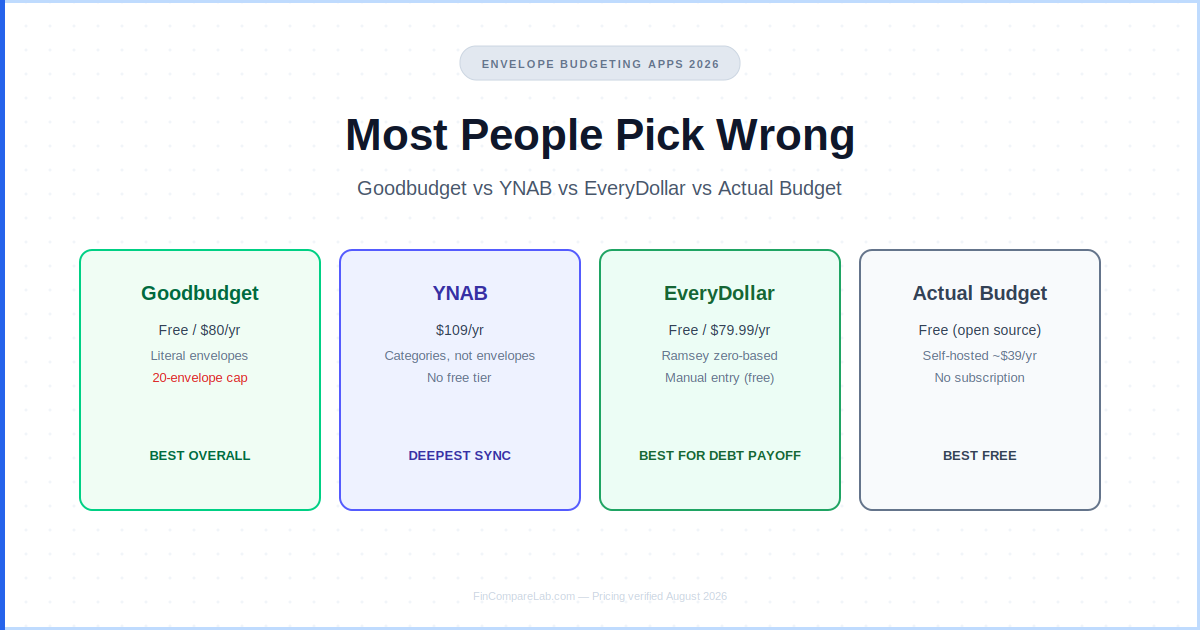
Envelope budgeting apps promise the simplicity of cash envelopes without carrying an actual wallet full of cash, but free-tier caps and confusion over which apps are even still around trip up more people than the budgeting method itself.
⚡ Quick Verdict
If you want the closest thing to true digital envelopes, Goodbudget is still the most literal option — just watch its 20-envelope free-tier cap. If you want envelope-style discipline with deeper bank sync, YNAB does it without calling them “envelopes.” For debt payoff on a strict system, EveryDollar pairs with Ramsey’s method. If you want it free forever with no compromises, Actual Budget is the open-source pick — self-hosting included.
How We Review Apps · Pricing verified across official app sites — 5 August 2026
What Makes an App an “Envelope Budgeting” App?
An envelope budgeting app splits your income into digital “envelopes” for categories like rent, groceries, and savings, so you can only spend what’s left in each one. It’s the cash-envelope method without the cash, and most apps sync directly to your bank.
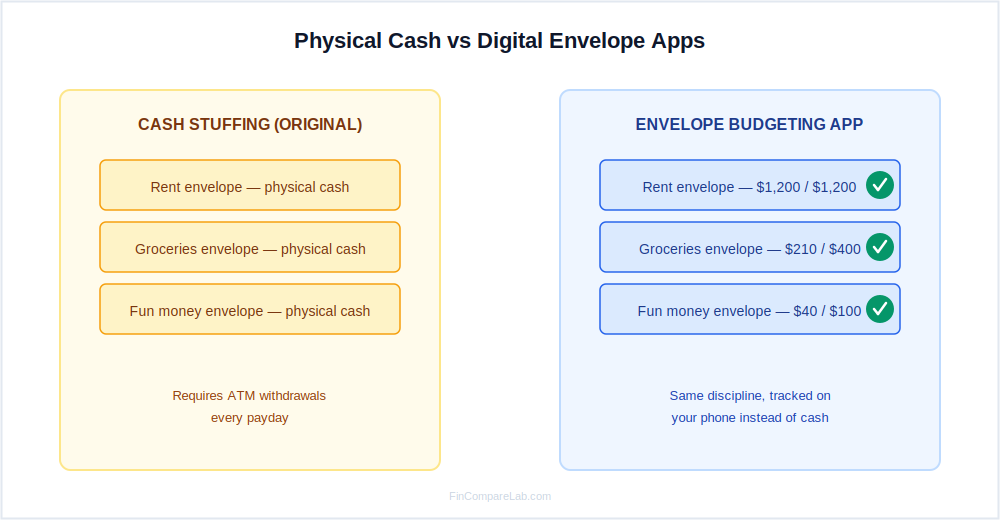
The core idea dates back decades before smartphones existed: put physical cash into labeled envelopes, and once an envelope is empty, you stop spending in that category until next month. Envelope budgeting apps digitize that discipline. Instead of a stack of paper envelopes on your kitchen counter, you get a list of categories inside an app, each with its own running balance.
Not every budgeting app uses this exact language, though. Some call them “categories” or “buckets” instead of envelopes, and a few — like YNAB — use their own terminology entirely while still following the same underlying logic. Goodbudget’s own explainer covers the classic version of this method well if you want the full history.
You’ve probably also seen “cash stuffing” videos floating around social media — that’s just the original, physical version of this same idea: literal cash in literal envelopes, no app involved. Envelope budgeting apps recreate that same discipline without an ATM run every payday.
That’s part of why searches for envelope budgeting apps get confusing fast, and why I’ve broken down which apps actually behave like envelopes below.
Which Envelope Budgeting Apps Are Worth Using in 2026?
Four apps consistently show up when people search for an app for envelope budgeting, and each one takes a different approach to the envelope method. Here’s how they compare.
| App | Envelope style | Price | Free tier? |
|---|---|---|---|
| Goodbudget | Literal digital envelopes | Free / $80/yr Premium | ✅ (20-envelope cap) |
| YNAB | “Give every dollar a job” categories | $109/yr or $14.99/mo | ❌ (34-day trial only) |
| EveryDollar | Zero-based category envelopes | Free / $79.99/yr Premium | ✅ (manual entry) |
| Actual Budget | Open-source category envelopes | Free (self-hosted ~$39/yr optional) | ✅ (fully free) |
Pricing verified from official websites — August 2026.
Goodbudget is the most literal envelope budgeting app of the group — you create named envelopes, fund them from each paycheck, and move money between them if one runs short. It’s built for households that want the classic envelope experience without carrying cash.
YNAB doesn’t call its categories envelopes, but the mechanics are nearly identical: every dollar gets assigned a job, and once a category’s funded amount is spent, it’s gone until you refund it. I cover this distinction in more detail below.
EveryDollar follows Dave Ramsey’s zero-based budgeting approach, where envelope-style categories are central to the Baby Steps debt-payoff method.
Actual Budget is open-source and free forever, using the same envelope-style category logic as YNAB but without a subscription — you just handle your own hosting if you want automatic bank sync.
One billing note worth flagging across all four: Goodbudget and EveryDollar both let you pay monthly instead of annually if you’d rather test the free-tier limits before committing to a full year. YNAB technically offers monthly billing too, but at a meaningfully higher effective rate than its annual plan, so it’s really only worth it if you’re unsure whether you’ll stick with the app past a couple of months.
Does Goodbudget’s 20-Envelope Cap Actually Trip People Up?
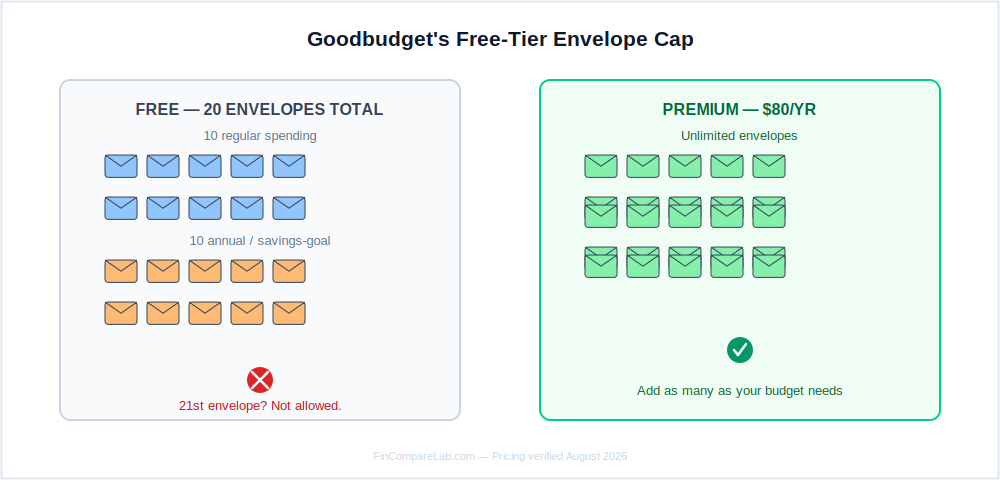
Yes — and it’s the single most common complaint I see about Goodbudget’s free plan. The free tier caps you at 20 total envelopes, split between 10 regular spending envelopes and 10 annual or savings-goal envelopes.
That sounds like plenty until you actually list out a real household budget: rent, groceries, gas, subscriptions, pet care, kids’ activities, gifts, home maintenance, and a handful of savings goals can easily blow past 20 categories. Once you hit the cap, you either have to combine categories that don’t really belong together, or upgrade to Premium at $80/yr to unlock unlimited envelopes.
This isn’t a dealbreaker — plenty of households genuinely fit inside 20 envelopes, especially if they group loosely (“household bills” instead of separate envelopes for electric, water, and internet). But if you’re the type who likes granular categories, budget for the $80/yr upgrade from day one rather than discovering the cap mid-setup.
Is YNAB Really an Envelope Budgeting App?
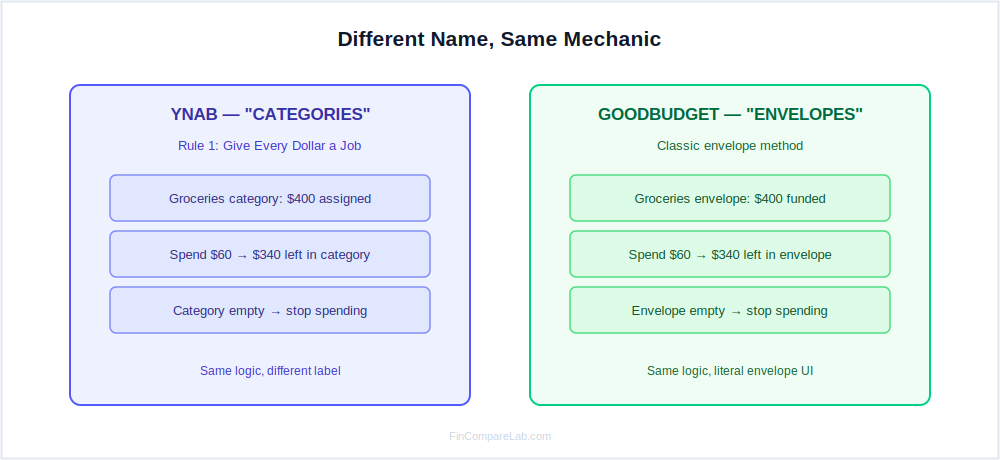
Functionally, yes — even though YNAB never uses the word “envelope” anywhere in its app. YNAB’s Rule One is “Give Every Dollar a Job,” which means every dollar of income gets assigned to a specific category the moment it hits your budget.
That’s the same core mechanic as an envelope: money sits in a category, you spend from that category, and once it’s empty, you either stop spending or move money in from elsewhere. The difference is mostly cosmetic — YNAB calls them “categories,” while Goodbudget and EveryDollar call them “envelopes.”
Where YNAB pulls ahead of a literal envelope budgeting app is bank sync depth and its “Age of Money” tracking, which shows how far ahead of your paycheck you’re actually living. If you want the envelope discipline with more reporting depth, YNAB’s $109/yr plan is worth the higher price tag. If you specifically want an app that visually shows envelopes, Goodbudget is the closer match.
What Happened to Mvelopes, and What Should You Use Instead?
Mvelopes shut down permanently on December 29, 2022. If you’re searching for it because you used to be a customer, the app is gone and can’t be redownloaded or reactivated — this isn’t a rebrand or a temporary outage.
Before it closed, Mvelopes offered a subscription-only envelope budgeting system with no free tier, priced across Basic, Premier, and Plus plans. It was well-reviewed while it operated, which is likely why it still gets searched for years later.
When Mvelopes announced its shutdown, YNAB published its own transition guide for displaced users. Goodbudget and EveryDollar picked up plenty of former Mvelopes customers too, since all three preserve the same envelope-style, zero-based structure Mvelopes users were used to.
If you’re one of them, Goodbudget is the closest match to Mvelopes’ original interface, while YNAB and EveryDollar are close seconds depending on whether you want deeper reporting or a Ramsey-aligned debt focus.
For context, Mvelopes never had a free tier — it ran three paid plans before shutting down: Basic at roughly $6/mo, Premier at roughly $10/mo, and Plus at roughly $20/mo, each unlocking more coaching and reporting features.
That’s worth knowing if you’re comparing what you paid then against what today’s apps cost now — every option covered here except YNAB is cheaper than Mvelopes’ old Basic plan, and three of the four (Goodbudget, EveryDollar, Actual Budget) have a genuine free tier Mvelopes never offered at all.
Which Envelope App Works Best for Couples?
Goodbudget is built around shared budgeting from the ground up — both partners can log in on separate devices and see envelope balances update in real time, which is exactly what a shared household budget needs.
YNAB also supports multiple users on one budget (up to six people on a single subscription), which makes it a strong couples option too, especially if you also want investment and net-worth context beyond pure envelope tracking.
Picture splitting rent and groceries with a partner: one person funds “rent,” the other funds “groceries,” and both see the same real-time balances instead of texting spreadsheet screenshots back and forth. That’s the real day-to-day value of a shared envelope app over doing it solo.
For a deeper breakdown of couples-specific budgeting apps beyond just the envelope method, see my best budgeting apps for couples guide.
Can You Do Envelope Budgeting for Free?
Yes, and you actually have three legitimate free options. Goodbudget’s free tier gives you real envelope budgeting up to 20 envelopes, though transaction entry is manual. EveryDollar’s free tier gives you the same zero-based categories, also with manual transaction entry. Actual Budget is free with no envelope cap at all, since it’s open-source software rather than a subscription product.
The tradeoff is usually convenience rather than functionality. Goodbudget’s cap forces some category consolidation once you outgrow 20 envelopes.
EveryDollar’s free manual entry takes more weekly upkeep since nothing pulls in automatically. Actual Budget’s automatic bank sync requires self-hosting (roughly $39/yr) or manual CSV imports otherwise. None of these are “free with hidden fees” — they’re free with a genuine convenience tradeoff, worth knowing upfront.
For a wider roundup beyond just envelope-style apps, I’ve also covered every legitimately free option on the site in best free budgeting apps.

Is Envelope Budgeting Good for Debt Payoff?
Envelope budgeting pairs naturally with debt payoff because it forces you to see exactly how much is left for discretionary spending once your debt payment envelope is funded first. EveryDollar was built specifically around Dave Ramsey’s zero-based, envelope-style method and the debt snowball approach.
Goodbudget and YNAB both work well for debt payoff too — you just create a dedicated debt-payment envelope or category and fund it before anything discretionary. For a full breakdown of snowball versus avalanche payoff strategies and which apps support each, see best budgeting apps for debt payoff or my guide on getting out of debt fast.
Say you’re carrying $10,000 in credit card debt and paying $350/month toward it. An envelope budgeting app forces that $350 into its own envelope the moment your paycheck lands, before rent or groceries get funded.
That’s the real value here — it’s not that envelopes make debt payoff faster on paper, it’s that they make it much harder to accidentally skip a payment because the money “disappeared” into everyday spending first.
Which Envelope Budgeting App Should You Actually Choose?
If you want the closest thing to literal cash envelopes with simple shared access for a household, start with Goodbudget and budget for the $80/yr Premium tier if 20 envelopes feels tight. If you want deeper bank sync and reporting and don’t mind the higher price, YNAB delivers the same envelope discipline under different terminology.
If debt payoff is your main goal, EveryDollar’s Ramsey-aligned structure keeps things simple. And if you want a genuinely free, no-subscription option and don’t mind a little technical setup, Actual Budget is the one to try.
Whichever you pick, the app matters less than actually funding your envelopes before the month starts — that’s the habit that makes envelope budgeting work, not the specific software.
What Do People Also Ask About Envelope Budgeting Apps?
Can You Do Envelope Budgeting With Google Sheets Instead of an App?
Yes, plenty of people build their own envelope budget system app-style tracker in Google Sheets, using separate rows or tabs as envelopes and manually deducting spending. It works, but you lose automatic bank sync and have to update it by hand every time you spend, which is exactly the manual upkeep an app is designed to remove.
What’s the Difference Between Cash Stuffing and a Digital Envelope App?
Cash stuffing is the physical version — literally putting paper cash into labeled envelopes each payday. A digital envelope budgeting app tracks the same category limits electronically instead, which means your money stays in your bank account and earns you the convenience of card payments while still enforcing the same spending caps.
Can Envelope Budgeting Work With Irregular Income?
Yes, though it takes more setup discipline. You fund envelopes based on your lowest expected income month rather than an average, and any extra income in a good month gets distributed to envelopes afterward instead of spent immediately. I walk through this in more detail in my guide to budgeting with irregular income.
Is There Truly a Free Envelope Budgeting App With No Catch?
Actual Budget comes closest — it’s open-source with no subscription tier at all. Goodbudget and EveryDollar are also genuinely free, but with real tradeoffs (Goodbudget’s 20-envelope cap, EveryDollar’s manual-entry-only free tier), so “free” doesn’t mean “unlimited” on any of them.
Do I Need a Separate Bank Account for Envelope Budgeting Apps?
No. Envelope budgeting apps track category limits digitally on top of your existing checking account, so you don’t need to physically move money into separate accounts. Some people still prefer a separate savings account for annual or goal-based envelopes specifically, but it’s a preference, not a requirement.
What’s the Best App for Envelope Budgeting on a Tight Starter Budget?
If money’s tight, start with Goodbudget’s free tier or EveryDollar’s free manual-entry plan before paying for anything. Both give you real envelope-style budgeting with zero subscription cost — you’re only trading away automatic bank sync (EveryDollar) or unlimited envelopes (Goodbudget), not the actual budgeting method. Upgrade later once you’ve confirmed the habit sticks.
Is There a Simple Envelope Budget System App for Complete Beginners?
Goodbudget is generally the easiest entry point if you’ve never used an envelope budget system app before, since its interface visually mirrors physical cash envelopes rather than abstract categories. EveryDollar is a close second if you specifically want Dave Ramsey’s baby-steps framework built in from day one.
Are Envelope Apps Safe to Link to My Bank Account?
Reputable envelope apps use bank-grade encryption and read-only connections through providers like Plaid, meaning the app can see transactions but can’t move money out of your account on its own. That said, always check an app’s specific security page before linking accounts, and use a unique password you’re not reusing anywhere else.
Is “Envelope” the Debit Card App Different From an Envelope Budgeting App?
Yes, and it’s a common mix-up. There’s a separate product literally named “Envelope” that pairs a checking account and debit card with built-in envelope categories, which is a different setup from the budgeting-only apps covered here.
None of the apps I recommend in this guide — Goodbudget, YNAB, EveryDollar, Actual Budget — require you to open a new bank account or switch your debit card; they all layer envelope tracking on top of whatever bank you already use.
