
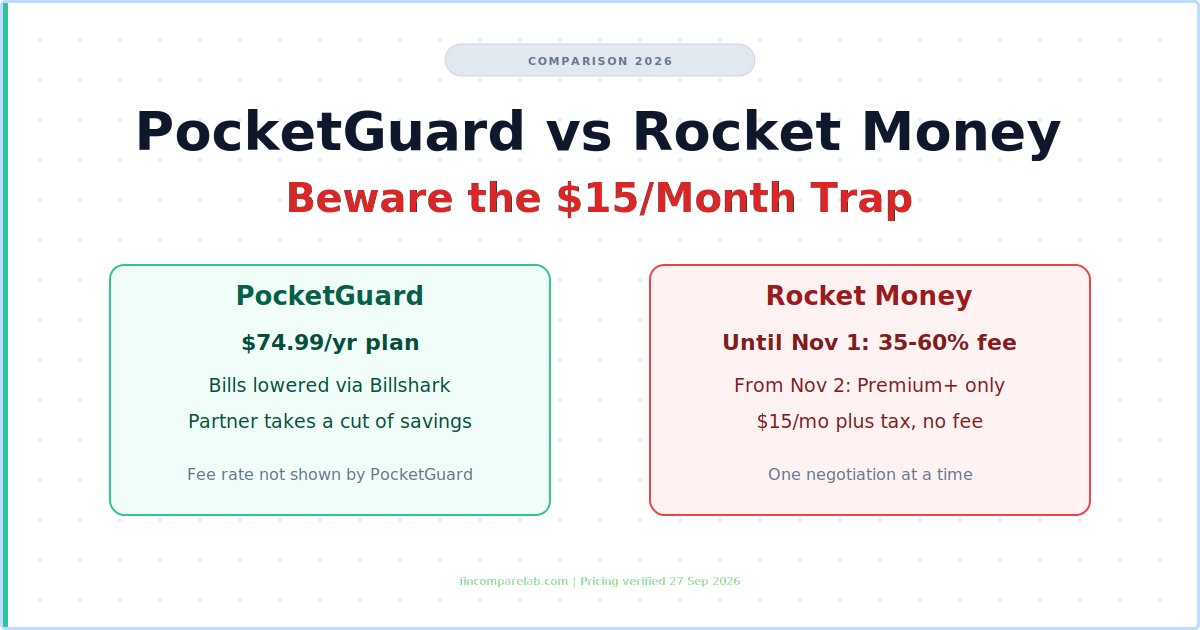
PocketGuard vs Rocket Money used to be a simple fixed-price versus free-plus-fees choice. On November 2, 2026, Rocket Money turns bill negotiation into a $15-a-month subscription, and PocketGuard quietly added bill negotiation of its own.
⚡ Quick Verdict
PocketGuard wins for overspenders and anyone with one bill to lower: $74.99 a year covers budgeting, and its partner Billshark takes a cut only when it saves you money. Rocket Money wins for subscription clutter and for people with several bills to negotiate, but from November 2 that means Premium+ at $15 a month plus tax.
How We Review Apps · Pricing verified from pocketguard.com and rocketmoney.com — 27 September 2026
What Is the $15/Month Trap in PocketGuard vs Rocket Money?
The $15/month trap is Rocket Money’s new rule that, from November 2, 2026, bill negotiation requires Premium+ at $15 a month plus tax. The success fee disappears, but the subscription replaces it. PocketGuard now negotiates bills too, through partner Billshark, which takes a cut of savings instead of billing monthly.
Why call it a trap? In any PocketGuard vs Rocket Money cost check, a year of Premium+ is $180, and if you only have one bill worth lowering, that’s often more than the old percentage fee would have cost. The flat price only pays off when you have several bills to work through.
If you already know which way you lean, you can start PocketGuard’s 7-day trial or open a free Rocket Money account. The rest of this PocketGuard vs Rocket Money comparison is about doing the math before you pay for either one.
A quick note on sourcing. I haven’t run either app day to day (I spent 15 years on YNAB and switched to Monarch Money this year), so everything here comes from PocketGuard’s and Rocket Money’s own pricing pages and help centers, checked on 27 September 2026, plus published user-review trends.
What Changes for Rocket Money Bill Negotiation on November 2?
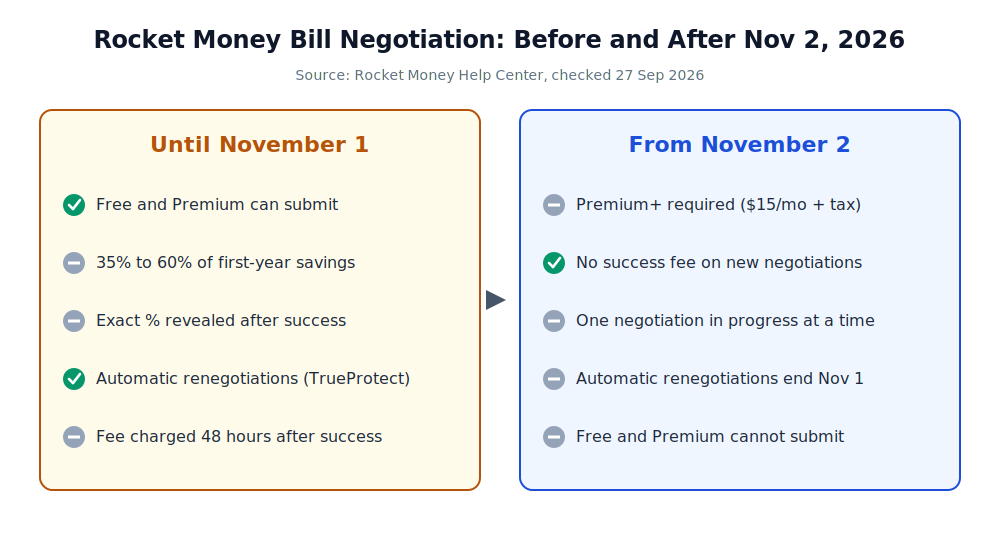
Starting November 2, 2026, only Premium+ members can submit new bill negotiations on Rocket Money. Free and Premium members keep every other feature but lose negotiation entirely (the biggest PocketGuard vs Rocket Money shift this year), and there’s no pay-per-bill option to fill the gap, according to Rocket Money’s help center announcement.
Automatic renegotiations end one day earlier, on November 1. If Rocket Money was scheduled to revisit a bill through TrueProtect when your promo rate expired, that won’t happen now. You’ll need to ask Rowan, the Premium+ AI assistant, or file a negotiation ticket yourself.
A negotiation already in progress finishes under the old terms. If it succeeds, you still pay the old percentage, even if you upgrade to Premium+ the next day. Premium+ also caps you at one negotiation in progress at a time, so three bills means three rounds, back to back.
Premium+ bundles Rowan and access to apply for Rocket Money’s high-yield savings account. Sales tax now applies to Premium and Premium+ in certain states, so $15 isn’t always your real monthly number. The full tier breakdown lives in my Rocket Money pricing guide.
Does Rocket Money Charge a Fee to Negotiate Bills Right Now?
Does Rocket Money charge a fee right now? Yes. Until November 1, it charges 35% to 60% of your first year’s savings when a negotiation succeeds, on both the free and Premium plans. If the negotiation fails, you pay nothing, and that part hasn’t changed.
The detail most comparisons skip is when you learn the percentage. Rocket Money doesn’t quote the rate before you submit a bill. Per its fee explainer, the exact figure arrives in a Negotiation Success email after your provider has already agreed to the lower price.
From that email, you have 48 hours. After that, the full Rocket Money negotiation fee goes on the card you confirmed when you requested the negotiation. The only way to spread it out is a payment plan (weekly, biweekly, or monthly for up to 12 months) set up through the link in that same email. The fee isn’t refundable once charged.
Here’s what that looks like on a $25-a-month internet cut. That’s $300 in first-year savings, so the Rocket Money success fee lands between $105 and $180, due as a lump sum two days after the good news. If $180 would strain your checking account that week, set up the payment plan the day the email arrives.
So, does Rocket Money charge a fee? For the next five weeks, yes, per successful negotiation. After November 2 the fee becomes a subscription, which is a different cost to plan around, and one that keeps billing whether or not a negotiation is running.
Does PocketGuard Negotiate Bills Too?
Yes, and it’s the change that reshapes PocketGuard vs Rocket Money most. PocketGuard’s pricing page lists Lower Your Bills as an included feature, and its Lower My Bills page explains that partner Billshark negotiates cell phone, cable, and WiFi bills for you, taking a cut only if it succeeds.
That contradicts PocketGuard’s own comparison blog, which still said PocketGuard has no bill negotiation and no lifetime plan after its 16 September update. The pricing page shows both. I’m going with the pricing page, since that’s where you actually pay.
The open question is the rate. PocketGuard’s page doesn’t publish Billshark’s percentage. Billshark’s sign-up page describes a one-time 40% fee on savings, while one of its partner landing pages quotes 35%. Which rate PocketGuard users get is unconfirmed as of 27 September 2026, so ask Billshark before you submit a bill.
Success-rate claims don’t line up either. PocketGuard’s page says Billshark averages 80%, and Billshark’s own pages claim 85% on one page and 90% on another. Treat all three as marketing, not a forecast for your cable bill.
One structural PocketGuard vs Rocket Money difference works in PocketGuard’s favor. You need a paid PocketGuard plan to reach Billshark, but that’s the same $74.99 a year you’d pay for budgeting anyway. Negotiation doesn’t add a monthly charge on top, which is exactly what Rocket Money Premium+ does.
How Much Does It Cost to Lower One Bill With Each App?
In a PocketGuard vs Rocket Money cost test with one bill cut by $300 a year, Rocket Money costs $105 to $180 until November 1, then $180 a year for Premium+. PocketGuard’s route through Billshark costs about $120 at Billshark’s published 40% rate, plus a plan you’d likely already have.
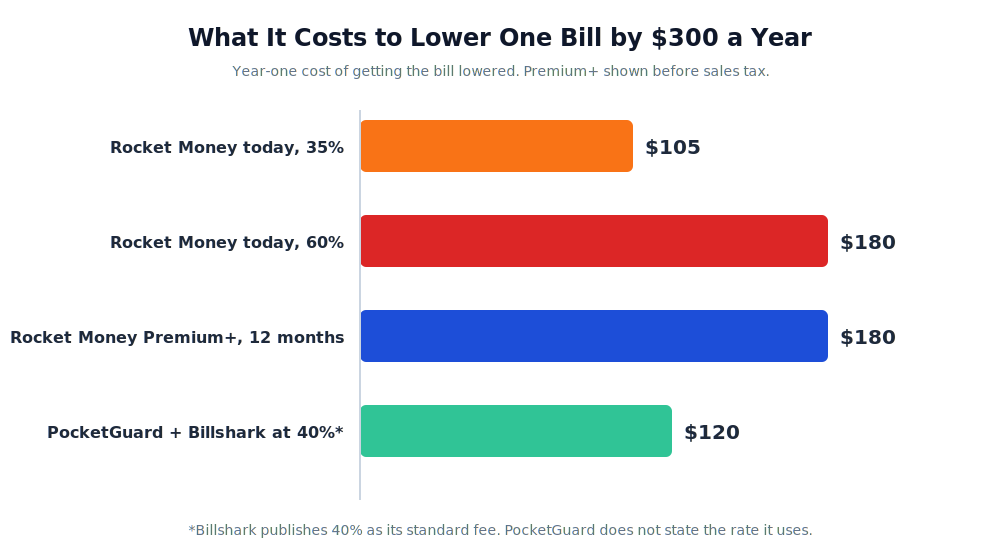
The Premium+ figure assumes you keep it for 12 months. Rocket Money’s help center says you can switch back to Premium by contacting support, so a shorter stint is possible. It doesn’t say how long a typical negotiation takes, though, so I wouldn’t budget for just one month.
Think about what else you’re buying, too. Premium+ includes every Premium feature, so if you already pay $14 for Premium, the jump is $1 a month and every future negotiation is fee-free. If you pay the $7 minimum, the jump is $8 a month, or $96 a year, mostly for negotiation access and Rowan.
That $1 gap is the part nobody’s talking about, and it’s why the answer to does Rocket Money charge a fee now depends on your tier. For a Rocket Money Premium plus member already paying the top of the sliding scale, the November change is close to a free upgrade. For a free-tier user with one old internet bill, it’s the most expensive way to lower it.
When Is Premium+ Cheaper Than a Percentage Fee?
This is where Rocket Money vs PocketGuard flips. Premium+ beats a 40% cut once your total first-year savings pass $450, because 40% of $450 is $180, the same as a year of Premium+. Against a 35% fee, the break-even is about $514. Against 60%, it’s $300.
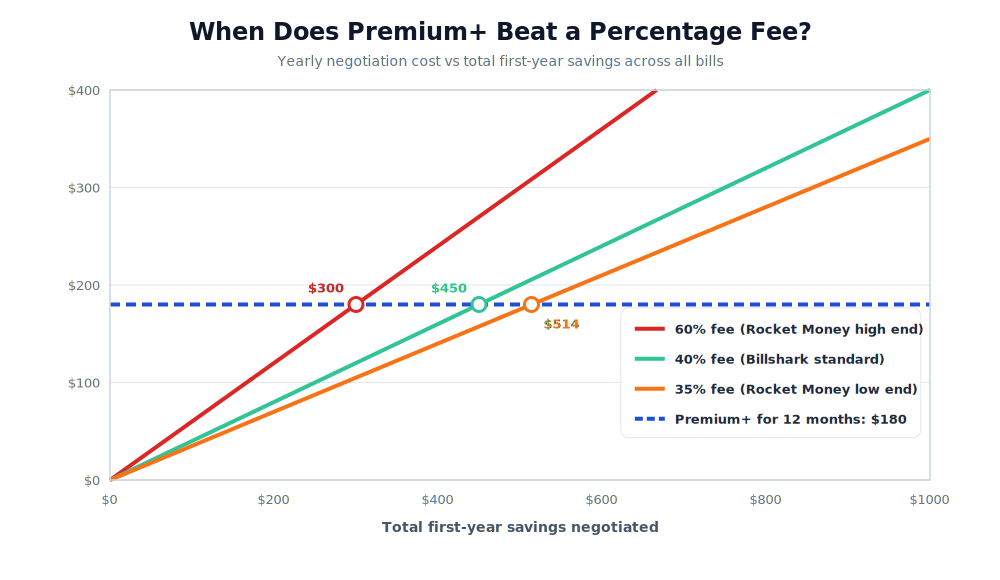
In practice, $450 is two bills, not one. A single $25-a-month internet cut ($300) sits below the line, so Billshark’s cut is cheaper. Add a phone bill trimmed by $20 a month ($240) and you’re at $540, where Premium+ wins at $180 against $216 at 40%.
The one-at-a-time rule stretches that math. You can’t run your internet and phone negotiations in parallel on Premium+, so several bills means several months of billing before you’ve worked through them. That’s fine if you’d keep the subscription anyway. It’s a trap if you signed up for one bill and forgot to downgrade.
My rule of thumb: add up the monthly amounts you realistically expect to shave off. Under about $37 a month in combined cuts, a percentage fee costs less than a year of Premium+. Over that, the flat price starts winning.
How Do PocketGuard and Rocket Money Plans Compare?
On plans alone, PocketGuard vs Rocket Money is a fixed price against a sliding one. PocketGuard sells one paid plan with three billing options. Rocket Money sells a free tier plus two paid tiers, and on the first paid tier you choose your own price.
| PocketGuard | Rocket Money | |
|---|---|---|
| Free option | ❌ None on the pricing page, 7-day trial only | ✅ Free tier: subscriptions, bills, spending, credit score |
| Monthly | $12.99/mo ($155.88/yr) | Premium: $7 to $14/mo, you pick |
| Annual | $74.99/yr ($6.25/mo) | Not offered, monthly billing only |
| Lifetime | ✅ $149.99 one-time | ❌ Not offered |
| Top tier | Same single plan | Premium+: $15/mo flat plus tax |
| Bill negotiation | Billshark, cut of savings (rate not published) | ⚠️ 35% to 60% fee until Nov 1, Premium+ only from Nov 2 |
| Free-tier budgets | Not applicable | ⚠️ Up to 3 per pricing table, 2 custom per same page’s FAQ |
| Sales tax | Not mentioned | Added in certain states |
Pricing verified from official websites, 27 September 2026.
PocketGuard lifetime costs almost exactly two years of the annual plan ($149.99 versus $149.98). If you’re confident you’ll still use it in year three, lifetime wins. It’s sold through web checkout rather than as an iPhone in-app purchase, so buy it on PocketGuard’s pricing page, not the App Store.
Rocket Money’s free-tier budget count is inconsistent on its own pricing article. The comparison table says up to 3 category budgets, while the prose and FAQ on the same page say two custom categories. Plan on two and treat a third as a bonus. My PocketGuard pricing guide has the full plan history.
What’s the Real PocketGuard Free vs Paid Situation?
The PocketGuard free vs paid answer is short: there’s no free plan on the pricing page anymore. You get a 7-day trial, then pay $12.99 a month, $74.99 a year, or $149.99 once. It’s really trial versus paid.
Is PocketGuard free in any form? Accounts from the old free era may still be grandfathered, and I can’t rule that out, but new sign-ups see only the trial. Rocket Money’s own budgeting-app roundup still describes a PocketGuard free version with ads, which doesn’t match PocketGuard’s current pricing page. That page actually advertises no ads.
On the paid side of PocketGuard free vs paid, you get unlimited accounts and category budgets, rollover budgeting, the debt payoff plan, transaction rules, import and export, Billshark negotiation, and priority human support plus AI chat. The plan card calls it PocketGuard Premium, while the FAQ on the same page still says PocketGuard Plus. Same product, two names.
Two timing rules from PocketGuard’s Terms of Use matter before the trial ends. Cancel auto-renewal at least 24 hours before the renewal date. After cancelling, paid features stay on for a 21-day grace period before the downgrade, and a 14-day pro-rata refund window applies to new purchases, lifetime included.
So the PocketGuard free vs paid decision comes down to the trial week. Link your smallest bank or credit union on day one, set a budget for every category you actually use, and cancel on day six if the Leftover number isn’t changing how you spend. My full PocketGuard review covers the day-to-day features in more depth.
Is Rocket Money Better Than PocketGuard for Beginners?
Is Rocket Money better than PocketGuard for a true beginner with no budget yet? Yes, Rocket Money is the easier first step because its free tier costs nothing and lists every subscription within minutes. PocketGuard is the better pick if your real problem is overspending between paychecks.
The difference is what each app asks of you. Rocket Money’s free tier is mostly a report: subscriptions, upcoming bills, a spending breakdown, and a couple of category budgets. PocketGuard’s Leftover number, the figure PocketGuard used to call In My Pocket, tells you what’s safe to spend today after bills and goals come out.
Picture a first job with $2,800 a month in take-home pay, rent split with a roommate, and four streaming services nobody remembers adding. Rocket Money free finds the streaming creep on day one. PocketGuard stops the $60 Friday takeout from eating the utilities money. Two different beginner problems.
So is Rocket Money better than PocketGuard for someone just starting out? If you can’t spare $74.99 for an app yet, yes, start free and fix the subscription leak. If you’re already overdrawn by the 25th of each month, pay for PocketGuard and skip the audit.
My best budgeting apps for beginners list and budgeting apps for young adults roundup cover more options at this stage, and the budget calculator helps you size categories before you link anything.
Which Features Actually Split the Two Apps?
Most PocketGuard vs Rocket Money features overlap. The table covers only the ones that genuinely differ as of September 2026, since a 40-row checklist of shared basics wouldn’t help you choose.
| Feature | PocketGuard | Rocket Money |
|---|---|---|
| Daily safe-to-spend number | ✅ Leftover | ❌ Not offered |
| Subscription detection | ✅ Yes | ✅ Yes, even on free |
| Subscription cancellation | ⚠️ Instructions, you cancel | ✅ Team cancels for you (Premium, 2 to 10 days) |
| Bill negotiation | ✅ Billshark, cut of savings | ⚠️ Fee until Nov 1, Premium+ only after |
| Debt payoff | ✅ Payoff plan, avalanche and snowball | ⚠️ Debt paydown listed for Premium, not documented |
| AI assistant | ⚠️ AI chat support | ✅ Rowan, texts you (Premium+) |
| Web access | ✅ Web, iPhone, Android | ⚠️ Desktop is Premium only |
| Partner sharing | Not listed on pricing page | ✅ Premium |
| Apple Card | ✅ Via Apple Wallet | Not listed |
Features verified from official websites, 27 September 2026.
The debt row is where I’d be most careful in any PocketGuard vs Rocket Money decision. Rocket Money’s pricing table now lists Debt paydown for Premium, but it doesn’t describe how the feature works, so Rocket Money debt payoff tools can’t be compared line by line with PocketGuard’s avalanche and snowball planner yet. If debt is your main goal, PocketGuard is the proven choice.
For deeper debt tools, my best debt payoff apps roundup and free debt tracker apps list compare dedicated options. You can also model a payoff date first with the debt payoff estimator, or read up on the snowball and avalanche methods before picking an app.
Couples should weigh the partner-sharing row. Rocket Money Premium gives a second login, while PocketGuard’s pricing page doesn’t mention sharing. If you budget as a pair, my budgeting apps for couples guide covers apps built for it.
How Do the Two Apps Connect to Your Bank?
PocketGuard pulls data through four connectors, listed on its security page: Finicity, Plaid, Salt Edge, and Apple Wallet. Rocket Money uses Plaid only. PocketGuard describes its access as read-only, meaning it sees transactions but can’t move money.
More connectors doesn’t guarantee a better connection, but it’s a real Rocket Money vs PocketGuard difference. It gives PocketGuard a fallback when one aggregator struggles with a small bank or credit union. With Rocket Money, if Plaid can’t reach your bank, there’s no second route to try.
Rocket Money is different on the money-movement side, too. Its Premium Financial Goals feature transfers money into savings automatically every 1 to 3 business days, so it isn’t purely read-only. That’s useful if you want automated saving, and something to switch off if your checking balance runs thin.
Test your trickiest institution during either trial, before you pay, since a failed sync decides PocketGuard vs Rocket Money faster than any feature list. If you’ve already fought sync errors in other apps, my net worth tracking apps roundup compares how several aggregators handle investment and loan accounts.
What Do Users Complain About Most?
In Rocket Money vs PocketGuard reviews, the loudest Rocket Money complaint is the size of the negotiation charge. A review roundup from The Ways to Wealth, drawing on Trustpilot, Reddit, and Better Business Bureau feedback, reports that users are often surprised by the lump-sum charge after a successful negotiation.
The November change removes that surprise for Premium+ members and swaps it for a recurring bill. That’s a better deal for people who negotiate often, and a quieter drain for people who don’t. Watch for the renewal on your card statement a month after your last negotiation closes.
Rollout looks uneven, which complicates any PocketGuard vs Rocket Money recommendation. A September Rocket Money review from Rob Berger describes Rowan and Premium+ as still in limited release, while Rocket Money’s help center now treats Premium+ as the only path to negotiation. If Premium+ doesn’t appear in your app, the help center’s advice is to contact support.
On PocketGuard’s side, the pattern in Billshark’s public Trustpilot replies is similar. Users agree to a percentage, then question how it was applied to annualized savings across several discounts. Ask Billshark to show you the savings math in writing before you approve the final charge.
Can You Use Both PocketGuard and Rocket Money?
Yes, and after November 2 the smart PocketGuard vs Rocket Money split changes. Use Rocket Money’s free tier to see every subscription, since viewing subscriptions stays free. Use PocketGuard for daily budgeting and, if you have only one or two bills to lower, for Billshark negotiation.
Where it stops making sense is paying for Premium+ and PocketGuard together. That’s $180 plus $74.99, about $255 a year, for two apps that both detect subscriptions. Premium+ already includes unlimited category budgets and transaction rules, so if you want it for negotiation, ask whether you still need PocketGuard at all.
If neither combination fits, my Rocket Money alternatives and PocketGuard alternatives roundups list other paths, and best free budgeting apps covers the no-cost end.
Which App Should You Pick Before November 2?
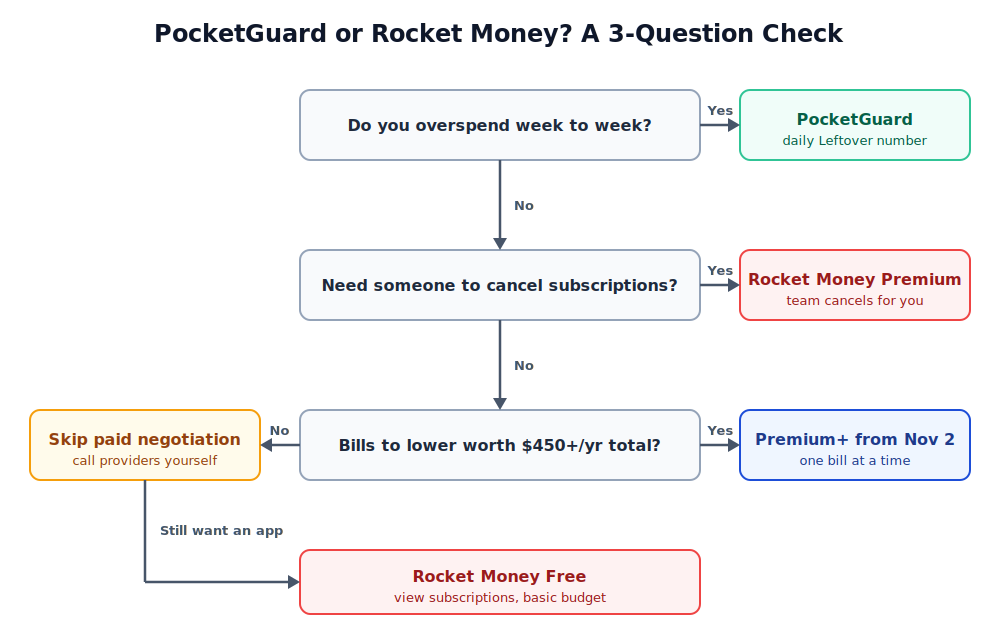
Match the app to your problem first, then check the calendar. The PocketGuard vs Rocket Money choice, or Rocket Money vs PocketGuard if you’re coming from the other side, comes down to whether your money leaks through daily spending or through recurring bills.
✅ Pick PocketGuard if:
- You overspend week to week and need a daily number to stop you
- You’re paying down credit card debt with the avalanche or snowball method
- You have one bill to lower and don’t want a monthly negotiation subscription
- You’ll budget for 3+ years and want the $149.99 lifetime plan
✅ Pick Rocket Money if:
- Your statement is full of subscriptions and you want a team to cancel them
- You want a genuinely usable free tier before paying anything
- You have several bills worth $450+ a year in combined savings
- You already pay near $14 for Premium, making Premium+ a $1 upgrade
⏰ Timing check
On Rocket Money’s free or Premium plan with one bill to lower? A negotiation submitted before November 2 finishes under the percentage-fee terms, with no Premium+ subscription needed. After that date, the only option is Premium+.
Still torn? The Find My App quiz matches your habits to an app in a couple of minutes. For other head-to-heads, see Rocket Money vs Monarch, Rocket Money vs EveryDollar, YNAB vs PocketGuard, and Monarch Money vs PocketGuard.
What Else Do People Ask About PocketGuard vs Rocket Money?
These PocketGuard vs Rocket Money follow-ups come up most once the November change is on the table. If you’re still asking is Rocket Money better than PocketGuard for your case, the scenarios above settle it.
Is PocketGuard free?
No, not for new users. PocketGuard offers a 7-day free trial, then costs $12.99 a month, $74.99 a year, or $149.99 for lifetime access. Older accounts may still be grandfathered on a legacy free plan.
Is Rocket Money free?
Yes, Rocket Money has a free tier that tracks subscriptions, upcoming bills, spending, and your credit score. Bill negotiation leaves the free tier on November 2, 2026, and having Rocket Money’s team cancel subscriptions has always required Premium.
Is Rocket Money worth it?
Premium is worth it if you want the team to cancel subscriptions or need unlimited budgets, net worth tracking, and desktop access at $7 to $14 a month. Premium+ is worth it mainly if you have several bills to negotiate, since one bill rarely saves enough to justify $180 a year.
Rocket Money vs PocketGuard: Which Handles Subscriptions Better?
Rocket Money, because on Premium its team cancels subscriptions for you, usually within 2 to 10 days. That’s the clearest Rocket Money vs PocketGuard win. PocketGuard spots subscriptions just as well but only gives you instructions to cancel them yourself.
What happens to my scheduled Rocket Money renegotiation?
It won’t run. Automatic renegotiations through TrueProtect end on November 1, 2026, so you’ll need to request the next one through Rowan or a ticket, which requires Premium+.
Can I negotiate a Rocket Money bill without Premium+ after November 2?
No. From November 2, Premium+ is the only way to submit a new negotiation, and there’s no pay-per-bill option. A negotiation submitted before then finishes under the old 35% to 60% fee terms.
Which app is better for paying off debt?
PocketGuard, for now. Its debt payoff plan supports the avalanche and snowball methods, while Rocket Money’s Premium Debt paydown feature isn’t documented in enough detail to compare.
📚 Read Next
