
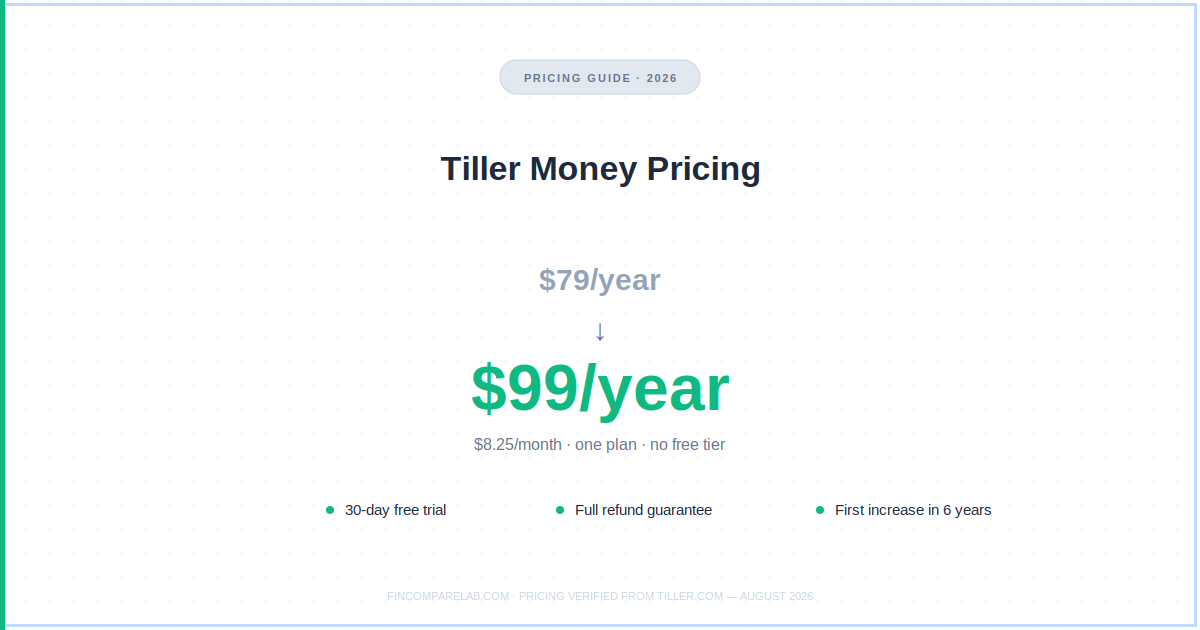
Tiller Money pricing changed in 2026: $99 per year, one plan, no tiers — up from $79, the first increase in six years. That’s the entire tiller money pricing story in one line. No monthly option, no free tier, no confusing upsells, just a flat $99/year that breaks down to $8.25 a month. If you’ve landed here wondering about tiller money pricing, how much is tiller money now, or whether tiller money is still worth it after the increase — you’re in the right place.
⚡ Quick Answer
Tiller Money now costs $99/year (about $8.25/month), up from $79 as of August 1, 2026. Tiller money pricing still includes one plan only — annual billing, no monthly option, no free tier. You get a 30-day free trial with a card on file (not charged until the trial ends) plus a full refund guarantee. That tiller money cost is now only about $10/year cheaper than YNAB and roughly tied with Monarch Money — it’s no longer the budget pick it used to be. Is tiller money worth it at $99? For spreadsheet users who want full data ownership, still yes — just not for the “cheapest option” reason anymore.
How We Review Apps · Pricing verified from tiller.com — 8 August 2026
Here’s tiller money pricing summarised in one table — there’s only one row to read, but the numbers changed in August 2026.
| Plan | Annual cost | Monthly equivalent | Free trial | Free tier | Refund |
|---|---|---|---|---|---|
| Tiller Money | $99/yr (was $79) | $8.25/mo | 30 days ✅ | None ❌ | Full guarantee ✅ |
Tiller money pricing verified from tiller.com — August 2026.
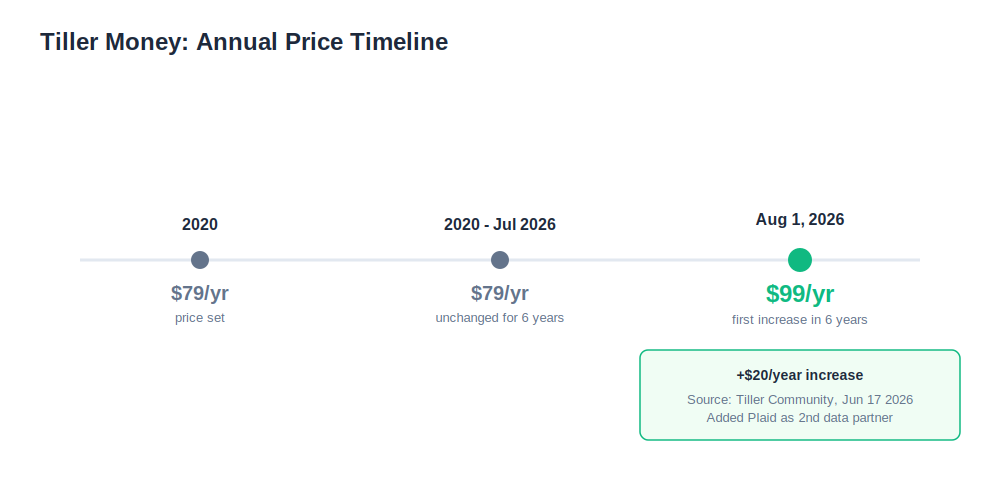
Tiller money pricing held at $79/year for six years before this year’s $99 increase.
That tiller money cost — $99/year — is no longer the lowest annual price in the category, but it’s still meaningfully cheaper than YNAB. No ads, no data selling, no hidden fees baked into the tiller money pricing. Sales tax may apply depending on your state.
Before I dig in: is tiller money worth it at the new price? Short answer — yes, if you live in spreadsheets and want your data in your own account. No, if you were choosing Tiller purely because it was the cheapest option — that reason mostly disappeared with this increase. I’ll cover every angle below.
3 things to know about tiller money pricing before you read on
- Tiller money pricing is now $99/year, one plan, no exceptions. The increase applies to everyone — new subscribers pay $99 immediately, and existing subscribers move to $99 at their next renewal.
- The free trial is still 30 days. Use it in full — it’s the best way to decide if tiller money worth it still applies to your situation at the higher price.
- Is tiller money worth it now? If you’re a spreadsheet person who wants data ownership, the pricing still pays for itself. If price alone was your reason for choosing Tiller, several competitors now undercut it.
What does Tiller Money actually cost in 2026?
Tiller Money costs $99 per year as of August 1, 2026 — full stop. How much is tiller money on a monthly basis? There’s still no monthly plan; tiller pricing is annual-only, billed once a year.
How much does Tiller Money cost after the free trial? Exactly $99/year for anyone signing up now. Existing subscribers keep their current rate until their next renewal date, then move to $99. Every subscriber gets the same complete feature set regardless of when they joined.
To put the $99/year fee in real-world terms: $99/year is $8.25 a month — a bit more than a single fast-casual lunch. And unlike free budgeting tools that monetise your financial data, the tiller money pricing model stays clean — you pay $99, they deliver the service, nobody sells your data.
One note on Tiller’s price: sales tax may be added to your invoice after the 30-day trial ends, depending on your state. That’s a small addition in applicable states, not a bait-and-switch.
Why did Tiller Money’s price jump from $79 to $99?
Tiller announced the tiller money price increase on its community forum in June 2026, giving subscribers about six weeks’ notice before the August 1 effective date. The company’s stated reason: this was the first price change in six years, and costs across the business — data aggregation, support, engineering — have risen substantially since the last increase in 2020.
Tiller also pointed to recent product investment as part of the justification: the company added Plaid as a second bank-data partner alongside its existing Yodlee connection, aiming for more reliable daily transaction syncing, plus smarter categorisation and a redesigned account console. Whether that’s worth an extra $20 a year is a personal call — I break down the tradeoff in the is Tiller worth it section below.
One detail worth knowing if you’re already subscribed: Tiller isn’t charging existing customers immediately. If your subscription renews in June or July, you keep your current rate until then. If you’re currently in a free trial, your price won’t change for a full year after you convert.
Is there a monthly billing option for Tiller?
No. Tiller’s plan is annual-only. You pay the full $99/year upfront. There’s no way to pay month-to-month — it’s $99 per year, billed once a year, every year you stay subscribed.
If billing flexibility matters to you, both YNAB ($14.99/month) and Monarch Money ($14.99/month) offer monthly billing — though you’d pay more per year than their annual plans if you stick with them long-term ($109/year for YNAB, $99.99/year for Monarch vs $99/year for Tiller).
My recommendation: use the full 30-day trial to validate that tiller money pricing makes sense for your workflow before committing to the annual fee. There’s no proration or partial-year option either — tiller money cost is always the full $99, whether you sign up in January or December.
Does Tiller Money have a free plan?
No. There’s no free plan. After your 30-day trial ends, you pay $99/year or your account is cancelled. That’s unchanged from before the increase.
This is a deliberate choice. Tiller skipped the freemium model entirely — no ads, no data selling, no premium upsell. The $99/year fee is the only revenue stream, which is part of why the company frames this increase as necessary to stay sustainable long-term without turning to ads or data partnerships.
If you genuinely need a free-forever tool, Goodbudget’s free plan (20 envelopes, no bank sync) or a manually-maintained Google Sheet are your best options. But if $99/year is workable, the free trial makes evaluating tiller money pricing genuinely risk-free — no charge until day 30, full refund guarantee after.
What do you get for the $99/year tiller money cost?
Everything is included in the single plan — there’s nothing gated behind a higher tier because there is no higher tier. Here’s what the $99/year fee covers:
- Daily bank sync via two data partners — transactions from 21,000+ US financial institutions auto-import every morning into your Google Sheet or Excel file. Tiller added Plaid alongside its existing Yodlee connection in 2026 specifically to improve sync reliability.
- AutoCat (AI categorisation) — Tiller’s rule-based auto-categorisation engine learns your spending patterns and applies categories automatically. You review and approve.
- Foundation Template — Tiller’s flagship budgeting spreadsheet. Includes monthly budget, spending trends dashboard, net worth tracker, and a full yearly overview.
- Community template library — dozens of free templates for debt payoff, savings goals, envelope budgeting, small business expense tracking, and more.
- Google Sheets AND Microsoft Excel — the plan covers both platforms, though Google Sheets tends to get feature updates first.
- Daily email digest — a morning summary of the previous day’s transactions and current account balances.
- US-based customer support — real humans via email.
- Privacy-first data architecture — your spreadsheet lives in your own Google or Microsoft account. Tiller’s servers feed transaction data into your sheet but never store it long-term.
What the annual price still doesn’t include: a dedicated mobile app, investment portfolio analysis, bill pay, or purpose-built couples access. Those gaps matter more now that Tiller’s price advantage over competitors has shrunk — I cover who they affect in the who should pay section below.
How does Tiller pricing compare to YNAB and Monarch now?
This is the question that changed the most with the price increase. Tiller money vs YNAB and Monarch used to be a clear win on cost for Tiller — that gap has mostly closed.
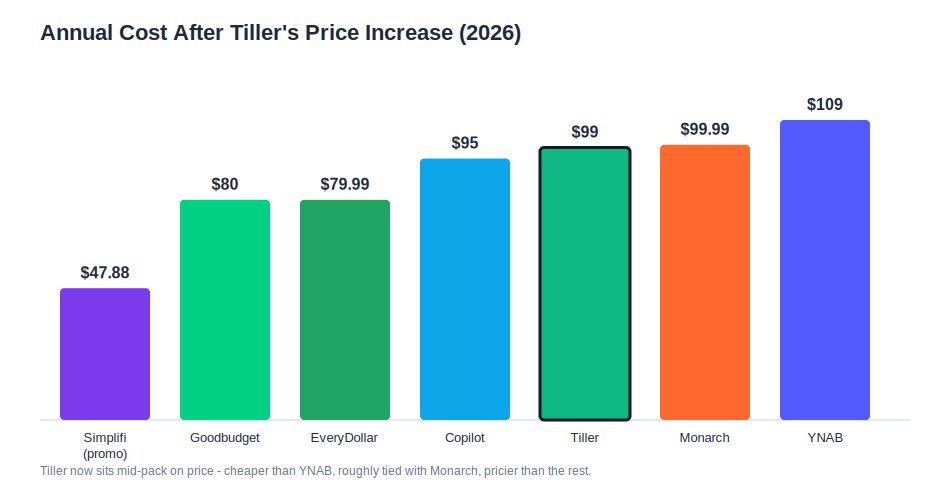
Tiller money pricing now sits mid-pack — no longer the clear budget pick it once was.
| Feature | Tiller Money | YNAB | Monarch Money |
|---|---|---|---|
| Annual price | $99/yr | $109/yr | $99.99/yr |
| Monthly billing | ❌ No | ✅ $14.99/mo | ✅ $14.99/mo |
| Free trial | 30 days | 34 days | 7 days |
| Mobile app | ❌ No app | ✅ iOS + Android | ✅ iOS + Android |
| Data ownership | ✅ Your account | ⚠️ YNAB’s servers | ⚠️ Monarch’s servers |
| Savings vs Tiller | — | $10 more/yr | $0.99 more/yr |
Tiller money pricing, YNAB pricing, and Monarch Money pricing verified from official websites — August 2026. See the full breakdown in my YNAB vs Tiller comparison and YNAB pricing guide.
The honest read: Tiller still beats YNAB by $10/year, but it’s now essentially tied with Monarch Money on price — a $0.99/year gap is not a real advantage. If cost alone was ever your deciding factor between Tiller and Monarch, that factor has effectively disappeared.
What hasn’t changed is the underlying tradeoff. Tiller’s price buys a spreadsheet-based system with complete data ownership. YNAB and Monarch pricing buys dedicated mobile apps, polished interfaces, and guided budgeting frameworks. Neither is objectively better — the question is which tradeoff fits your life, and after this increase, price is a smaller part of that decision than it used to be.
Is Tiller Money worth it at $99/year?
The “is Tiller money worth it” question has a different answer now than it did at $79. The core logic hasn’t changed, but the price argument has weakened.
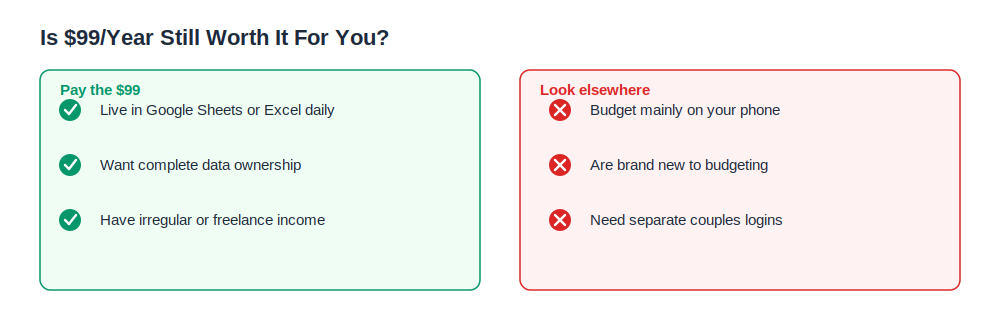
Worth the annual fee — yes, if you:
- Already live in Google Sheets or Excel — if spreadsheets are your daily environment, $99/year for automated bank data into a tool you already know is still strong value, even at the higher price.
- Want complete data ownership — your spreadsheet lives in your own Google or Microsoft account. Cancel tomorrow and every transaction, formula, and chart stays with you permanently. No other budgeting app at this price point offers that, including Monarch at nearly the same cost.
- Have complex or irregular income — freelancers and self-employed people often outgrow rigid app-based budgeting. Tiller’s price buys a fully customisable system that no fixed-template app matches, regardless of the $20 increase.
- Are coming from Mint’s shutdown — Tiller remains one of the most recommended Mint replacements for users who valued data access specifically.
Not worth it — no, if you:
- Were choosing Tiller mainly for the low price — that reason is largely gone. Copilot ($95/yr), EveryDollar ($79.99/yr), and Goodbudget ($80/yr) are all now cheaper, and Monarch is a rounding error away.
- Primarily budget on your phone — there’s still no Tiller mobile app, and that gap matters more now that the price no longer compensates for it.
- Are new to budgeting entirely — Tiller doesn’t provide methodology the way YNAB’s 4 Rules does. Beginners consistently find purpose-built apps less overwhelming.
- Need couples features with separate logins — Tiller runs on a single Google or Microsoft account. Monarch Money is the stronger call here, and it now costs about the same.
Is Tiller Money worth it? The one-paragraph answer
Worth $99/year = yes, but now specifically for spreadsheet ownership and irregular-income flexibility, not for being the cheapest option — that title has passed to Copilot, EveryDollar, and Goodbudget. If price was your only reason for considering Tiller, it’s worth checking those alternatives first. If data ownership and spreadsheet control matter to you, the extra $20/year doesn’t change the calculus much.
How does the Tiller Money free trial work?
The trial still runs for 30 days — that part didn’t change with the price increase. Here’s exactly how it works, step by step:
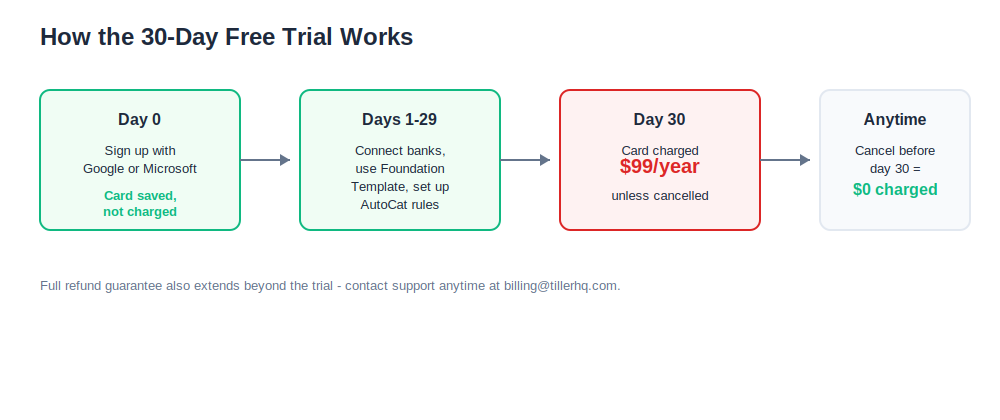
- Sign up at tiller.com with your Google or Microsoft account.
- Enter your payment details. Your card is saved but not charged on day one — the full $99/year fee doesn’t apply until after 30 days.
- Connect your bank accounts. Tiller supports 21,000+ US financial institutions via Yodlee and its newer Plaid connection. Your first transactions appear the next morning.
- Use the trial fully. Run the Foundation Template, configure AutoCat categories, and stress-test your workflow.
- At day 30: your card is automatically charged $99/year unless you cancel first. Cancel at any point during the trial and you pay nothing.
Tiller also offers a full refund guarantee that extends beyond the trial. If the annual plan doesn’t deliver after you’ve paid, contact support at [email protected] and they’ll issue a refund — no time limit specified. That makes trying tiller money pricing risk-free even at $99.
How to get the most from your Tiller Money free trial
Most users make a judgement within the first week based on incomplete data. Here’s how to actually evaluate tiller money pricing properly during the trial period, especially now that the stakes of getting it wrong are $20/year higher.
Connect every account on day one. AutoCat — Tiller’s AI categorisation engine — needs 2–3 weeks of transaction history to deliver useful suggestions. If you only connect accounts late in the trial, you’re not seeing what the $99/year plan actually buys you.
Set up AutoCat rules in week one. Spend 20–30 minutes creating rules for your most common merchants. By week three, AutoCat will categorise 80%+ of new transactions automatically.
Build one custom view. Try building one dashboard beyond the Foundation Template — a debt payoff tracker, a savings goals sheet, or a freelance income log.
Test on mobile before committing. Open your Tiller spreadsheet on your phone during the trial. If it feels clunky, that friction will only grow, and at $99/year the no-app gap is a bigger relative cost than it was at $79.
Cancel before day 30 if it’s not clicking. The trial is genuinely risk-free. If tiller money cost doesn’t justify itself within 30 days of real use, cancel and pay nothing.
Is there a Tiller Money discount code?
No publicly available Tiller Money discount codes exist in 2026. Tiller doesn’t run a promo code programme the way Monarch Money does (see my Monarch Money discount guide) or Copilot does with its referral codes.
The best deal in Tiller’s plan is the 30-day free trial itself. Use it fully — all 30 days, all accounts connected, actually building your budget system — before the $99/year price hits. That’s $99 you can avoid entirely if Tiller turns out not to be right for you.
If you’re already a subscriber hoping to avoid the increase at renewal, there’s no documented discount path. Tiller’s flat pricing model doesn’t typically include renewal discounts, though your rate won’t change until your current subscription period ends. However you slice it, how much is tiller money comes back to the same number: $99, with no coupon route around it.
Is Tiller Money safe to use?
Yes — data security is actually one of the stronger arguments for tiller money pricing, separate from the cost question entirely. Tiller doesn’t store your financial data on its own servers long-term; your spreadsheet lives in your own Google or Microsoft account, and Tiller’s bank-feed partners (Yodlee and, since 2026, Plaid) handle the connection without Tiller itself warehousing your transaction history.
Bank connections use read-only access — Tiller can pull transaction data but can’t move money or make changes to your accounts. Two-factor authentication is enforced at the Google or Microsoft account level, meaning your spreadsheet access inherits whatever security you’ve already set up there.
Is tiller money safe compared to app-based competitors? The tradeoff runs the other way from usability: YNAB and Monarch store your data on their own servers, which is more convenient but means your financial history lives somewhere you don’t control. Tiller’s model is less polished but keeps your data in your own hands. I go through the same kind of safety breakdown for Monarch Money in this guide if you want a side-by-side sense of how the two approaches differ.
What Reddit actually says about the Tiller price increase
I checked r/TillerMoney, r/personalfinance, and r/ynab for real reactions to the tiller money price increase. Here’s the unfiltered picture on how the community sees tiller money pricing now.
Reaction is split, but not hostile. A dedicated thread on r/TillerMoney about the jump to $99 drew dozens of comments — some frustrated about a service reduction alongside the price hike, but a large share of responses were resigned acceptance rather than anger, especially from long-time users who feel the data-ownership model still justifies the cost.
“I tried Tiller, it’s not bad for me, but it’s missing things… But I like being able to put my hands on my data, and I’m kinda skeeved by YNAB’s behaviour around the price increase, so I’ll stick with it a while longer.”
— u/kilogram007, r/budgeting
Data ownership drives the strongest endorsements, even post-increase. Reddit’s personal finance community was badly burned by Mint’s shutdown, and Tiller’s appeal for that group hasn’t moved much — the argument that your spreadsheet stays yours regardless of what happens to Tiller as a company holds regardless of whether the price is $79 or $99.
The no-mobile-app complaint comes up more often now. With the price gap to app-based competitors narrowing, several threads note that paying nearly the same as Monarch for a tool with no phone app feels like a worse deal than it did a year ago.
“The AI categorization is a game changer. It’s not perfect, but it saves me hours every month. I just review the suggestions and approve them.”
— r/budgeting user on AutoCat
The learning curve conversation is unaffected by price. First-timers still report spending 2–4 hours configuring the Foundation Template the way they want it — that setup cost is the same at $99 as it was at $79.
Who should pay for Tiller — and who shouldn’t?
Now that tiller money cost sits closer to Monarch than to the budget tier, the “who should pay” question is worth revisiting even if you’d already made up your mind at $79.
The $99/year fee makes the most sense if you:
- Work in spreadsheets professionally — accountants, analysts, data professionals, business owners. If Sheets or Excel is already open daily, $99/year for automated bank data is easy to justify.
- Have irregular income — freelancers and contractors often outgrow app-based budgeting entirely. Tiller’s customisation is unmatched at any price in this category.
- Value data portability above everything — your Tiller spreadsheet is yours permanently, exportable and shareable with your accountant. No other tool at a comparable price gives you this control.
Look elsewhere if you:
- Were mainly drawn by the low price — that’s largely gone. See my full YNAB alternatives roundup for cheaper, app-based options.
- Budget primarily on your phone — see Monarch Money or YNAB for strong mobile experiences at a similar or lower price now.
- Are brand new to budgeting — see my best budgeting apps for beginners guide.
- Need investment portfolio tracking — Tiller tracks net worth but not portfolio performance. Empower does this for free.
Best alternatives if Tiller pricing doesn’t fit your needs
With Tiller no longer the clear budget option, it’s worth comparing tiller money pricing against every real alternative before committing. The tiller money vs ynab gap especially has narrowed enough that it deserves a second look even if you ruled YNAB out before.
- YNAB — $109/year or $14.99/month. The gold standard for zero-based budgeting. Better mobile app, stronger methodology, 34-day free trial. Now only $10/year more than Tiller. Full YNAB review here.
- Monarch Money — $99.99/year or $14.99/month. Best Mint replacement, excellent couples features, strong mobile experience — and now essentially the same price as Tiller. Full Monarch Money review here.
- Copilot Money — $95/year or $13/month. iOS and Mac only. Stunning design, fast AI categorisation — and now $4/year cheaper than Tiller. Full Copilot review here.
- Quicken Simplifi — promo pricing starts around $47.88 for the first year. Significantly cheaper than Tiller if you’re price-sensitive and don’t need a spreadsheet interface. See my Simplifi pricing guide.
- Actual Budget — free and open-source. If what you actually want is control without paying anyone, it’s worth a look before paying $99/year for Tiller. See the Actual Budget review.
- Google Sheets — free. Build your own system manually. No automation, no bank sync, total control, zero cost.
- Empower — free. If investment tracking is the priority, Empower’s free plan beats paying $99/year for net worth tracking alone. Full Empower review here.
None of these alternatives replicate exactly what Tiller delivers — automated bank data in your own spreadsheet — but several now do it for less, which is the real change this price increase brought. If spreadsheet ownership specifically is what you’re after, no alternative matches this combination at any price.
Bottom line: tiller money pricing is $99/year, the free trial is still 30 days, and it’s worth it for spreadsheet users who want data ownership — just not because it’s cheap anymore.
Quick answers: $99/year plan essentials
- Tiller’s annual plan in 2026: $99/year, one plan, annual billing only — up from $79.
- Free trial: 30 days, card required but not charged. Cancel any time before day 30 and pay nothing.
- Is it worth it? Worth $99/year if you love spreadsheets and want data ownership. Not worth it if price alone was your reason for choosing Tiller.
- Tiller vs YNAB: Tiller saves you $10/year. Tiller vs Monarch: essentially tied, $0.99/year apart.
- Refund: full refund available anytime — email [email protected].
Tiller Money pricing FAQs
How much is Tiller Money in 2026?
Tiller Money costs $99 per year in 2026, up from $79 — the increase took effect August 1, 2026. That’s the only plan option: no monthly billing, no free tier, no tiered plans. The annual price breaks down to $8.25 a month.
Tiller Money vs YNAB: how do they compare now?
Tiller money vs YNAB comes down to $99 vs $109 per year — a $10 gap that’s much smaller than it used to be. YNAB adds a dedicated mobile app and guided zero-based budgeting methodology; Tiller adds complete data ownership in your own spreadsheet. For spreadsheet users, Tiller still wins on cost and control. For everyone else, the smaller price gap makes YNAB’s app and methodology easier to justify than before. See the full YNAB vs Tiller comparison.
Is Tiller Money safe?
Yes. Tiller uses read-only bank connections through Yodlee and Plaid, doesn’t store your financial data long-term on its own servers, and keeps your spreadsheet in your own Google or Microsoft account. Two-factor authentication is enforced at the account level you already control.
How does the Tiller Money free trial work?
The trial lasts 30 days. You sign up with a Google or Microsoft account and enter payment details, but your card isn’t charged at signup. Connect your bank accounts and the trial begins. At the end of 30 days your card is automatically charged $99 per year unless you cancel first. Tiller also offers a full refund guarantee after the trial ends — email [email protected] to request one at any time.
Tiller Money cost: what does it total over 5 years?
At $99/year, tiller money cost adds up to $495 over five years — about $50 less than YNAB’s five-year total and roughly $5 less than Monarch’s. That gap is much smaller than it was before the 2026 increase, when Tiller undercut both by a wider margin. The five-year math still favors Tiller slightly, but the difference is no longer large enough to be the main reason to choose it over a dedicated app.
📖 Read Next
- Tiller Money Review 2026 — full features, pros and cons
- YNAB vs Tiller Money 2026 — full comparison
- YNAB Pricing 2026 — is $109/year worth it?
- Monarch Money Pricing 2026 — plans, discount codes, free trial
- Copilot Money Pricing 2026 — the iOS option explained
- Is Monarch Money Safe? 2026 security breakdown
- Actual Budget Review 2026 — the free open-source option
- YNAB Review 2026 — is it still the best budgeting app?
- Best YNAB Alternatives 2026 — ranked and compared
- Best Budgeting Apps for Beginners 2026 — start here
