
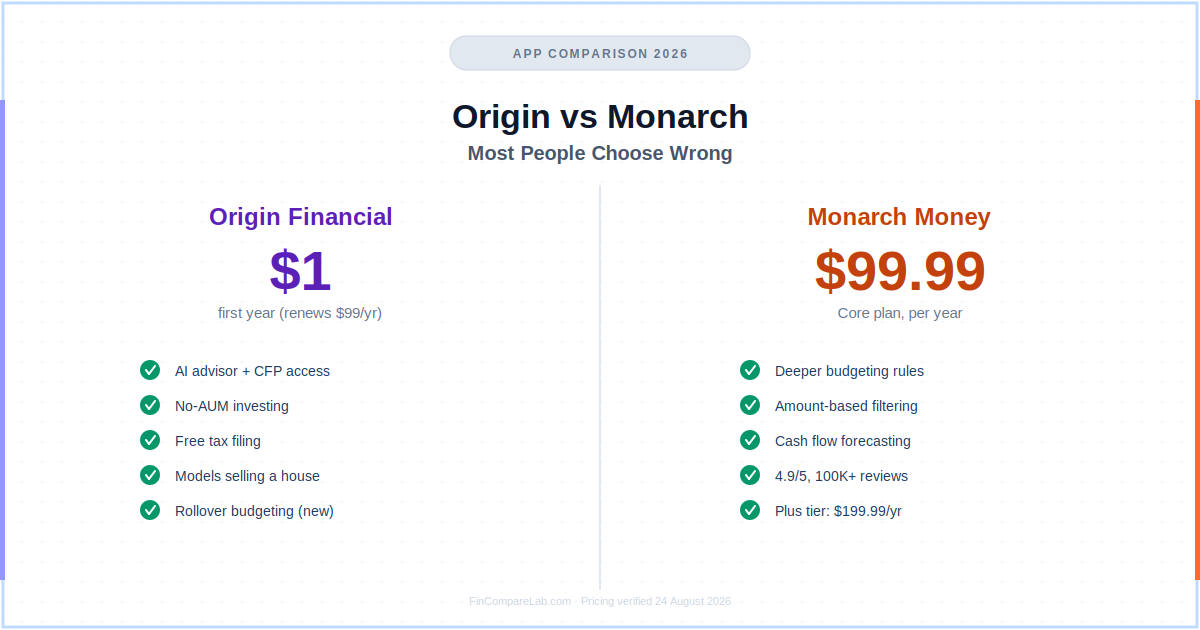
Origin vs Monarch is the kind of comparison that looks like a coin flip on paper, both apps sit around $99 a year, but most people pick based on brand recognition and end up with the wrong tool for what they actually need.
⚡ Quick Verdict
Origin and Monarch cost almost the same, but they’re not solving the same problem. Monarch is the sharper budgeting tool, with deeper customization and better cash flow reporting. Origin is the broader financial platform, with investing, tax filing, CFP access, and forecasting that can model things Monarch simply can’t. Right now Origin also has a $1 first-year promo that makes trying it nearly risk-free.
How We Review Apps · Pricing verified from useorigin.com and monarch.com — 24 August 2026
In this comparison:
- Why do most people choose wrong in the Origin vs Monarch debate?
- Origin financial vs Monarch: how do the 2026 prices compare?
- Monarch vs Origin: which has better budgeting now that Origin has rollover?
- Which app is actually better for investing and forecasting?
- Should Monarch’s Plus price jump push you toward Origin?
- Which is better for couples?
- What does Origin offer that Monarch doesn’t?
- What does Monarch offer that Origin doesn’t?
- Can you use both Origin and Monarch Money?
- Who should choose Origin Financial?
- Who should choose Monarch Money?
- What do real Reddit users say about Origin vs Monarch?
- Is origin vs monarch money still a fair fight in 2026?
Why Do Most People Choose Wrong in the Origin vs Monarch Debate?
Origin vs Monarch gets decided wrong more often than any other comparison I cover, because the price tag makes them look interchangeable when they’re not.
Monarch Money is a budgeting and net worth app. It shows you where your money went, lets you build a budget that fits how you actually spend, and gives you a clean dashboard for tracking accounts. It’s built to do that one job extremely well, and it shows in the polish.
Origin Financial starts in the same place, connected accounts, spending tracking, a net worth view, but layers on an AI financial advisor, one-on-one CFP sessions, no-AUM investing, free tax filing, and forecasting tools that go further than Monarch’s. If Monarch is a finely tuned dashboard, Origin is closer to a financial operating system with a subscription price attached.
The mistake I see most often is treating this as “which app is better” instead of “which job do I actually need done.” Someone who wants the sharpest possible budgeting tool and someone who wants one subscription to replace five different financial tools are going to land on different answers, and that’s fine.
Origin Financial vs Monarch: How Do the 2026 Prices Compare?
On origin financial vs monarch pricing, Origin costs $99/yr standard, or $1 for the first year under its current promo. Monarch costs $99.99/yr for Core, or $199.99/yr for its newer Plus tier.
| Origin Financial | Monarch Money | |
|---|---|---|
| Standard annual price | $99/yr | $99.99/yr (Core) |
| Monthly price | $12.99/mo | $14.99/mo |
| Higher tier | None, one plan for everyone | Plus, $199.99/yr |
| Current promo | $1 for the first year, renews at $99 | WELCOME code, roughly 30% off Core year one |
| Free trial | Suspended while the $1 promo runs | 7 days, payment method required upfront |
| Partner access | Free, included | Free, included |
Pricing verified live from useorigin.com and monarch.com, 24 August 2026.
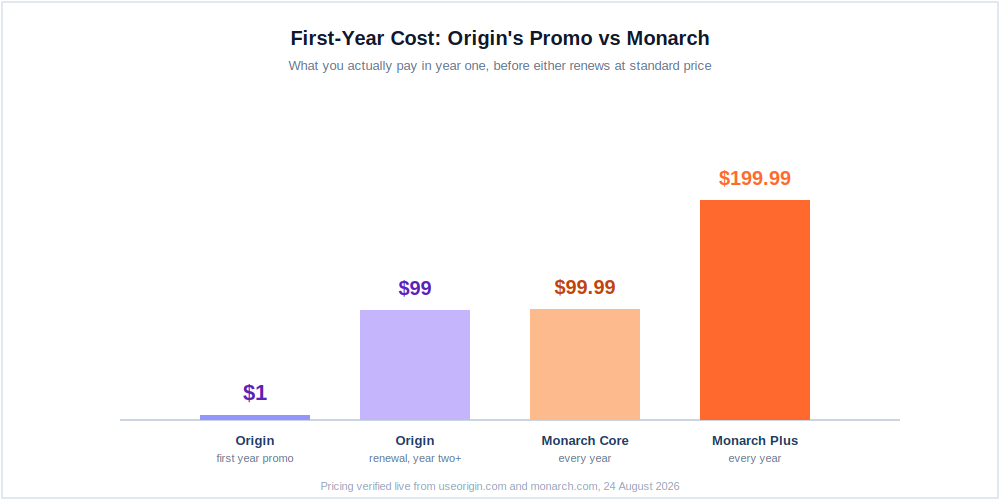
The number that actually matters this year is $1. I checked Origin’s sign-up page directly and the offer is real: first year for $1, renews at $99/yr, cancel anytime. That’s a 99% discount on year one, and it changes the math on trying Origin even if you’re already happy with Monarch.
There’s also a referral angle worth knowing. Get three people to sign up with your code and Origin gives you another year for $1, something a few Reddit users mentioned actively using to stretch the discount further.
Monarch’s own trial is less forgiving than it used to be. You now need to enter a payment method before the 7-day trial starts, so if you forget to cancel you’re charged automatically. The WELCOME code (about 30% off Core’s first year) is confirmed active directly on Monarch’s pricing page.
I’d skip any other discount code you see floating around forums claiming 50% off Core. Monarch’s own site only backs the WELCOME offer, and I can’t verify the rest. For the full tier breakdown, my Monarch Money pricing guide covers exactly what Plus adds over Core.
Monarch vs Origin: Which Has Better Budgeting Now That Origin Has Rollover?
Monarch still has the deeper budgeting toolset overall, but Origin closed one of its biggest gaps this year.
Monarch wins on budgeting depth, and I want to say that plainly because a lot of Origin’s own marketing tries to talk around it. You get flexible budgeting methods, highly customizable categories, detailed cash flow reporting, and rollover budgets that carry unspent amounts forward automatically.
Origin’s budgeting used to be the clear weak spot in this comparison. That’s shifted. Users on r/MonarchMoney confirmed Origin rolled out budget rollover in 2026, closing one of the two features that made Monarch the default recommendation for anyone who wanted tight manual control. Origin’s AI still auto-builds a starting budget from your spending history, which is useful if manual setup isn’t your idea of a good time.
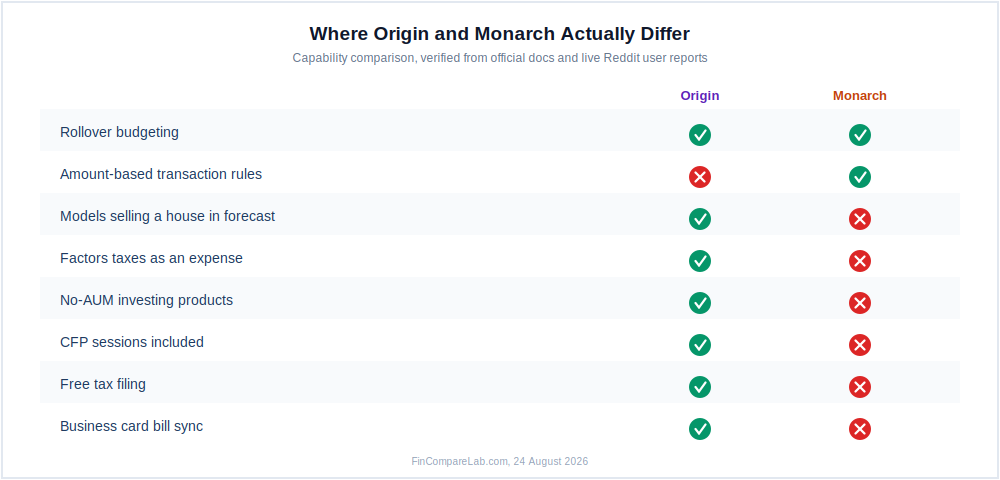
Where Origin still lags is rule automation. One recent Reddit thread about switching apps noted that Origin’s category rules only update based on merchant name unless the transaction is flagged as recurring, so you can’t filter by amount the way you can in Monarch. If your transactions need fine-grained, amount-based rules to stay organized, Monarch is still doing more of the manual work for you.
Bottom line: If budgeting depth and rule automation are the whole reason you’re paying, Monarch still edges it. If you just wanted rollover and didn’t want to build a complicated rule set, Origin closed enough of the gap that it’s worth a second look.
Which App Is Actually Better for Investing and Forecasting?
Origin financial vs monarch money stops being close on this front. On origin vs monarch investing, Origin offers real products and forecasting depth that Monarch doesn’t attempt to match.
Origin gives you automated index fund portfolios with no AUM fee (covered by the $99/yr subscription), a high-yield cash account, and forecasting that models specific life events. A Reddit user comparing both apps this year pointed out something Monarch genuinely can’t do.
Origin can model selling a house and calculate the proceeds against your remaining mortgage automatically, while Monarch will let you add a house as an asset but has no way to model selling it. Origin’s forecast also factors in taxes as an ongoing expense, which the same user said made their long-term projections noticeably more realistic than Monarch’s.
Monarch tracks your investment accounts, pulling in balances and performance, but it doesn’t offer any investing products of its own. You can see your portfolio; you can’t act on it from inside the app.
If investment tracking without a subscription is more your speed, my Empower review covers the strongest free alternative, and my Monarch vs Empower comparison goes deeper on when free tracking beats a paid app.
If you’re actively building wealth rather than just watching a number go up, Origin bridges day-to-day budgeting and real investing in one $99/yr subscription in a way nothing else in this price range does.
Should Monarch’s Plus Price Jump Push You Toward Origin?
Monarch introduced its two-tier system in 2026, and the jump from Core to Plus is steep enough that it’s actively driving people to look at Origin right now.
Core stayed at $99.99/yr, but Plus (the tier with forecasting, business income tracking, and deeper investment analysis) costs $199.99/yr, essentially double. On r/MonarchMoney, more than one long-time Monarch user described feeling blindsided by that gap, since planning and forecasting used to come bundled into the single plan they were already paying for.
A few explicitly said they were trying Origin’s $1 promo specifically because Origin bundles forecasting into its one flat $99/yr price with no upsell tier.
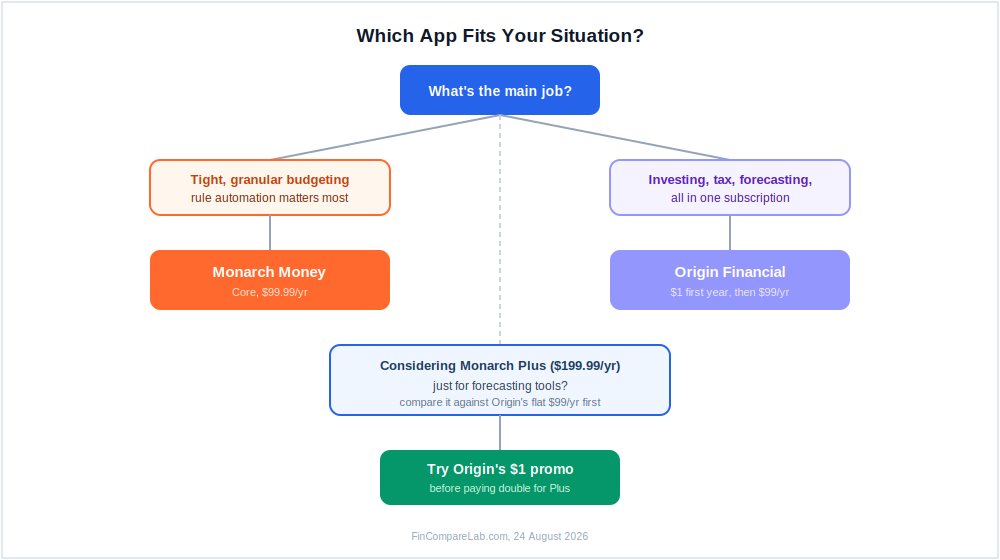
That doesn’t automatically make Origin the right move for everyone weighing origin vs monarch right now. If you only need Core’s features, Core is still $99.99/yr, nothing has changed for you. But if Plus’s forecasting and planning tools are the reason you were considering the upgrade, it’s worth comparing that $199.99/yr against Origin’s $99/yr (or $1 first year) before you commit to the higher tier.
Which Is Better for Couples?
Both apps include partner access at no extra cost, which matters if you’re weighing origin vs monarch alongside my best budgeting apps for couples roundup.
Monarch gives couples one shared dashboard: combined spending, shared goals, one net worth number. It’s simple and transparent, which some couples want and others find limiting if they’d rather keep some visibility separate.
Origin gives you three views in one subscription, your accounts, your partner’s accounts, and a combined view, and you can toggle between them or temporarily hide an account. That flexibility is the same one Reddit users praised for tracking a shared mortgage or joint investment account without merging every transaction into one feed.
It’s one more place origin vs monarch money comes down to how much separation you want, beyond cost alone.
What Does Origin Financial Offer That Monarch Money Doesn’t?
Origin vs monarch money opens up the widest gap right here, and it’s hard to dismiss once your financial life outgrows basic budgeting.
- AI Advisor (Sidekick): ask plain-English questions about your money and get answers grounded in your actual account data.
- CFP sessions: one-on-one meetings with Certified Financial Planners, discounted for annual members.
- No-AUM investing: managed index fund portfolios with no asset-under-management fee, covered by the subscription.
- Free tax filing: federal and state filing through Column Tax, included in membership.
- Estate planning: a basic will free with membership, full will and trust at a member discount.
- Life-event forecasting: models specific scenarios like selling a house or a new job, with taxes factored in as an expense.
- One flat price: no higher tier to upsell into, unlike Monarch’s Core/Plus split.
That’s a lot bundled into one $99/yr subscription, and the honest question is whether you’ll use enough of it to justify paying for features a dedicated budgeting app doesn’t need to offer.
What Does Monarch Money Offer That Origin Financial Doesn’t?
In the monarch vs origin matchup, Monarch isn’t simply the smaller app. It leads outright in a few areas that matter a lot to a specific kind of user.
- Deeper rule automation: filter and categorize by transaction amount as well as merchant name, something Origin still can’t do well.
- Longer track record: Monarch has been the default post-Mint recommendation since 2023, with a large, active Reddit community.
- Bill Sync via Spinwheel: automatic due-date tracking for cards that appear on your credit report (though it misses most business cards, a gap Origin’s direct bank connections can sometimes cover instead).
- Simpler, single-view sharing: one combined household dashboard instead of toggling between views.
- 4.9-star rating across 100,000+ reviews on its own site, reflecting a genuinely large, satisfied user base.
Monarch’s community backs that up with real activity. The r/MonarchMoney team actively answers user questions about account connections and feature requests in the subreddit itself, which is more direct access than most apps at this price point offer, and it’s a big reason monarch vs origin still favors Monarch for anyone who values that support.
Can You Use Both Origin and Monarch Money?
Yes, and on origin vs monarch specifically, a fair number of Reddit users are doing exactly that right now because Origin’s promo makes it nearly free to try.
Running both long-term means paying for heavily overlapping account tracking, so it’s not something I’d recommend as a permanent setup. But using Origin’s $1 first-year promo alongside an existing Monarch subscription, just to compare forecasting and investing tools on your own real numbers, is close to risk-free.
Several people in the threads I read did exactly this after Monarch’s Plus price jump, then decided whether to switch or stay based on their own accounts rather than a review.
Who Should Choose Origin Financial?
In the origin vs monarch decision, Origin makes the most sense once your financial life has outgrown pure spend tracking. Here’s the clearest signal you’re in that camp.
Choose Origin Financial if you:
- Want investing, tax filing, and CFP access bundled into one flat $99/yr price
- Need forecasting that can model selling a house or factor in taxes as a real expense
- Were about to upgrade to Monarch Plus and want to compare it against Origin’s $99/yr first
- Want to try the $1 first-year promo with next to nothing to lose
- Don’t need heavy rule automation and are fine with simpler, amount-agnostic categorization
Who Should Choose Monarch Money?
On monarch vs origin for pure budgeting, Monarch wins when disciplined budgeting is the actual job you need done. These signals point to the right fit.
Choose Monarch Money if you:
- Want the deepest budgeting and rule automation available at this price
- Already have investing and tax tools you’re happy with elsewhere
- Value a large, active community and a team that responds directly on Reddit
- Only need Core’s features and don’t want to pay for Plus’s forecasting tier
- Want a no-surprises 7-day trial (just remember it needs a card upfront)
What Do Real Reddit Users Say About Origin vs Monarch?
The community read on origin vs monarch splits along exactly the lines you’d expect. Budgeting-first users lean Monarch, planning-first users lean Origin, and origin financial vs monarch has gotten more interesting to watch since Origin’s recent updates.
On r/MonarchMoney, one long-time Monarch user (four years, self-described Mint refugee) tried Origin for a month after getting frustrated with recurring account sync issues. They specifically pointed to Origin’s better-organized investment tab and more useful forecasting as reasons they didn’t immediately switch back.
Another user who’d used Monarch for years said they now prefer Origin overall, describing Monarch as better for cash flow reporting but Origin as stronger for big-picture planning, right down to modeling what happens if they sell their house.
Not everyone who tries Origin stays. Several commenters described the AI advisor as adding little beyond what a friendly UI already implies, and more than one flagged that Origin pushes tax and account upsells harder than they’d like.
A Monarch team moderator (using the account lara_monarch) responds directly to sync complaints in these threads, generally attributing failures to third-party data providers like Plaid and MX rather than Monarch’s own code. That lines up with what I’ve seen reported across other budgeting apps too.
One recurring, very specific complaint favors Origin. Monarch’s Bill Sync only pulls due dates for cards that show up on your credit report, so business credit cards are frequently missing, and a few users noted Origin catches these through direct bank connections instead.
On the flip side, Origin users have reported their cash management account occasionally getting misclassified as an “investment” rather than cash, which can skew the portfolio view if you don’t catch it and manually reclassify it.
Is Origin vs Monarch Money Still a Fair Fight in 2026?
Here are the questions I see asked most often about this comparison.
Which is better, Origin or Monarch Money?
On origin vs monarch, it depends on the job you need done. Monarch is better for deep budgeting, rule automation, and cash flow reporting. Origin is better if you want investing, tax filing, CFP access, and forecasting bundled into one subscription. Both cost close to $99/yr at standard pricing.
Is Origin Financial vs Monarch Money really that different?
Yes, meaningfully. On origin financial vs monarch money, Origin is a broader financial platform with investing, forecasting, and CFP access. Monarch is a sharper, more customizable budgeting tool. They overlap on account tracking and net worth, but the two apps are optimized for different goals.
Is Origin worth the money?
On origin vs monarch value, Origin is worth $99/yr if you’ll actually use the investing, tax filing, or forecasting tools. At $1 for the first year under the current promo, it’s close to risk-free to find out. If you only want budgeting, you’re paying for features you won’t touch.
Is Monarch Money still the best budgeting app?
In the monarch vs origin debate on pure budgeting, most Reddit discussion still points to Monarch as the strongest dedicated option at this price, especially for rule automation and cash flow forecasting. It’s not the cheapest or the broadest app on the market, but it’s still the reference point most competitors get measured against.
Can Origin Financial replace Monarch Money?
For most people weighing origin vs monarch money as a straight swap, yes, Origin covers account aggregation, budgeting with rollover, and couples features. If you rely heavily on Monarch’s amount-based rule automation or its Bill Sync for business cards, you’d be trading those away. For investing, tax filing, and forecasting, Origin goes further than Monarch does today.
Does the origin vs monarch money decision change if you’re a couple?
Not fundamentally. Monarch’s single combined dashboard and Origin’s three-view setup both work well for couples, so the same budgeting-versus-planning question still decides it. Couples who want simple full transparency tend to prefer Monarch; couples who want separate and shared views together tend to prefer Origin.
Read next:
- Origin Financial Review 2026: Is It Worth It?
- Monarch Money Review 2026: Honest $99.99 Verdict
- Origin Financial Pricing 2026: The Hidden $1 Deal
- Monarch Money Pricing 2026: Core vs Plus, Promo Codes
- Is Monarch Money Safe? What the 2026 Plaid Update Means
- Is Origin Financial Safe to Use?
- YNAB vs Origin Financial 2026
- Best Net Worth Tracking Apps 2026
