
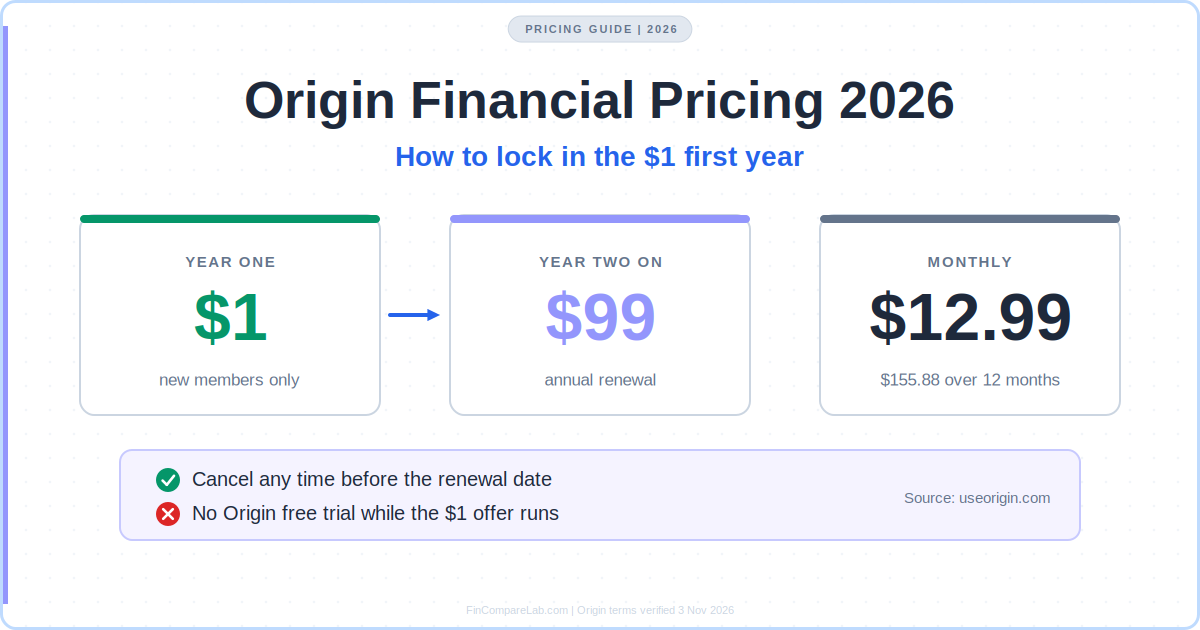
Origin Financial pricing is $99 a year, but new members can lock in year one for $1 and pay full price from year two.
⚡ Quick Answer
$12.99 a month or $99 a year, and new members can start year one for $1 before the plan renews at $99. The 7-day Origin free trial is unavailable while that offer runs, so the $1 year is the way in.
How We Review Apps, Pricing verified from useorigin.com, support.useorigin.com — 3 November 2026
How much does Origin Financial pricing cost in 2026?
Origin Financial pricing is $12.99 a month or $99 a year, and new members can start year one for $1 instead. The plan then renews at $99 unless you cancel first. Every plan includes the full app, while a few services, such as CFP sessions and trusts, cost extra.
I read the Origin sign-up page, its support center and its own FAQ on 3 November 2026 to confirm the numbers below. I haven’t used Origin myself, so everything here comes from official pages, app store listings and published reviews, and I flag whatever I couldn’t confirm. This guide covers prices, not financial advice.
The $1 offer is labeled limited time on the sign-up page, with no end date shown, and Origin’s $1 offer FAQ says it’s for new members only. Past subscribers aren’t eligible. That makes the first-year price a one-time door and the renewal price the number to plan around. Origin pricing after year one is the figure every comparison below uses.
So how much does Origin cost in practice? $1 for new members in year one and $99 a year after that. If you’re still deciding whether Origin fits at all, my Origin Financial review covers features, and my guide on whether Origin Financial is safe covers linking your accounts.
How do you lock in the $1 first year?
The Origin $1 for a year offer sits on a specific sign-up page, and the generic one doesn’t show it. On 3 November 2026 the dtc page at app.useorigin.com showed $1 for one year with a $99 renewal and a cancel-anytime note, while the plain sign-up page showed no price at all.
- Open the $1 sign-up page at app.useorigin.com/sign-up/dtc, not the generic sign-up page.
- Enter your email to create the account, which is the first step the page shows.
- Read the price line before you pay and confirm it says $1 for one year and $99 at renewal.
- Put a reminder in your calendar for about eleven months after sign-up, so the renewal date never lands unnoticed.
- Decide before the renewal date whether to keep Origin, because cancelling is allowed any time before then.
I stopped at the email screen, so whether the $1 checkout asks for a card is unconfirmed as of 3 November 2026.
Ready to start? Claim the $1 first year at Origin and check the price line first. That line is the quickest check on Origin Financial pricing there is.
Past subscribers don’t qualify, because Origin limits the offer to new members. If your employer or a partner program provides Origin, pricing can differ, so check with your benefits administrator before you pay anything.
What does Origin cost after the $1 year ends?
Your plan converts to the standard $99 annual rate on the renewal date, and Origin says you can cancel any time before then to avoid the charge. The support pages I read don’t promise a reminder email, so treat your own calendar as the safety net. After the promo, Origin Financial pricing is the same $99 a year that every annual member pays.
Over three years, the $1 start costs $199, annual billing from day one costs $297, and monthly billing costs $467.64. Monthly overtakes annual in month eight, because eight payments of $12.99 total $103.92 against $99.
| Path | Year 1 | Year 2 | Year 3 | 3-year total |
|---|---|---|---|---|
| $1 first year, then annual (new members) | $1 | $99 | $99 | $199 |
| Annual from day one (not eligible for $1) | $99 | $99 | $99 | $297 |
| Monthly at $12.99 | $155.88 | $155.88 | $155.88 | $467.64 |
Pricing verified from official websites, November 2026. Assumes prices stay unchanged for three years, which no app promises.
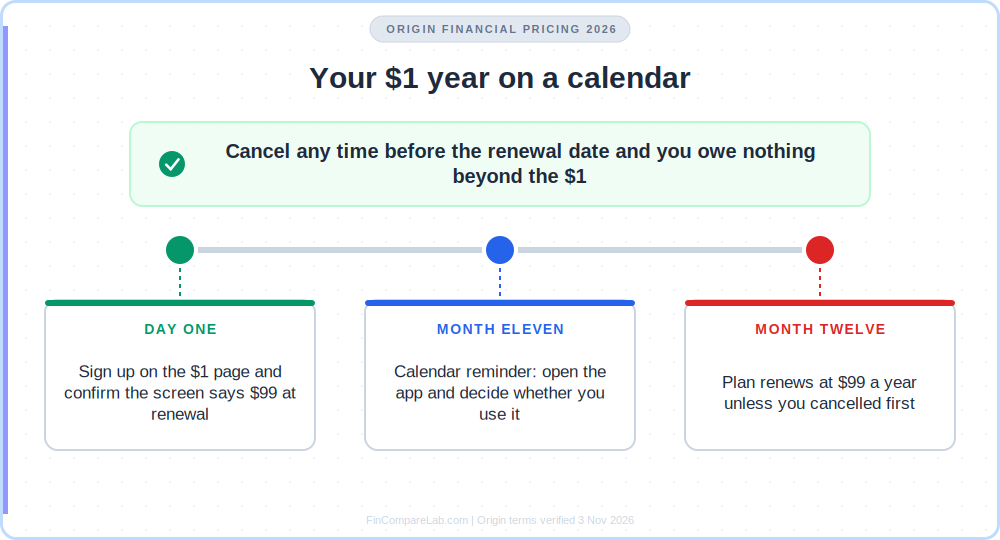
Your cancel window runs from day one to the renewal date, so the month-eleven reminder is the decision point.
The timeline puts your decision point at month eleven, which leaves about four weeks to ask one question. Did you act on anything Origin showed you? If the answer is no, cancel and keep the $98 you saved in year one.
If you’re paying monthly today, Origin’s support center has an article on switching from monthly to annual, and the annual plan bills as one $99 payment covering twelve months. Switching makes sense once you’re past month seven, and a full year of annual billing costs $56.88 less than twelve monthly payments.
Which Origin pricing plan should you pick?
Pick by eligibility first, then by how long you’ll use the app. New members should take the $1 first year, since it costs $98 less than annual in year one and carries the same cancel-anytime terms.
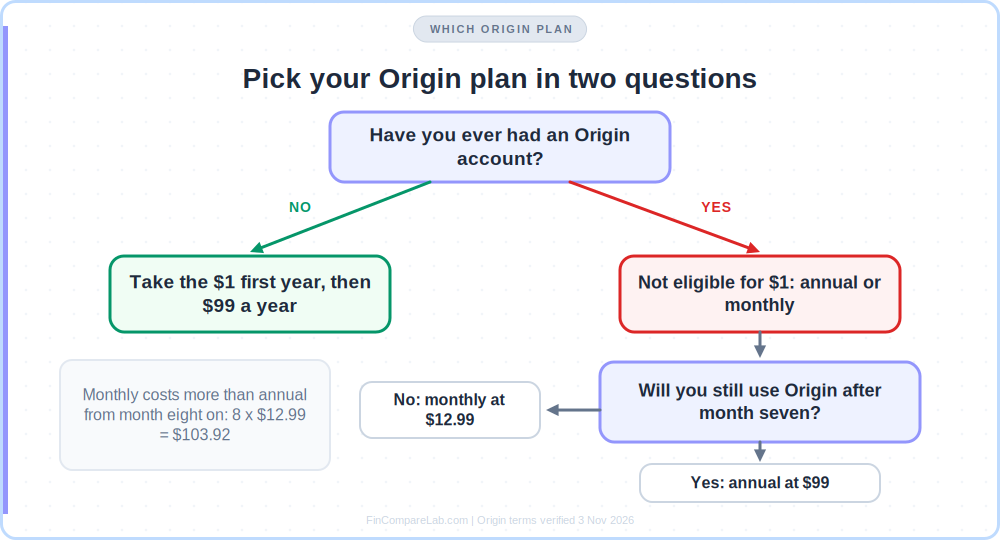
Eligibility decides the first branch, and your expected months of use decide the second.
Returning members, or anyone the offer doesn’t cover, should pay annually, because monthly costs more from month eight on. Monthly only wins if you expect to quit within seven months, such as while you decide whether tracking investments in one app is worth it.
Origin pricing works well for couples, who can add a partner at no extra cost, so Origin Financial pricing covers a household for one fee. Two partners splitting $99 pay about $49.50 each, and the $1 year works out to 50 cents each. My best budgeting apps for couples guide compares other joint options.
If you only want a free tracker, don’t pay at all. The best free budgeting apps and the best budgeting apps for beginners show where to start.
What does an Origin subscription include for $99 a year?
An Origin subscription is a single plan with no tier ladder, so the same Origin pricing covers everything the app does. Origin’s own FAQ says most people would otherwise juggle four or five separate apps.
- Spending, cash flow, subscription and bill tracking, with automatic categories you can edit and CSV import.
- Net worth and portfolio tracking across accounts linked through Plaid, MX and Finicity, which together cover more than 13,000 institutions.
- An AI Advisor that answers questions from your connected account data.
- Free DIY tax filing through April Tax, covering federal and state returns, W-2s, 1099s, RSUs and stock sales, with a max refund guarantee and a $10,000 accuracy guarantee per Origin.
- A basic will at no cost.
- Partner access at no extra cost.
- Origin investment accounts with 0.00% expense ratios, though the custodian DriveWealth can still charge fees and all investing carries risk of loss.
The tax-filing line is where an Origin subscription can pay for itself fastest. Origin’s own estimate puts tax software elsewhere at $50 to $100, so a household that files with paid software today may already cover half the $99.
Origin isn’t a bank, and its cash account APY is variable and can change at any time, so I left yield numbers out of this guide. For where Origin sits among net worth tools, see the best net worth tracking apps, and for a Mint-style tracker, the best Mint alternatives.
What costs extra on top of the Origin subscription?
A few services sit outside the subscription and bill per use, and they are the part of Origin Financial pricing that moves most. The estate-planning prices on Origin’s page today are higher than the figures in many older reviews, so check the live page before you plan around any of them.
| Service | Price | Notes |
|---|---|---|
| CFP planning session | $119 per session | From Origin’s 3 May 2026 FAQ. 30% off for annual members works out to about $83 (my math, not a published price). |
| Expert tax review | $189 | Add-on, separate from CFP sessions. |
| Basic will | Free | Included with the membership. |
| Full will | $199 | Estate page shows $249 struck through, with $199 as the membership price. |
| Trust | $399 | Estate page shows $599 struck through, with $399 as the membership price. |
Pricing verified from official websites, November 2026. Estate prices from the Origin estate-planning page, CFP and tax prices from Origin’s FAQ blog.
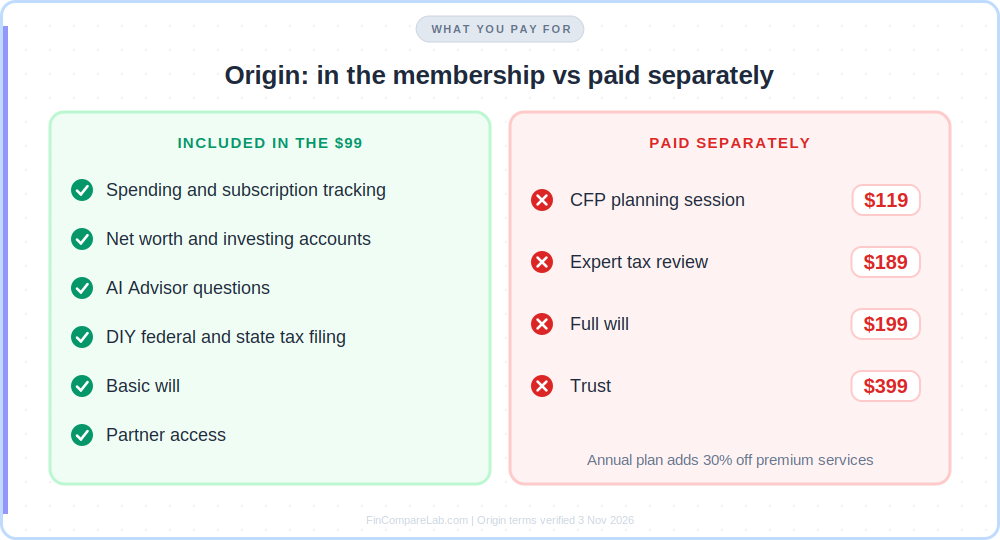
What the $99 covers on the left, and what bills separately on the right.
The 30% annual-member discount doesn’t line up with the estate page. $249 to $199 is about 20% off and $599 to $399 is about 33% off, and the page doesn’t say whether those prices need an annual plan. Treat the discount as unconfirmed as of 3 November 2026 and read the checkout screen.
A realistic heavy year for one household is the $99 membership plus one CFP session and a full will, which comes to $417. On the $1 first year the same bundle costs $319, and most people will pay the membership alone.
Origin says its planners hold the CFP credential and that sessions don’t replace an accountant or estate attorney. That’s the right way to read the $119, as one planning conversation and not a substitute for legal or tax advice.
Is there an Origin free trial in 2026?
Origin normally gives new members a 7-day Origin free trial on both the monthly and annual plans. While the $1 first-year offer runs, the trial is unavailable, according to two articles in Origin’s support center.
The swap is a better deal than it sounds. Seven days is enough to link accounts and look around, but a year at $1 covers a full budget cycle and a tax season. The cost is that you commit on day one, so your cancel date becomes your trial end date. That’s the real difference between the Origin free trial and the $1 year.
For comparison, YNAB gives 34 days with no card when you sign up on ynab.com, and Monarch gives 7 days with a payment method required. Origin’s support pages imply the trial returns after the promo, but no end date is published, so that timing is unconfirmed as of 3 November 2026.
Are there other Origin deals beyond the $1 year?
I couldn’t confirm any other Origin deals as of 3 November 2026. The sign-up page I read shows no code field before the email step, and Origin’s support pages don’t mention an Origin promo code or an Origin coupon.
Treat any code or coupon on a third-party page as unverified, because Origin deals outside the $1 year are unconfirmed. A percentage code on $99 can’t beat $1 anyway, since the first year is already 99% off for new members.
The real discount is annual billing, which saves $56.88 a year over monthly and adds 30% off premium services per Origin’s support center. Some employers also cover Origin as a benefit, and I saw no student discount on any page I read, which is unconfirmed.
How does Origin’s price compare with YNAB and Monarch?
Origin Financial pricing at $99 sits level with Monarch Core at $99.99 and under YNAB at $109, so the useful question is what each price buys.
| App | Annual | Monthly | Free trial | 3-year cost |
|---|---|---|---|---|
| Origin | $99 ($1 first year) | $12.99 | 7 days, unavailable during the $1 offer | $199 with promo, $297 without |
| YNAB | $109 | $14.99 | 34 days, no card when signing up direct | $327 |
| Monarch Core | $99.99 | $14.99 | 7 days, payment method required | $299.97 |
Origin prices verified 3 November 2026. YNAB and Monarch annual prices and trials from ynab.com/pricing and monarch.com/pricing, 3 November 2026. Monarch monthly price from its 28 October 2026 read.
Price hides the method difference. YNAB gives every dollar a job and carries unspent balances forward, Monarch tracks forward-looking cash flow and has a category budgeting mode, and Origin resets its budget each month with no rollover.
I used YNAB for 15 years, from 2011 until earlier this year, running strict zero-based envelopes, and I moved to Monarch when the month-end busywork stopped earning its keep. That history is why I read Origin’s monthly reset as a real gap for envelope budgeters and a non-issue for people who just want to see where the money went.
For direct matchups, read YNAB vs Origin Financial and Origin vs Monarch Money. My YNAB pricing guide and Monarch Money pricing guide show how each renews, the zero-based budgeting guide explains the method Origin skips, and the best YNAB alternatives list shows where Origin ranks.
Who should skip Origin even at $1?
Skip Origin if budgeting is the only job you want done. Its own FAQ admits the budget resets monthly with no rollover, sinking funds or envelopes, and calls that the most requested change.
- Forecasting assumes a fixed annual growth rate and doesn’t model contributions over time or separate taxable, pre-tax and Roth accounts, per the same FAQ.
- Origin finds subscriptions but can’t cancel them or negotiate bills for you.
- Sync problems show up with Charles Schwab 401k accounts and Webull, per Origin’s FAQ.
- The app keeps your session active by default instead of timing out, so log out manually on shared devices.
- The mobile app is US-only for now, though the desktop version works anywhere.
Ratings are strong but not spotless. Origin’s iOS listing shows 4.6 from about 4K ratings and its Google Play listing shows 4.4 from 769 reviews as of 3 November 2026. Rob Berger’s review, which cites Reddit users, also says budgeting isn’t Origin’s strongest feature.
None of this breaks the $1 math. It decides whether Origin Financial pricing at $99 is a good deal for you, which my Origin Financial review weighs in detail, and the Origin FAQ is worth reading in full.
What do people also ask about Origin’s price?
Most Origin pricing questions come back to three numbers, $1, $99 and $12.99, and the answers below stay with those.
How much does Origin Financial cost per month?
Origin Financial costs $12.99 a month on the monthly plan, or about $8.25 a month when billed $99 a year. New members can start with $1 for the first year instead. If you’re asking how much is Origin Financial over a full year on the monthly plan, it’s $155.88, which is $56.88 more than annual billing.
Is Origin Financial free?
No, Origin Financial has no permanent free tier. New members pay $1 for the first year and $99 a year after that, and the 7-day trial is unavailable while that offer runs. The basic will, DIY tax filing and partner access cost nothing extra, but only because the membership covers them.
Can you cancel Origin Financial before the $99 renewal?
Yes, Origin says you can cancel any time before your renewal date to avoid the standard annual charge. Set a reminder around month eleven, because the support pages I read don’t promise a renewal reminder. Read Origin’s $1 offer FAQ before you sign up, and keep the date from your confirmation screen.
Is Origin Financial worth $99 a year?
Origin is worth $99 if you’ll use at least two or three of its tools, such as net worth tracking, tax filing and the AI Advisor. It isn’t worth it if you only want a strict envelope budget. At $1 for the first year the risk is small, and the real test comes at renewal. Skip the guesswork and run the month-eleven check before renewal.
Check the $1 sign-up page again before you commit, since Origin labels the offer limited time, and I’ll update this guide when Origin Financial pricing or the estate-plan prices change.
📚 Read Next
- Origin Financial Review (2026): Is There a Real $99 Catch?
- YNAB vs Origin 2026: A Smart Way to Pick and Save Money
- Origin vs Monarch Money: Which Fits Your Budget?
- Monarch Money Pricing 2026: How To Pick Core or Plus Easily
- Is Origin Financial Safe? Account Linking and Data Privacy
- Best Budgeting Apps for Couples
