
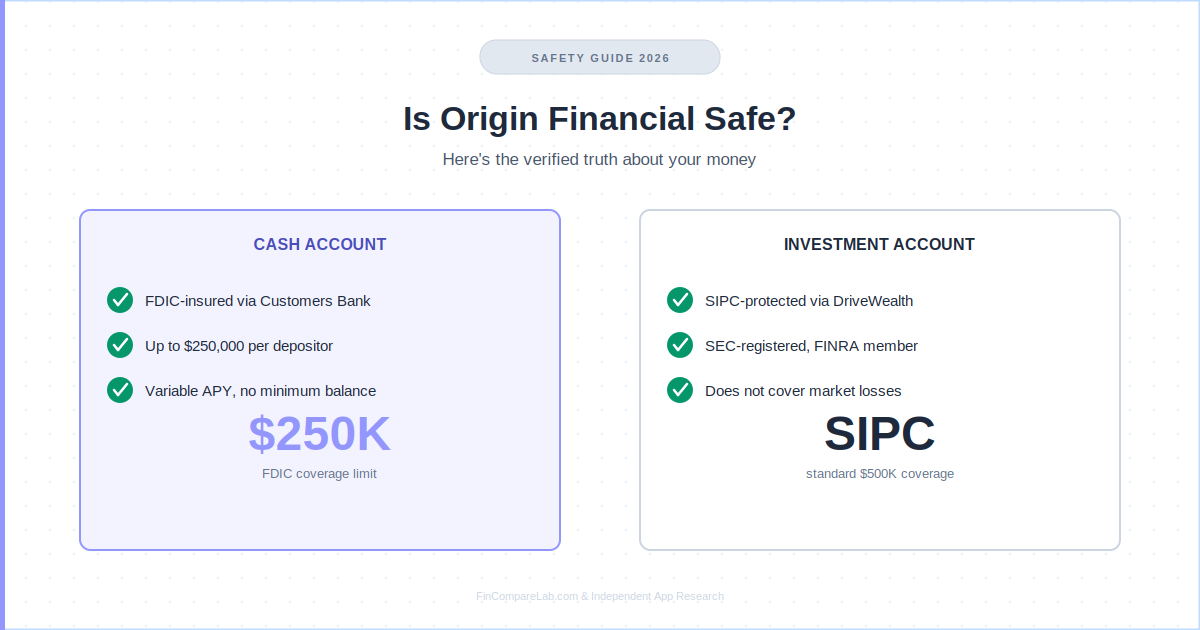
Is Origin Financial safe to use in 2026? Yes, and the short version is that your cash and your investments sit behind two completely different protection systems, which is the detail most reviews flatten into one line.
⚡ Quick Answer
Is Origin Financial safe? Yes, for most people: your cash account is FDIC-insured up to $250,000 through partner bank Customers Bank, and your investments are held by SEC-registered custodian DriveWealth under SIPC protection. Origin itself is not a bank, so knowing which part of your money sits where actually matters.
How We Review Apps · Security verified from useorigin.com — 17 August 2026
Jump to:
- Is Origin Financial safe to use in 2026?
- How does Origin protect your cash account?
- What protects your money if you invest through Origin?
- Is Origin Financial regulated by the SEC?
- How does Origin secure your personal data?
- Is Origin Financial legit, or just another budgeting app?
- Is Origin app safe on iOS and Android?
- What are Origin Financial reviews Reddit users sharing?
- How does Origin Financial security compare to other budgeting apps?
- What should you actually watch out for?
- What else do people ask about Origin’s safety?
Is Origin Financial safe to use in 2026?
Origin Financial is safe by every standard measure that actually matters: bank partnerships, custodian registration, and encryption practices. It launched in 2018 as an employee benefit for companies like Webflow and Turo before opening up to individual users, and it now runs two separate protection systems depending on where your money sits.
Cash in your Origin Cash Account is FDIC-insured through partner bank Customers Bank, up to $250,000 per depositor. Money you invest through Origin sits with DriveWealth, a broker-dealer registered with the SEC and a member of FINRA and SIPC. Neither of those protections covers market losses, but they do cover you if Origin, Customers Bank, or DriveWealth itself ran into financial trouble.
One thing worth saying plainly: Origin is a fintech company, not a bank. Its own legal disclosures state that Blend Financial Inc., doing business as Origin Financial, is “not a bank” and is “not an FDIC-insured depository institution.”
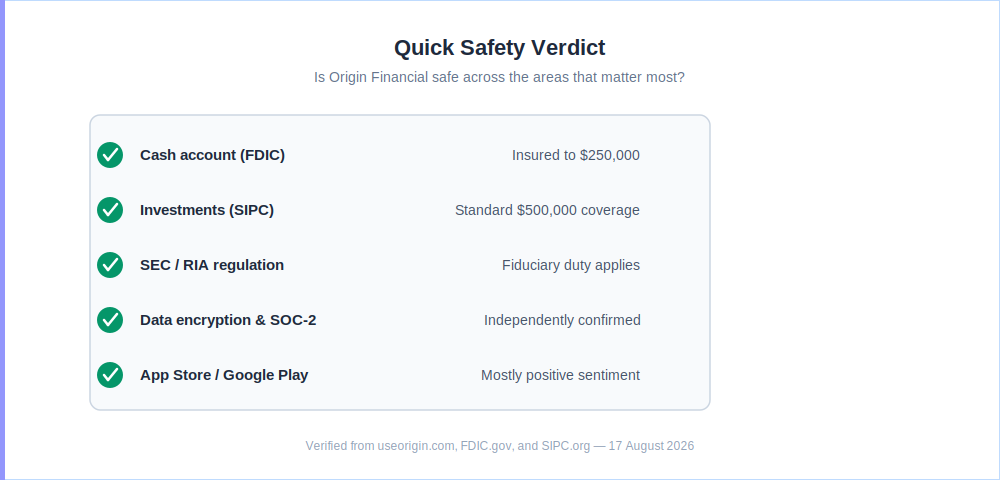
Is Origin Financial safe across the five areas that matter most? Here’s the quick scorecard before the full breakdown below.
That’s normal for apps like this (YNAB, Monarch, and Copilot work the same way, and you can see how Monarch’s own custody model compares), but it means the FDIC coverage lives with the partner bank, not with Origin’s brand name. Origin’s own support article on account security lays out the full breakdown if you want the source directly.
How does Origin protect your cash account?
Origin’s Cash Account holds your money with Customers Bank, a member of the FDIC. That gives you standard deposit insurance up to $250,000 per depositor, the same protection you’d get from a checking or savings account at any FDIC bank.
The account also carries a variable APY that’s adjusted monthly and tends to sit well above what a traditional big bank offers on a savings account. There’s no minimum balance and no maintenance fee tied to the cash account itself, which matters if you’re parking an emergency fund there rather than actively investing it.
A small but real distinction: FDIC insurance protects the principal you deposit if the bank fails. It does not protect against Origin the company shutting down, though your money would still legally belong to you and sit with Customers Bank independent of Origin’s own solvency. That’s the structural reason fintech apps partner with banks instead of holding deposits themselves.
If you’re weighing whether the cash account and its promotional rate are worth the subscription cost on top, the full Origin Financial pricing guide breaks down what you actually get for the $99/year fee.
What protects your money if you invest through Origin?
Your investment accounts are held in custody by DriveWealth, not by Origin. DriveWealth is registered with the SEC as a broker-dealer and belongs to FINRA and SIPC, which is the standard structure behind most robo-advisors and DIY investing apps.
Here’s a spot where I want to flag something rather than smooth it over: Origin’s own site shows two different coverage figures in two different places. Its investing product page cites SIPC protection up to $500,000 total, including a $250,000 cash sub-limit, which matches the standard SIPC coverage every brokerage customer gets.
A separate support article cites $49 million in total assets and $1 million in unused cash, which reads like DriveWealth’s excess-SIPC coverage, an additional policy some clearing firms carry on top of the standard limit. Both can be true at once, since excess SIPC sits above the base $500,000.
Origin’s public pages don’t clearly connect the two figures for a reader trying to understand their actual coverage. If this distinction matters for your situation, confirm directly with Origin’s support team rather than relying on either page in isolation.
SIPC protection matters if DriveWealth itself fails financially. It does not cover a stock going down in value, an ETF underperforming, or any ordinary investment loss. That’s true of SIPC everywhere, not something specific to Origin.
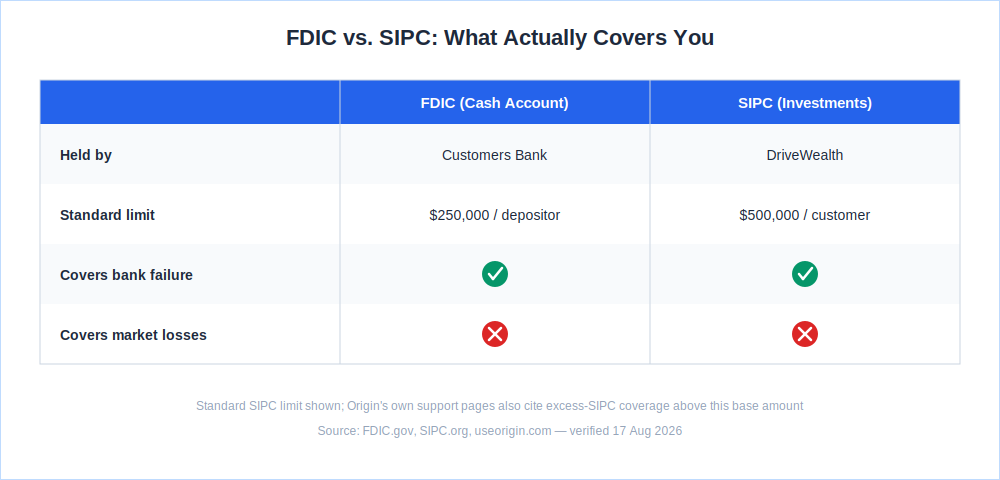
FDIC and SIPC protect against different failures, and neither covers a normal investment loss.
Is Origin Financial regulated by the SEC?
Is Origin Financial safe from a pure regulatory standpoint, separate from the FDIC and SIPC coverage already covered above? Investment advice inside Origin comes through Origin Investment Advisory LLC, a Registered Investment Adviser with the SEC and a wholly owned subsidiary of Blend Financial Inc., doing business as Origin Financial.
Registered Investment Advisers carry a fiduciary duty, meaning they’re legally required to act in your interest when giving investment advice, not just when it’s convenient.
The AI Advisor feature, which Origin calls Sidekick, operates under that same regulatory umbrella. Origin’s own materials describe its AI tools as delivering advice “subject to our fiduciary duty and regulatory oversight,” which ties the AI layer back to the same RIA registration rather than treating it as an unregulated chatbot bolted onto the side.
None of this makes Origin immune to normal investing risk. SEC registration means Origin operates within a regulatory framework and files the disclosures that framework requires; it doesn’t guarantee returns, and no legitimate financial app should ever claim it does.
How does Origin secure your personal data?
Origin Financial security starts with advanced data encryption, hardware security keys, and strict internal access controls on account information. It also describes its security team as running continuous audits, penetration tests, and third-party security reviews rather than a one-time compliance check.
To connect your accounts, Origin uses account aggregators Plaid, MX, and Finicity, which together cover more than 13,000 financial institutions. Most major banks and brokerages sync without trouble, though Charles Schwab 401k accounts and Webull show up fairly often as connection friction points, which is worth knowing before you assume every account you own will link cleanly on the first try.
Origin is also SOC 2 compliant according to third-party reviews of the app, a standard that specifically audits how a company handles and protects customer data over time rather than at a single snapshot.
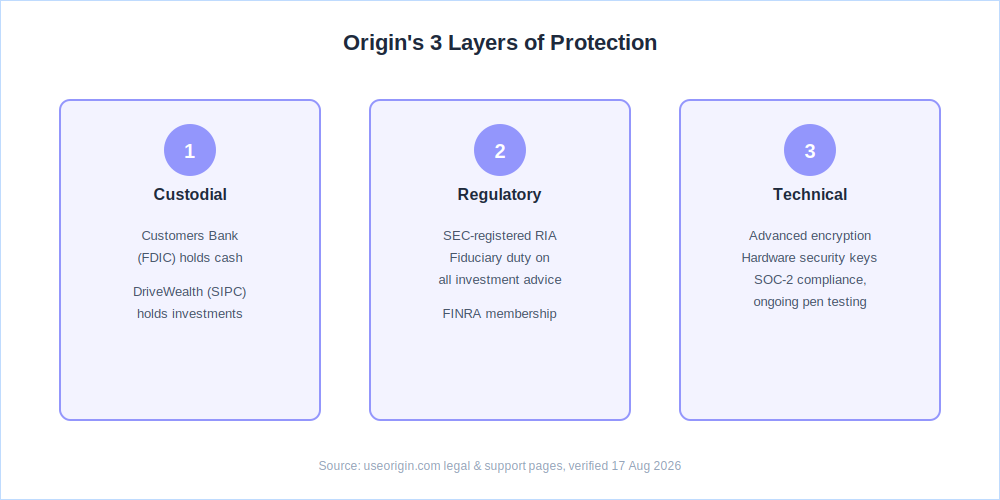
Origin Financial security breaks down into three separate layers, each covering a different kind of risk.
Is Origin Financial legit, or just another budgeting app?
Is Origin Financial legit compared to a stripped-down budgeting tool? It’s been reviewed independently by several finance publications, including The College Investor, Benzinga, and Finder, all of which describe it as a real wealth-building platform. It started life as a workplace financial-wellness benefit before becoming a consumer app, which is a different origin story than most budgeting apps that launch consumer-first.
A quick disambiguation worth making, since it trips people up: this Origin Financial is the personal-finance app at useorigin.com. It is a separate company from Origin Finance, a UK business-lending broker, from a US debt-settlement company that also uses the Origin Financial name, and from Origin Bank, a Louisiana-based FDIC bank.
If a search result about “Origin Financial” mentions loan negotiations, debt settlement, or a physical bank branch, you’re looking at the wrong company.
Origin’s own site lists more than 100,000 users as of this writing, and its roots as an employer-provided benefit at companies like Webflow, Turo, and Modern Health mean it went through a round of institutional vetting before it ever became a consumer app. That’s a different legitimacy signal than a brand-new app launching straight to the app stores with no employer track record behind it.
For couples specifically, Origin lets both partners log into one account at no extra cost, which is worth mentioning here since shared-account safety is a common trust question. Each partner keeps their own login credentials while sharing visibility into joint net worth, which is a cleaner setup than emailing spreadsheets back and forth.
If you’re comparing Origin against a dedicated net worth tracker, the best net worth tracking apps roundup covers where each option actually shines.
Is Origin app safe on iOS and Android?
Origin’s mobile apps connect through the same Plaid, MX, and Finicity aggregators as the web platform, so the underlying security model doesn’t change based on which device you’re using. App Store and Google Play reviews for Origin skew mostly positive, with users specifically calling out smooth account syncing and responsive customer service.
Is Origin app safe on a phone the same way it is on desktop? Yes, since the mobile app relies on the same aggregator and encryption practices covered above rather than introducing a separate security model of its own.
Origin’s stated customer service turnaround is fast for a finance app: roughly one minute for live chat and about 32 minutes for email response through its support address. That responsiveness matters more than it sounds, since a slow support team is often the first sign something’s wrong when a security question actually comes up.
If your bank offers its own security notifications, like login alerts or spending alerts, keeping those active alongside Origin gives you a second layer of visibility that doesn’t depend on Origin’s own systems at all. Is Origin app safe enough to skip those extra alerts entirely? Not really, since no single app should be your only line of defense.
What are Origin Financial reviews Reddit users sharing?
Origin Financial reviews Reddit threads tend to skew practical rather than alarmed. There’s an active Reddit community around Origin, with both team members and regular users participating, which is unusual for a finance app this size and generally a good transparency signal. Community sentiment leans toward Origin being a legitimate, if still growing, alternative to juggling separate budgeting, investing, and net-worth apps.
The most common Reddit thread pattern isn’t “is this a scam,” it’s “is this worth paying for compared to YNAB or a free spreadsheet,” which is a meaningfully different conversation. People who want deep, manual, every-dollar budgeting tend to say Origin’s automated approach feels too hands-off; people who want one dashboard for spending, investing, and net worth tend to say it’s exactly what they were missing.
Origin Financial reviews Reddit threads on this specific question tend to be more useful than star ratings, since they show the actual trade-off rather than a single number.
I’m not going to manufacture quotes here. If you want the unfiltered version, Origin’s own subreddit and the broader personal-finance communities are worth a scroll before you commit to a year of the app. For a side-by-side on the “worth it” question specifically, see YNAB vs Origin Financial or Origin vs Monarch Money.
How does Origin Financial security compare to other budgeting apps?
Origin’s security question is genuinely different from YNAB’s, Monarch’s, or Copilot’s, and it’s worth being specific about why. Those three apps use Plaid (or a similar aggregator) purely to read your transaction data; they never hold your actual money. Origin does both: it reads your linked accounts the same way, but it also custodies real cash and investment balances through Customers Bank and DriveWealth.
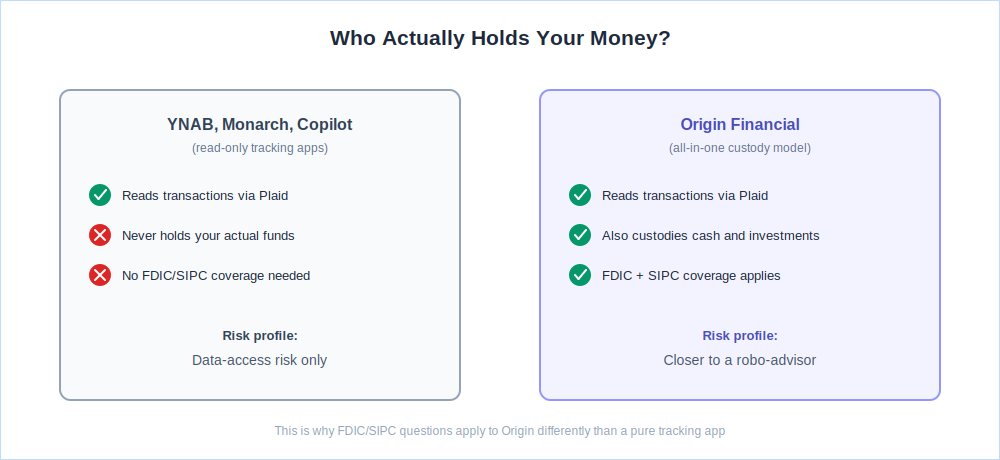
Origin’s dual role as both data-reader and money-custodian is why FDIC and SIPC questions apply here differently than for a pure tracking app.
That means Origin’s risk surface is closer to a robo-advisor like Betterment or Wealthfront than to a pure tracking app. It’s not a worse setup, but it’s a different one, and it’s why FDIC and SIPC coverage are relevant questions for Origin in a way they simply aren’t for an app that only ever looks at your data without holding your money.
The is Monarch Money safe and is Copilot Money safe guides cover the read-only aggregator model in more depth if you want the comparison.
Quick comparison: If you want an app that only tracks spending and never touches your actual funds, see the Monarch Money review or YNAB review. If you specifically want the all-in-one custody model Origin uses, see the full Origin Financial review for pricing and feature detail.
What should you actually watch out for?
None of this means you can stop paying attention entirely. Origin is not a bank, and its own disclosures say so directly. That’s not a red flag by itself, but it means you should always confirm which partner institution is actually holding your money at any given time, rather than assuming “Origin” is doing the holding.
SIPC and FDIC protection both have real limits and real gaps. Neither covers market losses, and the SIPC figures Origin publishes across its own pages aren’t fully reconciled in one place, as covered above. Origin Financial security ultimately depends on the partner institutions holding your money, not on Origin’s brand name alone.
If you’re planning to keep a large cash balance or a large investment balance with Origin, it’s worth a direct conversation with their support team about exactly how those coverage tiers apply to your account size.
Account-linking friction with Charles Schwab 401k accounts and Webull shows up often enough in reviews to be worth planning around, especially if either is a major part of your financial picture.
And like any app that centralizes your full financial life in one dashboard, the practical security advice is the same one that applies everywhere: strong unique password, two-factor authentication turned on, and normal vigilance about phishing attempts that impersonate the app.
If you’ve weighed the safety picture and want to see how Origin stacks up against other all-in-one platforms before signing up, the best personal finance software roundup is a good next stop.
Is Origin Financial safe enough for your specific situation? For most people managing a normal mix of cash and investments, yes. If you’re planning to keep a much larger balance with Origin than the FDIC or SIPC limits cover, that’s the one case worth a direct call to their support team before you commit.
What else do people ask about Origin’s safety?
A few quick answers to the specific safety questions that come up most often, gathered from the same official sources cited throughout this guide, including whether is Origin Financial legit enough for daily use, is Origin app safe on mobile specifically, and what Origin Financial reviews Reddit users actually leave behind.
Is Origin Financial’s cash account FDIC-insured up to $250,000?
Yes. Is Origin Financial safe for everyday checking-style balances under that threshold? Origin’s Cash Account is held with Customers Bank, a member FDIC institution, and is insured up to $250,000 per depositor, standard for any FDIC-insured deposit account.
Does SIPC insurance cover investment losses on Origin?
No. SIPC protects you if DriveWealth, Origin’s custodian, fails financially. It does not cover a decline in the value of your investments, which is true of SIPC coverage industry-wide, not specific to Origin.
Is Origin Financial the same company as Origin Bank?
No. Origin Financial (useorigin.com) is a budgeting and investing app. Origin Bank is a separate, unrelated FDIC-insured bank based in Louisiana. If you’re trying to confirm is Origin Financial legit versus this unrelated bank, the similar names are simply a coincidence worth knowing about if a search result seems off.
Is the Origin app legit for tracking my full net worth?
Yes. Is Origin Financial legit enough to trust with a full net worth picture? Origin connects through established aggregators (Plaid, MX, Finicity) covering over 13,000 institutions, and independent reviews from The College Investor, Benzinga, and Finder all treat it as a legitimate, established platform rather than an unproven startup app.
Origin Financial reviews Reddit threads echo the same conclusion, with most long-term users describing it as reliable for net worth tracking specifically.
Has Origin Financial had a data breach?
There’s no public record of a confirmed data breach at Origin as of this writing. Origin Financial security practices, including encryption and continuous audits, are designed to reduce that risk, but no confirmed record isn’t the same as a guarantee, so keep the same habits (two-factor authentication, unique passwords) you’d use with any financial app.
Is it safe to share an Origin account with a partner?
Yes. Origin’s Couples feature gives each partner their own login while sharing visibility into joint accounts and net worth, which is a more secure setup than sharing a single login and password between two people.
What happens to your money if Origin Financial shuts down?
Your cash stays with Customers Bank and your investments stay with DriveWealth regardless of what happens to Origin as a company, since those are the institutions actually holding the assets. You’d still go through a formal account-closure or transfer process, but the underlying money isn’t tied to Origin’s own solvency.
How can you verify Origin Financial’s security claims yourself?
Start with Origin’s own legal and support pages at useorigin.com, which list the specific partner bank, custodian, and RIA entity by name. From there, you can independently confirm Customers Bank’s FDIC status using the FDIC’s own BankFind tool and DriveWealth’s SIPC membership through SIPC’s public member list, rather than taking any single source’s word for it.
📖 Read next
