
You can learn how to get out of debt fast without gimmicks once you understand the two methods that actually move the needle: attacking the highest interest rate first, or clearing your smallest balance first.
⚡ Quick Answer
The fastest real path out of debt is picking one method, either the debt avalanche (highest interest rate first) or the debt snowball (smallest balance first), and pointing every spare dollar at it. The math favors avalanche. Sticking with a plan for six-plus months is what actually decides how fast you get free.
📋 What’s in this guide
- Why is 21% APR quietly draining your debt payments?
- How do you stop adding new debt before you can pay off what you owe?
- How do you list every debt you owe?
- What is the debt avalanche method and how does it actually work?
- What is the debt snowball method and how does it actually work?
- Debt snowball vs avalanche: which should you actually use?
- Where do you find extra money to pay off debt faster?
- What tools actually help you get out of debt fast?
- What questions do people ask about getting out of debt fast?
- How to get out of debt fast: what’s the real 6-step plan?
Why Is 21% APR Quietly Draining Your Debt Payments?
Total US credit card debt sat near $1.25 trillion in Q1 2026, according to the Federal Reserve Bank of New York’s household debt report. The average APR on those balances sat around 21% that same quarter, per the Federal Reserve Board’s separate G.19 Consumer Credit release, which tracks interest rates rather than balances.
Credit card balances sit near record highs, and a 21% average APR means minimum payments barely dent principal. On $5,000 at 21% APR, roughly $87 of a $150 minimum payment goes to interest alone. That gap, not a lack of income, is why so many people stay stuck for years.
Most people don’t stay in debt because they can’t afford to pay it off. They stay in because they don’t have a system telling them which dollar goes where. Once you have that system, the timeline shrinks fast, which is what the rest of this guide walks through. The free Debt Payoff Estimator lets you run your own numbers before you commit to a method.
A quick real-world gut check: someone carrying $8,000 in credit card debt at 21% APR, paying only the $200 minimum, spends more than three years grinding through it. Over $1,900 of that goes to interest alone.
Once you understand how to get out of debt fast, that timeline can shrink to under two years without earning a single extra dollar, just by changing which debt gets the extra payment each month.
How Do You Stop Adding New Debt Before You Can Pay Off What You Owe?
You can’t drain a bathtub while the tap’s still running. Paying down debt while adding new balances every month means you’re working against yourself. That’s the whole point of learning how to get out of debt fast: removing friction before you even touch a payoff method.
Stopping new debt doesn’t mean cutting up every card. It means removing the friction that makes overspending easy: delete saved card details from shopping sites, switch daily spending to cash or debit, and cancel subscriptions you’ve forgotten about. Small friction changes stop more impulse debt than willpower ever does.
Practical moves that hold up in practice:
- Remove saved card details from shopping sites. The friction of finding your physical card stops a surprising number of impulse purchases.
- Use cash or debit for daily spending. When you can see the money leave, you spend less of it.
- Keep one card for real emergencies. Leave the rest at home.
- Audit subscriptions against your last three bank statements. PocketGuard flags forgotten recurring charges automatically once you connect an account.
- Track what triggers impulse charges. For a lot of people it’s late-night phone scrolling or stress spending after a rough day. Naming the trigger makes it easier to interrupt before the card comes out.
One exception: a 0% balance transfer used to consolidate high-interest debt is strategic new debt, not the kind you’re trying to stop. More on that in the “extra money” section below.
How Do You List Every Debt You Owe?
Vague awareness of debt is expensive. It stops you from building a real plan. Skipping this step is one of the biggest reasons people search how to get out of debt quickly and never actually get there. Write down every debt you have, with four numbers: balance, interest rate (APR), minimum payment, and lender.
Listing every debt with its balance, APR, and minimum payment turns a vague sense of “I owe too much” into an actual number you can plan against. Most people find the total is different from what they expected, and that gap is usually what motivates the first real step toward how to get out of debt quickly instead of staying stuck in avoidance.
What Is the Debt Avalanche Method and How Does It Work?
The debt avalanche method targets your highest-interest debt first, which minimizes the total interest you pay across everything you owe.
The debt avalanche method has you pay minimums on every debt except the one with the highest interest rate, where every spare dollar goes. Once that’s cleared, you roll the payment onto the next-highest rate. It’s the mathematically cheapest way to become debt-free, though early progress can feel slow.
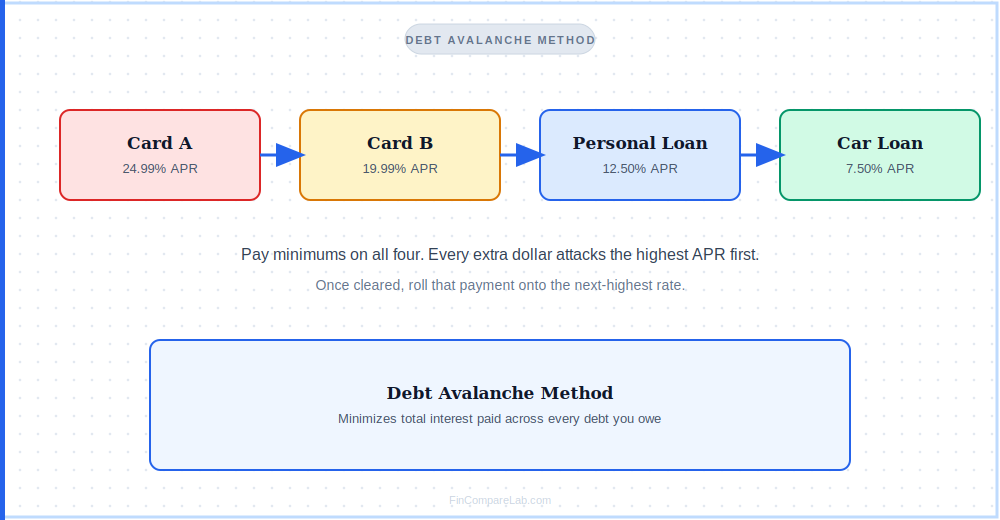
Using the table above: pay minimums on all four debts, then put every extra dollar toward Credit Card A at 24.99% APR. Once it’s gone, roll that payment onto Credit Card B, then the personal loan, then the car loan last.
The trade-off: if your highest-rate debt also has the largest balance, you might go months without a visible win. YNAB includes a loan planner feature that shows exactly how extra payments shift your payoff date, which helps offset that slow-start feeling. That’s the core mechanic behind the debt avalanche method in a nutshell: cheapest math, slowest first win.
What Is the Debt Snowball Method and How Does It Work?
The debt snowball method ignores interest rates entirely and builds momentum through fast, visible wins instead.
The debt snowball method has you pay minimums on every debt while attacking your smallest balance first, regardless of its interest rate. Clearing that balance completely, then rolling the payment onto the next-smallest, produces quick wins that keep people motivated. It costs more in total interest than avalanche but has a real behavioral advantage.
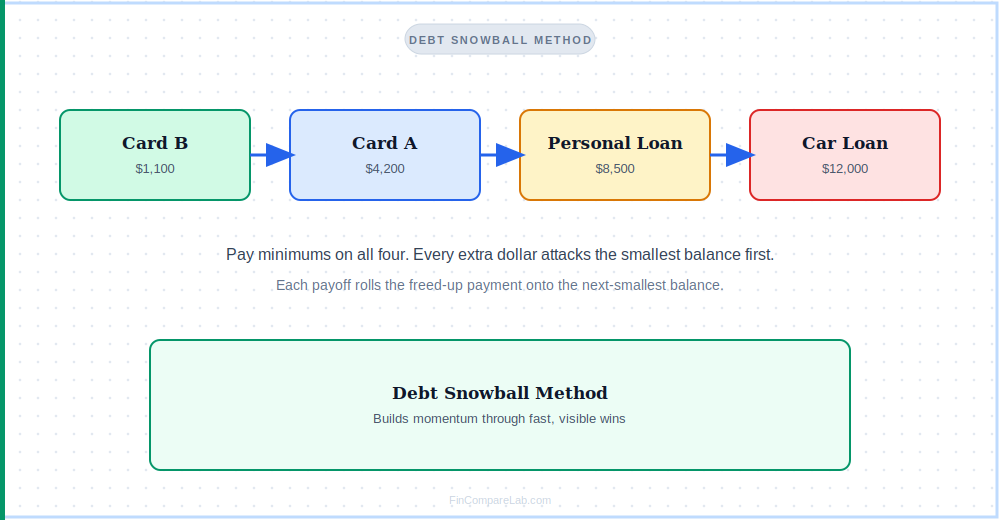
Using the same table: pay minimums on all four debts, then put every extra dollar toward Credit Card B at $1,100, the smallest balance. Once cleared, roll that payment onto Credit Card A, then the personal loan, then the car loan.
This is the default method in Dave Ramsey’s Baby Steps framework. If you’re following that plan specifically, EveryDollar vs YNAB breaks down how the two leading debt-payoff apps handle each method differently, since EveryDollar is built around the snowball by design. That’s the core mechanic behind the debt snowball method in a nutshell: slower on interest, faster on momentum.
Debt Snowball vs Avalanche: Which Should You Actually Use?
There’s no universal answer. It depends on whether numbers or momentum motivate you more consistently.
Choose avalanche if you’re motivated by minimizing total interest and can stay consistent without early wins. Choose snowball if you’ve abandoned debt plans before and need visible progress to keep going. Neither choice is wrong; the method you’ll actually stick with for six-plus months beats the mathematically “correct” one you quit.
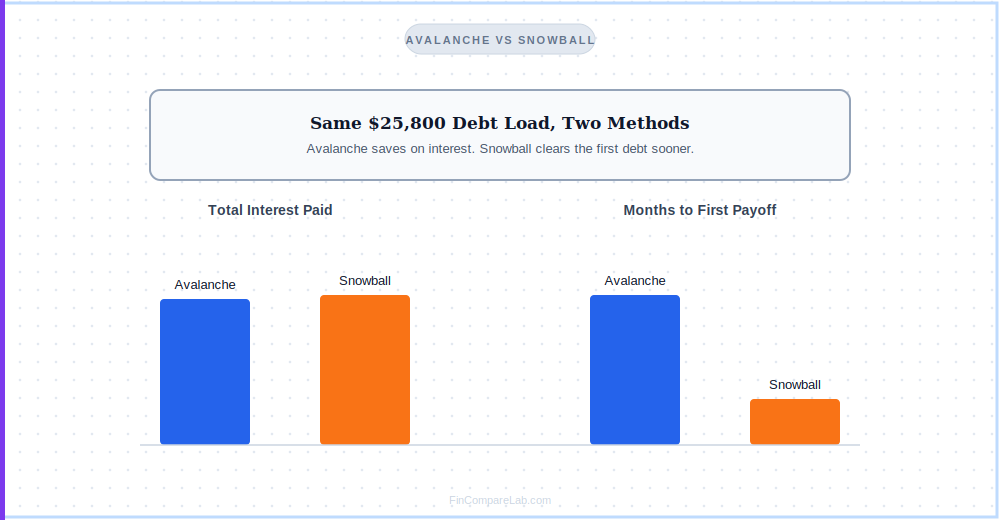
Run the same $25,800 debt load from the table above with an extra $300 a month beyond the minimums: both methods clear every debt in 40 months, and avalanche saves only about $107 in total interest ($4,565 versus $4,672), since the rate gap between these debts isn’t huge. This is a common surprise when comparing the debt snowball method against avalanche on your own numbers.
Where the methods really diverge is the first win. Avalanche’s first payoff, Credit Card A, takes 13 months. Snowball’s first payoff, Credit Card B, takes just 4 months. That’s the actual trade-off in this debt snowball vs avalanche comparison: a modest interest saving with avalanche versus a payoff you can feel in about a third of the time with snowball.
This debt snowball vs avalanche question is the single most common one people ask once they’ve listed every debt they owe.
Choose avalanche if…
- You’re motivated by saving money on interest
- Your highest-rate debt has a manageable balance
- You don’t need quick wins to stay consistent
Choose snowball if…
- You’ve tried debt plans before and quit
- You have several small debts you can clear fast
- The psychological win matters more than the math
Not sure which fits? Start with snowball, clear your smallest debt, and see how the momentum feels. If you’re frustrated by slower interest savings, switch to avalanche.
Run your own numbers first with the free Debt Payoff Estimator to see the exact dollar difference before committing either way. The gap between debt snowball vs avalanche shrinks or widens a lot depending on how spread out your own interest rates are.
Where Do You Find Extra Money to Pay Off Debt Faster?
Both methods assume you’re putting money toward debt beyond the minimums. Here’s where that money actually comes from when you’re serious about how to get out of debt fast.
Extra debt-payoff money usually comes from four places: cutting recurring expenses you’ve stopped noticing, a 0% balance transfer for high-interest cards if you qualify, directing windfalls like tax refunds straight at debt, and one added income stream held for six months, not indefinitely.
How Do You Cut Recurring Expenses First?
Go through your last three months of bank statements. Look for subscriptions you forgot about, insurance you haven’t reviewed in two-plus years, and phone plans with more data than you use.
Should You Consider a Balance Transfer?
A 0% APR balance transfer card can speed up how you pay off debt fast if you qualify for good credit. Every payment goes to principal during the intro period, usually 12 to 21 months, but transfers typically carry a 3–5% fee, so calculate whether the interest saved outweighs that cost first.
What Should You Do With Windfalls?
Put at least 50% of any tax refund, bonus, or unexpected cash directly onto your highest-priority debt before spending any of it. Every dollar you free up this way accelerates how to get out of debt fast, regardless of which method you picked.
Can One Extra Income Stream Speed Things Up?
Even an extra $200 to $300 a month changes the timeline significantly. Selling unused items, freelance work, tutoring, or delivery driving can each generate that range without a new full-time job. For a lot of people, this is the fastest real lever for how to get out of debt quickly without touching their existing budget categories at all.
Pick one option that fits your schedule and commit the income entirely to debt for six months, not indefinitely, so it doesn’t quietly turn into lifestyle spending instead. At $250 extra a month, a $5,000 balance at 20% APR clears in under 17 months. At $500 extra, it’s gone in under 10.
How to budget on irregular income is worth reading if variable pay makes it hard to commit a fixed extra amount each month.
What Tools Actually Help You Get Out of Debt Fast?
A budgeting app doesn’t do the work for you, but it keeps the plan visible so the debt payment happens before the money disappears elsewhere.
YNAB allocates money to debt categories before you spend and shows exactly how extra payments shift your payoff date. PocketGuard‘s built-in calculator runs both the debt snowball method and the debt avalanche method side by side against your real balances. Goodbudget offers a free envelope-based option for manual tracking.
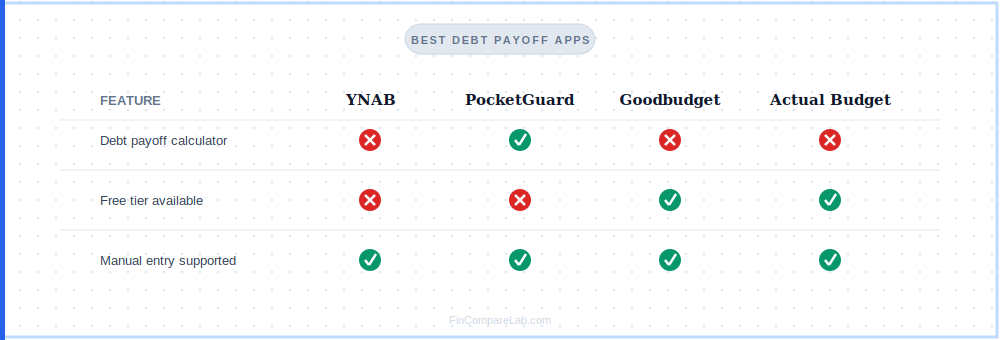
| App | Why It Helps With Debt | Price |
|---|---|---|
| YNAB | Allocates money to debt repayment categories before you spend it. The loan planner shows exactly how extra payments move your payoff date. | $109/yr Try YNAB → |
| PocketGuard | Plus includes avalanche and snowball calculators. The “In My Pocket” number stops overspending that would otherwise eat into debt payments. | $74.99/yr Try PocketGuard → |
| Goodbudget | Create a dedicated debt repayment envelope. Manual entry keeps spending awareness high when every dollar counts. | Free / $80/yr Try Goodbudget → |
| Actual Budget | Free and open-source with no vendor lock-in. Self-hosted, so there’s no subscription eating into the money you’re trying to free up for debt. | Free (MIT) Try Actual Budget → |
Pricing verified from official websites and app store listings (August 2026). See the full debt payoff app comparison for a detailed breakdown of all five top options.
My recommendation to pay off debt fast specifically: pick the app that matches how hands-on you want to be. YNAB rewards active daily use; PocketGuard automates the “can I spend this” question; Goodbudget and Actual Budget suit people who’d rather not pay a subscription while paying down debt. The right tool won’t replace a method, but it removes the excuses that slow down how to get out of debt quickly.
What Questions Do People Ask About Getting Out of Debt Fast?
Here are the most common questions people search when they’re trying to get out of debt fast, including a few about the debt snowball vs avalanche decision itself.
How to Get Out of Debt Quickly if You Have Multiple Debts?
List every debt with its balance and interest rate, then pick one method, avalanche or snowball, instead of splitting extra payments across all of them. Spreading extra money thin across several debts slows down every single payoff date compared to concentrating it on one at a time.
Is the Debt Snowball or Avalanche Method Better?
Mathematically, avalanche wins because it minimizes total interest paid. Psychologically, snowball works better for many people since visible wins reduce the chance of quitting partway through. The honest answer is whichever method you’ll actually follow through on for the full timeline.
Can a Budgeting App Actually Help You Pay Off Debt Faster?
Yes, mainly because it stops overspending in other categories, which frees up more money for debt payments each month. Apps like YNAB and PocketGuard add dedicated debt-planning tools on top of that.
What Should You Do If You Can’t Afford Your Minimum Payments?
Call your creditors directly before you miss a payment. Most credit card companies have hardship programs that can temporarily lower your rate or payment if you explain the situation honestly. A nonprofit credit counseling agency can also negotiate on your behalf if the debt load feels unmanageable alone.
How Long Does It Take to Get Out of Debt Fast?
It depends on your total debt, your interest rates, and how much extra you can put toward payments each month. A $5,000 credit card balance at 21% APR with $300 a month in payments clears in about 20 months. The same balance with $500 a month clears in about 11 months.
Run your own numbers with the free Debt Payoff Estimator to see your specific timeline for how to get out of debt quickly given your actual balances.
Not sure whether avalanche or snowball saves more for your specific debts? Run the numbers with the free Debt Payoff Estimator. It takes about two minutes to set up.
How to Get Out of Debt Fast: What’s the Real 6-Step Plan?
This is the actual playbook for how to get out of debt fast, not a listicle padded with the same five tips every other site repeats. Getting out of debt fast isn’t complicated, but it does take consistency over months, not days.
- Stop adding new debt
- List every debt: balance, rate, minimum payment
- Pick one method: avalanche or snowball
- Find every extra dollar you can point at the priority debt
- Use a budgeting app to keep that payment from disappearing before it happens
- Keep going until it’s done
The strategy is the easy part. Consistency for the months it actually takes is what separates people who get free from people who stay stuck at the minimum payment.
📚 Read Next
- Best Budgeting Apps for Debt Payoff 2026: Full Comparison
- YNAB Review 2026: Best App for Debt Payoff
- PocketGuard Review 2026: Automatic Debt Payoff Plan
- EveryDollar vs YNAB 2026: Snowball vs Zero-Based
- YNAB Pricing 2026: Plans, Free Trial & Student Discount
- How to Budget on Irregular Income 2026
- Free Debt Payoff Estimator: Avalanche vs Snowball Calculator
This article is for informational purposes only and does not constitute financial or debt advice. If you are struggling with serious debt, consider speaking with a qualified financial advisor or a nonprofit credit counseling service. See our disclaimer and affiliate disclosure for full details.
