
⚡ Quick Verdict
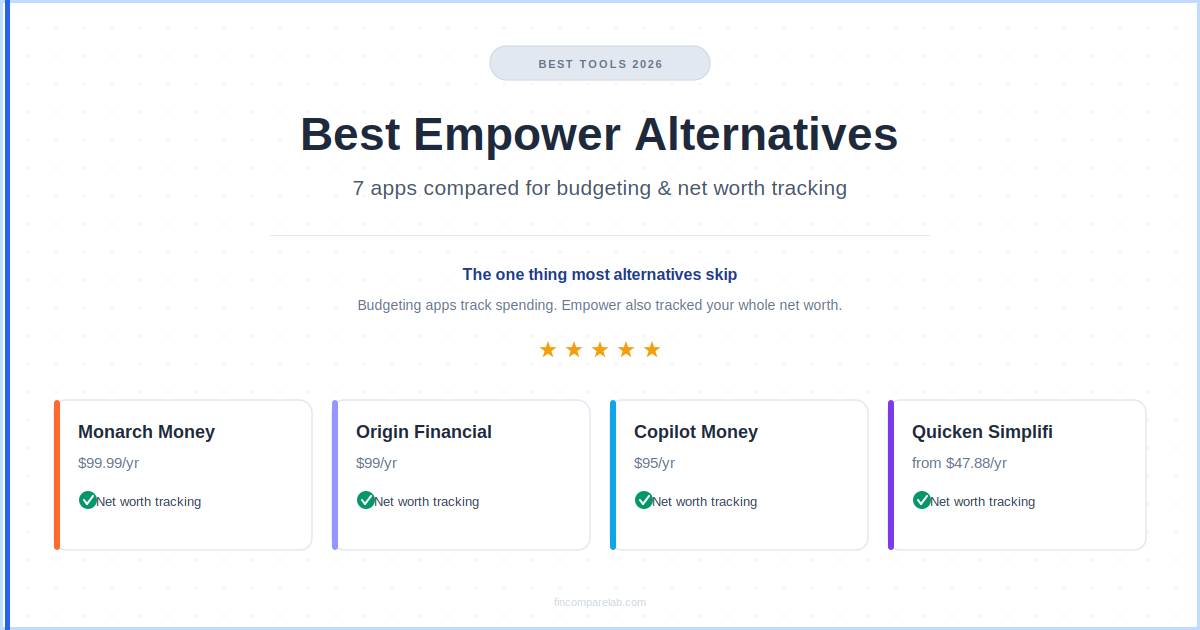
Monarch Money is the closest single-app replacement for Empower’s combination of budgeting and net worth tracking, and Origin Financial is the strongest pick if you also want tax filing and estate planning bundled in. Neither is free — if that’s a dealbreaker, be honest with yourself about what you’re giving up, because no free alternative on this list matches Empower’s investment-tracking depth.
How We Review Apps · Pricing verified from official sources — 28 July 2026
I put together this list of Empower alternatives by re-verifying every price directly at each app’s official site or app store listing, then testing the free tiers and trials myself where one was available. Apps that only replace Empower’s budgeting side without any net worth or investment view still made the list, but I’ve flagged that gap clearly rather than let it slide by in a features table.
What’s in this guide?
Quick links to every question this guide answers, in order.
- What is Empower, and why are people looking for alternatives?
- What’s the one thing most Empower alternatives skip?
- What are the best Empower alternatives in 2026?
- Is there a free Empower alternative?
- Which Empower alternative is best for couples?
- Which Empower alternative works if you’re paying off debt?
- Which Empower alternative is best if you’re 30+ and investing seriously?
- What do people ask about switching from Empower?
What is Empower, and why are people looking for alternatives?
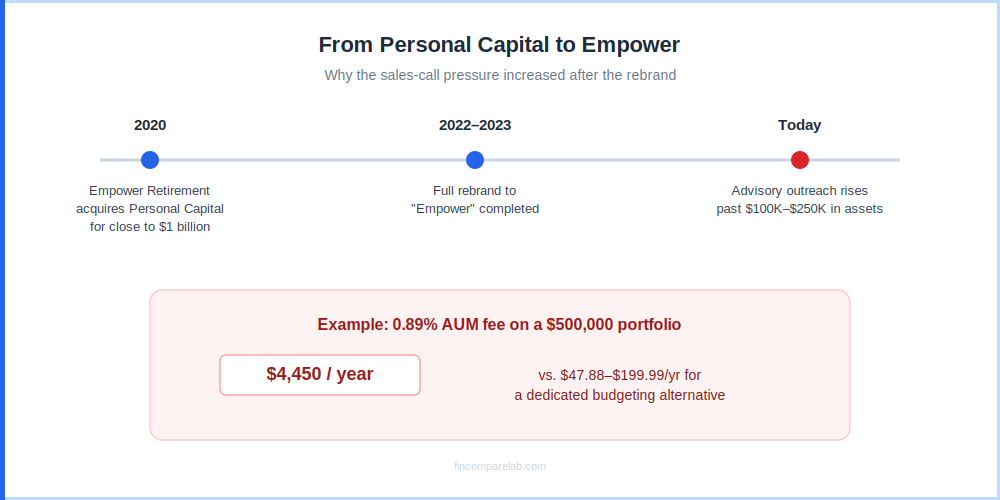
Empower alternatives are in demand mostly because of what Empower isn’t anymore. Empower was Personal Capital until Empower Retirement acquired it in 2020 for close to $1 billion and completed a full rebrand by 2023, and long-time users have noticed the shift since.
The free Personal Dashboard — net worth tracking, investment checkup, retirement planner — is still genuinely good, and it’s still free. What’s changed is the pressure that comes with it.
Once your linked accounts cross roughly $100,000–$250,000 in assets, multiple user reports describe a noticeable increase in outreach from Empower’s advisory team, pitching its paid wealth management service at 0.49%–0.89% of assets under management.
On a $500,000 portfolio, the higher end of that range works out to about $4,450 a year. That’s the trade people are opting out of when they go looking for an alternative — not a worse product, just a more aggressive sales funnel attached to a free tool.
You’ll see this same search phrased a few different ways — apps like Empower, personal capital alternatives, an alternative to Empower, or even Empower Personal Capital alternatives — and they all point at the same thing: a replacement for Empower’s free dashboard, minus the sales-call pressure that comes with it.
What’s the one thing most Empower alternatives skip?
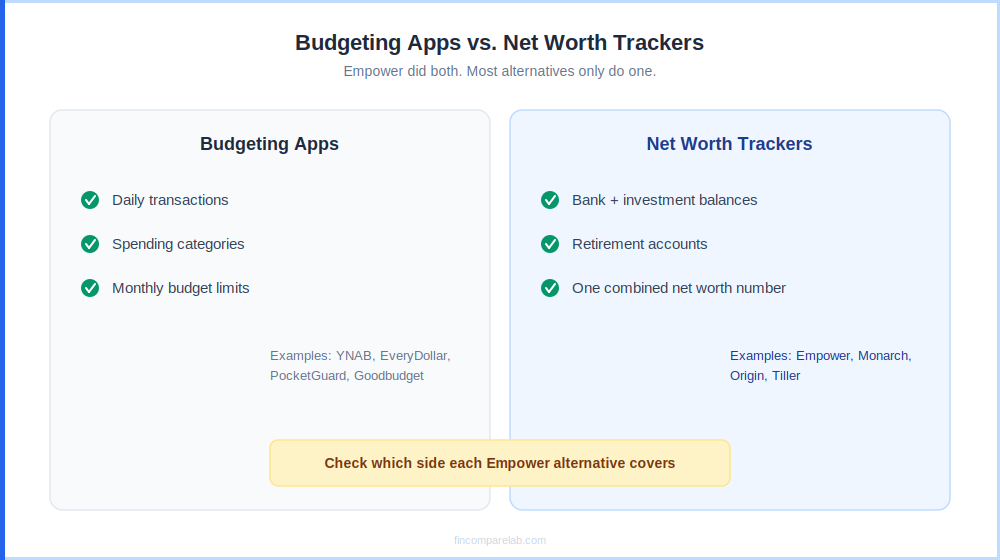
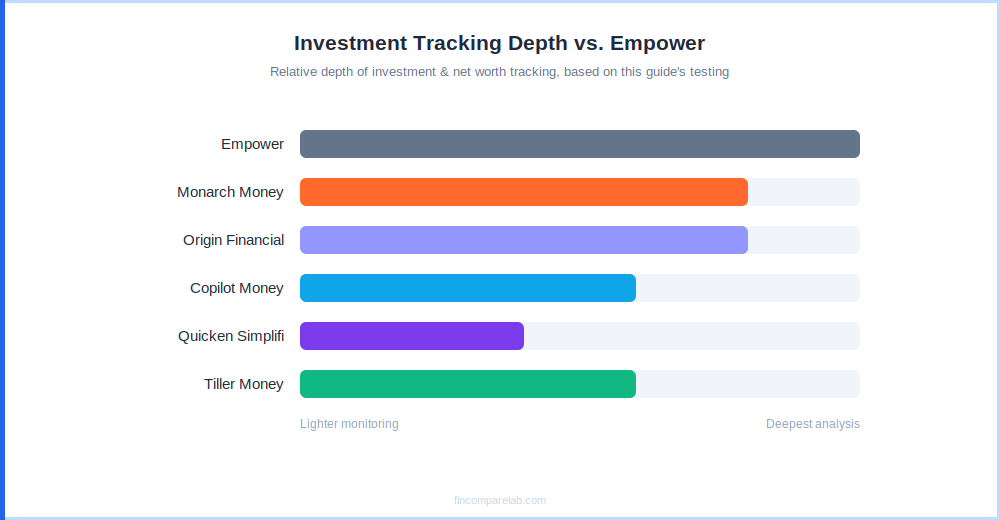
Most Empower alternatives skip investment and net worth tracking entirely — they replace the budgeting half of Empower’s job and quietly drop the half that made people love it in the first place.
Net worth tracking and budgeting solve different problems. Budgeting apps watch your daily spending and categorize transactions. Net worth trackers zoom out — they combine your bank balances, investment accounts, retirement accounts, and debts into one number.
That number tells you whether you’re actually building wealth, not just staying under budget this month. Empower does both, which is unusual — plenty of its “alternatives” only do one.
This matters most for the 25–34 crowd this guide is written for. You’re past the “am I overspending on takeout” stage and into “is my net worth actually growing” territory — dual income, maybe a house down payment fund, maybe your first real investment account.
Picking an alternative that only tracks spending and silently drops the net worth view is a downgrade dressed up as a switch. Check the table below for exactly where each app lands on that split before you commit.
Here’s what that looks like in practice. Say you leave Empower for a free budgeting app because you’re tired of the advisory calls. Six months later you want to check whether your 401k and brokerage account are actually growing alongside your checking account — and the app you switched to has no way to show that number at all.
You’re back to logging into three separate apps just to answer a question Empower answered in one screen. That’s the real cost of picking from a list of apps like Empower without checking which ones kept the net worth piece.
Whether you landed here searching for the best net worth tracker, the best net worth tracking apps, the best apps to track net worth, or an alternative to personal capital, the same split applies — check which side of that line each pick below actually covers before switching.
What are the best Empower alternatives in 2026?
Here’s how the current best net worth tracker contenders stack up against Empower, alongside a couple of budgeting-only picks worth knowing about even though they don’t cover the same ground.
| App | Price | Free tier | Net worth / investing depth | Best for |
|---|---|---|---|---|
| Monarch Money | $99.99/yr Core · $199.99/yr Plus | ❌ 7-day trial only | ✅ Full budgeting + net worth + investments | Closest single-app replacement, couples |
| Origin Financial | $99/yr (promo $1 first yr) | ❌ No free tier | ✅ Budgeting + investing + tax + estate | All-in-one, avoiding a separate advisor |
| Copilot Money | $95/yr | ❌ 1-month trial | ⚠️ Portfolio value + benchmarking, iOS/Mac only | iOS design, no Android households |
| Quicken Simplifi | $47.88–$83.88/yr | ❌ 30-day money-back, no trial | ⚠️ Monitoring only, not deep analysis | Cheapest paid pick, light investing view |
| Tiller Money | $99/yr | ❌ 30-day trial | ✅ Fully customizable net worth sheet | Spreadsheet control, no iOS app |
| Albert | $19.99–$39.99/mo | ❌ 30-day trial | ⚠️ Budgeting-first, optional human guidance | Wanting advice without the AUM fee model |
| PocketGuard | $74.99/yr or free (limited) | ⚠️ Limited, disputed by some sources | ❌ Budgeting only, no investment tracking | Simple spending control, not a net worth swap |
Pricing verified from official websites — July 2026.
Is Monarch Money a good Empower alternative?
As one of the most-searched personal capital alternatives, Monarch Money is the best overall Empower alternative if you want one app that still shows both your spending and your net worth. It covers checking, credit cards, investments, and loans in a single dashboard, and its couples access is genuinely built for two people rather than bolted on.
The catch is cost — Monarch has no permanent free tier, so you’re trading Empower’s free dashboard for a $99.99/year subscription. Read my full Monarch Money review or check current Monarch Money pricing for the latest promo codes before signing up.
Is Origin Financial a good Empower alternative?
Origin Financial is one of the newer personal capital alternatives to gain real traction, and it’s the strongest pick if you want to replace not just Empower’s dashboard but the idea of ever needing a separate financial advisor. At $99/year, it bundles budgeting, investing, a high-yield cash account, free basic will preparation, and paid CFP sessions into one subscription.
That’s genuinely comparable to stacking several standalone tools. Origin is newer than Monarch and doesn’t yet carry a FinCompareLab numeric rating, so weigh that against its broader feature set. See my Origin Financial review and the Origin vs Monarch Money comparison for a direct head-to-head.
Is Copilot Money a good Empower alternative?
Among apps like Empower that focus on investment visibility, Copilot Money is a strong Empower alternative specifically for iOS households who care about design and want real portfolio benchmarking against market indexes, not just a balance. The dealbreaker is platform — there’s no Android version, and couples on mixed phones each need a separate $95/year subscription, doubling the effective cost. Full details are in my Copilot Money review.
Is Quicken Simplifi a good Empower alternative?
Among apps like Empower with any investment view at all, Quicken Simplifi is the cheapest paid Empower alternative, currently as low as $47.88/year on its running promo. Its investing view is monitoring-focused — you’ll see holdings and performance, not deep allocation modeling or benchmarking — which makes it a lighter Empower swap, not a like-for-like one. My Quicken Simplifi review and Simplifi pricing guide cover the current promo terms.
Is Tiller Money a good Empower alternative?
If you want a best net worth tracker with full customization rather than a fixed dashboard, Tiller Money is the right Empower alternative — it gives you more control over your net worth view than Empower does, not less. Because it lives in a Google Sheet or Excel file you own, its Community Solutions library includes user-built net worth dashboards you can customize freely.
That’s a genuine strength for spreadsheet-comfortable users. There’s no iOS app, which rules it out for a lot of households. Read the full Tiller Money review.
Is Albert a good Empower alternative?
Albert is worth considering among apps like Empower if the specific thing pushing you away is the advisory sales-call model, since Albert’s Genius and Family tiers bundle optional human guidance into a flat monthly fee instead of a percentage of assets.
It leans budgeting-first rather than net-worth-first, so it’s a lighter replacement for Empower’s core dashboard experience. Full pricing and features are in my Albert review and Albert pricing guide.
Is PocketGuard a good Empower alternative?
PocketGuard is worth including only with a clear caveat: it’s a budgeting app, not a net worth tracker, and it won’t replace the half of Empower most people actually miss. Its free tier status is also disputed — my own testing shows a limited free tier still active, while some third-party sources report it discontinued, so confirm directly at signup.
If simple daily spending control is genuinely all you need, it’s a reasonable low-cost pick. Read the full PocketGuard review.
Is there a free Empower alternative?
Not one that matches Empower’s investment and net worth tracking depth for free — that’s the honest answer, and it’s worth knowing before you switch expecting a like-for-like free swap. Most free apps like Empower you’ll find in a search are actually free budgeting apps that dropped the net worth piece entirely.
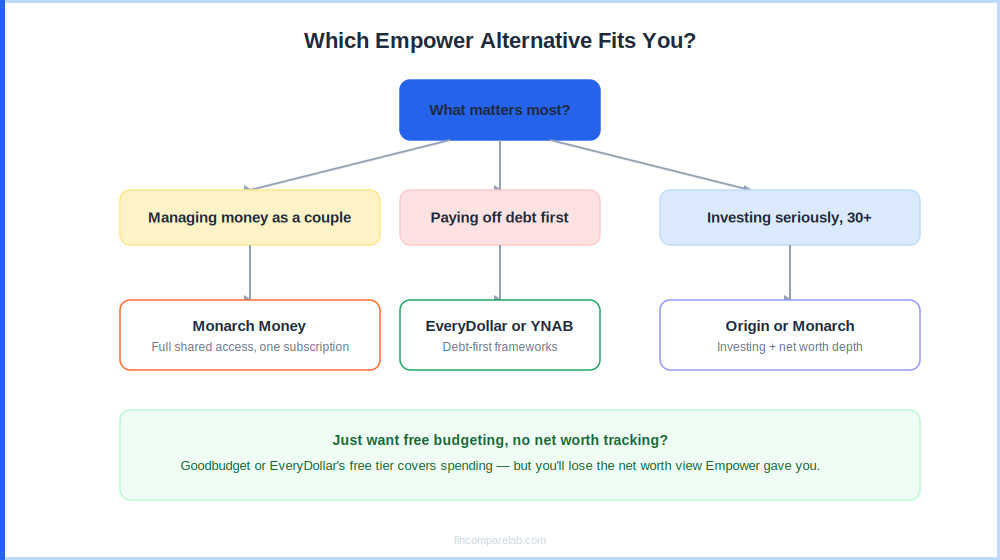
If cost is the hard constraint and you’re willing to give up investment tracking, Goodbudget’s free envelope tier and EveryDollar’s free manual plan both cover day-to-day spending at no cost. Neither shows a net worth number the way Empower does. My best free budgeting apps guide covers those options in more depth if that trade-off works for you.
Which Empower alternative is best for couples?
Monarch Money is the clearest couples pick among Empower alternatives, and among personal capital alternatives generally, since both partners get full shared access under one subscription rather than a bolted-on guest view.
If you specifically want more granular privacy controls — separate visibility per account rather than all-or-nothing sharing — Honeydue is worth a look too, though it comes with its own reliability caveats I cover in my best budgeting apps for couples guide.
Which Empower alternative works if you’re paying off debt?
None of the apps on this list are built primarily around debt payoff the way EveryDollar’s Baby Steps framework or YNAB’s zero-based system are. If debt elimination is your main goal right now, those two deserve a closer look first.
Run your numbers through my free debt payoff estimator — it’ll show how much runway you have before net worth tracking becomes the priority.
Which Empower alternative is best if you’re 30+ and investing seriously?
Origin Financial and Monarch Money are the two strongest Empower alternatives once investing becomes a bigger part of your financial life than day-to-day budgeting. Origin’s bundled CFP access and tax filing suit people who want fewer separate subscriptions; Monarch’s cleaner dashboard suits people who mainly want a better-looking, more current version of what Empower already does. Either beats sticking with Empower purely to avoid an advisory sales call.
If you’re managing alternative assets — rental property, a small business, significant equity compensation — neither app goes quite as deep as some dedicated wealth-tracking tools built specifically for that niche. For most dual-income households tracking retirement accounts, brokerage holdings, and a mortgage, though, Origin or Monarch covers the same ground Empower did, just without the advisory outreach attached.
What do people ask about switching from Empower?
A few quick answers below to the questions that come up most when people research Empower Personal Capital alternatives before switching.
Is Empower still worth using in 2026?
Yes, for the free dashboard specifically — Empower’s net worth tracking and investment checkup tools remain solid and cost nothing. The trade-off is the increased advisory outreach once your linked balances cross roughly $100,000–$250,000, which is the main reason people start comparing alternatives at all.
Is Empower the same company as Empower Finance?
No, and this trips a lot of people up. Empower (empower.com) is the net worth and investment dashboard covered in this guide.
Empower Finance was a separate cash-advance company, unrelated in ownership, that has since rebranded to Tilt. If you’re searching for cash advance alternatives, you want a different guide entirely.
Can I keep using Empower’s free dashboard alongside a budgeting app?
Yes, and plenty of people do exactly this. There’s nothing stopping you from keeping Empower’s free net worth tracker active for investment visibility while running your day-to-day budgeting through a dedicated app like YNAB, EveryDollar, or PocketGuard — you’ll just be managing two logins instead of one.
Why do people get advisory calls from Empower?
Empower’s free dashboard functions as a lead source for its paid wealth management arm, which charges 0.49%–0.89% of assets under management. Once your linked accounts show enough investable assets — user reports commonly cite a threshold around $100,000–$250,000 — outreach from the advisory team tends to increase noticeably.
How much does it cost to replace Empower with a paid app?
Expect somewhere between $47.88/year and $199.99/year depending on the app and plan — all cheaper than a 0.89% AUM fee on a mid-six-figure portfolio.
Quicken Simplifi’s current promo sits at the low end; Monarch Money’s Plus tier and Origin’s add-on services sit at the higher end.
Will I lose my account history when I switch from Empower?
Empower doesn’t offer a one-click export to competing apps, so switching means re-linking your accounts in the new app and losing Empower’s historical charts and trend data unless you screenshot or manually export what you want to keep first.
Are Empower alternatives safe to link my bank accounts to?
Yes, for the apps covered in this guide — Monarch, Origin, Copilot, Simplifi, Tiller, Albert, and PocketGuard all use Plaid or a comparable read-only aggregator, meaning none of them can move money out of your accounts.
Two-factor authentication is available on all of them, and none advertise selling user data to third parties. If privacy is your main reason for leaving Empower rather than the sales calls specifically, it’s still worth reading each app’s own privacy policy before connecting accounts, since “doesn’t sell data” and “doesn’t share data with partners” aren’t always the same claim.
What’s the best Monarch Money alternative if Monarch doesn’t fit either?
If Monarch’s cost or feature set doesn’t fit, my best Monarch Money alternatives guide covers a separate set of options matched to specific reasons people leave Monarch, including Empower itself for pure free investment tracking.
Whichever of these Empower alternatives you go with, the decision that matters most isn’t price — it’s whether you’re actually replacing what Empower did for you, or just replacing the app icon on your home screen.
