
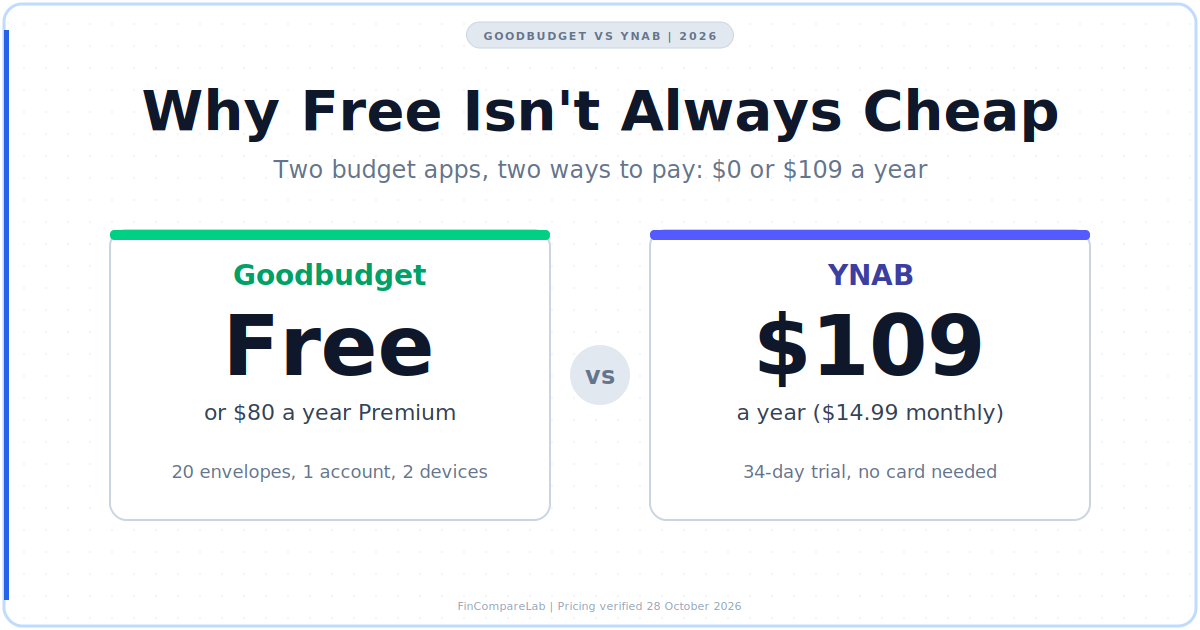
Goodbudget vs YNAB is a choice between typing your purchases yourself and paying $109 a year to skip most of that typing. Goodbudget has a free plan that never expires, and YNAB has a 34-day trial and then a bill. The cheaper app on paper is not always the cheaper one once you count the months you actually use it.
⚡ Quick Verdict
Goodbudget (free, or $80 a year for Premium) fits you if you want envelopes, no bank link and a $0 start. YNAB ($109 a year after 34 free days) fits you if you want imports and a method that makes you rebalance every week. Free stops being cheap when you quit, because a $109 prepay used for two months costs $54.50 per month of use.
How We Review Apps, Pricing verified from ynab.com and goodbudget.com — 28 October 2026
How Do Goodbudget and YNAB Compare at a Glance?
Goodbudget is free forever with 20 envelopes, one account and two devices, or $80 a year for Premium with US bank sync. YNAB costs $109 a year ($14.99 monthly) after a 34-day trial that needs no card. Both make you plan before you spend, but YNAB imports from banks on its only paid plan.
| Goodbudget | YNAB | |
|---|---|---|
| Price | Free, or $10/mo or $80/yr Premium | $14.99/mo or $109/yr ($9.08/mo) |
| Free plan | Yes, no time limit: 20 envelopes, 1 account, 2 devices, 1 year of history | No, 34-day trial only (365 days for college students) |
| Card for trial | Not needed | Not needed when you sign up direct |
| Method | Envelope budgeting | Zero-based budgeting |
| Getting transactions in | Type them, or upload a QFX, OFX or CSV bank file | Direct import from select US, Canada, UK and EU banks, file import, or type them |
| Automatic bank sync | Premium only, US banks, through Plaid | Included in the one paid plan, select banks |
| Sharing | 2 devices free, 5 on Premium | Up to 6 people on one subscription |
| Debt tools | Debt tracking on every plan | Integrated loan calculator |
| Refund | 30 days on Premium, by email | Unconfirmed as of 28 October 2026, nothing charged during the trial |
| FinCompareLab rating | 4.1/5 | 4.9/5 |
Pricing verified from official websites, October 2026.
That table shows sticker prices. It cannot show which app you will still open in month four, and that decides what you actually paid. The YNAB vs Goodbudget question is easier once you put numbers on staying versus quitting. Most Goodbudget vs YNAB comparisons stop at prices, so the next sections add cost per month of use, file import and a three-week test.
Why Isn’t Free Always Cheap in Goodbudget vs YNAB?
Free is cheapest on the invoice, not always in practice. A $109 YNAB year costs $9.08 a month if you use all twelve months and $54.50 a month if you quit after two. Goodbudget’s free plan costs $0 in cash, but every purchase you type costs time, and an abandoned setup wastes it.
Price per month of use is the number that matters. Divide a prepaid annual fee by the months you stay, and the cheap plan and the expensive plan swap places faster than most people expect. The chart runs both annual prices from one month to twelve.
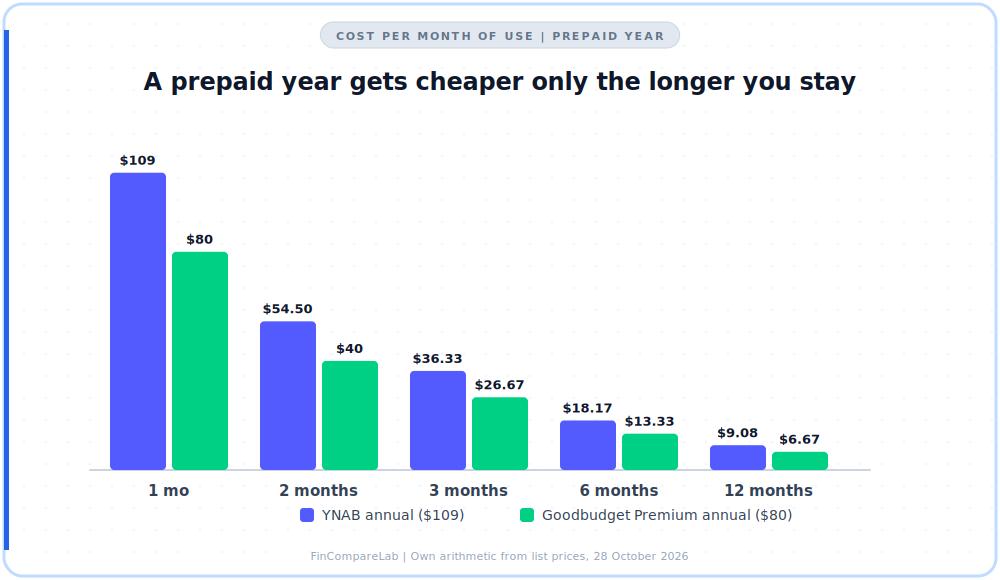
Effective monthly cost of a prepaid year by months actually used. Own arithmetic from list prices, 28 October 2026.
Two details soften the chart. YNAB’s 34-day trial needs no card when you sign up on its own site, so you can find out whether you will keep going before paying anything. Goodbudget refunds Premium if you email within the first 30 days. The real exposure is prepaying a year before you know.
Goodbudget free has a cost the chart cannot show. Say you log 60 purchases a month at 15 seconds each. That is 15 minutes a month and 3 hours a year, and at 150 purchases it is 7.5 hours.
Those figures are my assumptions, not measurements, so swap in your own purchase count. If your time is worth $15 an hour, 7.5 hours of typing is $112.50, about one YNAB year. YNAB still asks you to approve and categorize imports, so count only the typing it removes.
That is the sense in which free is not always cheap. Goodbudget free costs nothing while you keep logging, and it can cost more than it saves when you stop, because skipped weeks leave you rebuilding a month from bank statements. The free-plan file import covered below cuts that typing and shifts the math. That trade is the core of Goodbudget vs YNAB for anyone watching a tight budget.
How Can You Cap the Downside Before You Pay?
Start with trials and do not prepay. On YNAB, sign up on its site without a card and treat day 28 as your decision day, since YNAB says it sends a reminder one week before the trial ends. On Goodbudget, stay on the free plan until you hit a real limit such as a second account or bank sync.
If you do pay, YNAB’s monthly plan at $14.99 lets you leave without forfeiting prepaid months, and the annual plan saves about $71 over twelve months only if you stay. Plan-switching rules are unconfirmed as of 28 October 2026. Goodbudget Premium has the 30-day refund window, so decide inside it. A trial-first plan keeps the YNAB vs Goodbudget decision at $0 until you have evidence.
If you doubt you will keep any app up, a spreadsheet can outlast both, and this Google Sheets budget tracker versus apps comparison covers where a sheet wins. The best free budgeting apps list covers the other no-cost options.
What Does Goodbudget Cost Compared With YNAB Over Three Years?
Over three years at list prices, Goodbudget free costs $0, Goodbudget Premium $240 on annual billing, YNAB $327 and YNAB billed monthly $539.64. The paid-plan gap is $29 a year, so the real price decision is free versus paid, not one paid app versus the other.
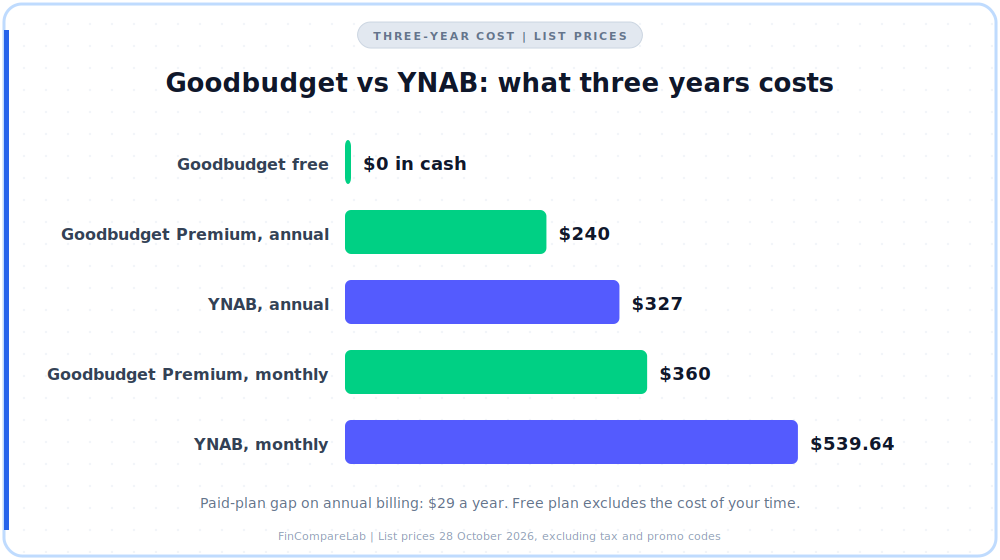
Three-year cost on list prices as of 28 October 2026. Tax and promo codes are excluded.
Premium billed monthly is $360 over the same three years, so annual billing saves $120 if you keep it. These totals assume list prices hold, which neither company promises. The YNAB pricing guide and the Goodbudget pricing guide track changes, and the Is YNAB worth it tool runs your own numbers.
Sharing changes the math. YNAB lets up to six people share one subscription, so a couple splitting $109 pays $54.50 each. Goodbudget Premium counts devices, five of them, and two phones can already share a budget on the free plan. The best budgeting apps for couples guide compares joint options beyond these two.
Goodbudget cost only becomes a real number if you need bank sync, more than one account or more than 20 envelopes. For a single checking account and a simple envelope list, the Goodbudget cost stays at $0 for as long as you use it. Over three years the Goodbudget vs YNAB spread runs from $0 to $539.64, and the Goodbudget cost on Premium is $87 below YNAB’s annual plan.
How Does Each App Get Your Transactions In?
Goodbudget free takes typed entries or an uploaded QFX, OFX or CSV bank file. Goodbudget Premium adds Plaid bank sync for US banks. YNAB imports directly from select US, Canadian, UK and EU banks, falls back to file import elsewhere, and accepts manual entry on its one paid plan.
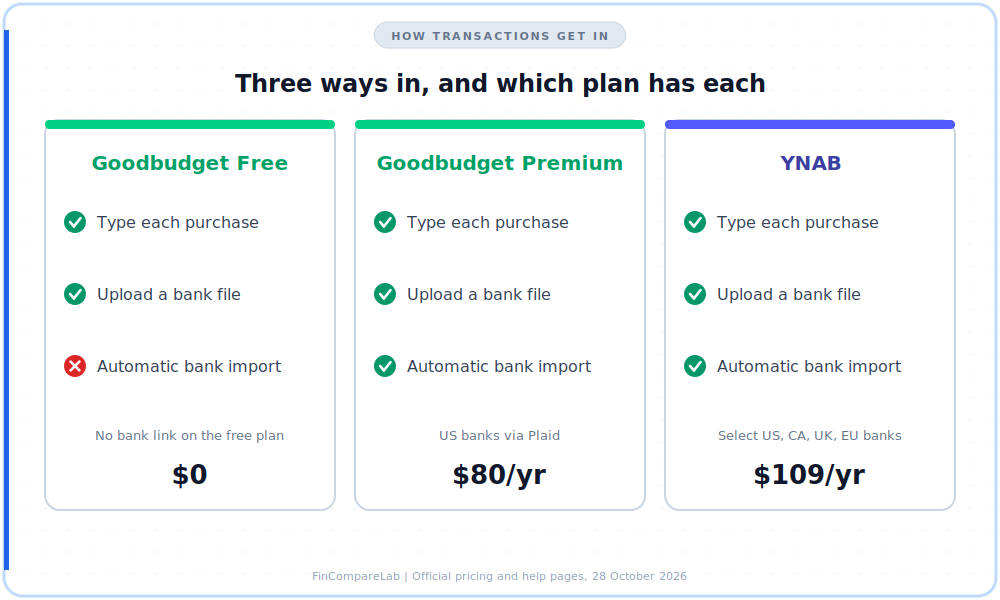
Entry methods by plan, from the official pricing and help pages, 28 October 2026.
Goodbudget’s free-plan import is the part several comparison pages skip, since they call the app entirely manual. Download your bank’s recent activity (not the monthly statement) as a QFX or OFX file, click the account in Goodbudget, choose Import bank transactions, upload the file and click Begin Import. CSV works for advanced users if your bank has no QFX or OFX option, per Goodbudget’s import help page.
Goodbudget describes the import as creating transactions from the file or matching them to ones you already entered. Uploading once a week turns 15 seconds per purchase into a few minutes per week. The catch is the one-account limit on the free plan, so you pick checking or a credit card, and Premium removes that limit.
Premium links accounts through Plaid for US banks, and synced transactions arrive as pending, then cleared, on the Need to Confirm screen. Goodbudget says banks decide how often Plaid receives new data, so timing varies by bank, as its bank sync help page explains. Some comparison pages wrongly say Goodbudget has no bank sync on any plan.
YNAB’s pricing page says direct import covers select banks in the US, Canada, the UK and the EU, with file-based import for everyone else. Credit cards are the usual stumbling block in YNAB vs Goodbudget entry. One App Store reviewer called YNAB’s credit card handling the least intuitive part, and YNAB’s reply said direct import and cards are being improved.
What Is YNAB Like After the First Month?
YNAB asks you to give every dollar a job when you are paid, then adjusts as imported transactions arrive. Expect a few hours of setup, a learning curve in month one and a routine of reviewing new transactions most days. One App Store reviewer describes the same setup time.
I used YNAB for 15 years, from 2011 until earlier this year, as strict zero-based envelopes. It earned its price while money was tight. Once my finances stabilized, daily reconciliation and the month-end YNAB dance of covering small overspends became busywork, and my YNAB review covers the full verdict.
Automation does not remove that chore, it moves it. Imports save typing, but you still approve transactions and move money when a category runs over. Shifting $60 out of dining because groceries ran over is the whole mechanism, and it is where the habit forms.
The method itself has changed. YNAB replaced the old four rules with a new framework, and the YNAB 4 rules explained guide covers what came next. New users can start with YNAB for beginners, and the zero-based budgeting guide shows what the method asks of you each week.
YNAB’s pricing page claims new users save $600 in the first month, but the average is YNAB’s own and the method is unpublished, so read it as marketing. Students get a 365-day trial through the College Program, covered in the YNAB for students guide. Debt payers get an integrated loan calculator, and the how to get out of debt fast guide shows how to pair it with a payoff plan.
Who Should Skip YNAB?
Skip it if you will not open the app most days, which is the main YNAB vs Goodbudget dividing line. Unapproved transactions stack up, and catching up after two weeks feels like homework. App Store reviewers also complain about frequent redesigns and the iPad layout, and YNAB tracks brokerage accounts manually, so net worth fans may prefer the YNAB vs Monarch Money comparison.
Goodbudget vs YNAB is easier to settle once you have watched your own habits for a few weeks, and the YNAB trial is the cheapest way to watch. A YNAB vs Goodbudget verdict after a month of real use beats any review, including this one.
What Is Goodbudget Like After the First Month?
Goodbudget is a digital cash-envelope app. You fund envelopes at the start of the month and record each purchase against one. Nothing links to your bank on the free plan, so what you see depends on what you log or upload.
Goodbudget vs YNAB details here come from its own pricing and help pages, store listings and community write-ups, and I have not run it through a full budget cycle. The Goodbudget review and the Goodbudget budget planner guide cover setup in more depth.
Ten regular and ten annual or goal envelopes cover most starter budgets. Rent, groceries, dining, transport, utilities, subscriptions, clothing, fun money and savings use nine of the 10 regular envelopes and leave the annual envelopes for car registration, holidays and similar. The best envelope budgeting apps list shows how other apps handle the same method.
Community write-ups keep returning to one theme, that manual entry builds awareness for some people and breaks the habit for others. A few skipped days turn into guessing from bank statements, which is why the weekly file upload matters. Reddit sits behind a login wall, so this rests on secondary summaries and is unconfirmed as of 28 October 2026.
Older reviews mention a Goodbudget Plus plan, but the signup page now lists Free and Premium only. The Goodbudget cost is $10 a month or $80 a year for Premium, which adds bank sync, unlimited envelopes and accounts, 5 devices, 7 years of history and email support. Goodbudget free keeps debt tracking, so the free plan can still hold a snowball payoff. Searches for good budget vs YNAB usually mean this same app.
Goodbudget free costs nothing to try, so the Goodbudget cost question only starts at Premium. If you want a zero-based app with a free tier instead, the EveryDollar review and the best zero-based budgeting apps list cover those.
Which App Is Better for Couples, Android Users and Privacy?
YNAB is better for couples who want one plan shared with up to six people. Goodbudget is better if you want no bank link at all, though its Google Play rating trails its App Store rating by more than a point. Neither stays private once you link a bank.
Which Is Better for Couples?
YNAB’s App Store listing says one subscription shares unlimited plans with up to six people, with real-time updates between devices. Goodbudget shares a budget across 2 devices on the free plan and 5 on Premium, so partners see the same envelopes. For couples, Goodbudget vs YNAB comes down to sharing rules and devices. The best budgeting apps for couples guide covers apps built for joint money.
Which Works Better on Android?
Goodbudget’s Google Play rating runs 3.2 to 3.4 across third-party trackers on about 19,000 reviews, against 4.6 on the App Store, and both are unconfirmed on the store pages as of 28 October 2026. YNAB’s Play rating is unconfirmed, so the Android edge is unclear. Read the recent Play reviews before paying, and see the Goodbudget review for the stability complaints.
Which Is More Private?
Goodbudget free has no bank link, so there is no aggregator to trust. Premium uses Plaid, and YNAB says it earns money only from subscriptions and does not sell your data, which is the company’s own statement on its security page. The Monarch Money safety guide shows what to check in any aggregator-based setup.
Can You Use Both Goodbudget and YNAB?
Yes, but only briefly. Running both means entering or approving the same purchase twice, and one app always goes stale. A one- or two-week overlap while you switch is useful, and anything longer is double work. Using both is rarely the answer in Goodbudget vs YNAB.
Start the new app on the first day of a month, enter opening balances for each envelope or category, and leave old history behind. I took that clean-break route moving from YNAB to Monarch. I did not import my YNAB CSVs because credit-card transfer anomalies would have wrecked the cash-flow reports, and the old files stayed archived. My Monarch Money review covers that move.
Goodbudget accepts CSV files for advanced users, but whether a YNAB export maps cleanly is unconfirmed as of 28 October 2026. Going from Goodbudget to YNAB has less to lose, since a few months of envelope history rarely justifies an import. Either way, expect to start clean.
If neither app fits after a trial, the best YNAB alternatives list is the next stop. Specific head-to-heads include Goodbudget vs PocketGuard, YNAB vs PocketGuard, EveryDollar vs YNAB, YNAB vs Simplifi and Actual Budget vs YNAB.
Which App Should You Pick?
Pick YNAB if you want imports and will check in most days. Pick Goodbudget if free, envelopes or no bank link matter most. If you cannot tell, run both trials in sequence at $0 and start with Goodbudget free, because the habit is the real test. That rule settles most YNAB vs Goodbudget debates in three weeks.
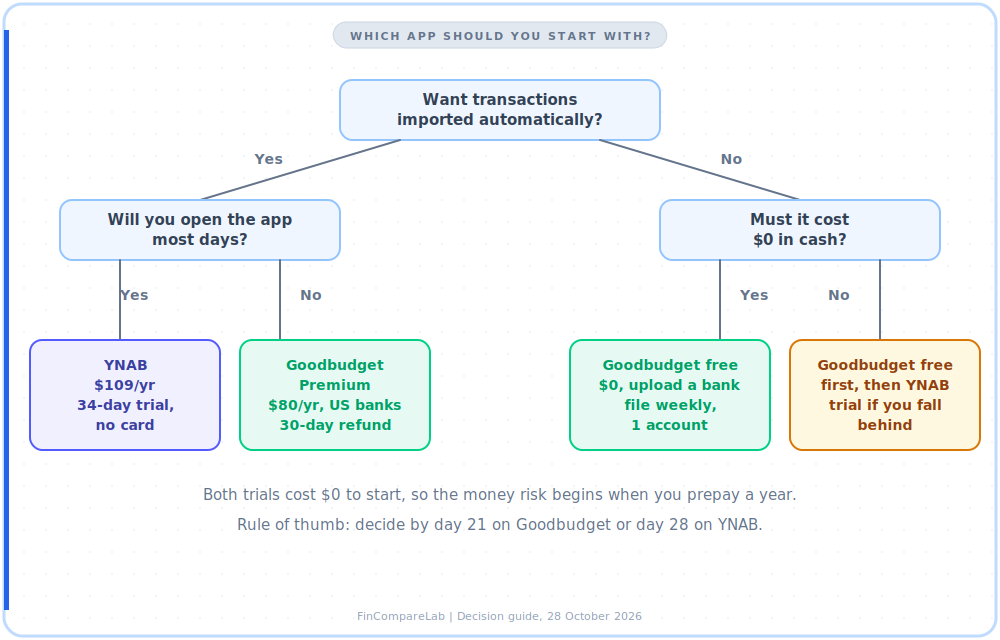
Start with the question about automatic imports. Rule of thumb, not an app benchmark.
Choose YNAB if…
- You want transactions imported from your bank
- You will open the app most days
- You are working through a debt payoff plan
- Your income swings, per the budgeting on irregular income guide
- You are a college student with a free year
- You share money with a partner or family
Choose Goodbudget if…
- Free is non-negotiable right now
- You do not want a bank link on the free plan
- You like the envelope method in the best envelope budgeting apps list
- You will upload a bank file weekly
- You are on iPhone more than Android
- You are starting out, per the best budgeting apps for beginners guide
Three-week Goodbudget test: in week 1, create nine regular envelopes plus a few annual ones and log every purchase the same day. In week 2, upload one bank file and fix mismatches. In week 3, count the days you logged within 48 hours.
If you logged fewer than 15 of the 21 days, start the YNAB trial, because import removes the exact chore that slipped. That threshold is my rule of thumb, not an app benchmark.
Young adults and first-job budgeters can also check the best budgeting apps for young adults guide before choosing.
What Else Do People Ask About YNAB vs Goodbudget?
People mostly ask about free limits, bank sync, spelling and refunds, and the answers below come from each company’s own pages.
Is Goodbudget Free Forever?
Yes, Goodbudget’s free plan has no time limit and needs no card. It includes 10 regular envelopes, 10 annual or goal envelopes, 1 account, 2 devices, 1 year of history and debt tracking.
Bank sync, unlimited envelopes and accounts, 5 devices and 7 years of history need Premium at $10 a month or $80 a year. Goodbudget free is a real plan, not a trial, and the limits are listed on its signup page.
Is YNAB Worth It Over a Free App Like Goodbudget?
It is worth it if you will open the app most days and want imports, and not worth it if you would quit by month two. YNAB’s own pricing page claims new users save $600 in the first month, but the method is unpublished, so treat it as marketing.
Use the 34-day trial to find out, and run the Is YNAB worth it tool on your own numbers before you prepay.
Good Budget vs YNAB: Is Good Budget the Same App as Goodbudget?
Yes, good budget is a common spelling of Goodbudget, the envelope app at goodbudget.com. Searches for good budget vs YNAB land on this same comparison, and every price here applies either way.
The app itself is spelled as one word, so the Goodbudget review and pricing guide use that spelling.
Does Goodbudget Connect to Your Bank?
Only on Premium. The free plan has no bank link, and Premium syncs US banks through Plaid, as the signup page lists.
Some comparison pages say Goodbudget has no bank sync on any plan, which is out of date. Free users can upload QFX, OFX or CSV files instead of typing.
Which Is Better for Beginners, Goodbudget or YNAB?
Goodbudget is the lower-risk start because it costs $0 and sets up in an afternoon. YNAB suits beginners who will check in most days, since its method teaches more but asks more.
Beginners who want a wider shortlist can read the best budgeting apps for beginners guide before picking.
Can You Get a Refund on Goodbudget Premium or YNAB?
Goodbudget Premium has a 30-day refund if you email its refunds address within the first 30 days. YNAB charges nothing during its 34-day trial when you sign up directly.
YNAB’s refund terms after the trial are unconfirmed as of 28 October 2026, so check its cancellation page before prepaying a year.
What Should You Do Next?
Pick one trial and set its reminder today. Goodbudget free needs no card, and YNAB’s 34 days need none either when you sign up on its site, so the first decision costs $0. Revisit the numbers after week three, when you know which chore you actually kept. Goodbudget vs YNAB is a $0 decision for the first month.
Then compare the winner against the best free budgeting apps if it does not stick.
📚 Read Next
