
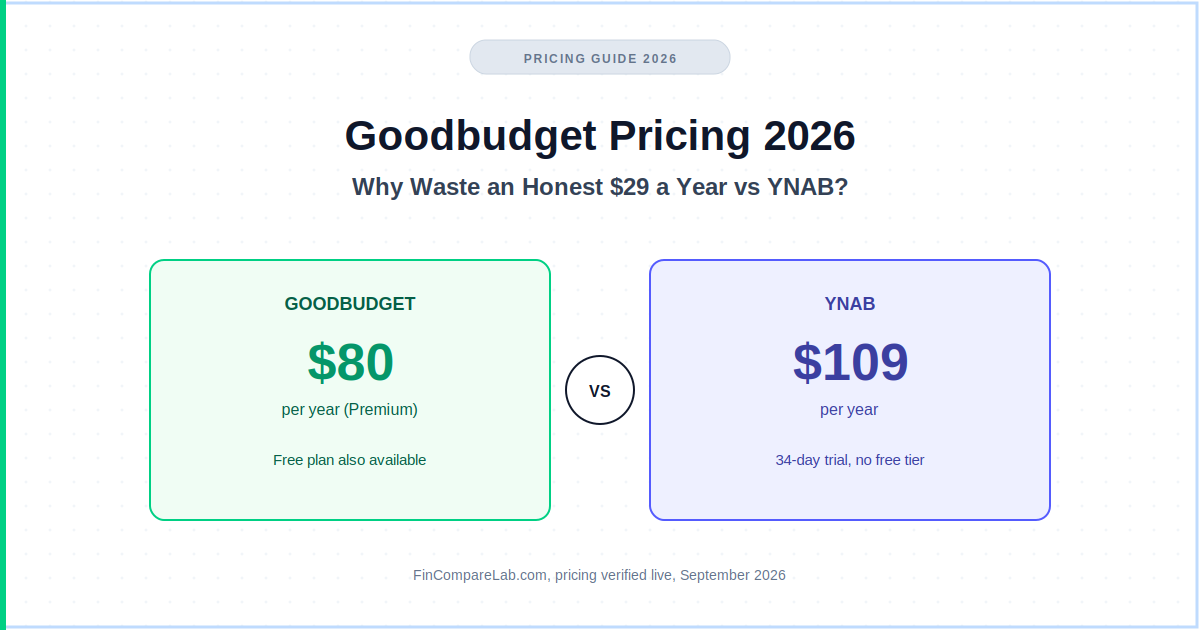
Goodbudget pricing in 2026 comes down to two real options: free forever, or $80 a year for Premium, which lands $29 cheaper than YNAB while still keeping a free tier YNAB doesn’t offer at all.
⚡ Quick Answer
Goodbudget pricing is $0 forever on the free plan (20 envelopes, 1 account, 2 devices) or $10/month ($80/year) for Premium (unlimited envelopes and accounts, automatic bank sync, 7 years of history). That’s $29 less per year than YNAB’s $109, and unlike YNAB, the free tier never expires. A 30-day refund applies if Premium isn’t the right fit. Pricing verified live from goodbudget.com/signup on 6 September 2026.
How We Review Apps · Pricing verified from goodbudget.com — 6 September 2026
📋 In This Guide
- How much does Goodbudget pricing cost in 2026?
- What’s the real difference between Goodbudget free and Premium?
- Is Goodbudget free?
- What happened to the Goodbudget Plus plan?
- Is Goodbudget Premium worth it?
- Is the $29 Goodbudget vs YNAB savings worth it?
- How does Goodbudget compare to EveryDollar and other envelope apps?
- What are the real limits of Goodbudget’s pricing model?
- What’s Goodbudget’s refund policy?
- What do people ask about Goodbudget pricing?
How Much Does Goodbudget Pricing Cost in 2026?
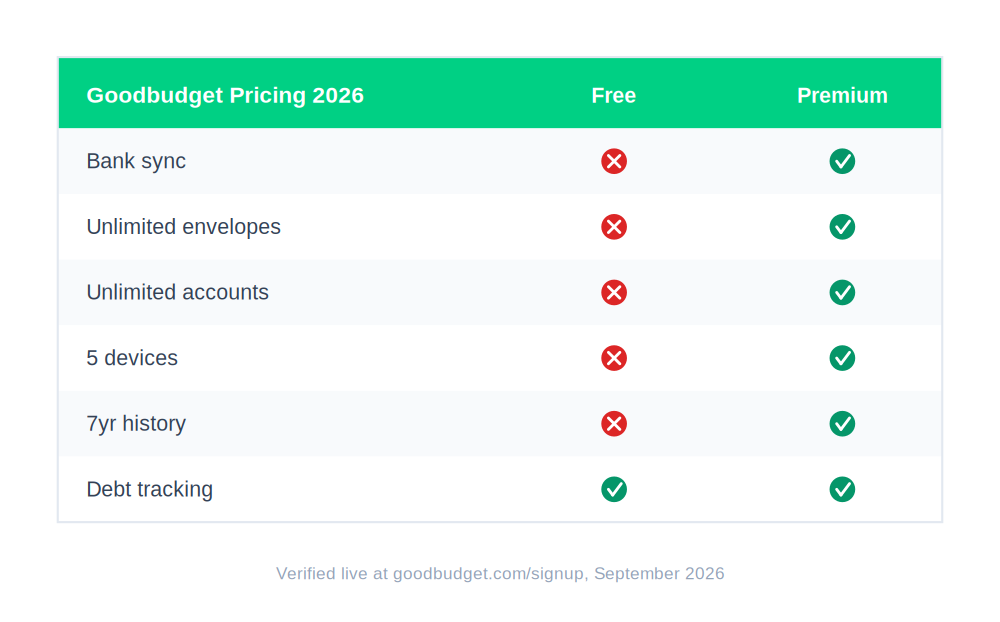
Goodbudget pricing has exactly two tiers in 2026: free forever, or Premium at $10/month or $80/year. Free gives you 20 envelopes, 1 account, and 2 devices. Premium adds unlimited envelopes and accounts, automatic bank sync, and 7 years of transaction history.
I checked this directly against Goodbudget’s own signup page rather than carrying over a number from an old draft, since Goodbudget pricing is exactly the kind of figure that goes stale fast. As of 6 September 2026, the numbers on goodbudget.com/signup still match what’s on the help center: nothing has moved.
One structural change worth flagging: Goodbudget quietly retired its standalone /pricing/ URL. The site’s own “Pricing” nav link now routes straight to the signup page, which is also where the plan comparison lives. If you’ve bookmarked the old page, update it.
| Free | Premium | |
|---|---|---|
| Price | $0 forever | $10/month or $80/year |
| Total envelopes | 20 (10 regular + 10 annual/goal) | Unlimited |
| Financial accounts | 1 | Unlimited |
| Devices | 2 | 5 |
| Transaction history | 1 year | 7 years |
| Bank sync | Manual entry only | Automatic (US banks only) |
| Support | Community forum | Email support |
Goodbudget pricing verified live at goodbudget.com/signup on 6 September 2026.
How Much Does Goodbudget Cost Per Month?
Goodbudget cost per month is either $0 on the free plan or $10 on Premium, billed monthly. If you pay annually instead, that same Premium plan works out to $6.67 a month, which is the number you’ll see people quote even though there’s no separate $6.67 plan to sign up for.
Paying monthly instead of annually costs an extra $40 a year for the identical feature set. If you’re confident you’ll stick with Goodbudget past the first year, the annual plan is the better deal outright.
One quirk worth flagging: Apple’s App Store listing for Goodbudget has historically shown in-app purchase price points that don’t line up cleanly with the website, including older Plus-era tiers alongside the current Premium pricing. Goodbudget’s own signup and billing help page is the authoritative source for the current plan structure. If you subscribe through the iOS app instead of the website, double-check the exact price shown before confirming, since Apple’s in-app purchase catalog doesn’t always stay in sync with a developer’s current plan names.
What’s the Real Difference Between Goodbudget Free and Premium?
Four things separate Goodbudget free from Premium: automatic bank sync, envelope limits, account limits, and transaction history length. Bank sync is the one that actually changes daily behavior; the other three are ceilings you either hit or don’t.
I’ll go through these in the order they actually matter to a real budget, not the order Goodbudget Premium’s own marketing page lists them in.
1. Bank sync. Free users type in every transaction by hand, or import a bank file manually. Premium users connect through Plaid, and transactions land in Goodbudget within 1 to 3 days of clearing.
If you know you won’t keep up with manual entry once life gets busy, this is the upgrade that actually solves that problem. Some long-time free users prefer entering everything by hand precisely because it forces a habit that auto-sync quietly lets slide.
2. Envelope count. Free caps out at 20 total (10 regular, 10 annual/goal). For a single person or a couple running a fairly standard household budget, that’s rarely the limiting factor. Premium removes the cap entirely, which matters more for households tracking a lot of separate savings goals at once.
3. Account count. Free supports exactly one financial account. This is the cap that actually forces most upgrades. The moment you’re tracking a checking account and a credit card, or a joint account and a personal one, the free plan can’t represent your real financial picture anymore.
4. Transaction history. Free keeps 1 year; Premium keeps 7. After your first 12 months on free, older transactions start dropping off. If you care about year-over-year spending comparisons, that’s a real limitation, not a minor one.
Is Goodbudget Free?
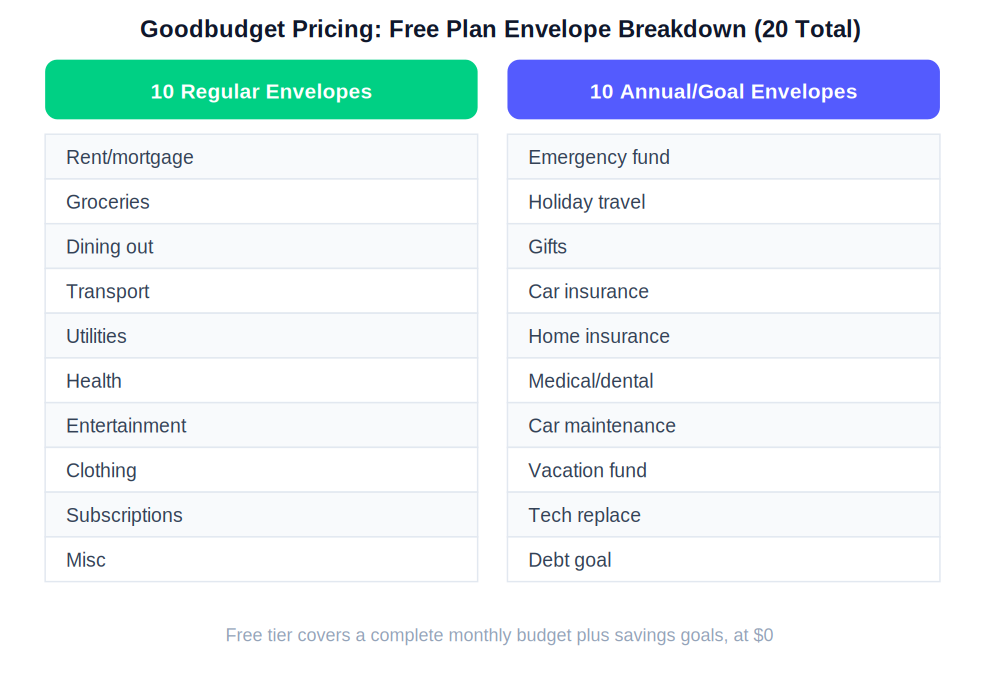
Genuinely, yes. The free plan never expires, requires no credit card, and includes 20 real envelopes plus debt tracking. The honest caveat is the one-account limit, which is the single most common reason free users eventually upgrade, not the envelope cap most reviews focus on.
Most comparisons stop at “the free plan has 20 envelopes,” which undersells it. Twenty envelopes covers a full monthly budget: rent, groceries, transport, utilities, dining, and subscriptions. Ten more annual or goal envelopes cover things like insurance premiums, holiday spending, and an emergency fund. That’s a genuinely complete household budget on a $0 plan.
Where the free plan actually breaks down is the single account restriction. If your spending only ever touches one checking account, you’ll likely never need Premium at all. If you’re juggling a checking account and a credit card, or you and a partner keep separate accounts, the one-account cap turns into a wall fast, and no amount of clever envelope naming fixes that.
It’s also worth knowing that the free plan never connects to your bank at all. That’s a real privacy advantage some people actively prefer, not just a missing feature: your login credentials never leave your head. It’s part of why the answer to is Goodbudget free holds up so well even after you dig past the marketing page.
What Happened to the Goodbudget Plus Plan?
Goodbudget Plus is discontinued for new signups. New users only ever see Free and Premium today. Existing Plus subscribers keep their plan indefinitely with no forced migration, though the only real capability Premium adds over old Plus pricing is automatic bank sync.
If you’ve seen “Goodbudget Plus” mentioned in an older review or a forum thread and can’t find it on the current signup page, that’s why. Goodbudget Plus wasn’t quietly folded into Premium; Goodbudget kept the legacy plan running for people already on it while pointing every new signup toward Premium instead.
Is Goodbudget Premium Worth It?
At $80 a year, Goodbudget Premium is worth it specifically if bank sync or a second financial account is what’s actually holding you back, not as a blanket upgrade. If neither applies to your situation, the free plan already does the job.
Here’s who tends to get real value from Goodbudget Premium at $80/year, broken down by the actual trigger rather than a generic “if you want more features” answer:
- You spend across more than one account, whether that’s checking plus credit card or two people’s separate accounts
- Manual entry keeps slipping, and you’ve noticed real gaps building up in your transaction log
- You’re budgeting with a partner and need more than 20 categories or more than 2 shared devices
- You want more than a year of history to compare spending year over year
- You’d rather email a real person than post in a community forum when something breaks
And here’s who is genuinely better off staying free: single-account budgeters who don’t mind typing transactions in, anyone testing envelope budgeting before committing money to it, and international users, since Premium’s headline feature (automatic bank sync) only works with US banks through Plaid.
Does Goodbudget Offer a Free Trial?
A Goodbudget free trial in the traditional sense doesn’t exist. Goodbudget doesn’t run a time-limited trial the way YNAB or Monarch Money do. Instead, there’s a permanent free tier you can use indefinitely, plus a 30-day refund window on Premium if you subscribe and decide it’s not for you.
In practice, that refund window functions like a trial with no expiration pressure: you can use every Premium feature for a full month, and if bank sync or the extra accounts didn’t change anything for you, email [email protected] and get your money back.
Is the $29 Goodbudget vs YNAB Savings Worth It?
Goodbudget Premium costs $29 less per year than YNAB ($80 vs. $109), and Goodbudget’s free tier never expires where YNAB only offers a 34-day trial. The savings are real, but YNAB’s stricter zero-based system and deeper reporting are what you’re giving up to get them.
I’ve used YNAB myself for over a decade, so I know exactly what that extra $29 buys: a rule that forces every dollar into a job the moment it hits your account, tighter credit card handling, and reporting that goes several layers deeper than Goodbudget’s. Any honest goodbudget vs ynab comparison has to admit that price alone doesn’t settle it: whether that gap is worth $29 a year to you depends entirely on whether you actually want that level of rigidity, or whether the looser envelope method is closer to how you naturally think about money.
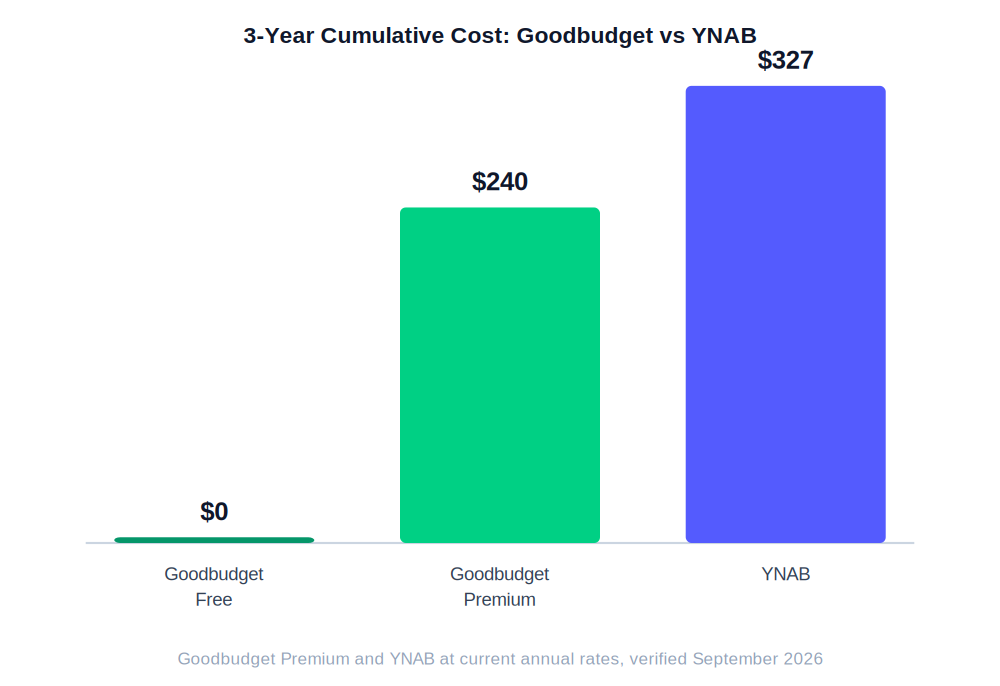
Over three years, the gap compounds to $87 between Goodbudget Premium and YNAB’s annual plan, which is real money but not a dramatic one. If you’re choosing purely on price, Goodbudget wins outright, especially with its free tier as a genuine fallback YNAB doesn’t offer.
I re-verified YNAB’s own pricing page, since YNAB’s annual rate has shifted before. As of this write-up it still lists $109/year or $14.99/month, which matches the $29 gap used throughout this guide.
For the full feature-by-feature breakdown, including how each app handles irregular income and credit cards, see the complete YNAB vs Goodbudget comparison. If you’re still deciding whether YNAB’s price is worth it in the first place, the YNAB ROI calculator runs the numbers against your own spending, and YNAB’s full pricing guide covers its own plans, including the free year available to students.
How Does Goodbudget Compare to EveryDollar and Other Envelope Apps?
Goodbudget and EveryDollar sit at nearly identical price points ($80/year vs. $79.99/year), both with usable free tiers built around manual entry. The real difference is philosophy: EveryDollar follows Dave Ramsey’s Baby Steps framework directly, while Goodbudget stays framework-neutral and works outside the US.
If Ramsey’s debt-payoff method is already how you think about money, EveryDollar‘s built-in coaching and debt-free date calculator add real value on top of budgeting. If you want the envelope method without a specific philosophy attached, or you need an app that works for international users, Goodbudget is the more neutral choice. Run a goodbudget vs everydollar comparison purely on price and they land within a penny of each other; the real decision is philosophy, not cost.
Against the wider field of envelope-style budgeting apps, Goodbudget’s combination of a genuinely free forever tier and a sub-$100 Premium plan is still one of the more competitive setups available. The best envelope budgeting apps roundup covers how it stacks up against the full field, not just EveryDollar.
How Much Is Goodbudget on the App Store?
Goodbudget app cost on iOS shows as “Free, with in-app purchases,” and its Google Play listing is currently rated 4.7 out of 5 from about 19,200 reviews, last updated 7 August 2026. Apple’s App Store shows 4.6 out of 5 from roughly 13,000 ratings.
The in-app purchase prices you’ll see inside the iOS app itself don’t always match the website’s current $10/month or $80/year figures exactly, since Apple’s IAP catalog can lag behind a developer’s live pricing page. If the number in the app looks different from what’s on goodbudget.com/signup, trust the website: that’s the source Goodbudget’s own help center points to first.
What Are the Real Limits of Goodbudget’s Pricing Model?
No plan here is flawless, and it’s worth being direct about where Goodbudget’s pricing model actually falls short rather than presenting it as a clean win over every alternative.
No investment or net worth tracking, on any plan. Goodbudget is a pure envelope budgeting tool at every price point. If you want to see investments and cash flow in the same dashboard, Monarch Money at $99.99/year or the free Empower app cover that; upgrading Goodbudget never will, no matter how much you pay.
The one-account cap is a harder wall than the marketing suggests. Goodbudget’s own materials lead with the envelope count, but in practice the single-account restriction on the free plan is what actually forces most upgrades, not running out of envelope slots.
A brief Android availability gap in 2025. Goodbudget’s Android app was temporarily pulled from Google Play in some countries after a Play Store billing-policy dispute, according to Goodbudget’s own blog. That’s been resolved: the Play Store listing is live, actively updated, and sitting at a healthy 4.7-star rating as of this write-up. It’s a reasonable data point if platform stability matters to you, but not a current, ongoing issue.
Refund routing depends on where you subscribed. If you subscribed through the Apple App Store or Google Play, Goodbudget can’t process your refund directly. You’d need to go through Apple or Google’s own refund process instead, which is a real extra step people miss until they’ve already tried emailing Goodbudget first.
What’s Goodbudget’s Refund Policy?
Goodbudget offers a full refund within 30 days of starting a Premium subscription, but only for subscriptions started directly on goodbudget.com. Email [email protected] to request one; partial refunds aren’t available once the window closes.
Think of the 30-day window as a built-in, no-pressure trial of Premium: long enough to actually connect a bank account and see whether automatic sync changes your habits, rather than guessing from a feature list. That’s the real reason the fairest answer on Goodbudget pricing, specifically whether Premium is worth it, depends so heavily on your own habits rather than a one-size-fits-all verdict.
Still deciding? The free budgeting apps comparison covers every zero-cost alternative worth knowing about if you want to rule out paying anything at all, and the free debt payoff estimator works fine alongside either Goodbudget plan.
What Do People Ask About Goodbudget Pricing?
How much does Goodbudget pricing cost in 2026?
Goodbudget’s free plan never expires. Premium costs $10/month or $80/year, which works out to $6.67/month if you pay annually. There’s no other paid tier for new signups; the old Plus plan is closed to new users. Verified live from goodbudget.com/signup on 6 September 2026.
Is Goodbudget really free?
Yes, genuinely free forever with no credit card required. The free plan includes 20 envelopes, 1 account, 2 devices, 1 year of history, and debt tracking. The main things missing are automatic bank sync, extra accounts, more devices, and longer history.
What’s the real difference between Goodbudget free and Premium?
Four things: automatic bank sync (Premium only, via Plaid), envelope limits (20 vs. unlimited), account limits (1 vs. unlimited), and transaction history (1 year vs. 7 years). Both plans include debt tracking and spending reports.
Is Goodbudget Premium worth it?
At $80/year, it’s worth it if you spend across multiple accounts, want automatic bank sync instead of manual entry, or need more than a year of transaction history. It’s not worth upgrading if you’re outside the US, since bank sync only supports US banks, or if a single account already covers your spending.
How does Goodbudget pricing compare to YNAB?
Goodbudget’s free plan costs $0; YNAB has no permanent free tier, only a 34-day trial. Goodbudget Premium is $80/year versus YNAB’s $109/year, a $29 annual gap, though YNAB offers a full free year for students with a valid .edu email.
What happened to the Goodbudget Plus plan?
Plus is discontinued for new signups; new users only see Free and Premium. Existing Plus subscribers can stay on that plan indefinitely. The main gap between Plus and Premium was always automatic bank sync, which Plus never included.
Is Goodbudget safe to use?
Yes. Goodbudget uses bank-grade encryption and doesn’t sell user data to third parties. The free plan is particularly low-risk since it never connects to your bank at all, so no login credentials are ever shared. Premium subscribers connect through Plaid’s read-only infrastructure, the same system used by YNAB and Monarch Money, which can’t move money or modify your accounts.
📚 Read Next
- Goodbudget Review 2026, Full Hands-On Assessment
- YNAB vs Goodbudget 2026, Full Comparison
- Goodbudget vs PocketGuard 2026, Full Comparison
- EveryDollar Review 2026, The Other Free Envelope App
- YNAB Pricing 2026, Plans, Student Discount and Free Trial
- Best Envelope Budgeting Apps 2026
- Free Debt Payoff Estimator, Works Alongside Goodbudget
Full disclosure →
