
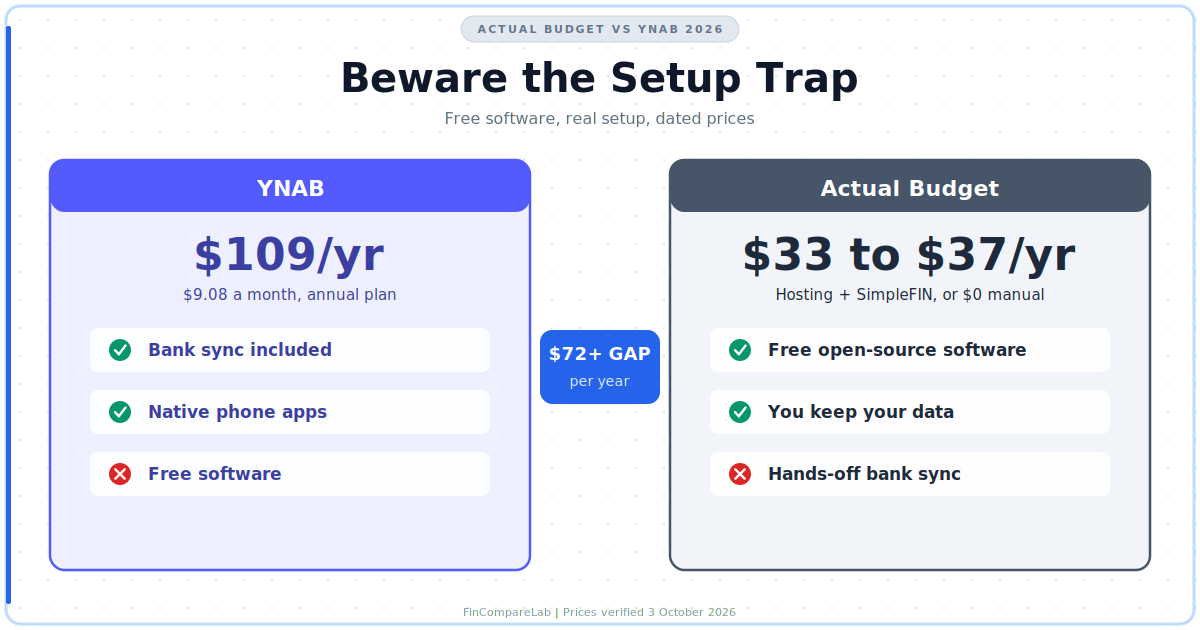
Actual Budget vs YNAB comes down to $109 a year for a guided app versus roughly $33 to $37 a year for a free app you set up yourself.
⚡ Quick Verdict
Pick YNAB for built-in bank sync, native phone apps and a method that works on day one. Pick Actual Budget if a few hours of setup is worth $72 to $76 a year, or $94 on your own server. The price gap in actual budget vs ynab is real, but credit card bookkeeping, imports and bank refresh limits cost more time than the subscription.
How We Review Apps, Pricing verified from ynab.com, actualbudget.org and pikapods.com — 3 October 2026
What’s in this comparison
- What Is the Real Difference in Actual Budget vs YNAB?
- How Much Does Each App Cost per Year?
- Why Is Actualbudget vs YNAB Such a Common Search?
- Does Actual vs YNAB Come Down to the Budgeting Method?
- Who Wins YNAB vs Actual for Bank Syncing?
- What Does Switching From YNAB to Actual Budget Involve?
- Which App Is Better on Phones and Across Devices?
- Which App Fits Beginners, Couples, Irregular Income and Debt Payoff?
- What Do Forum Users Say About Moving From YNAB to Actual?
- Can You Use Both YNAB and Actual Budget?
- Which Should You Pick in YNAB vs Actual Budget?
- What Else Do People Ask Before Choosing Between These Apps?
What Is the Real Difference in Actual Budget vs YNAB?
In Actual Budget vs YNAB, the difference is who does the work. YNAB charges $109 a year and handles bank sync, apps and support. Actual Budget is free, open-source software where you add hosting, bank sync and setup yourself, which brings the real cost to roughly $33 to $37 a year.
Both apps run the same core loop. Every dollar you have gets a category before you spend it, which is why moving from YNAB to Actual Budget feels familiar. The split shows up in the places where YNAB quietly does something for you and Actual hands you the controls.
My own 15 years were on YNAB (2011 through earlier this year), and my switch went to Monarch Money, not Actual. Every Actual detail below comes from its official documentation, dated where the source is older. Unconfirmed items carry the date they were checked.
Price gets the headlines. Credit card bookkeeping, import side effects and bank refresh limits cost people more hours. Those three get full sections here, because most comparisons stop at the subscription fee. For the single-app deep dives, see my YNAB review and my Actual Budget review.
Both lean on the same idea, so a primer helps if the method is new to you. My guide to zero based budgeting explains the logic, and the best envelope budgeting apps roundup shows where each of these two sits among its peers. The rest of this actual budget vs ynab comparison stays on what differs.
How Much Does Each App Cost per Year?
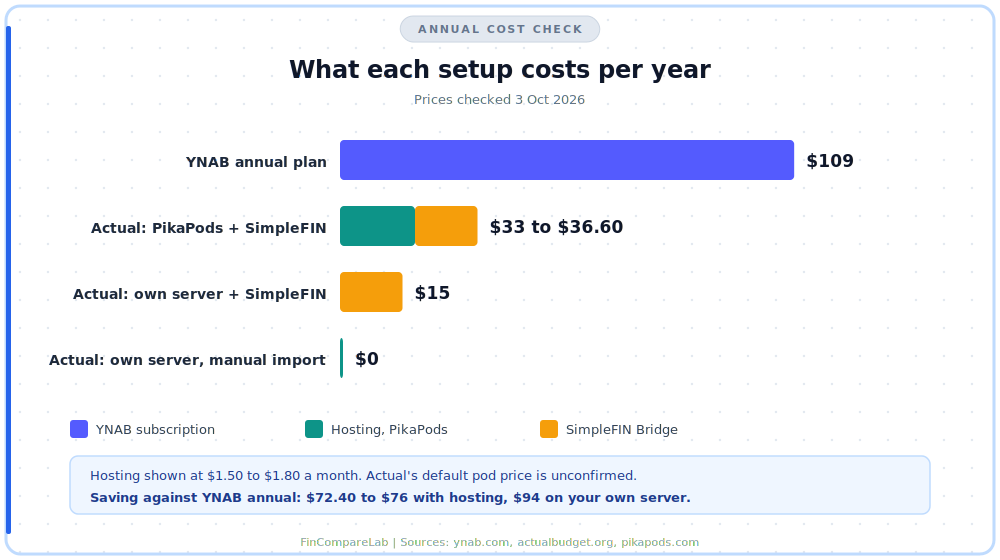
YNAB costs $109 a year on the annual plan, which is $9.08 a month, or $14.99 a month if you pay monthly. Actual Budget’s software costs $0, and the realistic add-ons are PikaPods hosting at about $1.50 to $1.80 a month plus SimpleFIN Bridge at $15 a year. Those are the numbers behind every ynab vs actual cost comparison, taken from ynab.com/pricing and the Actual docs.
| Setup | Software | Hosting | Bank sync | Yearly total |
|---|---|---|---|---|
| YNAB annual plan | $109 | Included | Included | $109 |
| Actual on PikaPods plus SimpleFIN | $0 | $18 to $21.60 | $15 | $33 to $36.60 |
| Actual on your own server plus SimpleFIN | $0 | Your hardware | $15 | $15 |
| Actual on your own server, manual imports | $0 | Your hardware | $0 | $0 |
Pricing verified from ynab.com, actualbudget.org and pikapods.com, 3 October 2026. Actual’s default pod price is unconfirmed.
The two hosting figures come from two sources. Actual’s own PikaPods guide says about $1.50 a month as of November 2025, while the live PikaPods homepage starts at $1.80 a month for new pods. The exact price of the default Actual pod is unconfirmed as of 3 October 2026, so the range stays a range.
Against the annual plan, hosted Actual saves $72.40 to $76 a year. Against YNAB’s monthly plan, which runs $179.88 a year, the gap is more than $140. That second number is the same monthly-versus-annual trap covered in my YNAB pricing guide.
Over three years, YNAB costs $327. Hosted Actual costs about $99 to $110 over the same stretch. PikaPods also gives new accounts a $5 welcome credit, which its docs say covers roughly three months, so year one lands a little lower.
The actualbudget vs ynab price gap is the same whichever spelling you search. A fair ynab vs actual budget price check counts hosting and sync, not just the license.
Time has a price too. Say setup takes four hours in year one, which is an assumption and not a measurement. That hidden time cost sits inside every actual budget vs ynab price comparison.
At $72.40 saved, you come out ahead only if an hour of your time is worth about $18 or less. From year two the saving mostly holds if maintenance stays near zero. My is YNAB worth it calculator lets you run that math with your own numbers.
Is Actual Budget Really Free?
The software is free and open source under the MIT license, but most people end up paying for hosting and bank sync. Your own computer or server removes the hosting fee, and manual CSV imports remove the sync fee.
So is Actual Budget free in practice? Only if you accept the manual route. The hosted subscription Actual once sold shut down in 2024, so any hosted Actual price quoted from before then is stale. If you want a feature-by-feature view of what free buys, the best free budgeting apps list puts it next to its peers.
Why Is Actualbudget vs YNAB Such a Common Search?
People type actualbudget vs YNAB as one word because the project’s site lives at actualbudget.org. The same one-word spelling is where trouble starts, since search results and app stores also surface similarly named apps that the Actual project did not build.
An unaffiliated iOS app with a near-identical name charges its own fees and is not the open-source project. Actual’s own FAQ lists the official native mobile apps as deprecated, so a store icon is not the supported route either. The breakdown of how to tell the real project from the lookalike sits in my Actual Budget review.
Expect lookalikes if you type ynab vs actual into an app store.
For this comparison, treat the official site as the only starting point. Both buttons below go through site links, and the Actual one resolves to actualbudget.org. If you ever see a price for Actual in an app store, that is a different product. Whichever spelling you use for actualbudget vs ynab, the same two cost lines apply: hosting and bank sync.
Does Actual vs YNAB Come Down to the Budgeting Method?
No. In actual budget vs ynab, both apps run envelope-style budgeting where you only assign money you actually have. The differences sit in how each app books credit cards, measures goals and treats unassigned cash.
That is why actual vs YNAB feels like a change of tools, not of habits, and why people who know YNAB understand Actual quickly. The label differs, with YNAB calling its method zero-based and Actual calling it envelope budgeting, but the habit is the same. If you want the method itself, the YNAB four rules explain it, and the best zero based budgeting apps page shows who else runs it.
How do the two apps handle credit cards differently?
YNAB moves money into a credit card payment category automatically as you spend, while Actual treats a card as an account holding negative dollars. Both end with the same budget total, but the bookkeeping path differs. In YNAB vs Actual bookkeeping terms, that matters most when you carry a balance.
Take a $60 grocery swipe. In YNAB, Groceries drops $60 and $60 moves into the card payment category. In Actual, Groceries drops $60 and the card account shows -$60, so paying the card later lets positive and negative dollars cancel without touching the budget. This comes from the Actual FAQ and its own YNAB comparison.
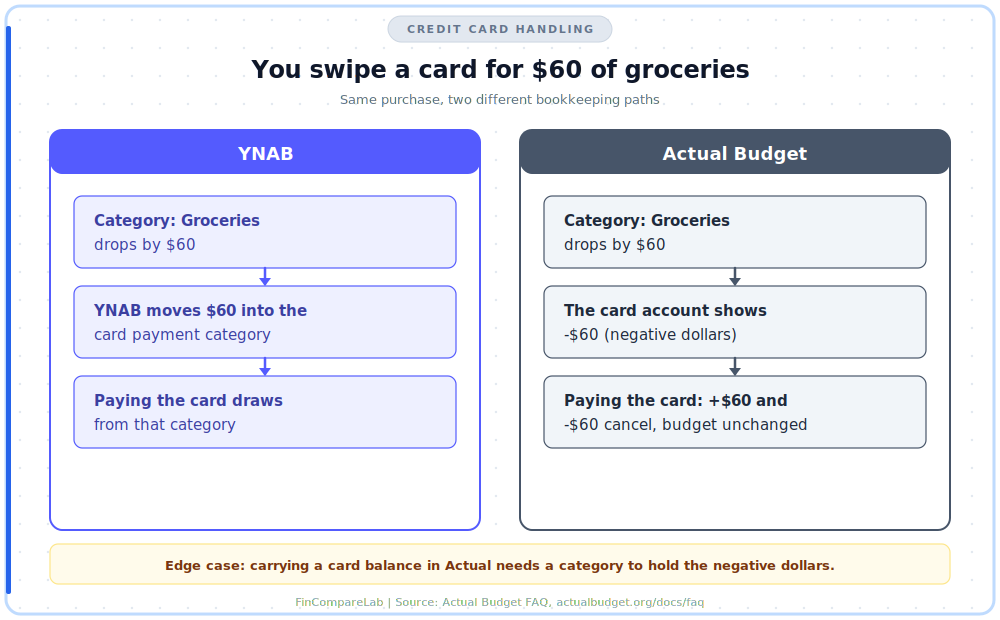
The edge case is a card balance you cannot pay off yet. Actual assumes you can clear any card in full at any time. If you carry debt, you need a category that holds the negative dollars so they do not eat your budget. Set that up before you rely on the numbers, not after the first month looks wrong.
How do goals and transaction rules differ?
Actual shows a goal as met or not met each month, while YNAB tracks progress against a total. Actual’s rules can modify far more than YNAB’s payee rules, and Actual also has a traditional non-envelope budget. These points come from Actual’s July 2024 comparison, so confirm current behavior in both apps before relying on them.
The monthly goal reset is the one people argue about. It is clearer if you like a fresh scoreboard each month and harsher if you fell behind in March. Actual is also local-first, so you can open your budget offline, while YNAB needs its web service. Either way, the budgeting with irregular income guide shows how monthly goals behave when pay is uneven.
One honest warning from 15 years of YNAB. What wore me down was the month-end dance of covering small overspending, not the method. Actual uses the same envelope logic, so that chore comes with you. If that routine is why you want out, a forward-looking app like Monarch Money is the real fix, and my YNAB vs Monarch comparison covers it.
Who Wins YNAB vs Actual for Bank Syncing?
YNAB wins on convenience. Its bank import is built in and runs through Plaid, while Actual relies on SimpleFIN Bridge for US banks, which costs $15 a year, refreshes about once a day and pulls at most 90 days of history.
That daily refresh changes how you use the app. Transactions appear the next day, not the moment you swipe, so Actual suits a weekly sit-down better than in-the-moment capture. In YNAB vs Actual terms, YNAB feels live, and Actual feels like a ledger you reconcile.
Sync is where actual budget vs ynab gets decided for most people.
The setup sequence is specific. Create a SimpleFIN Bridge account and subscribe at $1.50 a month or $15 a year before your first bank connection. Generate a one-time setup token, then in Actual choose Add account and Link bank account with SimpleFIN. Client and server must both be on version 24.10.0 or higher, per the SimpleFIN setup docs.
A first-time tip from the Actual FAQ saves reconciliation pain. Skip historical data. Create the account with the correct opening balance on a recent date, then connect the bank, so only transactions after that date sync. Starting with old history is the fastest way to a budget that never reconciles.
The free route is manual import of CSV or OFX files, which costs nothing and takes longer. If automatic sync is non-negotiable and you also want investments in view, look at the best YNAB alternatives instead, since several of them bundle sync into one price.
What Does Switching From YNAB to Actual Budget Involve?
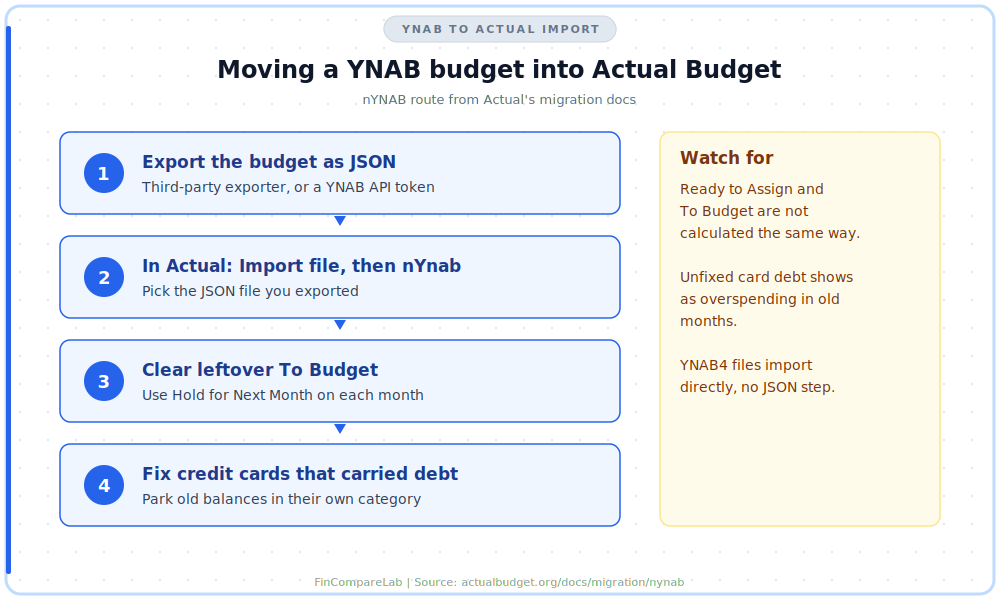
Switching means exporting your YNAB budget as JSON, importing it into Actual with the nYnab option, then cleaning up what the import changes. Expect to fix leftover To Budget amounts and any credit card that carried debt. Plan for cleanup, not a one-click move. The YNAB vs Actual cleanup list is short but specific.
Can You Import YNAB Into Actual Budget?
Yes. Actual officially supports importing both nYNAB, the current YNAB, and YNAB4 budgets. YNAB4 files import directly, while nYNAB needs a JSON export first, per the nYNAB migration docs.
- Export your budget as JSON, either with a third-party exporter the Actual docs link to or with a YNAB personal access token and one API request.
- In Actual, choose Import file and then nYnab, and select the JSON file.
- Open each imported month and use Hold for Next Month to clear leftover To Budget, which exists because nYNAB counts future-month funds in Ready to Assign.
- Fix every credit card that carried debt into the import, or old months will show overspending.
The trade-off sits in step one. The third-party exporter is easiest, but you authorize an outside tool against your YNAB account and Actual does not maintain it. The API token route avoids that and needs a command line request. Pick based on how much you trust a tool you cannot audit.
History is optional. When I left YNAB for Monarch Money, I skipped importing the YNAB CSV history and started clean with only the prior month’s balances, because years of credit card transfers would have distorted the new cash-flow reports. Actual’s importer carries history, so the credit card cleanup above is the same distortion in another form. If you never look at ten-year-old months, a clean start is a legitimate choice.
Anyone weighing actual budget vs ynab should price the cleanup hours, not just the subscription. Keep your YNAB data and subscription alive until the first month-end closes in Actual. The YNAB pricing guide shows how monthly billing makes a short overlap cheaper than it looks, and the YNAB for students page covers the free year if you qualify.
Which App Is Better on Phones and Across Devices?
YNAB is better on phones because it has native iOS and Android apps with real-time sync across devices. Actual’s official native apps are deprecated, so you install its responsive web app to your home screen as a Progressive Web App.
Does Actual Budget Have a Mobile App?
Not an officially supported native one. Actual’s FAQ calls the official mobile apps deprecated and recommends installing the web version to your home screen, while community members maintain unofficial native clients.
The PWA works, but it behaves like a website with an icon. Syncing between devices needs a server for Actual, where YNAB has it built in, so the server has to be reachable from your phone. If yours sits at home, that is one reason managed hosting appeals to people who budget from their phone.
If you budget mostly on your phone and want the least friction, YNAB vs Actual is not close on this one point.
In ynab vs actual budget, phone use is the clearest YNAB win, and actual vs YNAB on mobile is where most readers decide. My YNAB for beginners guide covers the phone workflow in detail, and the YNAB vs Copilot comparison shows what a more polished iPhone-first app looks like.
Which App Fits Beginners, Couples, Irregular Income and Debt Payoff?
YNAB fits beginners and anyone who wants support. Actual fits people who already understand envelope budgeting, want to keep their data and accept setup work. Couples, irregular earners and debt payoff each shift the balance a little, and life stage often matters more in actual budget vs ynab than the feature list does.
Is YNAB or Actual Budget better for beginners?
YNAB is the safer start. It has a 34-day trial with no card, a coach directory, and a free program for eligible college students. Actual leans on documentation and community help, which suits people who enjoy solving setup problems. A first-time budgeter who gets stuck at the hosting step may quit before the budget starts.
For a beginner, ynab vs actual budget is mostly a question of support. If you are starting from scratch with no strong preference, the YNAB for beginners walkthrough and the best budgeting apps for beginners list are better first stops than either app’s settings.
Which app works better for couples?
YNAB lets up to six people share one subscription, which is simple. Actual supports multiple devices through its sync server, so the person who runs the server becomes the household IT desk, so for couples YNAB vs Actual is partly an IT question. If one partner is far more technical than the other, that matters more than the price gap.
For a wider look at shared-budget tools, see the best budgeting apps for couples roundup.
Which app handles irregular income and debt payoff better?
Both apps budget the money you have right now, so a late client payment does not break either budget. For debt, actual budget vs ynab turns on whether you want the app to plan payoff, and YNAB has an integrated loan calculator. A WalletHub comparison says Actual has no debt payoff plans, which is unconfirmed against Actual’s own docs as of 3 October 2026.
If payoff planning is the goal, pair either app with the debt payoff estimator and read the how to get out of debt fast guide. The best free debt tracker apps list covers dedicated trackers. If net worth tracking matters more than envelopes, the best net worth tracking apps are a better fit than either of these.
What Do Forum Users Say About Moving From YNAB to Actual?
In a Bogleheads thread from earlier this year, the recurring verdict is that Actual works almost exactly like YNAB and costs far less. At least one user prefers its reporting to YNAB’s. Others describe a self-hosted setup that uses SimpleFIN for bank imports.
One user moved after a bank dropped support for the Quicken file exports that had been feeding YNAB4, and kept twelve years of history. Another argues an open-source tool is less exposed to the growth pressure they say squeezed YNAB. That is the YNAB vs Actual Budget debate in one line: price and control against polish.
The thread is a small sample of the actual vs YNAB conversation, so treat it as direction, not proof. It matches the docs, which put hosting and bank imports on you. For a wider set of options than these two, my Goodbudget review and YNAB vs Goodbudget comparison cover another envelope-style app with a free tier.
Can You Use Both YNAB and Actual Budget?
Yes, for a trial period. The two apps do not sync with each other, so run them in parallel for one billing cycle by importing or entering the same transactions into both. YNAB’s 34-day trial needs no card, so the overlap costs nothing if you are not already a subscriber. In actual budget vs ynab, a parallel run is the cheapest test there is.
Judge the overlap by behavior, not feeling. Count the minutes of your weekly session in each app. Note whether the one-day SimpleFIN lag annoyed you, and whether the credit card bookkeeping made sense by the second week. Do not cancel YNAB until the first month-end closes in Actual, and keep your JSON export as a backup.
Long-term double entry is a waste, since actual vs YNAB is a choice and not a pairing. If you would rather drop both apps for a spreadsheet, Tools Without Code compares Google Sheets budget trackers against apps.
Which Should You Pick in YNAB vs Actual Budget?
Pick YNAB if setup time is worth more to you than about $72 a year, and pick Actual if you are comfortable with hosting and weekly reconciliation. The decision in YNAB vs Actual Budget is mostly about who you want doing the maintenance work. Searchers weighing actualbudget vs ynab usually want one number, and the honest one is a range.
Choose YNAB if
You budget from your phone, want bank sync that just works, or share one budget with a partner who does not want to touch a server. The $109 a year (about $9 a month) buys time back.
Choose Actual Budget if
You already know envelope budgeting, accept a weekly reconcile, and want your data on hardware you control. Plan on $33 to $37 a year for hosting plus sync, or $0 if you import by hand.
Skip both if your real complaint is the daily reconciliation. The best Monarch Money alternatives and the Tiller Money review cover tools built around different habits, and my EveryDollar vs YNAB piece covers a free-to-start rival.
Before you commit, price your own year with the YNAB ROI calculator, then run a one-month parallel test. If hosting feels like a chore on day one, that is your answer.
What Else Do People Ask Before Choosing Between These Apps?
These are the questions that come up after the main comparison.
Is there a clear winner between the two apps?
Not universally. In ynab vs actual budget, YNAB wins on convenience, native apps and built-in bank sync. Actual Budget wins on price and data ownership. Which one is right depends on whether a few hours of setup is worth about $72 to $76 a year to you.
What does Actual Budget cost after the first year?
Expect a steady yearly cost of about $33 to $37 with managed hosting plus SimpleFIN Bridge at $15 a year. PikaPods gives new accounts a $5 welcome credit, so year one can run a little lower. Actual’s default pod price is unconfirmed as of 3 October 2026.
Where does Actual Budget store my data?
Actual is local-first, so your budget lives on your own device, with an optional sync server that you host or rent. PikaPods describes Actual as supporting end-to-end encryption for sync. Bank connections run through SimpleFIN Bridge, which is a separate paid service.
Does YNAB have a free tier?
No. YNAB has a 34-day free trial with no credit card required, then $109 a year or $14.99 a month. It also runs a free program for eligible college students.
Can Actual Budget import from apps other than YNAB?
Actual officially supports importing from YNAB4 and nYNAB. Its community-repos page lists unofficial tools for sources such as Mint, MoneyMoney and Financier. Those tools are not maintained by the Actual project.
Does Actual Budget have a debt payoff planner?
A third-party comparison from WalletHub says Actual has no debt payoff plans, while YNAB has an integrated loan calculator. That claim is unconfirmed against Actual’s own documentation as of 3 October 2026. Tracking debt with categories works in both apps.
The next useful step in actual budget vs ynab is a real number, not another comparison table. Open the app you are leaning toward, enter one month of transactions, and see how it feels by the second week.
📚 Read Next
