

Comparing Goodbudget vs PocketGuard usually comes down to one blunt question: do you want a budgeting app that costs nothing, ever, or one that costs at least $74.99 a year with no free option left at all? Whether you found this page searching goodbudget vs pocketguard or pocketguard vs goodbudget, these five honest truths cover what actually separates them, past the marketing pages.
⚡ Quick Verdict
Goodbudget
Best for envelope budgeting, couples, tight budgets, and anyone who doesn’t want to hand over bank credentials. Free forever, no trial clock, no expiry.
PocketGuard
Best for automatic tracking and one real-time safe-to-spend number. No free plan at all as of September 2026, just a 7-day trial, then $74.99/year minimum.
Neither app is “better” outright. They solve opposite budgeting problems, and the right pick depends on whether you want to plan spending or just watch it happen.
How We Review Apps · Pricing verified from goodbudget.com and pocketguard.com — 9 September 2026
📋 In This Comparison
- What Are the Key Differences Between Goodbudget and PocketGuard?
- How Does Goodbudget vs PocketGuard Pricing Actually Compare in 2026?
- Honest Truth #1: Is Goodbudget Really Free Forever, and Is PocketGuard Really Not?
- Honest Truth #2: Do Goodbudget and PocketGuard Even Solve the Same Problem?
- Honest Truth #3: Why Are the Paid Plans Priced Almost Identically?
- Honest Truth #4: Is Bank Sync More Reliable on Goodbudget or PocketGuard?
- Honest Truth #5: Which App Do People Actually Stick With?
- Can You Use Goodbudget and PocketGuard Together?
- Which App Should You Use?
- Which One Should You Pick?
- What Do People Ask About Goodbudget vs PocketGuard?
What Are the Key Differences Between Goodbudget and PocketGuard?
Goodbudget is manual, envelope-based budgeting that’s free forever. PocketGuard is automatic spend tracking with no free tier as of this update, starting at $74.99/year. One asks you to plan money before you spend it; the other tells you what’s left after you already have.
Searches for goodbudget vs pocketguard, or “which is better goodbudget or pocketguard,” usually assume there’s a single winner. There isn’t. The two apps sit at opposite ends of the budgeting spectrum, and picking wrong means paying for automation you don’t need, or grinding through manual entry when what you actually wanted was a number that updates itself.
| Goodbudget | PocketGuard | |
|---|---|---|
| Approach | Manual envelope budgeting | Automatic spend tracking |
| Free plan | ✅ Free forever, confirmed 9 Sep 2026 | ❌ None on the live pricing page, 7-day trial only |
| Paid plan | $10/mo or $80/yr | $12.99/mo or $74.99/yr |
| Lifetime option | ❌ Not offered | $149.99 one-time |
| Bank sync | Premium only, US banks only | ✅ All plans, US & CA |
| Couples / shared | ✅ Shared envelopes, 5 devices | ❌ Separate accounts required |
| FinCompareLab rating | 4.1/5 | 4.3/5 |
How Does Goodbudget vs PocketGuard Pricing Actually Compare in 2026?
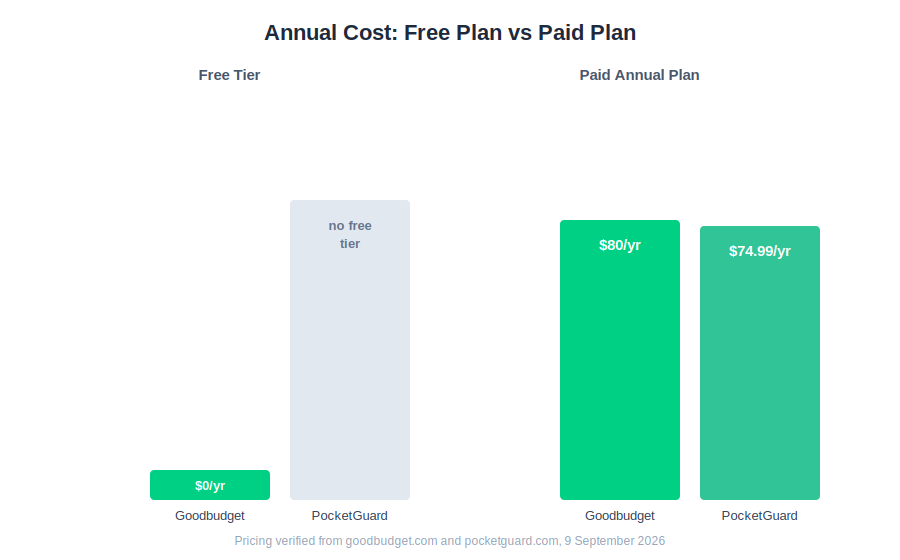
On paid plans, Goodbudget and PocketGuard are nearly identical: $80/year versus $74.99/year, about $5 apart. The real gap is the free tier. Goodbudget’s has never changed. PocketGuard’s disappeared from the pricing page entirely sometime this year.
To settle goodbudget vs pocketguard pricing for good, I re-verified both pricing pages directly on 9 September 2026 rather than trusting last quarter’s screenshots, and neither app’s paid pricing moved. Goodbudget’s own signup page still lists Premium at $10/month or $80/year. PocketGuard’s pricing page still shows its Yearly/Monthly/Lifetime toggle at $74.99/year ($6.25/month), $12.99/month standalone ($155.88/year), or $149.99 once, no subscription.
Does Goodbudget Have a Free Plan?
Yes. If you’ve searched is good budget free (sometimes typed as two words instead of the app’s actual one-word name, Goodbudget), the answer is the same either way: it hasn’t changed in years. Goodbudget’s free tier gives you 20 total envelopes (10 regular, 10 goal-based), 1 linked account, access on 2 devices, and 1 year of transaction history, with manual entry only. There’s no expiry date and no feature countdown.
Does PocketGuard Have a Free Plan?
If you’re asking is pocketguard free right now, the honest answer is not anymore, at least not on the current pricing page. As of this September’s live check, pocketguard.com/pricing shows only a 7-day free trial before billing starts, with no separate free tier listed at all. Older App Store and Google Play listings once described a narrow 2-account, 2-category free version, and some third-party reviews from earlier in the year still reference it, but the app’s own marketing has moved on to trial-only messaging.
| Goodbudget | PocketGuard | |
|---|---|---|
| Monthly | $10/month | $12.99/month |
| Annual | $80/year (~$6.67/mo) | $74.99/year (~$6.25/mo) |
| Lifetime | ❌ Not available | $149.99 one-time, web checkout only |
| What paid adds | Unlimited envelopes/accounts, 5 devices, 7 years history, bank sync, email support | Debt payoff planner, savings goals, transaction rules, priority support |
Here’s the part most goodbudget vs pocketguard comparisons skip: if you genuinely can’t or won’t pay for a budgeting app right now, this isn’t a close call. Goodbudget’s free plan works for real budgeting indefinitely. PocketGuard requires a card and a subscription (or the trial clock) to use with any confidence, which settles the free-vs-paid half of this decision before you even get to features.
Honest Truth #1: Is Goodbudget Really Free Forever, and Is PocketGuard Really Not?
Yes to both halves of that question, and it’s the single biggest reason people end up running a goodbudget vs pocketguard comparison in the first place. Goodbudget’s free envelope system has stayed intact through years of the company’s own pricing changes elsewhere, while PocketGuard has visibly moved away from offering any no-cost path at all.
Anyone still asking is goodbudget free in 2026 can stop wondering, it is, but that doesn’t mean Goodbudget’s free plan is unlimited in practice. Twenty envelopes sounds like plenty until you’re budgeting rent, four utility bills, groceries, two car payments, and a handful of subscriptions separately, at which point you’re consolidating categories or paying $80/year for the unlimited version anyway. The free plan is genuinely free, just not infinitely flexible.
Honest Truth #2: Do Goodbudget and PocketGuard Even Solve the Same Problem?
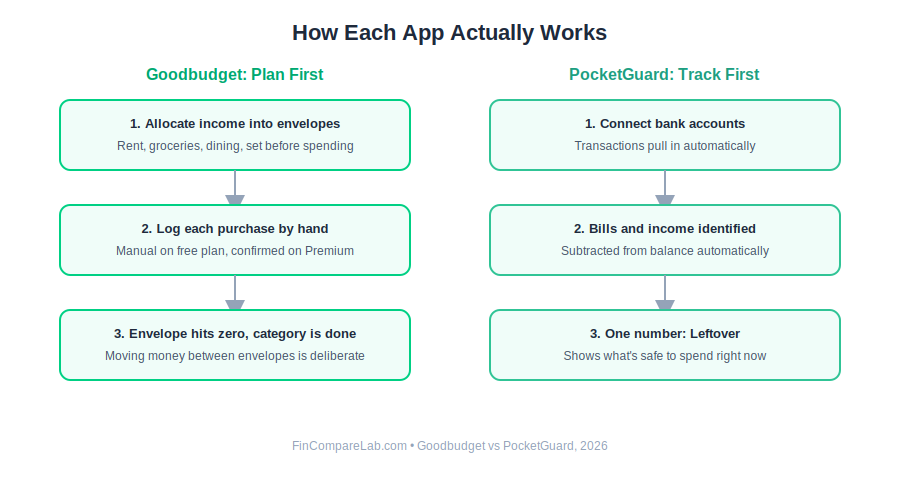
Not really, and this is the part most goodbudget vs pocketguard writeups gloss over. Goodbudget is a planning tool: you allocate income into envelopes before you spend, and manual entry is the whole point. PocketGuard is a tracking tool: it pulls in transactions automatically and shows you one number, Leftover, telling you what’s safe to spend right now.
Goodbudget’s mechanics: at the start of each pay period, you divide your income across envelopes like Rent, Groceries, and Dining. Every purchase gets logged against an envelope by hand, on the free plan, or automatically categorized after a Plaid sync on Premium, though you still confirm the envelope assignment yourself. When an envelope hits zero, that category is done for the period. Moving money between envelopes is possible but deliberate, which is the friction that makes envelope budgeting work for people who’ve tried and abandoned passive trackers before.
PocketGuard’s mechanics: connect your accounts, and PocketGuard identifies recurring bills and income, subtracts them from your balance, and surfaces one figure. No envelopes, no monthly allocation ritual, no manual confirmation step required unless you want one. For someone drowning in spreadsheet columns, that single number is the entire appeal.
The philosophical split explains most of the confusion in “which is better” searches, whether you type it as pocketguard vs goodbudget or the other way around: they’re not competing for the same user. Someone who thrives on YNAB’s zero-based method will likely prefer Goodbudget’s proactive structure over PocketGuard’s reactive one, and vice versa.
Honest Truth #3: Why Are the Paid Plans Priced Almost Identically?
Because both apps compete against the same mid-tier budgeting price band, roughly $75 to $110 a year, that also includes Goodbudget Premium, PocketGuard Plus, and cheaper alternatives like EveryDollar. The $5.01/year gap between them is small enough that pricing alone rarely decides a goodbudget vs pocketguard purchase.
This is where a goodbudget vs pocketguard price comparison gets more useful than a bare number. What actually differs is what that money buys. Goodbudget’s $80/year unlocks unlimited envelopes, 5 devices, and 7 years of history, features that matter most to households actively managing a shared budget long-term.
PocketGuard’s $74.99/year unlocks a debt payoff planner, savings goals, and transaction rules, features that matter most to someone consolidating scattered accounts into one dashboard. You’re not paying for “more budgeting,” you’re paying for a different kind of budgeting.
One number worth sitting with on the pocketguard vs goodbudget cost question: PocketGuard’s Lifetime option at $149.99 pays for itself against the annual plan in just under two years. If you’re confident PocketGuard’s approach fits how you think about money, the lifetime purchase is the better long-run math, though it’s sold only through PocketGuard’s own web checkout, not as an iOS in-app purchase.
Honest Truth #4: Is Bank Sync More Reliable on Goodbudget or PocketGuard?
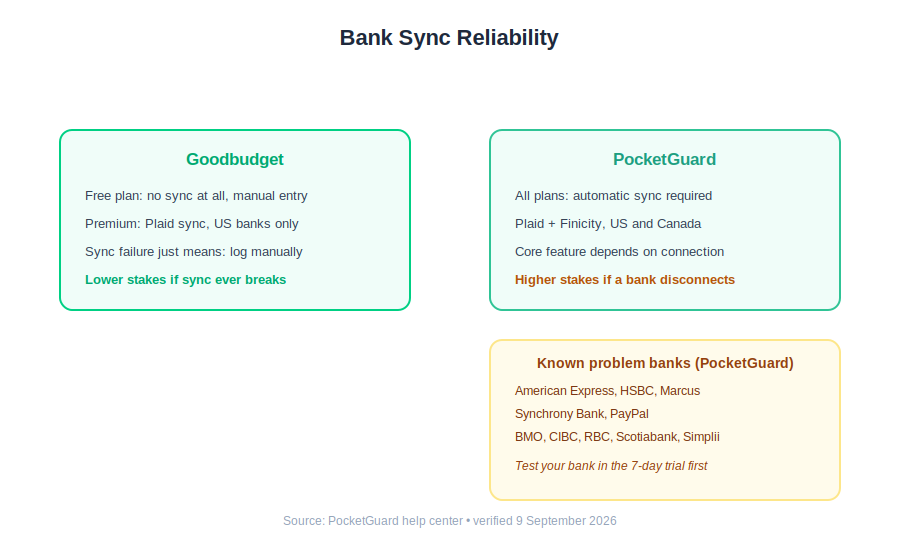
On the goodbudget vs pocketguard bank-sync question, neither app has flawless connectivity, but Goodbudget’s free plan sidesteps the problem entirely by not syncing at all. PocketGuard depends on bank connectivity for its core feature, which means its documented sync issues carry more weight than Goodbudget’s occasional Premium hiccups.
Does PocketGuard Have Bank Sync Problems?
Yes, and PocketGuard’s own help center acknowledges it directly rather than burying the issue. The company maintains a public list of institutions with known connectivity trouble, including American Express, HSBC, Marcus by Goldman Sachs, Synchrony Bank, and PayPal, plus several major Canadian banks (BMO, CIBC, RBC, Scotiabank, and Simplii). If your primary account is on that list, expect occasional disconnects, multi-factor re-authentication loops, and transaction delays.
Goodbudget’s free plan enters every transaction manually, so there’s nothing to disconnect. Goodbudget Premium syncs through Plaid for US banks only, which is generally solid for major institutions, and because the app’s core function never depended on that sync working, a failure there is an inconvenience rather than the whole product breaking down.
Practical takeaway: before paying for PocketGuard Plus, use the 7-day trial specifically to confirm your own bank connects reliably. A subscription built around automatic tracking isn’t worth much if your bank drops off the list of institutions PocketGuard handles well.
Honest Truth #5: Which App Do People Actually Stick With?
Community threads on r/personalfinance and r/budgeting tend to converge on the same pattern when people discuss goodbudget vs pocketguard, worth noting since it rarely shows up in a spec-sheet comparison: people who quit Goodbudget almost always cite manual entry fatigue specifically, not the envelope concept itself. They keep up for two or three weeks, miss a few days of logging, and the budget quietly stops matching reality. The fix people describe working is a fixed weekly ten-minute reconciliation habit rather than trying to log every purchase the instant it happens.
People who quit PocketGuard describe a different failure mode: the Leftover number is accurate, but seeing it doesn’t change what they spend. A recurring theme is that passive tracking works best for people who already have decent habits and just want visibility, and works poorly as a behavior-change tool for people whose actual problem is overspending in the moment. If that’s your situation, an app built around active allocation, like Goodbudget or YNAB, tends to get better long-term results in the same community discussions.
Neither pattern is universal, and I’m paraphrasing recurring community sentiment here rather than quoting anyone directly, but the split lines up with the core goodbudget vs pocketguard philosophical difference: proactive allocation versus passive observation.
Can You Use Goodbudget and PocketGuard Together?
Technically yes, and running a goodbudget vs pocketguard setup side by side is possible, but there’s little practical reason to. Both apps want to be your single source of truth for spending, and running two budgeting systems in parallel means double the upkeep for marginal extra insight.
The one scenario where pairing them makes sense: using Goodbudget’s free plan for envelope planning on a single, specific goal, a house down payment or a big purchase, while PocketGuard or another automatic tracker handles everyday spending visibility. Even then, most people find it simpler to commit to one philosophy, plan-first or track-first, rather than maintaining both indefinitely.
Which App Should You Use?
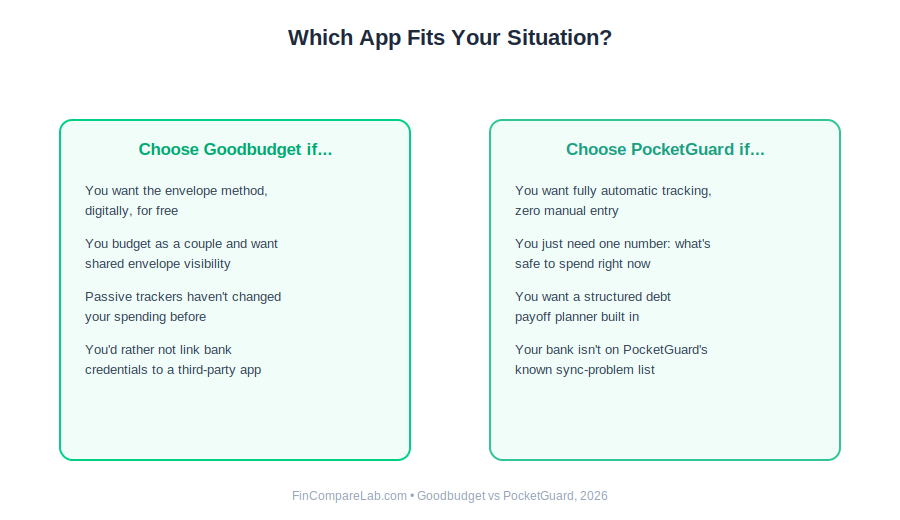
The quickest way to settle goodbudget vs pocketguard for your own situation is to match it against what each app actually does well, not against a generic feature checklist.
Use Goodbudget if:
- You want to try or continue the envelope method digitally, without paying anything
- You’re budgeting as a couple and want shared envelope visibility, see our best budgeting apps for couples roundup for other joint-account options
- You’ve used a passive tracker before and it didn’t change your spending
- You’d rather not link bank credentials to a third-party app at all
Use PocketGuard if:
- You want fully automatic tracking with zero manual entry
- You mainly need one clear answer: how much can I safely spend right now
- You want a structured debt payoff planner alongside your budget, or try the free Debt Payoff Estimator first
- Your primary bank isn’t on PocketGuard’s known sync-problem list
If neither side of goodbudget vs pocketguard fits, here’s where else to look:
Use neither if:
- You want joint household budgeting with investment tracking too → Monarch Money
- You want zero-based budgeting with reliable bank sync → YNAB, compared directly in YNAB vs PocketGuard and YNAB vs Goodbudget
- You need free net-worth and investment tracking alongside budgeting → Empower
- You want to see more free-forever options first → Best Free Budgeting Apps or Best Envelope Budgeting Apps
Which One Should You Pick?
If you’re still undecided on goodbudget vs pocketguard, ask yourself one question: do you want to plan your spending, or track it after the fact? Goodbudget makes you decide where money goes before you spend it, and the manual-entry friction is a feature, not a flaw, it keeps you conscious of every transaction. The free plan is genuinely usable at zero cost indefinitely, which is rare in this category.
PocketGuard tells you in real time what’s safe to spend without asking much of you at all. That’s the right trade for people who want awareness without effort, provided your bank actually syncs reliably, since the entire advantage collapses if it doesn’t.
Whichever direction you searched it, pocketguard vs goodbudget or the reverse, the paid-tier pricing is close enough that cost shouldn’t be the deciding factor. What should decide it: Goodbudget has no floor, the free plan is permanent and functional, while PocketGuard’s cheapest confirmed option is $74.99/year with no free fallback. If cost certainty matters more than automation, Goodbudget wins by default. If automation matters more than cost certainty, PocketGuard’s trial is worth testing against your specific bank before you commit.
What Do People Ask About Goodbudget vs PocketGuard?
Here are the questions that come up most often when people search which is better, goodbudget or pocketguard, including the two questions almost everyone types first: is goodbudget free, and is pocketguard free.
Is Goodbudget or PocketGuard better?
Neither is objectively better on a pocketguard vs goodbudget basis since they serve different budgeting styles. Goodbudget suits proactive envelope budgeting, couples, and anyone wanting a genuinely free option. PocketGuard suits automatic tracking and a single real-time safe-to-spend number, provided your bank connects reliably.
Which is cheaper, Goodbudget or PocketGuard?
On paid annual plans they’re nearly identical, Goodbudget at $80/year versus PocketGuard at $74.99/year, about $5 apart. Goodbudget’s permanent free plan changes the real-world math though: if you don’t need bank sync, Goodbudget costs nothing indefinitely, while PocketGuard has no free fallback at all as of this update.
Can couples use Goodbudget together?
Yes, Goodbudget is well-suited for couples. Both partners access the same shared envelopes under one account across up to 5 devices on Premium. PocketGuard has no joint household view, so each partner would need a separate paid subscription.
Does PocketGuard’s free plan still exist anywhere?
Not on PocketGuard’s own current pricing page, which shows only a 7-day trial. Some third-party review sites and older app store listings still describe a limited 2-account free tier from earlier in the year, so treat that specific claim as outdated unless PocketGuard’s own site confirms it again.
Which app is better for debt payoff?
PocketGuard has a more structured built-in debt payoff planner with avalanche and snowball strategies. Goodbudget handles debt through manual debt envelopes, which works but takes more discipline. For a broader comparison of dedicated options, see our best budgeting apps for debt payoff roundup, or try the free Debt Payoff Estimator.
Can you use Goodbudget and PocketGuard together?
Technically yes, but most people find little practical benefit in running both at once. The one exception is using Goodbudget for a single savings goal while PocketGuard or a similar tracker like the one compared in Monarch Money vs PocketGuard handles everyday visibility.
📚 Read Next
Full disclosure →
