
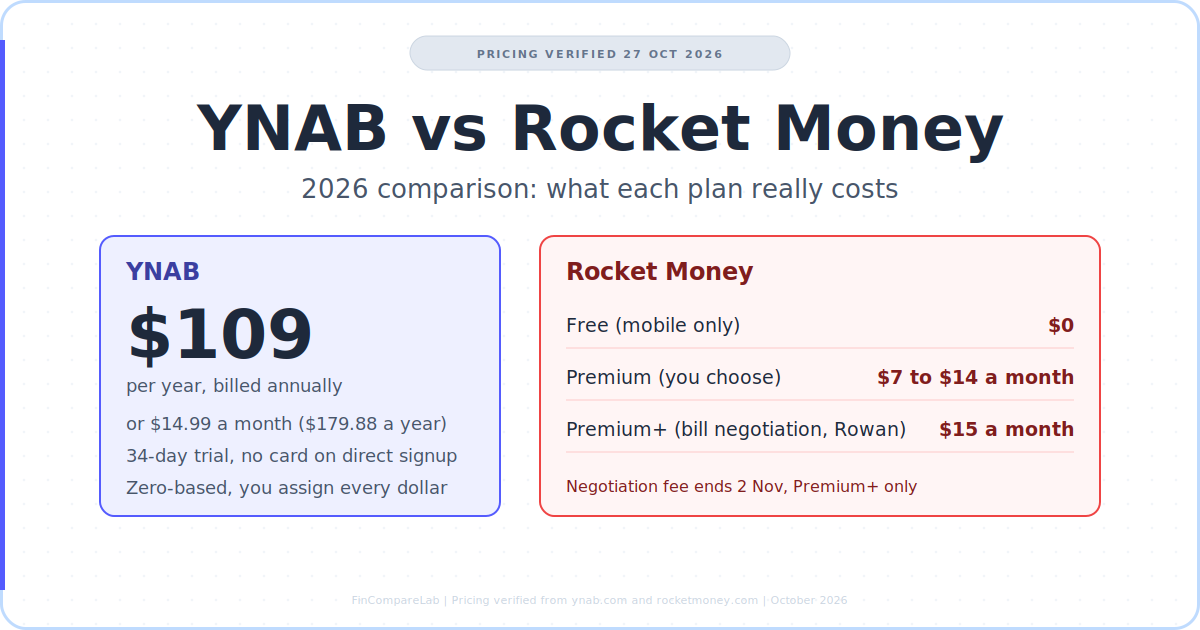
YNAB vs Rocket Money looks like a price contest, and that framing is exactly where most people choose wrong. One app charges $109 a year and asks for your attention. The other starts free and does chores for you. The right pick depends on which of those two things your money problem needs.
⚡ Quick Verdict
Pick YNAB if you overspend and want a system that makes you plan before the money leaves. Pick Rocket Money if your leaks are forgotten subscriptions and overpriced bills, and you won’t open a budget app daily. From 2 November, Rocket Money’s bill negotiation moves to Premium+ at $15 a month, which changes the cost math below.
How We Review Apps, Pricing verified from ynab.com and rocketmoney.com — 27 October 2026
What is the real difference in YNAB vs Rocket Money?
YNAB vs Rocket Money is a choice between a method and a service. YNAB makes you assign every dollar before you spend it, for $109 a year. Rocket Money tracks spending and cancels subscriptions for you, free or from $7 to $15 a month. Pick the chore you will keep doing.
Most people choose on price alone. Rocket Money’s free tier looks like an easy win over a $109 subscription, so they start there and then wonder why their spending never changes. A tracker tells you last month’s grocery total after the fact. A zero-based plan makes you pick this month’s grocery limit before the first trip.
That gap is the whole YNAB vs Rocket Money comparison, and a price tag doesn’t capture it. Most write-ups of this matchup stop at free versus paid. The more useful question is which weekly chore you will still be doing in month three, the same test I use in the best budgeting apps for beginners guide.
The YNAB vs Rocket Money comparison also moved this month. Rocket Money’s terms of service (effective 2 October 2026) make bill negotiation a Premium+ feature from 2 November, with no negotiation fee on new requests. That turns a pay-per-result fee into a $15 monthly membership, and the math is further down.
How does YNAB work, and what does it ask of you each week?
YNAB (You Need a Budget) is a zero-based budgeting app. Every dollar of income gets assigned to a category before you spend it, and when a category runs dry you move money from another one. You record or import transactions, and the plan updates as you go.
I used YNAB for 15 years, from 2011 until earlier this year, strictly zero-based with envelopes. It earned its price while money was tight. Once my finances stabilized, daily reconciliation and the month-end YNAB dance of covering minor overspending turned into busywork, and I moved to Monarch for a one-screen view of net worth and cash flow.
YNAB has dropped the Four Rules wording on its US site in favor of five questions, but the habit is the same: assign money you already have, cover overspending from another category, and plan for irregular bills. I explain the change in my YNAB 4 rules guide, and the zero-based budgeting guide covers the method itself.
Pricing is $14.99 a month or $109 a year, about $9.08 a month and roughly $70 less than twelve monthly payments. The 34-day trial needs no card when you sign up on ynab.com, though app stores may ask for one. One subscription covers up to six people, and my YNAB pricing guide covers billing details.
YNAB’s catches are real, and they decide a lot of YNAB vs Rocket Money matchups. App Store reviewers on the YNAB listing complain that credit card handling is the least intuitive part, that the interface changes often, and that the iPad layout feels oversized. One reviewer says setup took a few hours, then upkeep dropped to minutes a day. Read the YNAB for beginners setup guide first.
YNAB’s Loan Planner calculates time and interest saved on a payoff plan, so loans get a real schedule while credit cards stay in ordinary categories. Whether it compares snowball and avalanche strategies is unconfirmed as of 27 October 2026. YNAB says new users save $600 in their first month on average, but the method behind that number is unpublished, so treat it as marketing.
That is the YNAB half of YNAB vs Rocket Money, and my full YNAB review has the long verdict.
How does Rocket Money work in 2026?
Rocket Money (formerly Truebill, owned by Rocket Companies since late 2021) links your accounts, finds subscriptions, and categorizes spending automatically. Its own site reports more than 10 million members. The pitch is that the app does the oversight so you don’t have to.
There are three tiers. Free tracks subscriptions, gives you a few category budgets and a FICO Score 2, and runs on mobile only. Premium is pay-what-you-choose at $7 to $14 a month with a 7-day trial, and adds cancellation help, unlimited budgets, net worth, sharing, savings goals, debt paydown, credit report access, and web access.
Premium+ is a fixed $15 a month plus tax. It includes everything in Premium plus Rowan (an AI assistant you text), phone support, access to apply for a high-yield savings account, and bill negotiation with no success fee. Rocket Money’s Premium+ help article tells people who don’t see the tier to contact support, so availability may vary by account.
My Rocket Money pricing guide tracks the tier changes, and the Rocket Money review covers the app itself. Which tier you pick decides how the YNAB vs Rocket Money cost math turns out.
Is Rocket Money a budgeting app?
Rocket Money is a budgeting app in the tracking sense, not the zero-based sense. It sets category limits and shows spending against them, but it never asks you to assign income to anything. Free accounts get only a few category budgets, and unlimited budgets need Premium.
That makes it closer to the Mint-style overview apps than to YNAB. In a Rocket Money vs YNAB match it is a tracker against a planner, and I compare it with a similar dashboard app in Monarch vs Rocket Money. If you only want automatic tracking, the best free budgeting apps list has other no-cost options.
What does YNAB vs Rocket Money cost over a full year?
In YNAB vs Rocket Money on sticker price, the winner depends on which Rocket Money tier you compare against. YNAB is $109 a year, or $179.88 if you pay monthly. Rocket Money is $0 on the free plan, $84 to $168 a year on Premium, and $180 a year on Premium+, with sales tax added where it applies.
| Plan | Per month | Per year | Three years |
|---|---|---|---|
| YNAB, annual billing | $9.08 | $109 | $327 |
| YNAB, monthly billing | $14.99 | $179.88 | $539.64 |
| Rocket Money Free | $0 | $0 | $0 |
| Rocket Money Premium at $7 | $7 | $84 | $252 |
| Rocket Money Premium at $14 | $14 | $168 | $504 |
| Rocket Money Premium+ | $15 | $180 | $540 |
Pricing verified from official websites, October 2026. Sales tax excluded. Rocket Money Premium is priced by the member within a range that can change.
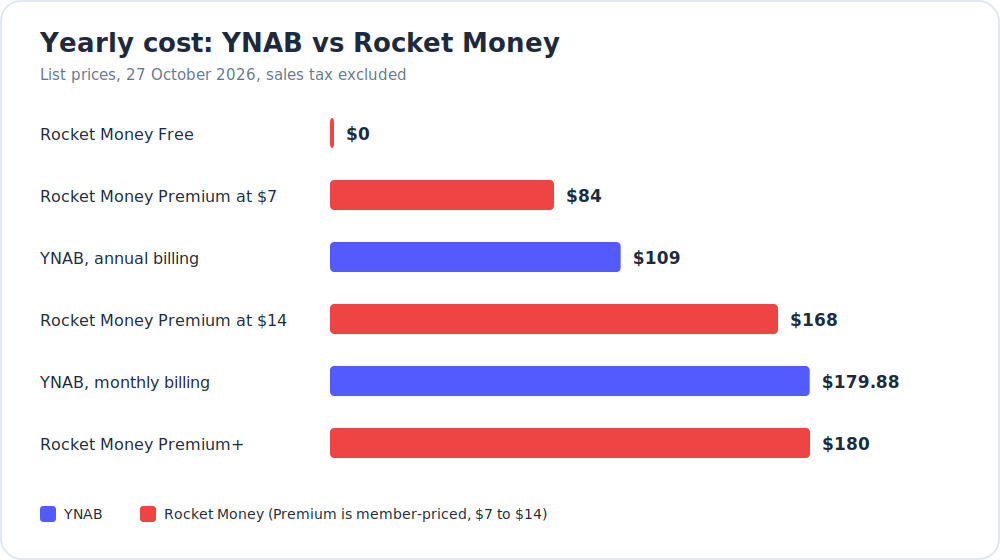
Yearly cost of each plan, list prices as of 27 October 2026. Sales tax excluded.
Read the table from the other direction. YNAB at $109 is cheaper than Rocket Money Premium at the $14 end ($168) and cheaper than Premium+ ($180). The $7 minimum is the only paid Rocket Money setting that undercuts YNAB, by $25 a year. That is the YNAB vs Rocket Money gap the free label hides.
Sharing changes the YNAB vs Rocket Money math again. One YNAB subscription covers up to six people, so a couple splitting $109 pays about $54.50 each. Rocket Money’s sharing is a second view-only login on one account, which gives a partner visibility but no joint planning, and the best budgeting apps for couples guide compares joint options.
College students should check YNAB first, because its College Program gives a free 365-day trial, covered in YNAB for students.
What are the key differences between the two apps?
In a YNAB vs Rocket Money feature check, three rows decide most cases: the budgeting method, subscription cancellation, and sharing. The rest of the table is closer than the marketing on either side suggests.
| Feature | YNAB | Rocket Money |
|---|---|---|
| Budgeting method | Zero-based, you assign every dollar | Tracking with category limits, automatic |
| Free tier | ❌ 34-day trial only | ✅ Free plan, mobile only |
| Trial | ✅ 34 days, no card on direct signup | ⚠️ 7 days on Premium, Premium+ trial unconfirmed |
| Subscription cancellation | ❌ None | ✅ Premium and Premium+, the team cancels for you |
| Bill negotiation | ❌ None | ⚠️ Fee-based until 2 Nov, then Premium+ only |
| Debt tools | ✅ Loan Planner | ⚠️ Debt paydown listed under Premium, details unconfirmed |
| Credit | ❌ None | ✅ FICO Score 2 free, credit report on Premium |
| Net worth | ⚠️ Report, investments entered by hand | ✅ Premium, manual assets allowed |
| Automated savings | ❌ Manual only | ✅ Goals with Smart Savings (Premium) |
| Sharing | ✅ Up to six people | ⚠️ One view-only login (Premium) |
| Web access | ✅ Yes | ⚠️ Premium only |
| Learning curve | ⚠️ Steep, plan on weeks | ✅ Minimal setup |
Pricing verified from official websites, October 2026.
The old YNAB vs Rocket Money gap on debt tools is smaller than most write-ups say. Rocket Money’s Learn page lists debt paydown under Premium, but how it handles several cards at once is unconfirmed as of 27 October 2026. For a plan you can run in either app, the free debt payoff estimator works from your own balances.
What does the 2 November change do to Rocket Money bill negotiation?
Bill negotiation is the one YNAB vs Rocket Money feature that changes on 2 November. Rocket Money’s terms say that from that date it is exclusively a Premium+ feature, with no negotiation fee on requests started after it. Negotiations already in progress keep their agreed fee, and auto-renegotiations end the same day.
Until then, free and Premium users pay a one-time fee you pick between 35% and 60% of 12-month savings. Take an internet bill cut from $90 to $68. That saves $264 over twelve months, so the fee runs from $92.40 at 35% to $158.40 at 60%.
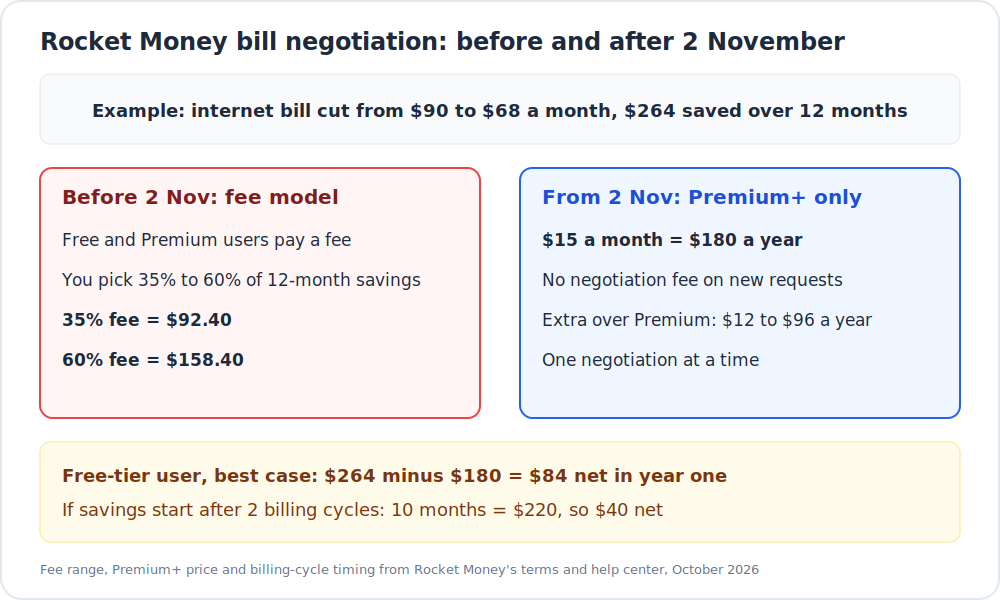
Worked example using one $22-a-month bill reduction. Fee range from Rocket Money’s terms.
After 2 November, the price of negotiating is the Premium+ membership, and the useful number is the difference from Premium. Premium is $7 to $14 and Premium+ is $15, so negotiation access costs $1 to $8 a month on top, about $12 to $96 a year, if you already pay for Premium.
On the free tier, the full $180 is the price of entry. One $22-a-month cut nets $84 in year one in the best case. The terms say savings take one to two billing cycles to show up, and a two-cycle delay leaves ten months of savings, $220, and a $40 net.
Premium+ members can submit only one negotiation at a time. Before 2 November, holding your current rate counts as a negotiated win and triggers the standard fee for non-Premium+ users. The terms also don’t say whether a finished negotiation stays fee-free if you cancel Premium+ afterward (unconfirmed as of 27 October 2026), so ask support before you subscribe just to cancel.
In Rocket Money vs YNAB terms, YNAB has no negotiation service, so a YNAB user calls the provider or switches plans personally. The best Rocket Money alternatives guide covers apps that charge differently for the same job.
Which app wins for your situation?
Is YNAB better than Rocket Money? For most spending problems, yes, and for most subscription problems, no. These situations show where the line falls.
Is YNAB or Rocket Money better for couples?
YNAB, for joint budgets, and YNAB vs Rocket Money for couples comes down to joint planning. Up to six people share one subscription and see the same categories, so both partners plan against the same numbers. Rocket Money’s second login is view-only, which suits a partner who wants visibility without managing the app. For a shared net worth dashboard, see YNAB vs Monarch Money.
Is YNAB or Rocket Money better for debt payoff?
YNAB, if you want a payoff plan tied to your spending. The Loan Planner models time and interest saved on loans, and YNAB’s categories keep new card spending visible. Rocket Money’s debt paydown tool is less documented, so check it in the trial before relying on it. The best budgeting apps for debt payoff guide and how to get out of debt fast cover the strategy side.
Is YNAB or Rocket Money better for subscriptions?
Rocket Money, and it isn’t close. Subscriptions are the one place Rocket Money leads outright in YNAB vs Rocket Money. Free users see every detected subscription, Premium users can ask the team to cancel, and Rocket Money says cancellations usually take 2 to 10 days.
YNAB has no subscription detection, only scheduled transactions you enter yourself. If cancelling is the whole job, read how to cancel Rocket Money before you start paying.
Is YNAB or Rocket Money easier for beginners?
Rocket Money starts faster, and YNAB teaches more. Connect your accounts and Rocket Money’s dashboard fills in the same day, while YNAB asks you to build categories and assign a paycheck first. If you have never budgeted, the best budgeting apps for beginners guide lays out the trade-offs.
Which app handles irregular income better?
YNAB, because its method only assigns money you already hold. A late client payment leaves a category short and doesn’t break the plan. That is why irregular income tips YNAB vs Rocket Money toward YNAB. My budgeting on irregular income guide shows the setup.
Where does Monarch fit in YNAB vs Monarch vs Rocket Money?
Monarch is the app I moved to after YNAB. It is a forward-looking cash flow and net worth dashboard, with Core at $99.99 a year (monarch.com, 26 October 2026), and it doesn’t give every dollar a job. Choose it over both apps here only if one screen for accounts and investments matters more than envelope control or subscription cleanup. My Monarch Money review has the detail.
What do app ratings and Reddit say about YNAB vs Rocket Money?
I couldn’t read Reddit threads directly because of the login wall, so this section rests on App Store text and secondary summaries (unconfirmed as of 27 October 2026). The ynab vs rocket money reddit pattern in those summaries is consistent. People with a named problem such as overspending or debt land on YNAB, and people who want an overview or subscription cleanup land on Rocket Money.
| App | iOS rating | Android rating | Source status |
|---|---|---|---|
| YNAB | 4.8 (about 61,000 ratings) | Unconfirmed | Third-party tally, 20 August 2026, store page unconfirmed ⚠️ |
| Rocket Money | 4.5 (about 398,000 ratings) | 4.5 (about 140,000 ratings) | Store listings, 11 October 2026 ✅ |
Ratings change daily. Counts are rounded.
In YNAB vs Rocket Money, treat ratings as a tiebreaker, since they come from every user, including people who never finished setup. YNAB’s App Store reviews praise the method and the support team, and complain about redesigns, credit cards, and the iPad layout. A third-party review summary of Rocket Money lists unexpected Premium or bill negotiation charges among its complaints, which is why the terms section below matters.
One theme in the rocket money vs ynab reddit discussion matches my own experience: manual categorizing is the friction that breaks set-and-forget habits. That friction is YNAB’s method and its cost. If you can’t stand daily reconciliation, a tracker will hold up longer, even if it changes your spending less. Rocket Money or YNAB, the app you keep opening wins.
Can you use YNAB and Rocket Money at the same time?
Yes, and in YNAB vs Rocket Money it is the one combination worth trying. Run YNAB for the plan and keep Rocket Money’s free tier linked for subscription detection and your FICO Score 2. The free plan has no sharing, no web access, and no cancellation help, so treat it as a monthly audit tool.
Link only the accounts that hold recurring charges, check the subscription list on payday, and cancel what you don’t use yourself. If a service resists cancellation, that is when Premium’s concierge earns its $7 to $14. Premium bills monthly, so one month can cover a cleanup.
Don’t run both for budgeting. Each app categorizes transactions its own way, and you end up reconciling two versions of the same month. Each linked app is also another data connection, so read is Rocket Money safe before you link accounts, and see the best YNAB alternatives if you want one lighter tool instead.
If you do keep both, ynab or rocket money stops being the question. The question becomes which one owns your categories, and the answer should be YNAB.
What should you check in each app’s terms before you sign up?
In YNAB vs Rocket Money, the fine print is lopsided. YNAB’s is short. The 34-day trial ends without a charge if you signed up directly, and app store subscriptions renew unless you turn off auto-renew at least 24 hours before the period ends.
YNAB says it earns money only from subscriptions and doesn’t sell your data, which is the company’s own statement, so read its privacy policy before you link a bank.
Rocket Money’s terms are longer. By creating an account you authorize ACH debits and credits on your linked bank account, and to stop a subscription debit you must cancel at least three business days before the scheduled date. Bill negotiation also makes Rocket Money your limited agent, which can mean giving it provider credentials and letting its agents say they are the account holder.
The terms also include binding arbitration with a class action waiver, and they cap Rocket Money’s liability to you at $500. Those clauses are common in finance apps, but you should know them before you hand over bank access. My safety guide covers the data connections (Plaid, Akoya and Experian) and what is still unconfirmed.
Which app should you pick? (decision guide)
Use the flowchart for a 60-second YNAB vs Rocket Money answer, then read the trial plan below it.
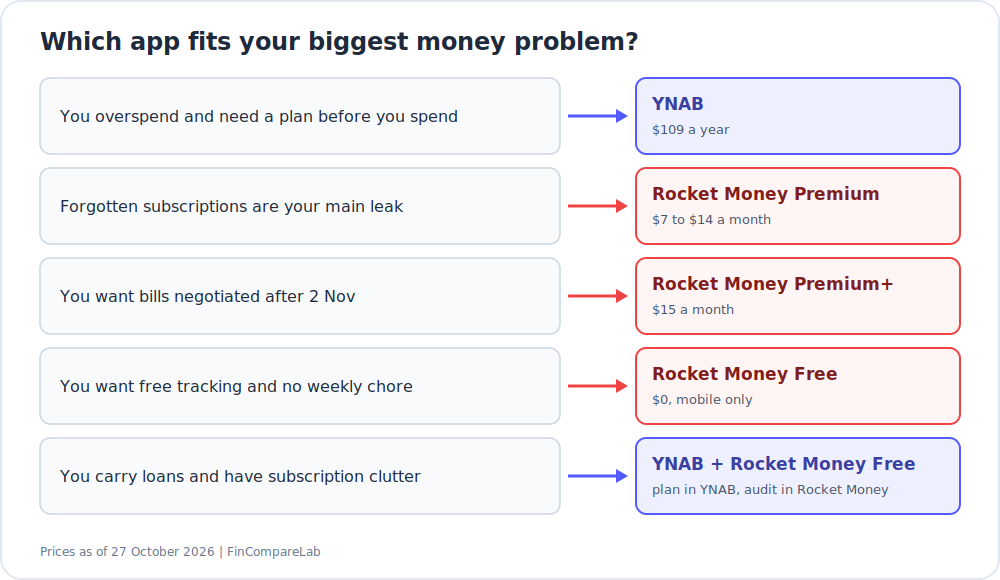
Match the app to your biggest money problem. Prices as of 27 October 2026.
Choose YNAB if…
- You overspend and want a plan before you spend
- You carry loans and want a payoff schedule
- You budget with a partner and want shared categories
- Your income arrives unevenly
- You will open the app most days
Choose Rocket Money if…
- Forgotten subscriptions are your main leak
- You want free tracking with no weekly chore
- You want bill negotiation without a per-result fee
- You want a free credit score in the same app
- You prefer automation over daily decisions
How should you trial both without paying for the wrong one?
Whether it ends up Rocket Money or YNAB, test both on real paychecks instead of sample data.
Start YNAB’s trial the day after payday and assign the whole paycheck until Ready to Assign reads $0. YNAB emails a reminder a week before the 34 days end and doesn’t charge unless you subscribe, so the decision point is day 28, when you know whether you opened the app unprompted.
For Rocket Money, link only your checking account and your main credit card, and review the subscription list on day 1. If you start the 7-day Premium trial, set a reminder for day 3 so a cancellation clears the three-business-day ACH notice.
Two weeks of real use settles YNAB vs Rocket Money better than any review, including this one.
Compare the pricing details in my Rocket Money pricing and YNAB pricing guides, or run your own numbers in the Is YNAB worth it tool.
Next step: pick the one chore you will still do in month three, start that app’s trial or free plan today, and check the result on your next payday.
What else do people ask about YNAB vs Rocket Money?
Is Rocket Money better than YNAB?
Not for budgeting control in YNAB vs Rocket Money, but yes for subscription cleanup. Rocket Money is better at finding and cancelling subscriptions and, from 2 November on Premium+, negotiating bills without a fee. YNAB is better at changing what you spend, because it forces a plan before the money moves.
Is YNAB worth $109 a year compared to free Rocket Money?
It is if you will open it most days and your problem is overspending. If you only want tracking and subscription cleanup, free Rocket Money does that job and YNAB’s $109 buys a method you won’t use. Run your own numbers in the Is YNAB worth it tool.
Can Rocket Money replace YNAB?
Only if you used YNAB to see where your money went. Rocket Money tracks and reports, but it has no zero-based assignment, so a YNAB user who relies on giving every dollar a job loses that workflow. If you want tracking without the chore, the best YNAB alternatives guide covers lighter options.
📚 Read Next
