
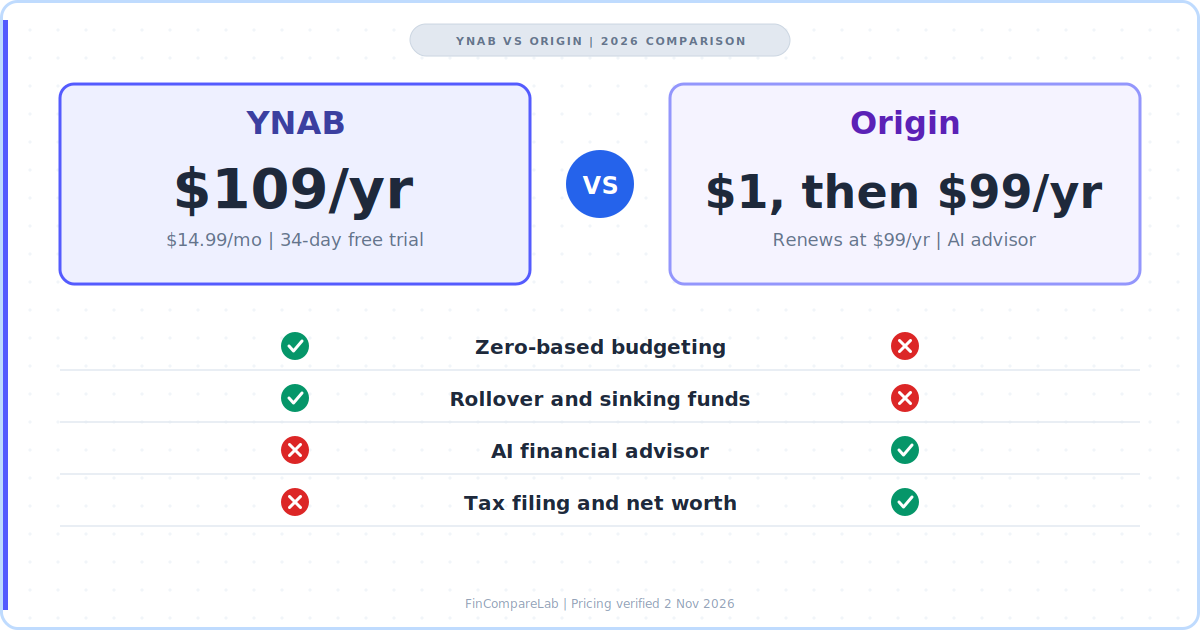
YNAB vs Origin looks like a $10 price decision until you read what each subscription does. YNAB charges $109 a year to run a zero-based budget with you. Origin charges $99 a year, after a $1 first year, to cover budgeting, investing, taxes and advice in one app.
Picking on price alone is how people end up paying for the wrong one. Origin’s $1 first year makes that mistake easy to make.
⚡ Quick Verdict
Pick YNAB if you want a system that makes you decide where every dollar goes. Pick Origin if you want budgeting, net worth, investing and an AI advisor under one $99 renewal.
Over three years Origin costs $128 less, but $108 of that is the $1 first year. From year two the gap is $10, so choose on fit.
How We Review Apps, Pricing verified from ynab.com and useorigin.com — 2 November 2026
In this comparison
- What is the real difference in YNAB vs Origin?
- How much do YNAB and Origin really cost in 2026?
- Is YNAB a zero based budgeting app and does Origin work the same way?
- What does YNAB investment tracking actually cover?
- Is Origin an AI financial advisor app worth paying for?
- Which wins in Origin vs YNAB for couples?
- Which app fits debt payoff better?
- Which app fits your situation?
- How do you switch from YNAB to Origin without losing history?
- Can you use both YNAB and Origin together?
- What else do people ask about YNAB and Origin?
What is the real difference in YNAB vs Origin?
YNAB is a zero-based budgeting app where you give every dollar a job and keep the plan current each week. Origin is an all-in-one finance app with budgeting, investment tracking, taxes and an AI advisor, but its budget resets monthly. YNAB costs $109 a year and Origin $99 after a $1 first year.
That split shows up in daily use. In YNAB you assign money to categories before you spend it, and unspent money carries forward. Origin’s AI budget builder drafts targets from your linked accounts, then reports how you did against them. Origin is also an AI financial advisor app, and YNAB isn’t.
I used YNAB for 15 years, starting in 2011, and ran it strictly zero-based. Once my finances stabilized, the daily reconciling and the month-end shuffle to cover small overspending became busywork. That fatigue is exactly what Origin’s pitch targets, and I moved to Monarch instead, which I cover in my YNAB vs Monarch comparison.
I haven’t run Origin as my own budget. The Origin details here come from its official pages, Help Center, FAQ and public app listings, and anything unverified carries a date. Read the full Origin Financial review and my YNAB review for each app on its own.
| What you get | YNAB | Origin |
|---|---|---|
| Zero-based budgeting | ✅ Core method | ❌ Monthly targets |
| Rollover and sinking funds | ✅ Unspent money carries forward | ❌ Budget resets monthly |
| CSV import | ✅ Yes | ❌ Not listed |
| Spending tags | ✅ Yes | ❌ Not listed |
| Investment and net worth view | ⚠️ Tracking accounts only | ✅ Linked accounts |
| Credit score monitoring | ❌ No | ✅ Yes |
| Tax filing and estate documents | ❌ No | ✅ Yes, some paid |
| AI advisor | ❌ No | ✅ Sidekick |
Origin rows from useorigin.com/compare and Origin’s FAQ, YNAB rows from ynab.com, checked 2 November 2026.
How much do YNAB and Origin really cost in 2026?
YNAB costs $109 a year or $14.99 a month. Origin costs $99 a year after a $1 first year, and its $12.99 monthly price is unconfirmed as of 2 November 2026. The standard annual gap is $10, so price only decides year one.
| Plan detail | YNAB | Origin |
|---|---|---|
| Annual price | $109/yr ($9.08/mo) | $99/yr ($8.25/mo) |
| Monthly price | $14.99/mo | $12.99/mo (unconfirmed as of 2 November 2026) |
| Current offer | None | $1 for the first year, limited time |
| Free trial | 34 days, no card when you sign up directly ✅ | 7 days, unavailable during the $1 offer ⚠️ |
| Free tier | None ❌ | None ❌ |
| Student offer | Free first year via SheerID ✅ | None confirmed ⚠️ |
| Sharing | Up to 6 people on one plan ✅ | Partner access at no extra cost ✅ |
| Renews at | $109/yr | $99/yr after the $1 year |
Pricing verified from ynab.com and useorigin.com, November 2026.
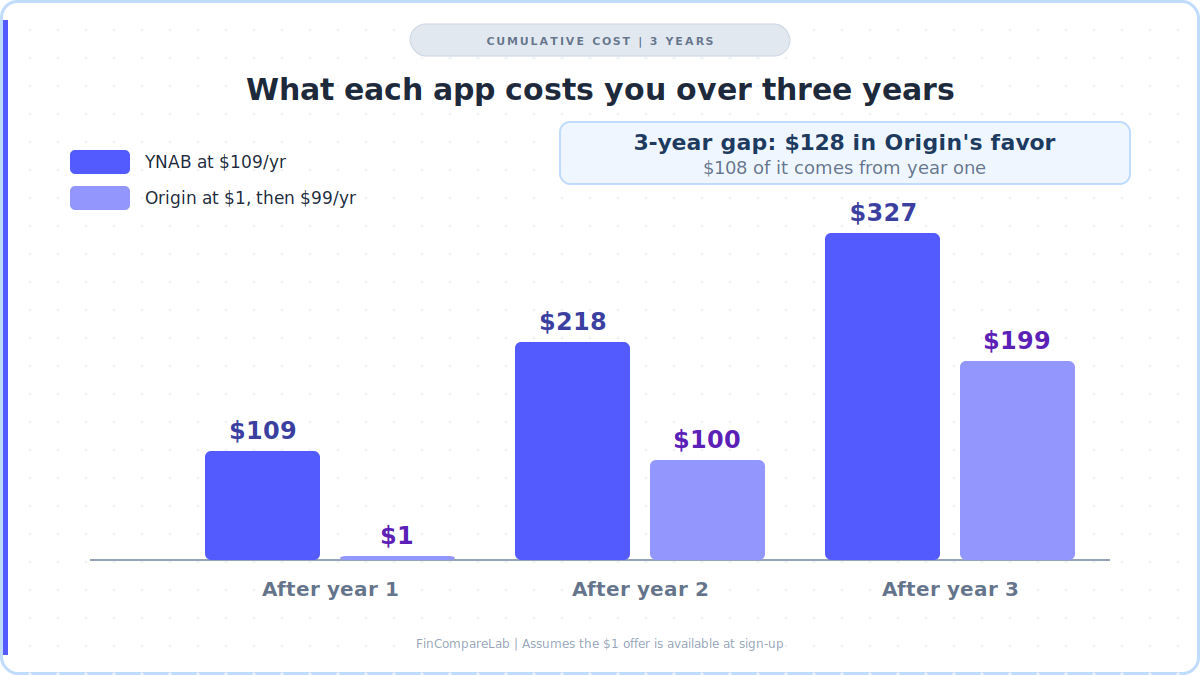
Cumulative cost if Origin’s $1 first-year offer is still open when you sign up.
Over three years YNAB costs $327 and Origin $199. That $128 gap is real, but $108 of it comes from year one, because years two and three differ by $10 each. In Origin vs YNAB, price is a year-one question and fit is a year-two question.
Spread out, YNAB’s $109 is $9.08 a month, about two coffees, and Origin’s $99 is $8.25.
Origin’s sign-up page calls the $1 deal a limited-time offer. Its Help Center says the plan converts to the regular annual rate unless you cancel before the year ends, and that the 7-day trial is unavailable while the promotion runs. Whether the offer asks for a card at checkout is unconfirmed as of 2 November 2026, so put a reminder in your calendar for month 11 either way.
YNAB’s pricing page says the 34-day trial needs no card when you sign up directly, though app-store signups can ask for card details. Students can claim a free first year, which my YNAB for students guide walks through. Every plan detail and discount is in my YNAB pricing breakdown, and Origin’s add-ons are in my Origin Financial pricing guide.
Try YNAB free for 34 days or see Origin’s $1 first-year offer.
Price alone settles little in YNAB vs Origin, because the two apps do different jobs.
Does Origin have a free version?
No. Origin has no permanent free tier, and its 7-day trial is unavailable while the $1 first-year offer runs. If free is the requirement, my best free budgeting apps roundup covers the options that cost nothing.
Is YNAB a zero based budgeting app and does Origin work the same way?
Yes, YNAB is a zero based budgeting app, and Origin isn’t. YNAB asks you to assign every dollar before you spend it and carries unspent money forward. Origin sets monthly targets and resets them, and its own FAQ says unspent balances don’t carry over.
Take a $1,200 car insurance premium due in June. YNAB lets you set aside $100 a month, so June’s bill is already funded when it arrives. In Origin, that $1,200 lands in a single month’s spending, and the FAQ lists rollover budgets and sinking funds as its most requested missing feature.
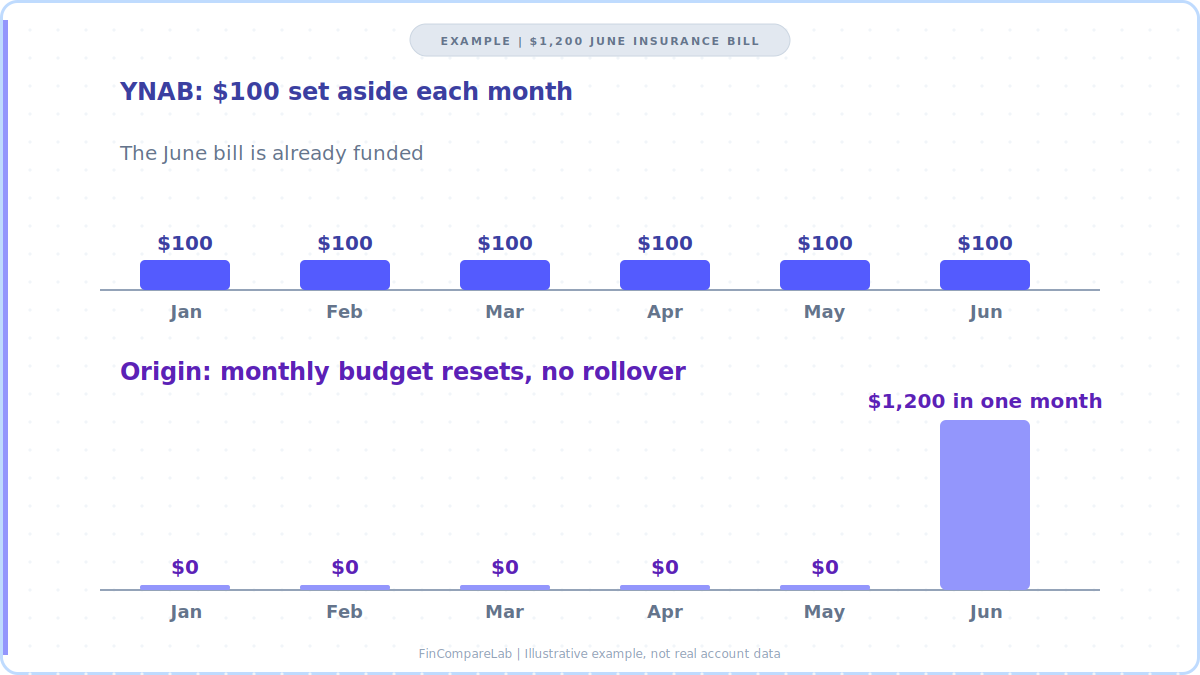
Illustrative example based on Origin’s monthly-reset budget, not real account data.
If you carry many irregular bills, such as annual insurance, car registration or holiday travel, that difference matters more than any price tag, and in YNAB vs Origin it’s the sharpest dividing line. It’s also why zero-based budgeting suits uneven paychecks, which my guide to budgeting on irregular income works through.
YNAB’s cost is effort. The weekly categorizing and reconciling that wore me down after 15 years is the same work that builds the habit, and it’s why the YNAB Method keeps loyal users. If upkeep has made you quit budgeting apps before, count that honestly, and see the best zero based budgeting apps for options with less friction.
Is Origin better than YNAB for beginners?
Origin is easier on day one, because its AI budget builder drafts a budget from your linked accounts. YNAB takes longer to learn, but as a zero based budgeting app its method gives beginners a clearer habit loop. If you carry debt or live paycheck to paycheck, start with YNAB, and use my YNAB for beginners guide to get through setup.
What does YNAB investment tracking actually cover?
YNAB investment tracking is limited to tracking accounts that sit outside your budget, so you see a balance but no portfolio view. There are no performance charts, no asset allocation and no trading. Origin links brokerage and retirement accounts, shows net worth, and its sign-up page links an Investment Advisory Agreement, Form ADV and Form CRS.
On investing, YNAB vs Origin isn’t close. Origin has the portfolio view, and YNAB investment tracking stops at a balance.
Origin’s FAQ names two connection trouble spots, Charles Schwab 401(k) accounts and Webull, and sends users to support when they fail. It also admits its forecasting tool has limits, which matters if you want retirement projections built from a specific account mix. Check that your own institutions connect before you count on the net worth view.
For YNAB investment tracking that goes deeper than a balance, most people pair it with a free dashboard. My YNAB vs Empower comparison and the best net worth tracking apps roundup show where those fit.
Origin’s investing and advice products carry risk and fees described in its own disclosures, so read the Form ADV before moving money. Neither app promises a return, and nothing here is personal financial advice.
Is Origin an AI financial advisor app worth paying for?
Origin’s AI advisor, Sidekick, reads your linked accounts and answers money questions using that data. Origin says it benchmarked the AI at 98.3% on the CFP exam, which is the vendor’s own claim and unconfirmed as of 2 November 2026. YNAB has nothing comparable.
As an AI financial advisor app, it answers questions like “can I afford this” from your real balances instead of a generic rule. That’s useful, but AI output isn’t licensed advice, and Origin sells human CFP sessions as a paid add-on for harder questions. Forbes Advisor rates Origin 4.6 and YNAB 4.4 in its 2026 budgeting app ranking.
During the $1 year, ask it three questions you already know the answer to, such as how many months of expenses your cash covers, then compare against your own math. If it gets those wrong, don’t trust it with bigger decisions. That check costs nothing extra and tells you more than any vendor benchmark.
Origin vs YNAB on advice is lopsided by design, since only one of them is an AI financial advisor app.
Is Origin safe to use?
Origin links accounts through Plaid, MX and Finicity, according to its FAQ, and says it doesn’t sell your financial data. Those are Origin’s own statements, so read my guide on whether Origin Financial is safe before you connect accounts.
Which wins in Origin vs YNAB for couples?
YNAB wins for couples who want one shared zero-based plan, and Origin wins for couples who want shared visibility with some privacy. One YNAB subscription covers up to six people, per its pricing page. Origin includes partner access at no extra cost.
Origin describes its couples setup as three views, partner A, partner B and combined, for one price. That suits couples who keep some money separate. Couples usually share one YNAB budget, and every person on the subscription gets a login.
Origin vs YNAB fails the same way for couples when one partner stops opening the app. YNAB breaks first, since every unassigned dollar becomes the other person’s problem. For more options, see my best budgeting apps for couples roundup.
Which app fits debt payoff better?
YNAB fits debt payoff better. Its built-in loan calculator and category plan let you send every extra dollar to a specific balance. Origin shows debt balances falling inside its net worth view, and a dedicated payoff planner is unconfirmed on its pages as of 2 November 2026.
For debt, YNAB vs Origin is a one-sided call.
Run your own balances through my debt payoff estimator to see how much a higher monthly payment shortens the timeline. The best budgeting apps for debt payoff roundup and my guide to getting out of debt fast cover the wider options. Once the balances are gone, Origin’s investing side starts to make more sense.
Which app fits your situation?
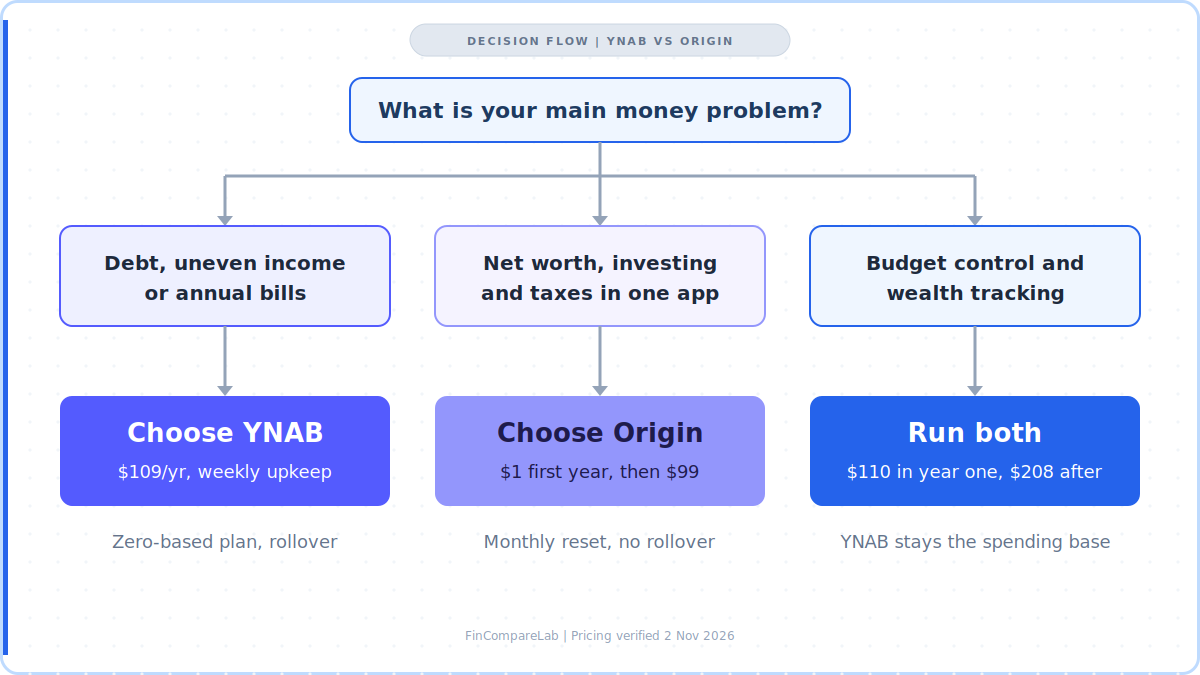
Match the app to the problem you have now, not the one you expect in five years. YNAB vs Origin gets easier once you name that problem.
✅ Choose YNAB if…
- You carry credit card or loan balances and want every extra dollar assigned
- You want a zero based budgeting app, not a spending tracker
- Your income is uneven and annual bills keep catching you off guard
- You’ll open the app weekly and reconcile transactions
- You need CSV import and spending tags, which Origin’s comparison page doesn’t list
- You want one subscription shared with up to six people
✅ Choose Origin if…
- You budget loosely and want net worth, investments and cash flow in one place
- You pay separately for a tax filer, an investment tracker or estate documents
- You want an AI financial advisor app that reads your linked accounts
- You want partner access without paying twice
- You’re fine with a monthly reset instead of rollover
- You’ll set a calendar reminder for the $99 renewal
If you land in the middle, past the worst of your debt but not yet investing seriously, pick the weakness you can live with: YNAB’s upkeep or Origin’s reset. In Origin vs YNAB App Store ratings, Origin sits at 4.6 from about 3,200 ratings and YNAB at 4.8 from about 59,000, per third-party trackers from spring 2026, so check the live App Store listing for current figures.
Still unsure the price is worth it? Run your numbers through my Is YNAB worth it calculator, then compare YNAB alternatives if neither app fits. For a third angle, my Origin vs Monarch Money comparison shows where a middle option sits.
How do you switch from YNAB to Origin without losing history?
There’s no import path from YNAB to Origin. Origin’s comparison page lists CSV import for YNAB and not for Origin, so your history stays in YNAB. Export your YNAB budget and register data before you cancel and keep the files as an archive.
Start Origin at the beginning of a month so the first month is clean, and run both until that month closes. Running both for a full year costs $110 in year one, since the Origin side is $1. When I left YNAB for Monarch this year, I skipped the CSV import and archived the old files, because credit card transfers in the history would have warped my cash-flow reports.
Is Origin worth it if you already use YNAB?
Origin is worth adding only if it replaces two or more tools you pay for now, such as a tax filer, an investment tracker or estate documents. If YNAB already covers your budget and you just want net worth, a free dashboard costs less, and my comparison of YNAB and Empower explains that trade.
Can you use both YNAB and Origin together?
The YNAB vs Origin question isn’t always either-or, but running both costs $208 a year at standard prices, or $110 in year one with Origin’s $1 offer. The workable split is YNAB for the monthly plan and Origin for net worth, investments and taxes. Skip Origin’s budget screen if you do this.
The catch is that both apps categorize transactions, and they will disagree. Make YNAB the source of truth for spending, and use Origin only for balances and net worth. YNAB stays your zero based budgeting app, and Origin’s net worth view fills the YNAB investment tracking gap. After the first year, ask whether the extra $99 still earns its place.
What else do people ask about YNAB and Origin?
Most follow-up questions come back to the $1 offer, the renewal and what carries over from YNAB.
What happens when Origin’s $1 first year ends?
The plan converts to Origin’s regular $99 annual rate unless you cancel before the year ends, per its Help Center. Set a reminder around month 11, and cancel before the renewal date if you’d rather not continue.
Can YNAB replace Origin?
Not if you want automatic investment tracking, net worth, taxes or advice. YNAB investment tracking stops at balances with no portfolio detail, so it replaces Origin’s budget and nothing else.
Is YNAB or Origin cheaper over three years?
Origin is cheaper by $128 if the $1 offer is available, $199 against YNAB’s $327. After year one the gap is $10 a year.
Does Origin import YNAB data?
No. Origin’s comparison page lists no CSV import, so there’s no import path from YNAB. Export your YNAB data and keep it as an archive.
Before you pay either one, write down the last three times your money surprised you, then check which app would have caught each. That list settles most YNAB vs Origin debates faster than any price table.
📚 Read Next
- Origin Financial Review (2026): Is There a Real $99 Catch?
- Origin Financial Pricing 2026: The Hidden $1 Deal Most People Miss
- Is Origin Financial Safe? Security and Privacy Guide
- YNAB Review 2026: Is It Worth $109 a Year?
- YNAB Cost 2026: How to Easily Pay Less in 4 Steps
- Origin vs Monarch Money 2026: Most People Choose Wrong
- Best Budgeting Apps for Couples 2026
