
If you’re comparing the best PocketGuard alternatives right now, there’s a good chance it’s because PocketGuard’s free tier seems to have quietly disappeared, and I checked that directly rather than repeating the old rumor. Here’s how five real alternatives stack up, including one that could save you $81 a year without costing you anything at all.
⚡ Quick Picks: Best PocketGuard Alternatives 2026
- Best overall: YNAB, real behavior change, 34-day trial
- Best free: Goodbudget, free forever, no bank link required
- Best for couples: Monarch Money, one subscription, joint dashboard
- Best for subscription cleanup: Rocket Money, finds and cancels forgotten charges
- Best value paid: Quicken Simplifi, $47.88/yr promo, 30-day guarantee
How We Review Apps · Pricing verified from official app websites — 10 September 2026
📋 In This Guide
- Why Are People Looking for PocketGuard Alternatives?
- Is PocketGuard’s Free Tier Really Gone in 2026?
- How Do the Best PocketGuard Alternatives Compare?
- Is YNAB the Best Overall PocketGuard Alternative?
- Is Goodbudget the Best Free PocketGuard Alternative?
- Is Monarch Money Better for Couples Than PocketGuard?
- Is Rocket Money Better for Subscription Cleanup?
- Is Quicken Simplifi a Cheaper PocketGuard Alternative?
- What About Empower as a Free Option?
- How Do I Choose the Right PocketGuard Alternative?
- Which PocketGuard Alternative Should You Pick?
- What Do People Ask About PocketGuard Alternatives?
Why Are People Looking for PocketGuard Alternatives?
Most searches for the best PocketGuard alternatives come down to four real triggers: an apparently vanished free tier, bank sync failures with specific banks, no shared view for couples, and a “leftover” number that tells you what’s left but never asks you to plan ahead. None of these are PocketGuard being a bad app; they’re just the edges where its particular design stops fitting certain people.
PocketGuard’s core idea, the real-time Leftover number, genuinely works well for people who just want a simple answer to “can I spend this?” without building a full budget system. The apps below solve for the specific thing PocketGuard doesn’t: more control, a genuinely free option, joint accounts, subscription cleanup, or a cheaper price with comparable automation.
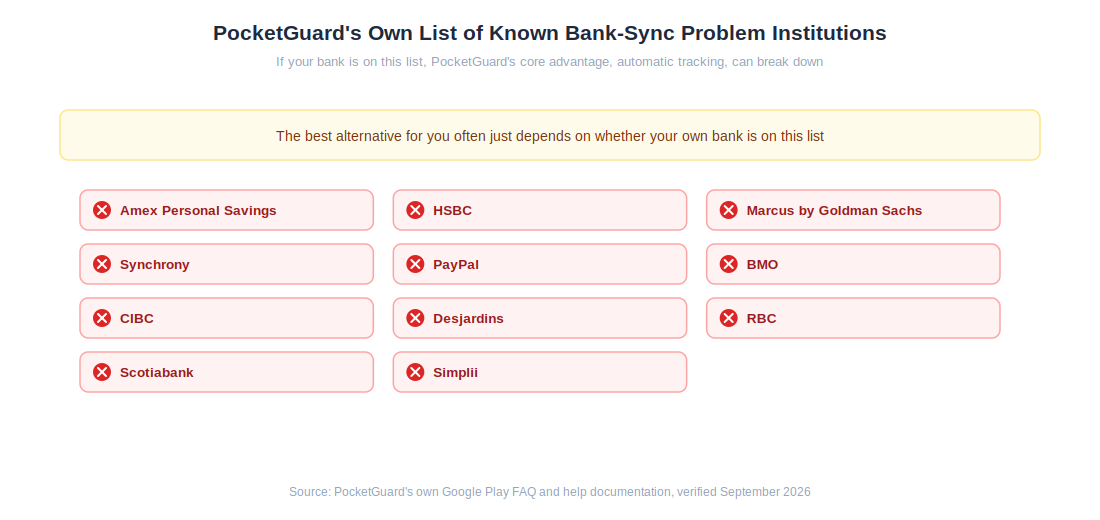
Bank sync reliability is the most-documented complaint, and it isn’t a rumor. PocketGuard’s own help documentation lists specific problem institutions: American Express Personal Savings, HSBC, Marcus by Goldman Sachs, Synchrony, PayPal, and several major Canadian banks including BMO, CIBC, RBC, Scotiabank, and Desjardins. If your bank is on that list, PocketGuard’s biggest selling point, automatic tracking, stops working the way it’s supposed to.
The passive-tracking ceiling shows up a lot in community discussion too. A recurring pattern in budgeting forums is that people who successfully broke a paycheck-to-paycheck cycle usually did it with a method that made them assign a job to every dollar, not one that just reported a balance back to them. That’s a real, documented gap between what PocketGuard does well (visibility) and what some people actually need (a plan).
Is PocketGuard’s Free Tier Really Gone in 2026?
As of this month, PocketGuard’s own pricing page makes no mention of a free tier at all, only a 7-day trial of the $74.99/year Plus plan. That’s a change from earlier reporting that described a working free tier capped at 2 accounts and 2 categories, and it’s now consistent across three separate checks on this site this month.
I went to pocketguard.com/pricing directly rather than relying on an old note. The page shows a single “Start Free 7-Day Trial” call to action, a Yearly/Monthly/Lifetime toggle, and nothing describing a permanently free plan anywhere on it.
Earlier this year, Forbes Advisor and PocketGuard’s own site disagreed on this exact point, one saying the free tier was discontinued, the other still describing it. That conflict looks resolved now, at least on the page PocketGuard shows new visitors.
I can’t rule out that a free plan still exists for grandfathered accounts created years ago, since PocketGuard hasn’t published a changelog confirming a hard cutoff. But if you’re a new user hoping to start free, don’t count on it. Goodbudget and Empower below are both confirmed, unambiguously free with no asterisk.
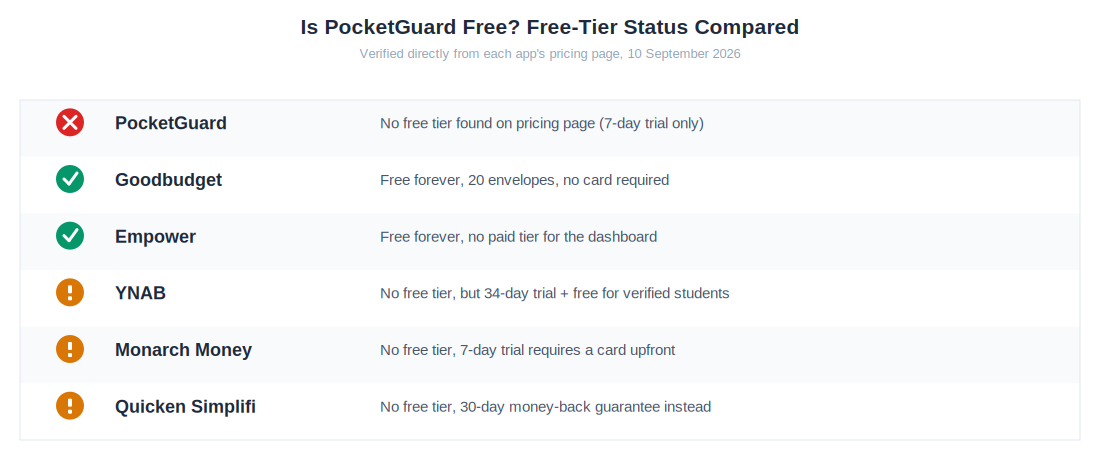
Either way, the math doesn’t move: PocketGuard Plus costs $74.99/year with a 7-day trial to decide, well before you’ve run a full budgeting month. That’s a much shorter runway than several of the best PocketGuard alternatives give you below.
Does PocketGuard Still Have a Free Version?
No, not on the current pricing page. PocketGuard’s site now shows only a paid Plus plan with a 7-day trial, a change from earlier in the year when a limited free tier (2 accounts, 2 categories) was still advertised.
How Do the Best PocketGuard Alternatives Compare?
YNAB, Goodbudget, Monarch, Rocket Money, and Quicken Simplifi are the five best PocketGuard alternatives for 2026, each solving a different reason people leave: real habit change, a genuinely free plan, joint budgeting, subscription cleanup, or a lower price with similar automation. Empower is a strong sixth option if net worth tracking matters more than daily budgeting.
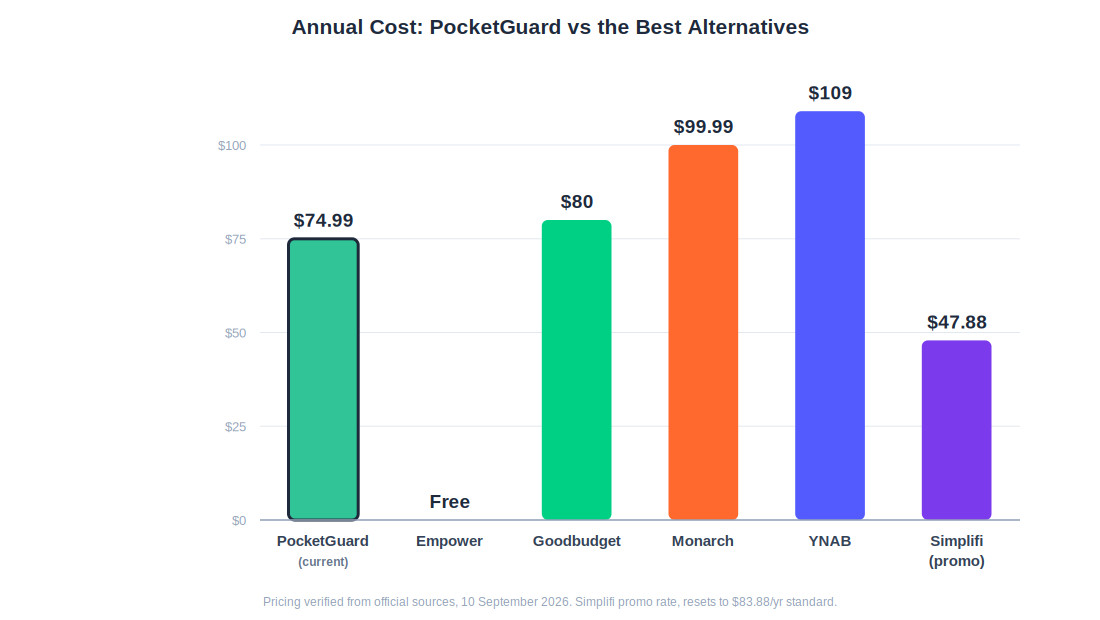
| App | Annual Cost | Free Tier | Bank Sync | Best For |
|---|---|---|---|---|
| PocketGuard (current) | $74.99 | Not on pricing page | Known problem banks | Safe-to-spend number |
| YNAB | $109 | 34-day trial · Free for students | Reliable | Changing habits, debt payoff |
| Goodbudget | Free / $80 | Free forever, confirmed | Premium only | Envelope budgeting, privacy |
| Monarch Money | $99.99 | 7-day trial, card required | Plaid, Finicity, MX | Couples, full financial picture |
| Rocket Money | Free / $84–$180 | Free forever (basic) | Reliable | Subscription cleanup, bill negotiation |
| Quicken Simplifi | $47.88 promo | 30-day money-back guarantee | Very reliable | Affordable automation, spending plan |
| Empower | Free | Free forever, confirmed | Reliable | Net worth + investing, free users |
Pricing verified from official websites, 10 September 2026.
Is YNAB the Best Overall PocketGuard Alternative?
Of every app on this list, YNAB is the one that trades PocketGuard’s “here’s what’s left” simplicity for something more demanding but ultimately more useful: a plan for that leftover money before you spend it.
The zero-based method, give every dollar a job, sounds like homework until you actually try it for a month. Assigning income to categories on purpose, rather than checking a number after the fact, is the exact behavioral shift that PocketGuard’s passive model skips. Give it two full weeks before deciding whether it’s for you; the first week is usually the hardest.
Run the numbers on PocketGuard vs YNAB side by side and the pattern holds: YNAB costs $34 more per year but covers up to 6 people on one plan, gives you 34 days to test it instead of 7, and offers verified students a full year free.
I used YNAB myself from 2011 through earlier this year, so I can say directly: the learning curve is real, but it’s also the reason it worked when a passive tracker hadn’t.
Better than PocketGuard for: Proactive budgeting, debt payoff, irregular income, shared budgeting up to 6 people, a longer trial, student pricing.
Worse than PocketGuard for: Simplicity, it asks more of you upfront. No investment tracking. No real-time safe-to-spend number.
FinCompareLab rating: 4.9/5
→ Full YNAB review · YNAB vs PocketGuard · YNAB pricing breakdown · Budgeting with irregular income
Is Goodbudget the Best Free PocketGuard Alternative?
If PocketGuard’s disappearing free tier is exactly why you’re here, Goodbudget answers the question with no fine print at all.
Goodbudget uses the envelope method: you allocate income into virtual categories at the start of the month, then log transactions against them by hand on the free plan. Bank sync only arrives with the $80/year Premium tier, and it’s explicitly US-banks-only on Goodbudget’s own signup page, worth knowing if you bank internationally.
That manual step is either the whole point or the whole problem, depending on why you’re switching. A recurring theme in budgeting communities is that people who quit Goodbudget usually cite manual-entry fatigue specifically, not the envelope method itself. If PocketGuard felt too passive, that same manual entry is what forces the awareness PocketGuard never asked for.
Better than PocketGuard for: Free forever, privacy on the free plan, couples sharing envelopes, the cash-stuffing method.
Worse than PocketGuard for: No automatic sync without paying, no subscription detection, no debt payoff planner.
FinCompareLab rating: 4.1/5
→ Full Goodbudget review · Goodbudget vs PocketGuard · Goodbudget pricing guide
Is Monarch Money Better for Couples Than PocketGuard?
For anyone budgeting with a partner, Monarch Money is built around a shared view from day one, something PocketGuard has no real equivalent for.
I spent over a decade on YNAB’s zero-based method before switching to Monarch this year, and the reason wasn’t that YNAB stopped working. It’s that my finances got more complex than a leftover-money question could answer.
I needed net worth, cash flow, and investment tracking in the same place I did my day-to-day spending, not a second app for that. Monarch’s receipt scanning and its browser extension for auto-splitting transactions are the two features I actually use weekly.
Put PocketGuard vs Monarch side by side for couples specifically, and both partners get full access under one subscription, joint and individual accounts in the same dashboard, at no extra cost. PocketGuard has no household plan at all; each partner needs a separate $74.99/year subscription, which is nearly $50 more per year than Monarch for two people.
Better than PocketGuard for: Joint household view, investment tracking, net worth, stronger sync reliability, better value for two people.
Worse than PocketGuard for: No real-time Leftover-style number, a more involved interface, the trial requires a card upfront.
FinCompareLab rating: 4.8/5
→ Full Monarch Money review · Monarch Money vs PocketGuard · Best budgeting apps for couples
Is Rocket Money Better for Subscription Cleanup?
Not everyone leaving PocketGuard wants a new budgeting method at all, some just want the forgotten charges gone, and that’s a different job entirely.
PocketGuard is about daily spending control. Rocket Money is about finding the recurring charges you forgot existed, old subscriptions, free trials that quietly became paid, bills that haven’t been renegotiated in years, and it now serves over 10 million members. The free tier alone covers unlimited account linking, subscription discovery, and spending tracking.
Rocket Money’s newer Premium+ tier adds Rowan, an AI agent that can negotiate bills on your behalf. It’s still a limited rollout with a public waitlist as of this writing, not something every user can turn on yet.
Worth flagging honestly: Rocket Money’s own site lists free-tier budget categories inconsistently, its pricing table says “up to 3” while its FAQ prose says “two.” Don’t be surprised if what you see in-app doesn’t match either number exactly.
The PocketGuard vs Rocket Money decision rarely comes down to price at all, it comes down to which job you actually need done.
One more real caveat: cancellation is a known pain point. You have to cancel through iOS Settings or Google Play, not inside the app itself, or the charge continues. Set a calendar reminder before any trial ends; this is the single most common Rocket Money complaint in community discussion.
Better than PocketGuard for: Subscription management, bill negotiation, a genuinely useful free tier, credit score tracking.
Worse than PocketGuard for: Weaker daily budgeting tools, no real-time safe-to-spend number, a confusing cancellation process.
→ Full Rocket Money review · PocketGuard vs Rocket Money · How to cancel Rocket Money the right way · Rocket Money pricing guide
Is Rocket Money Actually Free to Use?
Yes. The free tier includes unlimited account linking, automatic subscription detection, and basic spending tracking with no time limit. Bill negotiation is also available free, though it charges a 35–60% success fee only when it actually lowers a bill.
Is Quicken Simplifi a Cheaper PocketGuard Alternative?
Price-sensitive readers comparing PocketGuard alternatives often skip past Quicken Simplifi, and that’s a real mistake at its current promo rate.
At $47.88 for the first year, Simplifi costs $27.11 less than PocketGuard’s $74.99, with a comparable feature set. Simplifi’s Spending Plan works like PocketGuard’s Leftover number: it takes income, subtracts bills and savings goals, and shows what’s left, but it adjusts in real time and is more customizable than PocketGuard’s version.
Two things worth knowing before you sign up: there’s no free tier at all, and the $3.99/month promo is explicitly first-year-only, it resets to the $6.99/month standard rate afterward. Calendar that renewal date. Bank sync reliability, on the other hand, is excellent; Quicken has connected to financial institutions since the early 1990s, and that infrastructure shows in fewer sync failures than PocketGuard’s documented problem-bank list.
Better than PocketGuard for: Lower price at the current promo, stronger bank sync reliability, a 30-day guarantee instead of a 7-day trial, investment tracking.
Worse than PocketGuard for: No free tier at any point, annual billing only, a smaller user community.
FinCompareLab rating: 4.2/5
→ Full Quicken Simplifi review · Quicken Simplifi’s official pricing page
What About Empower as a Free Option?
Empower never charges for its budgeting or net worth dashboard, which makes it a strong pick if the vanished PocketGuard free tier is what brought you here in the first place. Its free investment dashboard is stronger than anything else on this list, best for anyone who wants net worth and portfolio tracking alongside day-to-day spending without paying Monarch’s $99.99/year.
The trade-off is a persistent upsell toward Empower’s paid wealth management arm, which you’re free to decline without losing dashboard access.
→ Full Empower review · Best net worth tracking apps
How Do I Choose the Right PocketGuard Alternative?
The right pick among the best PocketGuard alternatives depends entirely on which specific gap sent you looking in the first place, not a generic ranking.
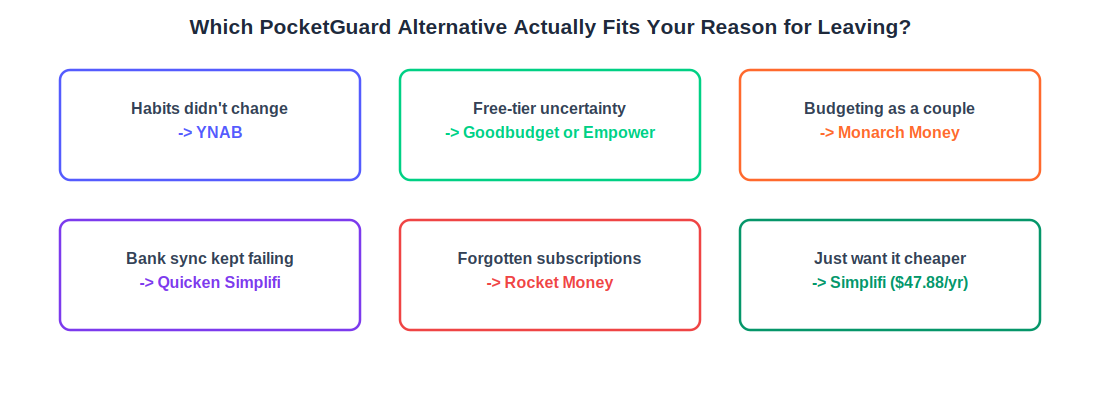
PocketGuard didn’t change your spending habits → YNAB. The zero-based method forces the planning step passive trackers skip. Use the full 34-day trial before judging the learning curve.
The free-tier disappearing is the whole issue → Goodbudget or Empower. Goodbudget for envelope budgeting, Empower for spending visibility plus investment tracking, both confirmed free with no fine print.
Budgeting as a couple → Monarch Money. One subscription covers both partners with a joint dashboard, better value than two separate PocketGuard accounts.
Bank sync kept failing → Quicken Simplifi first. Its bank connectivity has decades more infrastructure behind it than PocketGuard’s.
Forgotten subscriptions and high bills are the real problem → Rocket Money. The free tier alone may solve it before you ever pay.
What Is the Best Overall Alternative to PocketGuard?
YNAB is the best overall PocketGuard alternative for most people who want more than passive tracking. It costs more ($109 vs $74.99/year) but produces real behavior change through zero-based budgeting, something a leftover-money number alone can’t do.
Which PocketGuard Alternative Should You Pick?
PocketGuard’s Leftover concept is genuinely useful, a real-time safe-to-spend number is a smart, simple idea. But a free tier that’s disappeared from its own pricing page, documented bank sync issues, and no joint budgeting option leave real gaps that the alternatives above fill better, depending on which gap actually applies to you.
For most people, YNAB is the upgrade worth paying for. For couples, Monarch is the clear switch. For anyone who wants automation without the $74.99 price tag, Simplifi’s $47.88 promo is the value pick, a real $27.11 a year cheaper. For a confirmed, no-asterisk free option, Goodbudget or Empower deliver that without the uncertainty PocketGuard now carries.
Use the trial or free tier properly before deciding: connect your real accounts, run one full budget cycle, then judge. The best app on this list is whichever one you’re still using next month.
What Do People Ask About PocketGuard Alternatives?
Here are the questions that come up most often around the best PocketGuard alternatives, including the free-tier question and how each app stacks up on price.
Is PocketGuard still free in 2026?
No, not on PocketGuard’s own current pricing page. It now shows only a paid Plus plan at $74.99/year with a 7-day trial, a change from earlier reporting that described a limited free tier. If a confirmed free option matters to you, Goodbudget and Empower are both free with no ambiguity.
What is the best free PocketGuard alternative?
Goodbudget is the best free PocketGuard alternative, a confirmed permanent free tier, no credit card required, 20 envelopes that never expire. Empower is also completely free and better if you want investment tracking alongside spending.
Is YNAB better than PocketGuard?
For most people trying to actually change their finances, yes. YNAB costs $109/year versus PocketGuard’s $74.99 but covers up to 6 people on one plan and offers a 34-day trial. Its zero-based method produces more lasting behavior change than PocketGuard’s passive Leftover tracking, though it asks more of you upfront.
Is Rocket Money better than PocketGuard?
They solve different problems, so “better” depends on the job. PocketGuard is built for daily spending control, while Rocket Money is built for finding and cancelling forgotten subscriptions and negotiating bills, and its free tier offers real functionality PocketGuard’s paid-only model doesn’t.
Is Quicken Simplifi cheaper than PocketGuard?
Yes, at the current promo rate. Quicken Simplifi costs $47.88 for the first year versus PocketGuard’s $74.99, a $27.11 gap, though Simplifi’s rate resets to $83.88/year after the promo period and it has no free tier at all.
What is the best PocketGuard alternative for couples?
Monarch Money. Both partners get full access under one $99.99/year subscription with a joint dashboard and shared goals. PocketGuard has no joint plan; each partner needs a separate $74.99/year account.
📚 Read Next
Full disclosure →
