
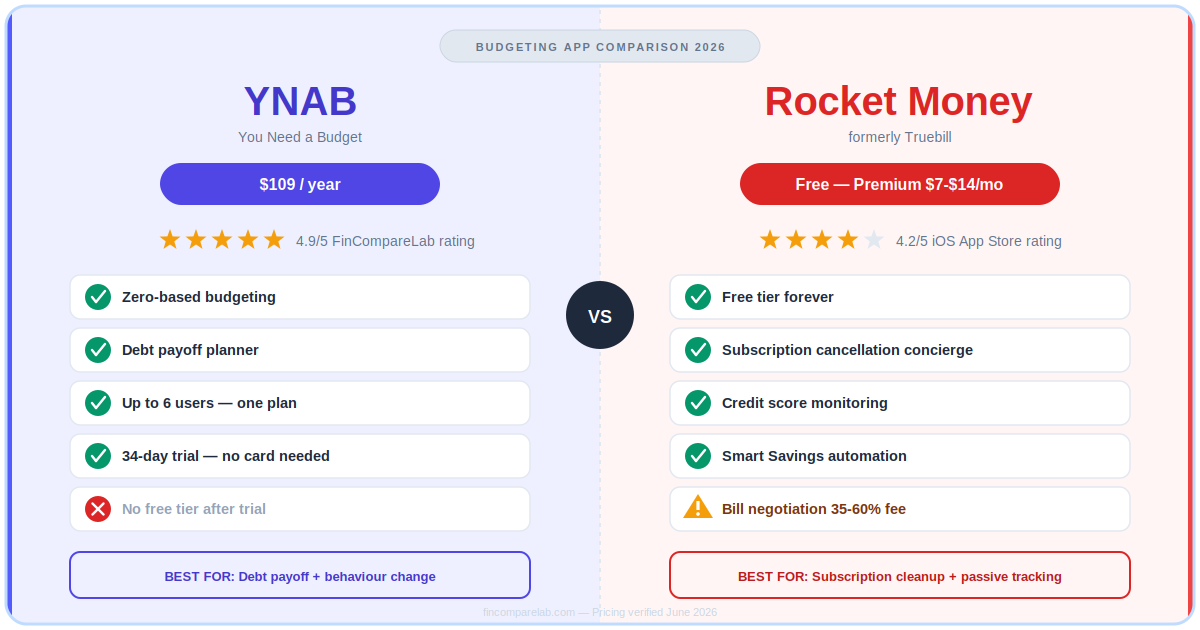
YNAB vs Rocket Money comes down to one question: do you want to change how you handle money, or just understand where it’s going? One app builds financial discipline from scratch. The other automates oversight so you barely have to think about it. They’re not really rivals — and picking the wrong one is the most common mistake people make when choosing a budgeting app.
⚡ Quick Verdict
YNAB wins for people who want to break the paycheck-to-paycheck cycle, pay off debt, or build a real zero-based budget. Rocket Money wins for people who want passive financial visibility, subscription cleanup, and credit monitoring with minimal effort. If you’re not sure which describes you, the answer is almost always YNAB — the $109/year cost pays for itself fast once the method clicks.
How We Review Apps · Pricing verified from ynab.com and rocketmoney.com — June 2026
Is YNAB vs Rocket Money even a fair comparison?
YNAB and Rocket Money are not direct competitors — they solve different financial problems. YNAB is a zero-based budgeting system built for behaviour change; Rocket Money is a passive financial dashboard built for automated oversight. Picking the wrong one is the most common mistake people make when switching budgeting apps.
That said, most people choose between them because their budgets don’t stretch to two subscriptions. So here’s the clearest summary on YNAB vs Rocket Money before we get into the detail: if you have a specific problem to solve — debt, overspending, no savings cushion — YNAB is built for that. If you want a reliable financial overview with minimal effort, Rocket Money delivers it better than any app at this price.
That said, the YNAB vs Rocket Money decision is real — most people’s budgets don’t have room for two subscriptions. So here’s the clearest summary I can give you before we get into the weeds: if you have a specific financial problem you’re trying to solve — debt, overspending, no savings cushion — YNAB is the tool built for that. If you want a reliable overview of your finances without doing much work, Rocket Money delivers that better than any other app at this price point.
I’ve tested both. Here’s exactly how they compare.
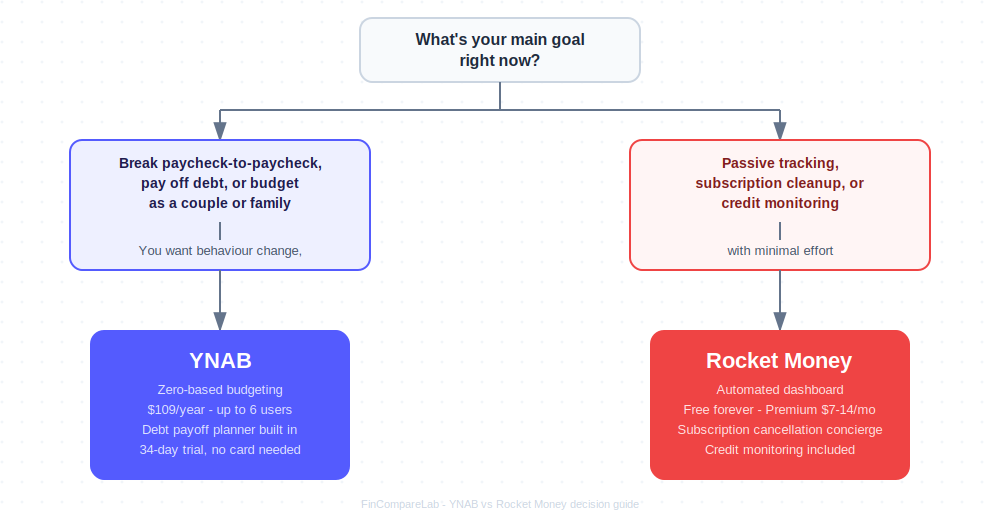
How does YNAB work?
YNAB — You Need a Budget — runs on a single core idea: give every dollar a job the moment it arrives, before you spend a cent. You enter your income, then manually assign it across categories — rent, groceries, debt payment, savings goals — until you reach zero. That zero budget means every dollar has a purpose. Nothing sits in your account quietly bleeding into vague “miscellaneous” spending.
The method is built around four core rules: give every dollar a job, plan for irregular expenses like car repairs and annual subscriptions, move money between categories guilt-free when plans change, and gradually age your money until you’re spending last month’s income instead of this month’s. That last one — aging your money — is what breaks the paycheck-to-paycheck cycle for good.
The learning curve is real. Plan for two to four weeks before the zero-based budgeting system feels natural. But the community around YNAB is genuinely remarkable — r/ynab has nearly 200,000 members sharing wins, tips, and troubleshooting. YNAB also offers free live workshops every week, which no competitor matches.
Key stats: 92% of YNAB users report feeling less stressed about money. The average user saves $600 in the first month and $6,000 in the first year, according to YNAB’s own data. Costs $14.99/month or $109/year. The 34-day free trial requires no credit card — one of the only apps in this category that doesn’t ask for payment details upfront.
How does Rocket Money work?
Rocket Money (formerly Truebill, acquired by Rocket Companies in 2021 for $1.275 billion) takes the opposite approach. Connect your bank accounts and credit cards and the app does the heavy lifting. It categorises transactions automatically, identifies every subscription and recurring charge, tracks your net worth, monitors your credit score, and surfaces insights about where your money goes — all with minimal input from you.
Two features define Rocket Money in ways no competitor matches:
- Subscription cancellation concierge — Rocket Money Premium members request a cancellation and the team contacts the provider directly, handles the retention call, and confirms it’s done. No hold music, no hassle.
- Bill negotiation — Rocket Money specialists contact cable, internet, and phone providers to negotiate lower rates. If successful, you pay 35–60% of your first year’s savings as a fee. More on this in the hidden cost section below.
The free tier is genuinely functional — account linking, basic budgeting, subscription tracking, spending overviews. Rocket Money Premium ($7–$14/month, you choose the price) adds subscription cancellation, Smart Savings automation, credit monitoring, net worth tracking, and custom budget categories. Every Premium user gets identical features regardless of how much they pay. Smart users pick the $7 minimum. That flexibility is one of the genuine advantages Rocket Money holds in the YNAB vs Rocket Money pricing debate.
What are the key differences as a budgeting app?
The YNAB vs Rocket Money feature gap is larger than most reviews acknowledge. Here’s the full side-by-side:
| Feature | YNAB | Rocket Money |
|---|---|---|
| Price | $109/yr · $14.99/mo | Free · Premium $7–$14/mo |
| Free tier | ❌ Trial only (34 days) | ✅ Free forever |
| Free trial | ✅ 34 days, no card needed | ⚠️ 7 days (Premium only) |
| Budgeting method | Zero-based (manual) | Traditional (automated) |
| Subscription cancellation | ❌ None | ✅ Rocket Money Premium only |
| Bill negotiation | ❌ None | ⚠️ 35–60% success fee |
| Debt payoff planner | ✅ Built in | ❌ None |
| Credit score monitoring | ❌ None | ✅ Rocket Money Premium |
| Net worth tracking | ⚠️ Basic | ✅ Rocket Money Premium |
| Automated savings | ❌ Manual only | ✅ Smart Savings (Premium) |
| Shared users | ✅ Up to 6 users, one plan | ⚠️ 1 share (Premium only) |
| Free live workshops | ✅ Weekly | ❌ None |
| Learning curve | ⚠️ Steep (2–4 weeks) | ✅ Minimal setup |
| iOS App Store rating | 4.3 / 5 | 4.2 / 5 |
| Android rating | 4.6 / 5 | 4.3 / 5 |
Pricing verified from ynab.com and rocketmoney.com — June 2026.
What does YNAB vs Rocket Money cost over a full year?
The YNAB vs Rocket Money pricing comparison looks simple on the surface but gets complicated quickly. YNAB is $109/year flat — that’s every feature, up to 6 users, no asterisks. Rocket Money’s pricing has more moving parts.
| Scenario | YNAB annual cost | Rocket Money annual cost |
|---|---|---|
| Free tier | ❌ Not available | $0/year |
| Premium minimum | $109/year | ~$84/year ($7/mo) |
| Premium maximum | $179.88/year ($14.99/mo) | ~$168/year ($14/mo) |
| With bill negotiation | N/A | $84–$168 + 35–60% success fee on top |
Pricing verified from ynab.com and rocketmoney.com — June 2026.
The real-world YNAB vs Rocket Money cost comparison favours Rocket Money at the Premium minimum — $84 vs $109 per year. But YNAB covers six users on that $109. For couples, YNAB works out to $18.17 per person per year. Rocket Money’s one shared account means both people get access, but it’s a thinner experience than YNAB’s full multi-user budget.
What does YNAB do better?
In the YNAB vs Rocket Money comparison, YNAB wins on one dimension that matters more than any feature: it actually changes how you think about money. Rocket Money shows you data. YNAB changes behaviour.
Zero-based budgeting builds real discipline. Assigning every dollar before you spend it sounds like work — and it is, especially in weeks one and two. That friction is the entire point. You can’t overspend a category without consciously moving money from somewhere else. That forced decision-making is what rewires spending habits over time. After three months with YNAB, most users report that their relationship with money has fundamentally shifted.
The debt payoff planner is a genuine differentiator. YNAB’s built-in tool lets you model snowball or avalanche debt payoff strategies across multiple accounts, see projected payoff dates, and watch your debt-free date move closer as you make extra payments. (If debt payoff is your primary goal, also read our guide on how to get out of debt fast.) In the YNAB vs Rocket Money comparison, this feature alone is decisive for anyone carrying credit card or student loan debt. Rocket Money has zero equivalent functionality.
Six users for one flat price. YNAB puts up to six people on a single $109/year subscription. Couples, families, even adult children learning to budget alongside parents — all covered. In the YNAB vs Rocket Money comparison for households, this is one of the starkest value gaps in the category.
Free weekly workshops with real humans. YNAB runs live budgeting workshops every week at no extra cost. You can ask questions, learn the method, and troubleshoot alongside other users. No other budgeting app in this price range offers anything close to this level of education and support.
34-day free trial, no card required. More than a full month to test a complete budget cycle with zero financial risk. Rocket Money’s Premium trial is seven days — not enough to meaningfully evaluate it. In the YNAB vs Rocket Money trial comparison, YNAB wins by a wide margin.
What does Rocket Money Premium do better than YNAB?
Flip the comparison around — Rocket Money vs YNAB — and Rocket Money wins on features that YNAB simply doesn’t offer. Several of these are genuinely valuable for the right type of user.
Subscription cancellation that actually works. Rocket Money Premium’s concierge cancellation is the best implementation of this feature anywhere in personal finance apps. You request the cancellation, they handle the provider call, you get confirmation. For someone paying for four forgotten subscriptions — and most of us are — this feature can save more than the annual Premium cost in month one.
A free tier that never expires. Rocket Money’s free plan includes account linking, transaction tracking, basic budgeting, and subscription identification. It’s limited compared to Rocket Money Premium, but it’s real and permanent. YNAB has no free option after the 34-day trial ends.
Credit score monitoring included. Rocket Money Premium gives you full credit report access and score tracking with alerts for significant changes. This matters enormously if you’re building credit, monitoring for identity theft, or preparing to apply for a mortgage. YNAB has nothing here.
Smart Savings automation. Rocket Money analyses your cash flow patterns and automatically moves money into savings when your balance runs higher than usual — without you doing anything. YNAB’s savings approach is entirely manual. For people who struggle to save consistently, this passive automation can be more effective than any budgeting system.
Easier, faster onboarding. Connect accounts, and the dashboard is live. No categories to build, no method to learn. For people who tried YNAB and bounced off the learning curve, Rocket Money delivers immediate value without a two-week adjustment period — and that ease of use is a real advantage in the YNAB vs Rocket Money accessibility comparison.
What is Rocket Money’s hidden cost most people miss?
Bill negotiation is Rocket Money’s marquee feature — and also the one most comparison posts fail to explain honestly. Here’s what you need to know before you sign up.
When Rocket Money successfully negotiates a bill down, you pay them 35% to 60% of your first year’s savings as a fee. You choose the percentage at signup. The service is available on both free and paid plans, but the success fee applies regardless.
The math: Rocket Money negotiates your internet bill from $90 to $68 per month — a $264 annual saving. At a 40% fee, you hand over $105.60 upfront. For something you could have done yourself in ten minutes with a competitor quote on your screen.
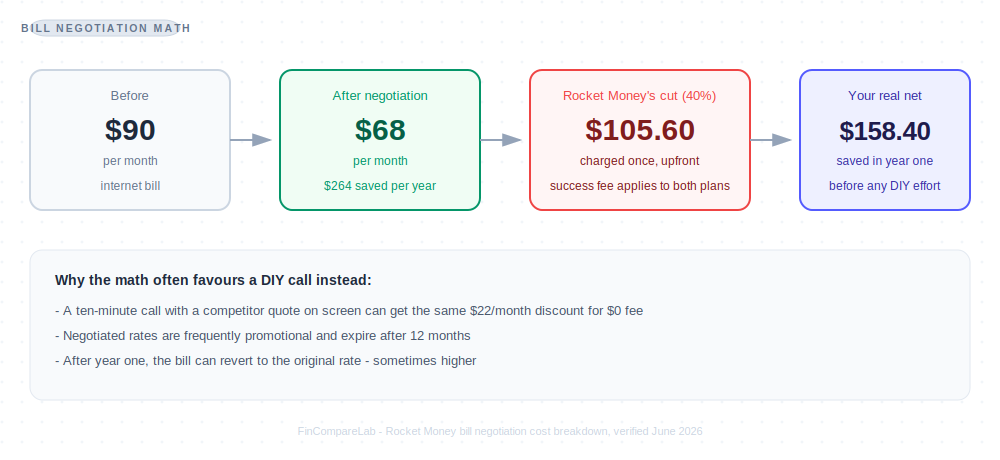
There’s a second layer to this most people miss. Negotiated savings are often promotional rates that expire after 12 months. After year one, your provider quietly reverts to the original rate — sometimes higher. So your actual net saving over two years may be a fraction of what the initial negotiation suggested.
My recommendation: use Rocket Money Premium’s subscription cancellation feature freely — it’s included and genuinely excellent. Be cautious with bill negotiation. The math rarely favours you compared to a ten-minute DIY phone call. This is a key YNAB vs Rocket Money transparency gap — YNAB has no hidden variable costs.
What’s the Rocket Money cancellation problem?
There’s no cancel button inside the Rocket Money app. Not hidden. Not buried in settings. It simply doesn’t exist.
To cancel Rocket Money Premium, you must go to your device’s native subscription manager — iOS Settings or Google Play Store — at least 24 to 48 hours before your next billing date. Users who search the app for a way to cancel, don’t find one, miss their billing date, and get charged again have documented this complaint consistently from 2024 through 2026.
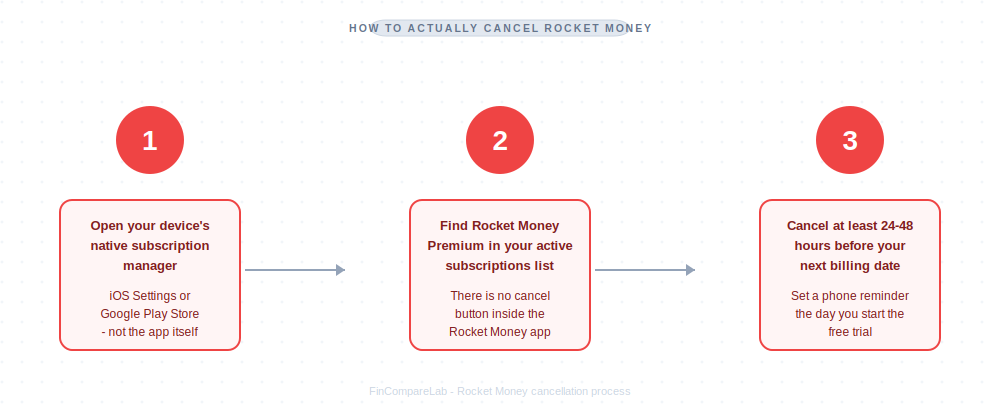
This is a deliberate UX decision, not a bug. Set a phone reminder the day you start the free trial. That’s not cynical advice — it’s just practical.
How does YNAB vs Rocket Money compare for specific situations?
The YNAB vs Rocket Money answer shifts depending on your specific situation. Here’s how each app performs where it matters most.
Is YNAB or Rocket Money better for couples?
YNAB wins this comparison clearly. Up to six users share one $109/year subscription, and the shared zero-based budget creates a structured, transparent conversation about household finances. Both partners see the same categories, the same targets, the same trade-offs. Rocket Money Premium allows one shared account — functional, but passive. If joint budgeting and financial alignment are the goal, YNAB vs Rocket Money isn’t close for couples. See our full best budgeting apps for couples roundup for more options.
Is YNAB or Rocket Money better for debt payoff?
YNAB again. The built-in debt payoff planner models snowball and avalanche strategies, shows projected payoff dates, and lets you see the impact of extra payments in real time. Rocket Money has no debt payoff tooling at all — not even a basic goal tracker. If you’re working to eliminate debt, the YNAB vs Rocket Money decision is clear: YNAB gives you a system, Rocket Money just shows you a balance. Worth noting: EveryDollar is the other strong debt-payoff contender if you follow Dave Ramsey’s Baby Steps.
Is YNAB or Rocket Money better for subscription management?
Rocket Money wins this one completely. YNAB doesn’t identify, track, or cancel subscriptions automatically — nor does PocketGuard, the other passive tracker frequently compared to both apps. Rocket Money Premium’s cancellation concierge handles provider calls on your behalf — no equivalent exists in YNAB. If subscription bloat is your primary frustration, Rocket Money is the right pick in the YNAB vs Rocket Money comparison.
Is YNAB or Rocket Money easier for beginners?
Rocket Money is easier to start. Connect accounts and you’re live in minutes, no method to learn. YNAB takes two to four weeks before zero-based budgeting clicks. But “easier to start” and “better for you” aren’t the same thing. Beginners who want immediate results with low effort choose Rocket Money. Beginners who are serious about changing their financial habits choose YNAB and stick with it through the learning curve. Not sure where to start? Our best budgeting apps for beginners guide covers all the top options.
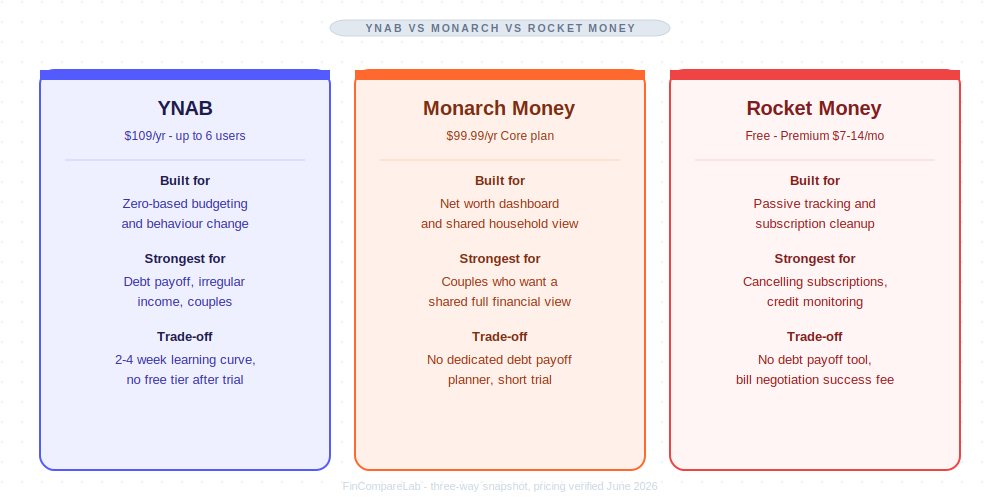
Is Monarch Money the Answer in the YNAB vs Monarch vs Rocket Money Debate?
If neither app feels like a full fit, it’s worth asking where Monarch Money lands in the YNAB vs Monarch vs Rocket Money comparison. Monarch sits closer to Rocket Money than YNAB — it’s a net-worth and spending dashboard, not a zero-based budgeting system.
What sets it apart: Monarch is built specifically for couples who want one shared financial view, which is a gap in Rocket Money’s single-share model. It costs more than Rocket Money’s free tier ($99.99/year Core plan) and doesn’t include Rocket Money’s subscription-cancellation concierge or YNAB’s debt payoff planner.
In practice: choose YNAB if you want a system that changes your habits, choose Rocket Money if subscription cleanup is the priority, and add Monarch to the shortlist if a shared couples’ dashboard matters more than either of those two things. Our full YNAB vs Monarch Money comparison breaks down that matchup in detail.
Can you use YNAB and Rocket Money at the same time?
Yes — and some users do. The combination that makes the most sense: YNAB for active zero-based budgeting, Rocket Money free tier for passive subscription tracking and credit monitoring. You get YNAB’s behavioural discipline plus Rocket Money’s automation without paying twice for Premium features.
That said, most people don’t need both. Whichever direction you search it — YNAB vs Rocket Money or Rocket Money vs YNAB — the overlap between them (transaction tracking, spending categories, goal setting) is significant enough that running two apps creates more complexity than value for the average user. Pick the one that matches your primary financial goal right now. You can always switch later.
The one case where running both genuinely makes sense: you’re in active debt payoff mode (YNAB), and you have a specific subscription problem you want handled without thinking about it (Rocket Money free tier). That’s a real use case and a reasonable setup.
What does Reddit say about YNAB vs Rocket Money?
The r/personalfinance and r/ynab communities are consistently clear-eyed about this comparison. I pulled real community sentiment from Reddit threads on the YNAB vs Rocket Money question — here’s what actual users say.
What Does the Rocket Money vs YNAB Reddit Discussion Say?
Search “rocket money vs ynab reddit” and the same pattern shows up thread after thread: people who need a full budgeting system land on YNAB, and people who wanted a Mint replacement land on Rocket Money. Neither group tends to regret the choice once they understand what each app is actually built for.
“YNAB is a budgeting app. Rocket Money focuses on subscription cancellation. They’re not really the same thing.”
“I have both apps but only actually use YNAB.”
“I looked into Rocket Money and it doesn’t really look like budgeting software to me.”
The broader Reddit consensus: YNAB users chose it because they had a specific financial problem. Rocket Money users tend to be people who wanted a Mint replacement and didn’t need a full budgeting system. Both groups are right about what they need. The mistake is choosing Rocket Money when you actually need YNAB’s discipline — passive tracking doesn’t fix active overspending.
One thing the YNAB vs Rocket Money ratings tell us: YNAB earns an average of 4.7 stars on Trustpilot, higher than Rocket Money. The loyalty gap between the two user bases is significant. YNAB users rarely leave once the method clicks — a key signal in the YNAB vs Rocket Money loyalty comparison. Rocket Money users more often cycle through alternatives.
Who should choose YNAB?
YNAB is the right call in the YNAB vs Rocket Money decision if you recognise yourself in any of these situations.
- You’re living paycheck to paycheck — YNAB’s zero-based budgeting method is built precisely for this. It’s the most recommended app in r/personalfinance for breaking this cycle.
- You’re paying off debt — the built-in debt payoff planner and intentional budgeting method make YNAB the standard recommendation for credit card or student loan payoff.
- You’re budgeting as a couple or family — six users on one $109/year plan, with full shared budget visibility. No other app in this category matches that value.
- You have irregular income — YNAB is consistently the top recommendation for self-employed people. You budget what you have, not what you expect. See our full guide to budgeting with irregular income.
- You want to change your financial behaviour, not just monitor it. In the YNAB vs Rocket Money debate, YNAB is the system that delivers that change. Rocket Money is a dashboard.
Who should choose Rocket Money?
Rocket Money makes sense in the Rocket Money vs YNAB decision if any of these apply to you.
- You want a genuinely free budgeting app — Rocket Money’s free tier is permanent and functional. YNAB expires after 34 days.
- You’re coming from Mint — Rocket Money is the closest functional replacement for passive financial overview users.
- Subscription bloat is your main problem — Rocket Money Premium’s cancellation concierge is the best tool in the market for this specific pain point.
- You want credit monitoring in the same app — Rocket Money Premium includes full credit score access. YNAB doesn’t touch credit data.
- You prefer passive, automated money management — in the YNAB vs Rocket Money choice, you want the dashboard, not the discipline.
Choose YNAB if…
- Breaking paycheck-to-paycheck is the goal
- Debt payoff is a priority
- You budget as a couple or family
- You have irregular or freelance income
- You want behaviour change, not just tracking
Choose Rocket Money if…
- You want free or low-cost tracking
- Subscription clutter is your main problem
- You prefer passive, automated oversight
- Credit monitoring matters to you
- You’re upgrading from Mint
So what is the final word on YNAB vs Rocket Money? Rocket Money tells you where your money went — and that is the core YNAB vs Rocket Money distinction. YNAB changes where your money goes. That’s the YNAB vs Rocket Money distinction every review in this space gets right — and most people only understand once they’ve tried both. That distinction sounds subtle. In practice, it’s the difference between feeling informed and feeling in control.
Still have questions about YNAB vs Rocket Money?
Is YNAB or Rocket Money better for beginners?
Rocket Money is easier to start — connect your accounts and the dashboard is live in minutes. YNAB has a two-to-four-week learning curve for its zero-based budgeting method. But beginners who push through YNAB’s initial friction consistently report bigger financial changes than passive Rocket Money users. Start with Rocket Money’s free tier if you want zero commitment. Start with YNAB’s 34-day free trial (no card needed) if you’re ready to actually change your spending habits.
Does Rocket Money replace YNAB?
No — in the YNAB vs Rocket Money comparison, they solve completely different problems. Rocket Money is a financial dashboard built around passive tracking, subscription management, and automation. YNAB is a zero-based budgeting system built around proactive spending control and financial behaviour change. The Reddit community consistently points this out: users who switch from Rocket Money to YNAB do so because they want control, not just visibility.
Is YNAB worth $109 a year compared to free Rocket Money?
Yes, if you use YNAB consistently. You can run the numbers yourself with our YNAB ROI calculator. In the YNAB vs Rocket Money value comparison, YNAB’s own data shows the average user saves $600 in the first month — the $109 annual cost pays back in under a week for most committed users. Rocket Money’s free tier is worth trying first if cost is a barrier. But passive tracking doesn’t change spending behaviour. The $109 is an investment in a system that has a genuine track record of financial transformation — not just a cleaner dashboard.
Read Next
- YNAB Review 2026: Is It Worth $109/Year?
- Rocket Money Review 2026: Free vs Premium Compared
- YNAB Pricing 2026: Every Plan, Trial and Discount Explained
- Rocket Money Pricing 2026: What You Actually Pay
- YNAB for Beginners: How to Set Up Your First Budget
- YNAB vs Monarch Money 2026
- Monarch Money Review 2026
- YNAB vs Copilot Money 2026
- PocketGuard vs Rocket Money 2026
- Best Free Budgeting Apps 2026
- Best Budgeting Apps for Debt Payoff 2026
