
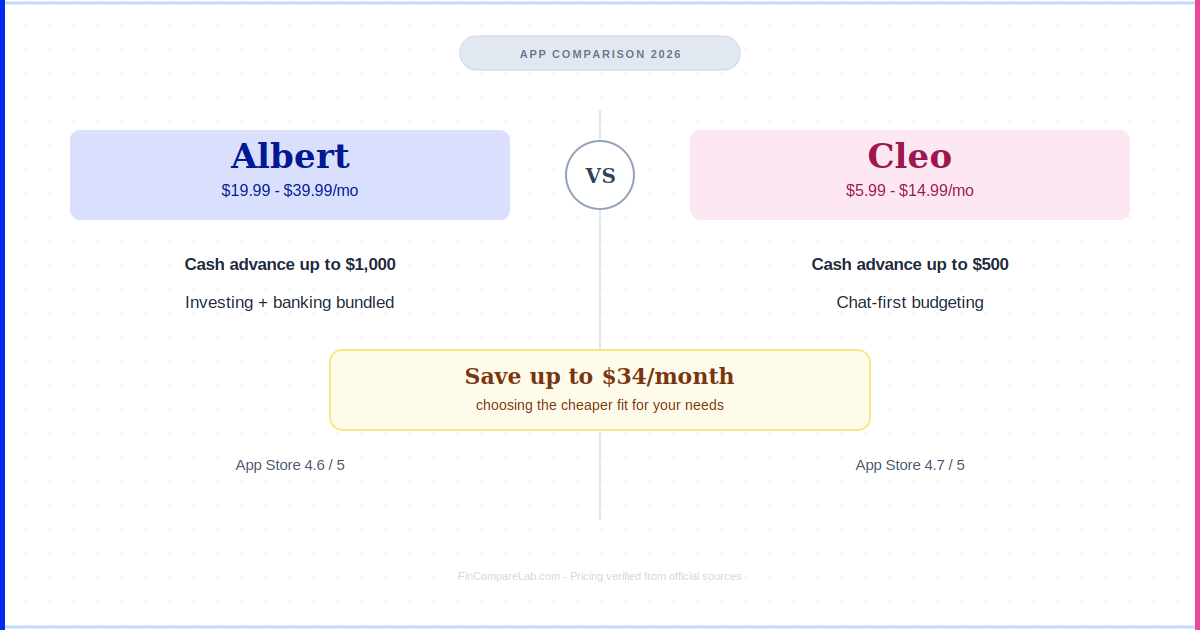
If you’re weighing Albert vs Cleo for your budget, the real question isn’t which app has more features. It’s whether Albert’s higher price actually buys you something Cleo doesn’t. This Albert vs Cleo comparison breaks down the pricing, the cash advance limits, and the trust record so you’re not guessing.
⚡ Quick Answer
Albert runs $19.99 to $39.99 a month for budgeting, investing, and banking in one app. Cleo runs $5.99 to $14.99 a month for chat-first budgeting and cash advances, with no investing at all. If you just want budgeting help and occasional advances, Cleo is the cheaper fit. If you want investing and banking under one roof, Albert’s higher price is doing more work.
How We Review Apps · Pricing verified from help.albert.com and web.meetcleo.com, 1 September 2026
Jump to:
- What’s the Albert vs Cleo Pricing Difference in 2026?
- What’s the Best Way to Save $34 a Month on One of These Apps?
- What Do You Actually Get for Albert’s Higher Price?
- Which App Gives You a Bigger Cash Advance?
- Which One Is Safer: Albert or Cleo?
- How Do You Cancel Albert or Cleo If You Change Your Mind?
- Can You Use Albert and Cleo Together?
- Albert vs Cleo: Which App Fits Your Situation?
- How Do Albert and Cleo Compare on Ratings?
- What Else Do People Ask About Albert vs Cleo?
What’s the Albert vs Cleo Pricing Difference in 2026?
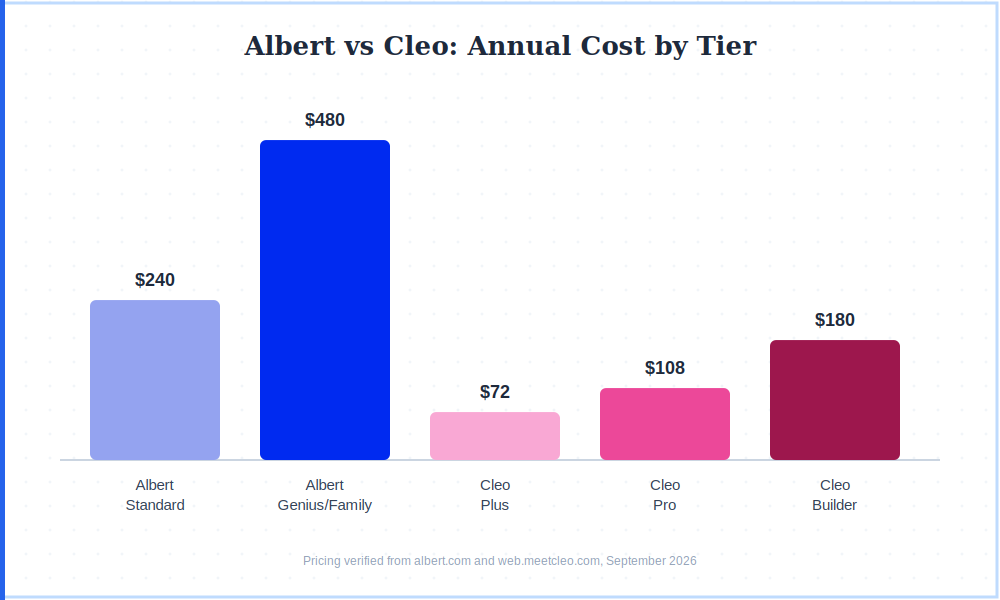
Albert costs $19.99 to $39.99 a month across its Standard, Genius, and Family tiers. Cleo costs $5.99 to $14.99 a month across Plus, Pro, and Builder. The gap runs $14 a month at the entry tier and $25 a month at the top tier, so Albert costs 2 to 4 times more than Cleo.
Here’s the full Albert vs Cleo tier-by-tier breakdown, including where that gap widens once you look at annual cost instead of the monthly sticker price.
| Tier | Albert | Cleo |
|---|---|---|
| Entry paid plan | $19.99/mo (Standard) | $5.99/mo (Plus) |
| Mid-tier plan | — | $8.99/mo (Pro) |
| Top plan | $39.99/mo (Genius or Family, up to 4 members) | $14.99/mo (Builder) |
| Free trial | 30 days, no card required | No formal trial; cash advance available without subscribing |
| Annual cost (top tier) | $479.88/yr | $179.88/yr |
Pricing verified from official websites, September 2026.
A lot of older content still lists Albert’s top tier at $14.99 a month. That figure is gone. Albert repriced Standard to $19.99 and Genius to $39.99.
Any Albert vs Cleo comparison built on the old number is working from the wrong math entirely. There’s also no separate “Basic” tier at $14.99, despite what a few third-party roundups still claim. Albert’s own help center lists exactly three tiers: Standard, Genius, and Family.
Run the annual math and the Albert vs Cleo gap widens fast. Albert’s top tier costs $479.88 a year. Cleo’s top tier costs $179.88 a year.
That’s a $300 difference. It’s enough to cover a month of groceries for most households, just for the option to use Albert’s investing and banking tools.
What’s the Best Way to Save $34 a Month on One of These Apps?
The single biggest lever is picking the tier that matches what you’ll actually use, not the tier with the most features. Comparing Albert Genius ($39.99) against Cleo Builder ($14.99) is the full $25 gap. Comparing Albert Standard ($19.99) against Cleo Plus ($5.99) is the full $14 gap. Either comparison nets real monthly savings if you’re not using the extra tier’s marquee feature.
Here’s the practical version. If investing is the reason you’re looking at Albert, keep it. Cleo has no brokerage feature at any price, so downgrading to Cleo to save money means giving up investing entirely, not just paying less for it.
But if you signed up for Albert Genius mainly for the cash advance, that’s the $34-a-month mistake worth avoiding. Albert’s advance now works without any subscription at all; you can request one without paying for Genius. That means the entire monthly fee for advance-only users is arguably unnecessary.
Downgrading to Albert Standard, or switching to Cleo Plus for its lower advance ceiling, is the actual best way to save $34 a month for that specific use case.
The other lever is billing cadence. Neither app currently discounts for paying annually up front. Both bill monthly at the same effective rate, so there’s no annual-plan trick to exploit here the way there is with apps like YNAB, which does offer a meaningfully cheaper annual rate. If you’re used to hunting for an annual discount, that instinct doesn’t pay off on either Albert or Cleo right now.
What Do You Actually Get for Albert’s Higher Price?
Albert and Cleo aren’t really building the same product. That’s the part of the Albert vs Cleo debate that gets lost when you only look at the sticker price. Albert is closer to a full financial platform. Cleo is a budgeting and cash-advance app with a chatbot personality bolted on top.
| Feature | Albert | Cleo |
|---|---|---|
| Budgeting & spend tracking | ✅ Yes | ✅ Yes, chat-based |
| Investing (stocks/ETFs) | ✅ Yes, via Albert Investments | ❌ Not offered |
| Banking / spending account | ✅ Yes, via Stride Bank, N.A. | ⚠️ High-yield savings only, via Thread Bank |
| AI assistant | ✅ “Genius” AI financial assistant | ✅ Conversational chatbot (core identity) |
| Credit-building tools | ⚠️ Limited | ✅ Secured Cleo Card (Builder tier) |
| High-yield savings APY | ⚠️ Standard rate, not separately marketed | ✅ 2.75% APY (Pro and Builder) |
If investing is on your radar at all, even casually, that’s where Albert earns its keep. Cleo has no brokerage feature whatsoever; it isn’t trying to be one.
For someone starting to think about net worth beyond a checking account, that gap matters more than the raw dollar difference suggests. If tracking net worth across accounts is your actual goal rather than active investing, it’s worth comparing Albert against a dedicated net worth tracking app before assuming Albert is the only option.
On the flip side, if you never plan to invest through the app and just want spend tracking, savings nudges, and an occasional cash cushion, you’re paying Albert’s investing premium for a feature you won’t touch. Albert’s own help center lists Standard’s benefits as investing, identity protection, credit score monitoring, cash back rewards, and fee-free ATM access.
Worth noting: some older reviews still describe Albert Genius as including sessions with outside financial planners, or estate-planning add-ons like wills and tax filing. That’s not accurate for Albert. Those are the kind of paid add-ons you’ll find on a dedicated planning-focused app instead, not on Albert’s own pricing page.
Albert’s Genius tier is also worth a specific note. As of Albert’s most recent update, Genius is described purely as an AI-powered financial assistant, not access to a live human advisor.
If a review promises “real financial experts” as part of Albert’s subscription, that’s likely describing an earlier version of the product. Cross-check the claim against Albert’s current help center before treating it as a reason to subscribe.
Cleo counters with gamification Albert doesn’t attempt. Money IQ is a weekly quiz about your own spending habits with a $4,000 grand prize, plus twenty $25 runner-up prizes, on the line. Autopilot automates savings moves toward a goal you set once.
Neither feature moves the needle financially the way investing does. But they’re part of why Cleo’s chat-first approach sticks for people who find traditional finance apps boring enough to abandon. If gamified saving habits are what actually keep you engaged, it’s worth reading how Cleo stacks up in a broader Cleo alternatives roundup before committing to either app.
Which App Gives You a Bigger Cash Advance?
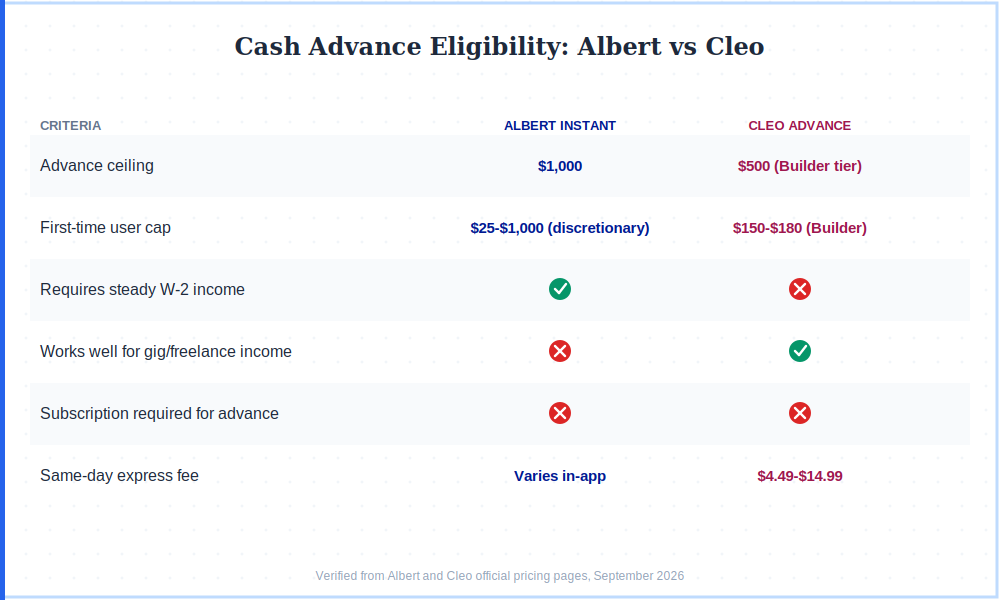
Both apps offer cash advances, but the ceilings and eligibility rules are very different. This is one of the sharpest lines in the whole Albert vs Cleo comparison. Albert Instant goes up to $1,000. Cleo tops out at $500 on its priciest plan, and most users see far less than either app’s advertised maximum.
Albert Instant
$25–$1,000 · no subscription required · requires an Albert Cash account with Smart Money set to automatic · eligibility leans on steady, verifiable income.
Cleo Advance
$20–$250 on Plus/Pro (first-time users $20–$100) · up to $500 on Builder for existing users who direct-deposit at least $750/month · first-time Builder users are capped at $150–$180, not the full $500.
That Builder detail matters and gets glossed over in a lot of Albert vs Cleo comparisons: the $500 ceiling is not available to a brand-new Builder subscriber. You need an existing account with a qualifying direct deposit before Cleo unlocks the top of that range. A first-time user signing up for Builder specifically to chase the $500 figure will be disappointed on day one.
The eligibility difference is the real story here. Albert wants to see steady, verifiable income flowing through its Cash account before it opens up the higher end of that $1,000 range. Cleo doesn’t require traditional employment verification, which makes it a genuinely better fit if you’re freelancing, doing gig work, or dealing with irregular income.
Neither advance is free money to access quickly. Cleo charges an express fee for same-day delivery. Cleo’s own pricing page and app store listings show slightly different figures here: $4.49 to $14.99 on the pricing page versus $3.99 to $14.99 on the App Store listing. Treat the low end as approximate until you check the in-app checkout screen.
Daily disbursement on Plus/Pro is capped at $170 even if you’re approved for more, so a $250 approval can mean multiple daily requests. Cleo lets you pick a repayment date between 3 and 14 days out; the standard transfer is free but takes 3 to 4 business days.
Albert doesn’t charge interest on Instant, but a Genius subscription still unlocks the higher advance tiers even though the advance itself no longer strictly requires a subscription. So you’re paying for broader access, not per-use.
This lines up with the general pattern reported across independent cash-advance app reviews: freelancers and gig workers tend to qualify more easily with Cleo than with income-verification-heavy apps like Albert, precisely because Cleo doesn’t require a W-2-style paycheck pattern.
If irregular income is your main financial reality, that’s a bigger factor in the Albert vs Cleo decision than either app’s headline advance ceiling. For a deeper look at Albert’s advance mechanics specifically, my Albert pricing guide breaks down exactly how the $25–$1,000 range gets calculated.
Which One Is Safer: Albert or Cleo?
Both apps have documented complaint patterns. This isn’t a case of one being clean and the other risky. Both are worth knowing about before you hand over your bank login, since safety is the part of the Albert vs Cleo decision that’s easiest to skip past when you’re focused on price.
Cleo’s biggest black mark is regulatory. In March 2025, the Federal Trade Commission announced that Cleo AI agreed to a $17 million settlement: $10 million in consumer redress and a $7 million civil penalty.
The FTC alleged Cleo advertised cash advances “up to $250” or “up to $500” while most users received far smaller amounts, and that it made subscriptions difficult to cancel. According to the FTC’s own case file, the matter is still listed as pending in the Southern District of New York rather than fully closed.
Cleo disputes the underlying allegations, but the settlement still requires clearer upfront disclosures and an easier cancellation path going forward.
Albert hasn’t faced FTC action, but its most common verified complaint is similar in spirit: users report that Albert requires you to zero out all linked balances before your account will let you fully deactivate.
Multiple independent review sites and app store complaint threads describe this same friction pattern. Cancellation requests get stalled behind an outstanding Cash, Savings, or Instant balance that has to hit zero first. If legitimacy and cancellation friction are your main concern rather than price, it’s worth reading a broader app-safety due-diligence checklist that applies the same questions to a different category of app.
Practically, the same advice applies to both: read the cancellation terms before you subscribe, and don’t assume “cancel anytime” means cancel instantly. Both apps use standard bank-connection technology and encryption; neither has a track record of data breaches specifically.
Is Cleo Legit After the FTC Settlement?
Yes. Cleo is still operating and disputes the FTC’s allegations, but the settlement requires clearer upfront disclosures and an easier cancellation path. The case remains listed as pending rather than closed, and the settlement didn’t shut Cleo down or find the app unsafe to use in a general sense.
How Do You Cancel Albert or Cleo If You Change Your Mind?
Given the complaint history on both sides, it’s worth knowing the actual cancellation steps before you’re stuck figuring them out mid-frustration. This is the part of the Albert vs Cleo comparison most people only research after they’ve already subscribed.
Albert requires you to zero out every linked balance: paying off any outstanding Instant advance and withdrawing remaining funds from your Albert Cash account, before the app lets you fully deactivate. Until that’s done, the subscription keeps billing.
Budget a few extra days to settle balances if you’re planning to cancel around a billing date. Full steps are in my how to cancel Albert subscription guide.
Cleo’s post-settlement process is meant to be simpler. The FTC’s consent order specifically requires Cleo to provide a straightforward cancellation path and to stop blocking users with outstanding advances from canceling. In practice, paying off any active Cleo advance first still avoids back-and-forth some users reported before the settlement.
Either way, cancel through the app itself rather than just deleting it from your phone. Uninstalling doesn’t stop the subscription charge on either platform.
Can You Use Albert and Cleo Together?
Yes, and it’s not unusual. Albert vs Cleo doesn’t have to be a strictly either/or decision. Since the two apps don’t overlap much, some people run both without issue: Albert leans into investing and banking, and Cleo leans into chat-based budgeting and advances.
Doubling up rarely makes financial sense once you factor in the subscription cost, though. If you’re already paying Albert Genius at $39.99 a month, adding Cleo Builder at $14.99 a month for its credit-building card puts you at nearly $55 a month across two apps.
That’s more than most people pay for actual banking. It only makes sense if you’re specifically after Cleo’s secured card and Albert doesn’t offer an equivalent credit-building tool.
The more common pattern is people testing both Albert and Cleo during their respective trial or no-subscription windows, then keeping whichever one matched their actual habits, not running both long-term.
If you’re weighing a third option that isn’t either app, the best budgeting apps for couples roundup and the best free budgeting apps guide both cover ground that neither Albert nor Cleo fully addresses.
Albert vs Cleo: Which App Fits Your Situation?
The honest answer depends less on features and more on what you’re actually trying to solve. Here’s how I’d sort Albert vs Cleo.
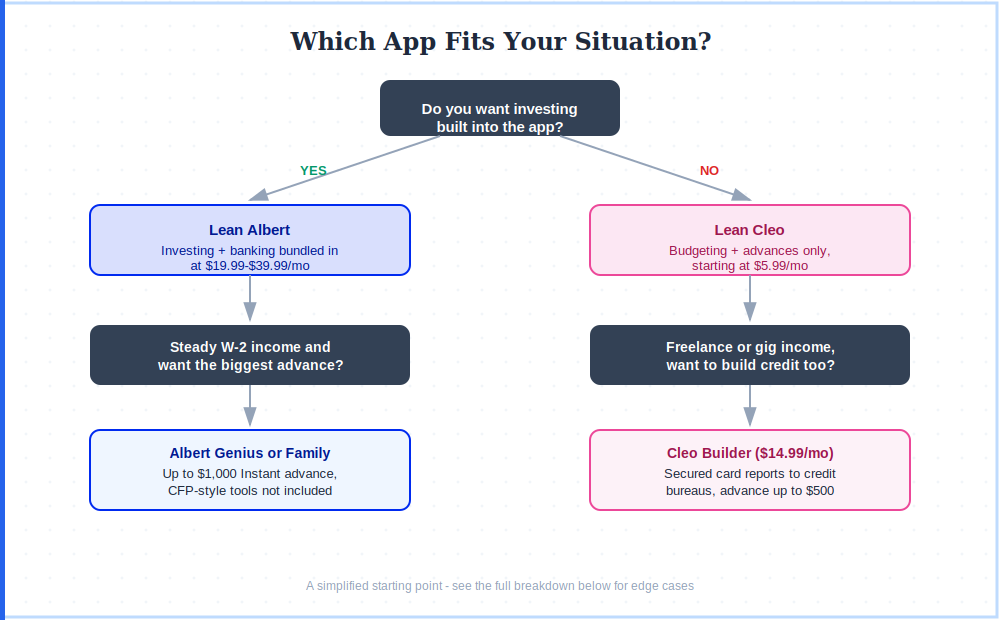
Choose Albert if:
You want investing and banking bundled with budgeting · you have steady, verifiable income · you might need a cash advance up to $1,000 · you don’t mind paying more for broader access rather than per-use.
Choose Cleo if:
You’re on a tight budget and want the cheapest paid tier · you’re a freelancer with irregular income · you want to build credit with a secured card · you like a conversational, low-intimidation interface.
For couples splitting rent and building a joint budget, neither app is purpose-built the way Monarch Money is. It’s worth a look if that’s your main use case.
For someone paying off debt on a single income, Cleo’s Debt Reset feature and lower price point probably beat Albert’s investing tools you won’t touch yet. My debt payoff guide walks through the avalanche-versus-snowball math either app’s users tend to ask about.
Students and early-career readers weighing Albert vs Cleo for the first time should factor in how much of the subscription they’ll realistically use. Someone with a first paycheck and no investments yet gets more value per dollar from Cleo’s $5.99 tier than from Albert’s $19.99 tier sitting mostly idle.
Someone a few years further along, already investing casually elsewhere, might consolidate into Albert instead of running two separate apps.
Which App Is Cheaper, Albert or Cleo?
Cleo is cheaper at every tier. Its entry plan is $5.99 a month versus Albert’s $19.99, and its top plan is $14.99 a month versus Albert’s $39.99. That’s a gap of $14 to $25 a month depending on which tiers you compare.
How Do Albert and Cleo Compare on Ratings?
Both apps rate well publicly, though neither is flawless once you dig into the complaint patterns above. Ratings alone won’t settle Albert vs Cleo for most readers.
| Source | Albert | Cleo |
|---|---|---|
| App Store (lifetime average) | ~4.6/5 | ~4.7/5 |
| Google Play (lifetime average) | ~4.5/5 | ~4.4/5 |
| FinCompareLab rating | 3.9/5 | 3.8/5 |
App store figures are lifetime averages and can shift week to week. Check the live listing for the current number before making a decision based on rating alone.
Ratings are one of the few places the Albert vs Cleo comparison genuinely comes out close to a tie. The app store scores are close enough that they don’t really settle the question on their own.
My lower editorial ratings for both come down to the same theme: cancellation friction and unclear advance eligibility, not the core budgeting functionality, which works fine on both. If ratings alone decided it, this Albert vs Cleo comparison would be a toss-up. The real deciding factor is still what you personally need from the app.
What Else Do People Ask About Albert vs Cleo?
A few questions come up often enough that they’re worth answering directly, starting with the one everyone actually wants answered about Albert vs Cleo: which app is better for your specific situation, not in general.
Is Albert or Cleo Better Overall?
Neither is better in every case. Albert is better if you want investing and banking bundled in; Cleo is better if you want the cheapest paid tier and don’t need investing at all.
Does Cleo Affect Your Credit Score?
Only if you use the Cleo Builder secured card, which reports to all three credit bureaus. The free tier and lower paid tiers don’t report activity to credit bureaus on their own.
Can Freelancers Use Albert Instant?
Yes, but Albert’s eligibility check leans on verifiable, recurring deposits, which can make freelancers and gig workers qualify for smaller amounts than traditional W-2 employees do.
Do Albert and Cleo Both Require a Bank Connection?
Yes, both apps connect to your bank accounts to function: Albert for budgeting, banking, and investing, and Cleo for chat-based budgeting and cash advance eligibility checks.
Is There a Free Version of Albert or Cleo?
Albert doesn’t have a free tier of meaningful functionality; it offers a 30-day free trial instead, after which a paid plan is required. Cleo lets you request a cash advance without subscribing at all, though budgeting and credit-building tools sit behind its paid tiers.
Cleo Free Trial 30 Days: Does It Actually Exist?
No, not in the way people usually mean it. Cleo doesn’t structure its onboarding as a trial at all. There’s no 30-day countdown or trial-then-bill model the way Albert works. Instead, Cleo lets you request a cash advance without subscribing to anything, and its Plus, Pro, and Builder tiers each bill from day one once you choose to subscribe.
Does Cleo Have a Free Trial the Way Albert Does?
No. If you were expecting a free month before being charged the way Albert’s 30-day trial works, Cleo doesn’t offer that. You either use the no-subscription advance path or start paying immediately on Plus, Pro, or Builder.
Albert App vs Cleo: Which Has the Better Mobile Experience?
Both apps are native iOS and Android experiences with app store ratings within a few tenths of a point of each other, so neither wins decisively on raw usability. Albert app vs Cleo really comes down to interface philosophy: Albert organizes around dashboards and account tiles, closer to a traditional banking app, while Cleo runs almost entirely through chat.
Some people find Cleo’s chat interface faster; others find it slower for a simple task like checking a balance. If you want a quick glance at numbers, Albert’s layout gets you there in fewer taps. If you’d rather ask a question and get a plain-language answer, Cleo’s chat interface is built for that.
Cleo vs Albert: Which Do Freelancers and Reddit Communities Recommend?
Cleo vs Albert comes up often in freelancer-focused personal finance communities, and the consensus leans toward Cleo for anyone without a steady W-2 paycheck. That’s because Cleo doesn’t require the same recurring-deposit pattern Albert’s eligibility check looks for.
Albert still gets recommended by freelancers who want investing and banking bundled together despite the stricter advance eligibility. Community discussion around debt payoff and irregular income tends to favor whichever app matches income stability rather than crowning one app universally better.
Is Albert Worth $480 a Year?
It depends entirely on whether you use the investing and banking features. If you only want budgeting and occasional cash advances, $480 a year is hard to justify next to Cleo’s $180. If you’re actively investing through Albert, the math looks different.
Whichever way you land on Albert vs Cleo, don’t subscribe to either app’s top tier before testing the free trial or the no-subscription advance option first.
If you’re still deciding between structured budgeting apps more broadly, my YNAB review is worth a look, and if debt payoff is part of your decision, try the debt payoff estimator to see how either app’s cost fits your bigger picture.
For a closer look at either app on its own, my full Albert review and Cleo review cover more ground than a head-to-head can. The Albert pricing guide and Cleo pricing guide break down every tier in more depth than fits here.
If neither app feels right after this Albert vs Cleo breakdown, the best Albert alternatives and best Cleo alternatives roundups cover the rest of the field.
