
⚡ Quick Verdict
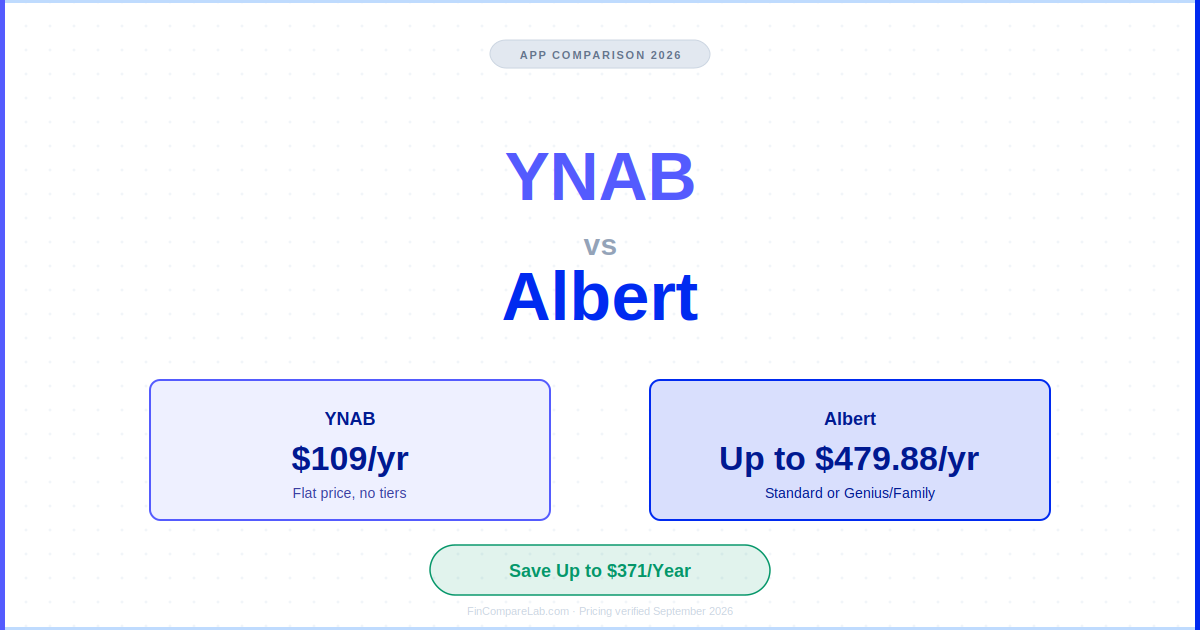
YNAB is the smarter buy at $109/year if what you actually want is a system that makes you plan every dollar before you spend it. Albert can still be worth its higher price if you need cash advances, automated saving, and light investing bundled into one app, but at $479.88/year for its top tier, you’re paying up to $371 more for features YNAB never tries to offer.
How We Review Apps · Pricing verified from ynab.com and help.albert.com — 3 September 2026
In this YNAB vs Albert comparison:
- What Do YNAB and Albert Actually Do?
- How Do YNAB and Albert Compare on Price in 2026?
- Which App Wins on Core Budgeting Features?
- Which App Wins for Cash Advances and Banking?
- Are YNAB and Albert Safe to Use?
- Which App Is Better for Debt Payoff?
- Which App Is Better for Couples?
- What Do Reddit and App Store Reviews Say?
- Can You Use Both Apps Together?
- Which App Should You Choose?
- What Are the Most Common Questions About YNAB vs Albert?
What Do YNAB and Albert Actually Do?
YNAB is a dedicated zero-based budgeting app built around one job: you assign every incoming dollar a purpose before you spend it. Albert is a broader financial app that bundles budgeting with a checking account, cash advances up to $1,000, automated savings, and optional investing, all sitting behind an AI assistant called Genius.
Read the full breakdown in my YNAB review and my Albert review if you want the deeper dive on either app alone.
In short: YNAB is a budgeting method you commit to. Albert is a financial toolbox you dip into when you need one specific thing. The YNAB vs Albert decision only gets easy once you know which of those two things you actually need this year.
Where the two overlap, in any ynab vs albert breakdown, is basic transaction syncing and categorization. Both connect to your bank and sort spending automatically.
Where they split apart is depth. YNAB goes deep on a single job, budgeting discipline, and refuses to be anything else. Albert spreads itself thin across banking, saving, investing, and short-term credit, and does each one at a “good enough” level rather than a best-in-class one.
Picture the two most common situations people land in when they search ynab vs albert, or type the reverse order, albert vs ynab, into Google. If you just got your first real paycheck and want a system that stops money from quietly disappearing between paydays, YNAB’s structure, covered in detail in my YNAB four rules guide, is built for exactly that scenario.
If you’re already reasonably good with money but want one app that also covers an emergency cash cushion, a savings account that moves money on autopilot, and some light investing once you’re past your 20s, Albert’s bundle starts making more sense, even at the higher price.
Neither app fits you if a permanent free tier is non-negotiable. If that’s the priority, apps like Goodbudget or EveryDollar are the better starting point in a ynab vs albert search, both covered in my best free budgeting apps roundup.
Here’s how the choice tends to break down by situation:
- First job, first budget: YNAB’s guided four-rule system teaches the habit from scratch, explained fully in my YNAB for beginners guide
- Splitting rent with a partner: YNAB’s per-category funding shows a shortfall before it happens; Albert shows it in your transaction history after the fact
- Paying off debt on a tight timeline: YNAB’s zero-based method redirects spare dollars toward payoff automatically; Albert’s advances only patch short-term gaps
- Saving for a house or starting to invest in your 30s: Albert’s automated savings and guided investing cover both in one subscription; YNAB covers neither
How Do YNAB and Albert Compare on Price in 2026?
YNAB charges a flat $109/year (or $14.99/month) no matter which features you use, with no tiers. Albert prices by plan: Standard runs $239.88/year and Genius or Family runs $479.88/year. That’s a real $370.88 gap, roughly $371, between YNAB and Albert’s top tier, for a single year of service.
See my full YNAB pricing guide and Albert pricing guide for every tier broken down individually. Any ynab vs albert pricing comparison, or albert vs ynab if you’re searching it the other way around, has to start with that asymmetry: one app has a single price, the other has three.

| YNAB | Albert | |
|---|---|---|
| Monthly price | $14.99/mo | $19.99/mo (Standard) or $39.99/mo (Genius/Family) |
| Annual price | $109/yr | $239.88/yr (Standard) or $479.88/yr (Genius/Family) |
| Free trial | 34 days, no card required | 30 days, no card required upfront |
| Free tier | ❌ None | ❌ None (cash advance works without a paid plan) |
| Sharing | ✅ Up to 6 people, no extra fee | ✅ Up to 4 family members on the Family plan |
| Student discount | ✅ Free for 12 months via SheerID | ❌ Not offered |
Pricing verified from official websites, September 2026.
Sit with this number for a second, since it’s the whole reason a ynab vs albert price comparison matters: pay for YNAB annually and you’re at $109 for the year. Pay for Albert’s Genius or Family tier annually and you’re at $479.88. That’s $370.88, call it $371, for twelve months of service. If budgeting is genuinely all you need, that’s $371 going toward features you’ll never open.
Broken down monthly, YNAB’s annual plan works out to about $9.08/month, close to the price of two coffees. Albert’s Genius or Family tier runs close to $40/month, more like a full week of coffee runs.
Neither figure sounds unreasonable in isolation, but the gap compounds. Stay on each app for three years and the difference adds up to over $1,100 in extra Albert subscription cost, the clearest single number in this whole ynab vs albert comparison.
If you’re only weighing YNAB against Albert’s cheaper Standard plan, the gap narrows to about $130.88/year, $239.88 versus $109. Still real money, but a far easier number to justify if you specifically want Albert’s cash account and Instant advance access, which is really what an albert vs ynab search is usually about once price stops being the only question.
A lot of budgeting content online still quotes Albert at its old $14.99/month price across every tier. Albert repriced to $19.99/month for Standard and $39.99/month for Genius and Family, so if you’re comparing quotes from other sites, check the date before trusting the number.
One pricing myth worth clearing up on YNAB’s side, since it’s repeated often enough to have become conventional wisdom: subscribing through the Apple App Store does not push your price up to $179/year. A direct check of YNAB’s current US App Store listing shows the in-app purchase prices match ynab.com exactly, $14.99/month and $109/year, with no platform markup.
The real $70/year gap some people cite comes from comparing monthly billing to annual billing, not from where you sign up: $14.99 times 12 months is $179.88, while the annual plan is $109, a genuine $70/year savings that YNAB itself advertises with a “$70 Savings!” badge on its own pricing page.
Pay annually, on ynab.com or through the App Store, and the price is the same either way. It’s one of the more persistent myths in ynab vs albert content across the web, and worth retiring for good.
Which App Wins on Core Budgeting Features?
For budgeting specifically, YNAB wins outright. Its four-rule system, give every dollar a job, embrace true expenses, roll with the punches, age your money, is built around changing behavior, not just displaying it. Albert’s dashboard reacts to spending after it happens; YNAB’s structure is designed to stop bad spending before it starts.
- ✅ YNAB: category-based zero-based budgeting, rollover categories, goal tracking, a loan payoff simulator
- ✅ Albert: automated spending categorization, a “safe to spend” style dashboard, savings automation
- ❌ Albert doesn’t ask you to plan spending in advance the way YNAB does; it reports on spending after the fact instead of shaping it beforehand
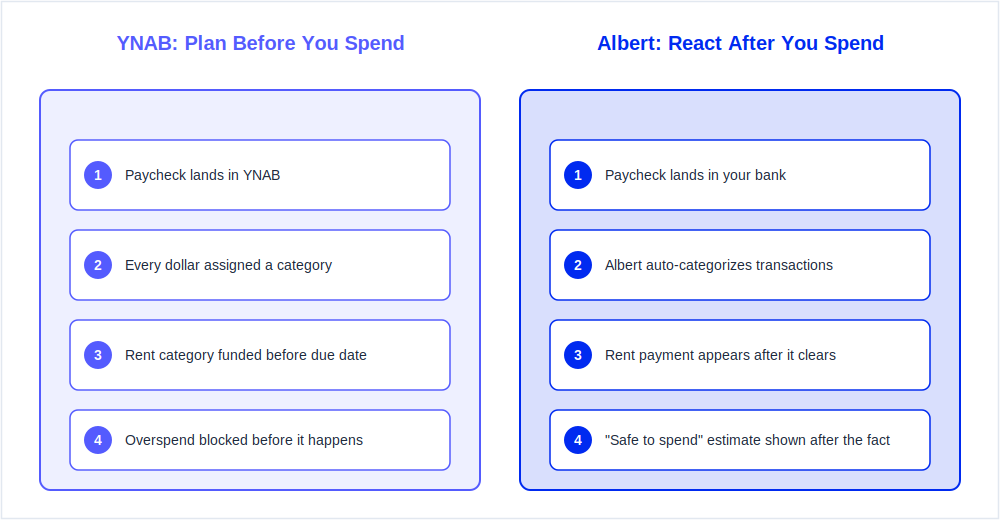
If your goal is to build an active, hands-on habit of planning every paycheck before it lands, YNAB’s structure does that job on purpose. Albert’s dashboard functions closer to a smart mirror on your spending than a system built to redirect it. On core budgeting features, this ynab vs albert comparison isn’t close.
The daily-use gap in ynab vs albert shows up clearest in ordinary moments. Picture splitting rent with a partner for the first time. With YNAB, you’d build a rent category, fund it before the money can go anywhere else, and see immediately if you’re short before the due date arrives.
With Albert, the rent payment shows up in your transaction history after it clears, next to an automated “safe to spend” estimate that’s useful for awareness but won’t stop you from spending that same money on something else first.
Which App Wins for Cash Advances and Banking?
This is the one category where YNAB doesn’t compete at all. Albert’s Instant cash advance offers $25 to $1,000 with no interest, and as of this year no longer requires a paid Genius subscription to access. Albert also runs a full cash account with early direct deposit through its banking partners. YNAB has no banking layer whatsoever; it plans money that already sits somewhere else.
Beyond the albert instant cash advance product, Albert also offers an Instant Line of Credit and an Instant Loan for larger amounts, products YNAB has no equivalent for since it isn’t a lender or a bank in any sense.
If you search albert cash advance specifically, this is the feature people are usually trying to understand before signing up, and it’s the single biggest reason anyone picks Albert over YNAB in the first place.
If you’re in your early-to-mid 20s and still building a financial cushion, Albert’s combination of advance access plus automated savings can genuinely help you sidestep an overdraft fee while your budget gets under control, a use case my irregular income budgeting guide also covers from the YNAB side.
If you’re past that stage with stable savings and a predictable paycheck, you’re paying for a safety net you may never touch, which is really the crux of any albert cash advance decision.
For a closer look at how Albert’s advance stacks up against a similar feature elsewhere, my Albert vs Rocket Money comparison covers that specific matchup, and it’s worth reading if the albert instant cash advance feature is what brought you to this ynab vs albert page in the first place.
Are YNAB and Albert Safe to Use?
Both apps are safe, but in different ways. YNAB syncs data through Plaid and never holds your money directly; it’s read-only software layered on top of accounts you already control. Albert goes further: its Cash and savings balances carry FDIC insurance up to $250,000, and its investing arm carries SIPC protection up to $500,000.
That SIPC protection covers broker failure, not market losses on whatever you’ve invested, a distinction worth keeping straight before you link anything.
Albert’s banking setup is worth understanding precisely, since it’s changed more than once and older reviews online often get it wrong. Albert currently operates through three separate bank partners: Sutton Bank, Stride Bank, N.A., and Wells Fargo, N.A., all active at the same time rather than one replacing another in sequence.
If you’ve read an older comparison claiming Stride simply took over from Sutton, that’s an outdated version of the story; the current structure runs all three in parallel.
Neither setup is inherently unsafe, but the risk they carry is different in kind. YNAB never touches your money at all. Albert directly holds and moves it.
If you’re investment-tracking-curious in your 30s and want that feature bundled into the same app, Albert’s SIPC-covered brokerage is a reasonable entry point, just know you’re taking on market risk that has nothing to do with the app itself.
Security shouldn’t be the deciding factor in a ynab vs albert decision either way; both are legitimate, regulated products with real institutional backing. That question comes up often enough in albert vs ynab searches that it’s worth stating plainly.
Is Albert Legit and Safe to Link My Bank To?
Yes. Albert is a legitimate, regulated financial app, not a scam or an unlicensed lender. Its cash and savings balances carry FDIC insurance through its bank partners, and its cash advance product charges no interest, which separates it from the payday-loan category some people worry it resembles at first glance.
Which App Is Better for Debt Payoff?
YNAB is the stronger debt-payoff tool. Its zero-based system forces every spare dollar into a category before it can disappear into random spending, which directly supports snowball or avalanche payoff strategies. Albert can only help around the edges, mainly by covering a short-term gap with an interest-free advance so a missed payment doesn’t trigger a late fee.
YNAB vs Albert decision box: Debt payoff
Choose YNAB if you want a system that forces you to redirect every spare dollar toward debt before it disappears into everyday spending. Choose Albert only if you need occasional interest-free cash advances to avoid overdrafts while you pay debt down; it isn’t built as a debt-payoff planner on its own.
Community sentiment on budgeting forums consistently points to YNAB as the app people credit with breaking a paycheck-to-paycheck cycle, largely because its structure won’t let leftover money quietly vanish the way passive-tracking apps allow. On the debt-payoff question specifically, this ynab vs albert comparison has a clear winner.
For a broader look at apps built specifically around this goal, my best budgeting apps for debt payoff roundup covers several alternatives beyond just this matchup.
Which App Is Better for Couples?
For couples specifically, this ynab vs albert comparison tilts hard toward YNAB on cost-per-person. One $109/year subscription covers up to 6 people, which works out to about $18/person/year split six ways, or roughly $54.50/person for a two-person household. Albert’s Family plan covers up to 4 members for $479.88/year combined, a fixed household price that doesn’t scale down the same way for just two people.
YNAB vs Albert decision box: Couples
YNAB’s single subscription splits far more cheaply between two people than Albert’s Family plan does, since Albert’s $39.99/month price stays fixed whether 2 or 4 people are actually using it. On pure cost-per-person, YNAB wins the couples side of this comparison outright, though my best budgeting apps for couples guide is worth a look if joint banking features matter more to you than price.
What Do Reddit and App Store Reviews Say?
On the community side of this ynab vs albert comparison, sentiment is fairly consistent across both apps. A recurring theme in budgeting subreddits is that YNAB draws the most loyalty from people who commit to its method for at least a few months straight, while its price is the most common complaint from people who quit early.
Albert draws more mixed reactions: users who mainly want the cash advance tend to question whether the subscription is worth carrying, while users who lean on the savings automation report more consistent satisfaction. It’s a split that shows up just as often in albert vs ynab discussions as it does here.
On the app store side, Albert’s ratings sit at 4.6/5 on the App Store from roughly 312,000 ratings, and 4.5/5 on Google Play from around 154,000 reviews. The most consistent complaint across both platforms is cancellation difficulty.
Albert requires you to zero out all linked balances before your account will fully deactivate, a step that catches a lot of people off guard, and one my guide to canceling Albert walks through directly.
YNAB doesn’t carry that same friction. Since it never holds your money, canceling simply stops billing with no balance requirements attached. That’s a real difference if you’re the type who wants an easy exit if a tool doesn’t work out.
On the flip side, YNAB users who abandon the zero-based method partway through often report the subscription feeling wasted, since the software does very little without active, ongoing engagement from you.
Does Albert Offer Investing Like a Robo-Advisor?
Yes. Albert’s Genius and Family tiers include guided investment portfolios and individual stock and ETF access starting from as little as $1. YNAB has no investing features at all, since it’s strictly a budgeting tool rather than a brokerage or savings platform.
Can You Use Both Apps Together?
Yes, and plenty of people genuinely do run both sides of this ynab vs albert comparison at once. It’s common to keep YNAB as the primary budgeting system while using Albert strictly for its Instant cash advance or its higher-yield savings account, without paying for Albert’s Genius tier at all.
The catch is cost. Running YNAB alongside Albert’s Standard or Genius plan means paying for two subscriptions instead of one. That only makes sense if each app is doing a distinct job it’s genuinely good at, not as a way to hedge your bets between two tools that overlap. It’s a question that comes up almost as often as the core albert vs ynab pricing debate itself.
Which App Should You Choose?
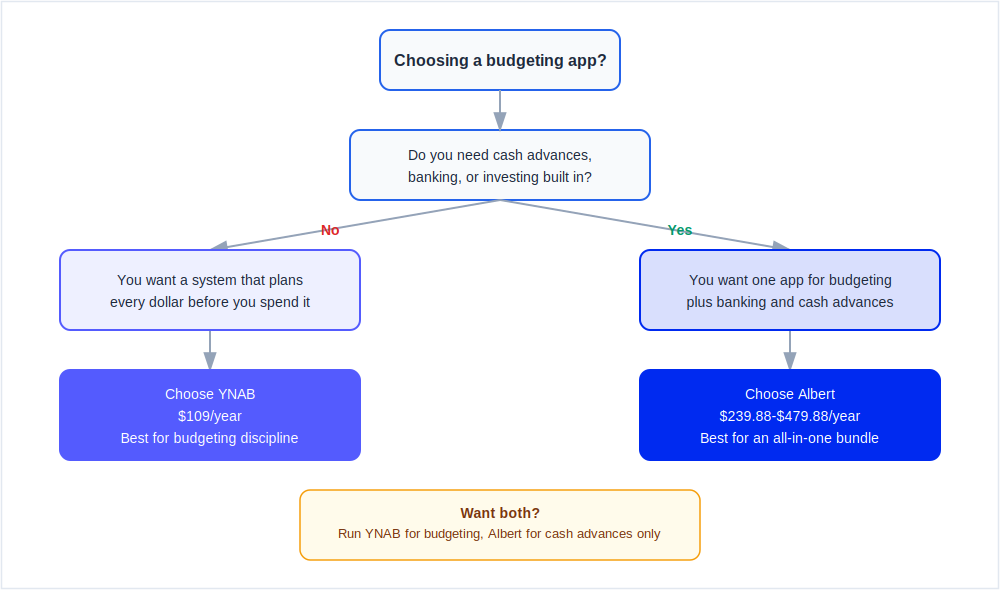
Pick YNAB if budgeting discipline is the actual goal. It’s cheaper, it’s the higher-rated app in this ynab vs albert comparison, and it’s purpose-built for exactly this job. Pick Albert only if you specifically need its banking, cash advance, or investing features enough to justify paying up to $371 more per year to get them.
Final YNAB vs Albert decision box
For most people searching ynab vs albert, the honest answer is that you’re not really choosing between two budgeting apps. You’re choosing between a budgeting method and a financial services bundle that happens to include light budgeting. Once that’s clear, the $371 price gap makes a lot more sense.
If you’re still weighing the YNAB side of this ynab vs albert decision, my YNAB ROI calculator can show whether the $109/year pays for itself based on your own numbers, and my debt payoff estimator is worth running regardless of which app you land on.
If neither app feels quite right after all this, my best YNAB alternatives and best Albert alternatives roundups cover other directions worth a look, and my Albert vs Cleo comparison is a useful next read if Albert’s cash-advance category, not budgeting, is what actually brought you to an albert vs ynab search in the first place.
For a completely different kind of YNAB matchup, one focused on net-worth tracking instead of cash advances, see my YNAB vs Monarch Money comparison.
What Are the Most Common Questions About YNAB vs Albert?
These are the questions that come up most often around the ynab vs albert matchup, based on the pricing and feature breakdown above.
Is Albert Worth It Compared to YNAB?
Albert is worth it compared to YNAB only if you need its banking, cash advance, or investing features. For budgeting alone, YNAB is the cheaper and more focused choice at $109/year, with nothing extra to weigh against it.
Why Is Albert So Much More Expensive Than YNAB?
Albert costs more because it bundles a checking account, an albert cash advance product, savings automation, and optional investing into one subscription. YNAB charges only for its budgeting software and doesn’t try to be anything else. This is really the whole answer to is albert worth it once you compare the two feature sets directly.
Does YNAB Offer Cash Advances Like Albert?
No. YNAB has no banking features at all, and no version of an albert cash advance equivalent exists anywhere in the app. It’s strictly a budgeting tool that connects to accounts you already have elsewhere, with no lending or advance product of its own.
Can I Use YNAB and Albert at the Same Time?
Yes. Some users run YNAB for budgeting and Albert only for its Instant cash advance or savings account, though that means paying for both subscriptions rather than picking one.
Which App Is Better for Paying Off Debt, YNAB or Albert?
YNAB is generally the stronger choice, since its zero-based system is built to redirect spare dollars toward debt rather than letting them disappear into everyday spending. Albert only helps at the margins with occasional advances.
Does Albert Have a Free Version Like YNAB’s Trial?
Albert doesn’t offer a permanent free tier, but it does provide a 30-day free trial with no card required upfront, similar in spirit to YNAB’s 34-day trial period.
Is YNAB or Albert Better for Budgeting Beginners?
YNAB has a steeper learning curve but teaches an actual budgeting method from day one. Albert’s automated dashboard is easier to start using immediately, but it doesn’t build the same active budgeting habit over time.
What Bank Does Albert Actually Use for Its Cash Account?
Albert currently runs its Cash account and advance products through three bank partners at once: Sutton Bank, Stride Bank, N.A., and Wells Fargo, N.A. Older reviews describing a simple switch from one partner to another no longer reflect the current setup.
📚 Read Next
