
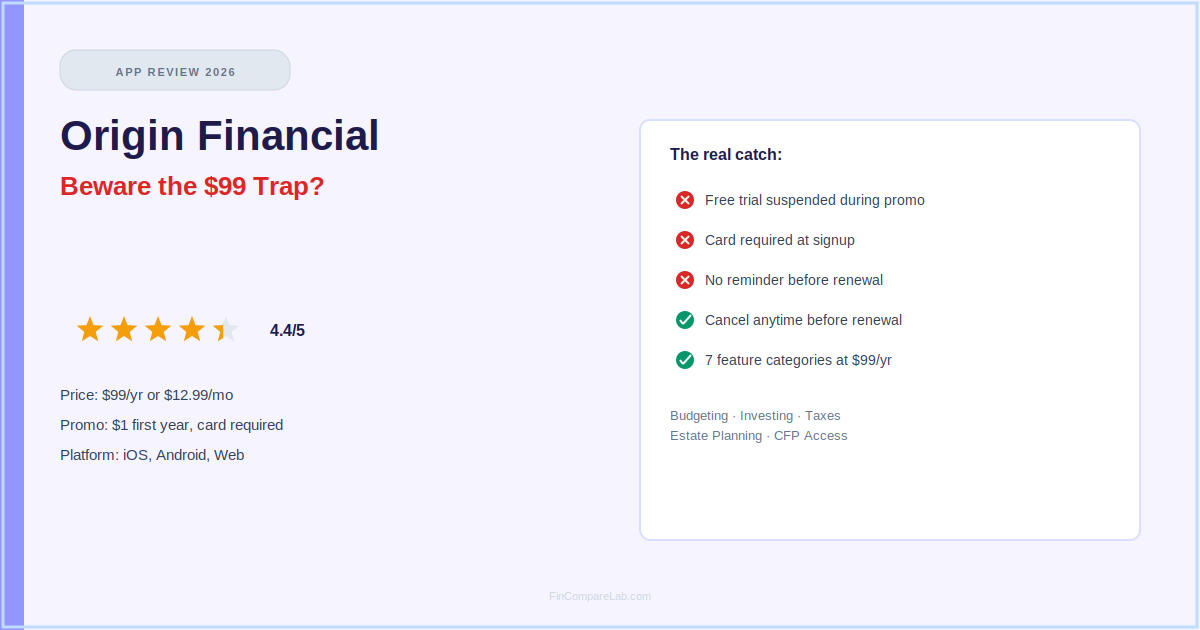
⚡ Quick Verdict
This is one of the most ambitious all-in-one finance apps available right now, combining AI budgeting, investment tracking, free tax filing, estate planning, and CFP access in a single $99/yr subscription. The catch: the current $1 promo replaces the usual free trial, so you’re committing with a card on file from day one, and missing the cancellation window means a jump straight to $99 at renewal.
Budgeting isn’t as deep as YNAB, and investment tracking isn’t as detailed as Empower, but no other app matches this breadth at this price.
How We Review Apps · Pricing verified from useorigin.com, August 16, 2026
Table of Contents
- What exactly is Origin Financial, and who is it for?
- Is there a real catch behind Origin Financial’s $99 price?
- What features do you actually get inside Origin Financial?
- How does Origin Financial handle couples and shared finances?
- How does Origin Financial compare to YNAB, Monarch, and Empower?
- What does this Origin Financial review flag as its real weaknesses?
- Is Origin Financial Planner access worth the $83 CFP discount?
- What are real users on Origin Financial Reddit threads saying?
- What are the most common questions about Origin Financial?
What exactly is Origin Financial, and who is it for?
This origin financial review covers the full picture: pricing, the $1 promo’s real terms, AI budgeting, investment tools, tax filing, estate planning, and how it stacks up against YNAB, Monarch, and Empower. Origin Financial is an all-in-one platform combining all those features in a single $99/yr subscription, named Forbes Best Budgeting App in 2024.
Before you read further, here’s the key framing: this isn’t a pure budgeting app. If you open it expecting YNAB-style zero-based budgeting or Monarch’s granular category controls, you’ll find something different, a financial command centre that includes budgeting as one of many features. Whether that trade-off works for you is what this origin app review is designed to help you figure out.
The ideal user is someone in their late 20s or 30s whose finances have grown beyond one checking account. You have investments to monitor, taxes to file, maybe equity compensation at work, and you’re tired of logging into five different apps.
That’s exactly who the platform is built for. If you’re still at the “first budget” stage, a free tool covered in my best free budgeting apps roundup will serve you better right now.
Two things come up constantly in reader questions before they sign up: whether this genuinely works as an origin financial planner replacement, and what origin financial reddit threads actually say once the initial hype wears off. Both get a full answer further down this review.
Is there a real catch behind Origin Financial’s $99 price?
Yes, and it’s worth naming plainly: Origin Financial costs $99/yr or $12.99/mo, but right now new users can lock in their first full year for just $1. That $1 offer is genuinely one of the best entry prices in this niche, and it isn’t a bait-and-switch. The catch is in the mechanics, not the math.
| Plan | Cost | What’s included |
|---|---|---|
| Monthly | $12.99/mo | Full platform access |
| Annual | $99/yr (~$8.25/mo) | Full platform access + 30% off CFP sessions |
| First-year promo | $1 for year one | Full access, new users only, replaces the free trial |
| CFP session | $119/session ($83 annual members) | 1:1 with a Certified Financial Planner |
| Expert tax filing | $189 | Tax pro review + screen share support |
| Basic will | Free for members | Legally valid in all US states |
Pricing verified from useorigin.com, August 16, 2026.
Here’s the actual catch: the standard 7-day free trial is suspended while the $1 promo runs, and the promo requires a card on file at signup, confirmed directly on Origin’s own support page. Most competing apps let you poke around free with no payment method attached. Here, you’re a paying customer from minute one, just paying almost nothing for the first year.
Cancel before your renewal date and you owe nothing beyond the $1. Forget, and you’re charged the full $99 automatically, with no grace-period warning built into the signup flow itself.

The $1 promo has no built-in reminder before it renews at $99/yr.
To put this in context: YNAB costs $109/yr and Monarch Money costs $99.99/yr, and neither includes tax filing, zero-fee investing, or estate planning. At $99/yr on renewal, Origin is priced almost identically to Monarch but bundles substantially more into that subscription.
Separate tools (YNAB + TurboTax + an investment tracker) can easily run $300+ annually. The value case holds up even after the promo ends, which is the real test of whether a “deal” is worth taking.
What features do you actually get inside Origin Financial?
The origin financial app packs more into one subscription than any other app in this space. Here’s an honest look at each major feature: what works well, what’s good enough, and where specialist alternatives still win.
What does the AI Advisor (Sidekick) actually do?
Sidekick is the origin financial app’s AI advisor, and it’s the feature that sets the platform apart most clearly. You can ask it anything from “how much did I spend on dining last quarter?” to “if I buy a house in 2027, what does my net worth look like in 10 years?” and it answers using your actual account data, not generic estimates.
The company claims Sidekick outperformed human CFPs on all eight CFP exam modules in internal benchmarking, scoring 17 points above average. That can’t be independently verified, but the practical experience backs it up: answers are specific, data-grounded, and don’t feel like recycled blog content. The AI also surfaces things proactively: upcoming forgotten bills, subscription charges creeping up, and cash flow anomalies worth investigating.
The limitation: Sidekick gets sharper the more transaction data it has. In the first two weeks, advice can feel surface-level. After 60–90 days of real spending history, the personalised recommendations start landing much better. Don’t judge the feature on a short trial, which is one more reason the suspended-trial catch above matters.
How does Origin Financial’s AI budgeting tool work?
As this origin financial review found: the budgeting app is AI-first by design. Connect your accounts and Sidekick analyses your past three months of spending, then generates a personalised budget with category limits based on your actual habits, not arbitrary defaults. You can accept the AI suggestion, tweak individual categories, or build from scratch manually.
This is fundamentally different from YNAB’s zero-based approach, where you manually assign every dollar before it’s spent. Origin takes a passive-tracking approach: it flags when you’re off-track rather than requiring you to plan each dollar in advance. No rollovers, no future-month budgeting.
It’s the right call for people who want intelligent spending oversight without the maintenance burden. It’s the wrong call for people who want granular, proactive control over every transaction. See my full YNAB review if that’s your priority.
You can create custom categories, set transaction rules (all Lyft charges to Transportation, for example), split transactions across categories, and set one-time budgets for holiday or travel months. Day-to-day tracking works well. Methodology depth is where YNAB still wins by a clear margin.
Does Origin Financial offer investment tracking and in-app investing?
Yes, and this is where this origin financial review found the platform genuinely pulls away from pure budgeting apps. You get a full investment dashboard showing real-time portfolio performance across all connected accounts: brokerage, 401k, IRA, crypto, and more. You can link real estate via Zillow or manually add other assets like your car’s value. My best net worth tracking apps roundup covers how this stacks up against dedicated trackers.
Beyond tracking, the origin financial app lets you open investment accounts directly inside the platform. Automated index portfolios charge 0% AUM fees, no management fees on top of the subscription. “Stock Bundles” let you invest in curated collections of 8–20 stocks grouped by theme. For someone building a portfolio alongside daily budgeting, it’s a genuinely useful addition.
Where dedicated trackers still lead, and where an origin financial planner conversation with a human CFP can help fill the gap: Empower (free) offers deeper investment analysis, tax-lot tracking, a fee analyser, and more sophisticated retirement modelling than Origin currently provides. Apple Store reviewers flagged gaps in taxable vs pre-tax account categorisation and fixed-rate assumptions in the forecasting tool.
For most casual investors, what’s here is more than enough. For someone seriously optimising a multi-account portfolio, Empower still has an edge.
Can you file taxes inside Origin Financial?
As every origin app review should mention: yes, federal and state tax filing is free with your membership. It supports multi-state filing, investment reporting, itemised deductions, and additional income sources. The experience is interview-style, similar to TurboTax or FreeTaxUSA, with a maximum refund and accuracy guarantee.
If you want a professional to review and file for you, as this origin financial review found, expert-assisted filing costs $189. For most W-2 employees or straightforward freelancers, the self-guided option is genuinely sufficient, and saves $89–$169 versus TurboTax every April.
Does Origin Financial have estate planning tools?
Anyone treating this as an origin financial planner alternative will want to know: members get a legally valid basic will for free, a real benefit most competing apps don’t offer at any price. Full wills, trusts, and powers of attorney are available at a discount for annual members. Annual members also get 30% off CFP sessions, bringing the per-session cost from $119 down to $83.
This isn’t a replacement for an estate attorney in complex situations, and it’s not a full origin financial planner engagement either. But for a 29-year-old with a partner, some investments, and no existing estate documents, the free basic will alone is a meaningful perk most competing apps can’t match.
Is there a cash management account in Origin Financial?
Yes, and this origin app review found it’s one of the more overlooked perks. The Cash Management Account earns around 3.7% APY and is FDIC-insured through partner banks up to $250,000. No withdrawal limits, no minimum balance, and nothing extra beyond your subscription.
The one practical gap: there’s no debit card or ATM access. It’s a savings-style holding account, not a full checking replacement.
How does Origin Financial handle couples and shared finances?
Partner access on the origin financial app is included at no extra cost, one of the platform’s clearest pricing advantages. Both partners get separate logins, connect their own accounts, and share a single dashboard showing joint and individual finances side by side. This origin financial app setup means couples can manage a shared budget, track combined net worth, and see each other’s spending without paying for two subscriptions.
Compare that to Copilot, which requires two separate $95/yr subscriptions for couples ($190/yr combined). Both are among the strongest options for couples at this price point. For a full breakdown, see my best budgeting apps for couples roundup.
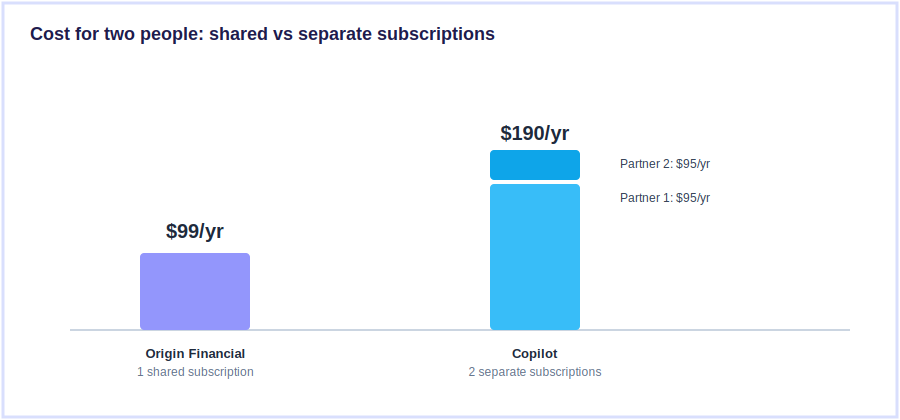
One shared Origin subscription costs less for a couple than Copilot’s two separate accounts combined.
One 2026 caveat this origin financial review has to flag: there’s no clean way to segment net worth between partners yet. The dashboard shows combined figures without a clear breakdown of whose assets are whose. The team has flagged this as an upcoming feature.
For most couples at the budgeting stage, not a dealbreaker. For couples with significantly different asset profiles, worth knowing before you commit.
How does Origin Financial compare to YNAB, Monarch, and Empower?
No single competitor this origin financial review tested matches the platform on breadth, but each beats it in at least one category.
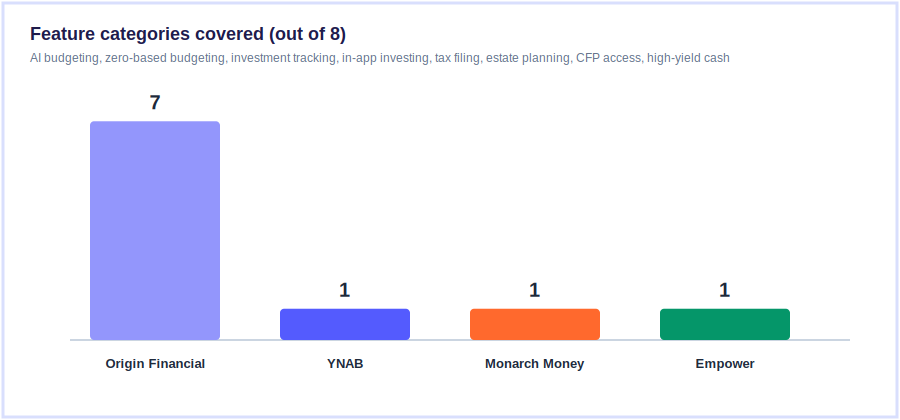
Origin covers 7 of 8 major feature categories; each competitor here covers just 1.
| Feature | Origin Financial | YNAB | Monarch Money | Empower |
|---|---|---|---|---|
| Price | $99/yr | $109/yr | $99.99/yr | Free |
| AI budgeting | Yes, Sidekick | No | No | No |
| Zero-based budgeting | No | Yes, best in class | No | No |
| Investment tracking | Yes | No | Yes | Yes, best in class |
| In-app investing | Yes, 0% AUM | No | No | No (wealth mgmt only) |
| Tax filing | Yes, free | No | No | No |
| Estate planning | Yes, free basic will | No | No | No |
| CFP access | $119/session | No | No | No (wealth clients only) |
| Free trial without card | No, suspended during promo | Yes, 34 days | No, card required | N/A, free forever |
| High-yield cash account | Yes, ~3.7% APY | No | No | No |
Pricing verified from official websites, August 2026.
The pattern is clear: Origin Financial wins on breadth, YNAB wins on budgeting methodology, Empower wins on investment depth. If your finances are growing in complexity and you’re already paying for multiple tools, the all-in-one value starts making a compelling case.
See my full YNAB review and Empower review for deeper dives on each, my Origin vs Monarch Money comparison for a head-to-head, and my best personal finance software roundup for how it ranks against the wider category.
What does this Origin Financial review flag as its real weaknesses?
No origin app review earns a 4.4/5 without honest caveats. Here’s where the platform genuinely falls short.
The $1 promo has a real catch. Miss the cancellation window and you’re charged the full $99/yr automatically, with a card that was required at signup rather than added later. There’s no grace period built into the flow itself, so mark a calendar reminder if you’re only testing the waters.
No zero-based budgeting. If you want to assign every dollar before you spend it, the methodology that makes YNAB so effective for breaking the paycheck-to-paycheck cycle, Origin won’t give you that. The AI budget builder is reactive, not proactive. It’s a great tracking tool; it’s not a behaviour-change system the way YNAB is.
No budget rollovers. Underspend on groceries this month? That surplus disappears; it doesn’t carry forward. Origin financial reddit threads bring this up often for envelope-method budgeters running a tight monthly plan, and it’s a real gap.
Investment tracking has a ceiling. Apple App Store reviewers of the origin financial app flagged that accounts can’t be categorised by taxable status, and the forecasting tool uses a fixed rate of return. For actively managing a multi-account portfolio, Empower’s free tools go meaningfully deeper.
Schwab and Webull connection issues. The origin financial app uses Plaid, MX, and Finicity, covering 13,000+ institutions, but Charles Schwab 401k accounts and Webull connections have known friction. Support is responsive, but if either is your primary brokerage, expect some setup friction.
No bill negotiation is available either. Rocket Money actively negotiates bills on your behalf, a feature Origin doesn’t offer. See my Rocket Money review if bill management is your primary goal, and my YNAB vs Rocket Money comparison for a broader look at priorities.
Is Origin Financial Planner access worth the $83 CFP discount?
If you’re weighing Origin as a financial planner substitute rather than just a budgeting app, the math is worth spelling out. A single session with a Certified Financial Planner outside Origin typically runs $200–$400. Annual members pay $83 per session, standard members pay $119. Either way, you’re getting the same credential at a fraction of the going rate.
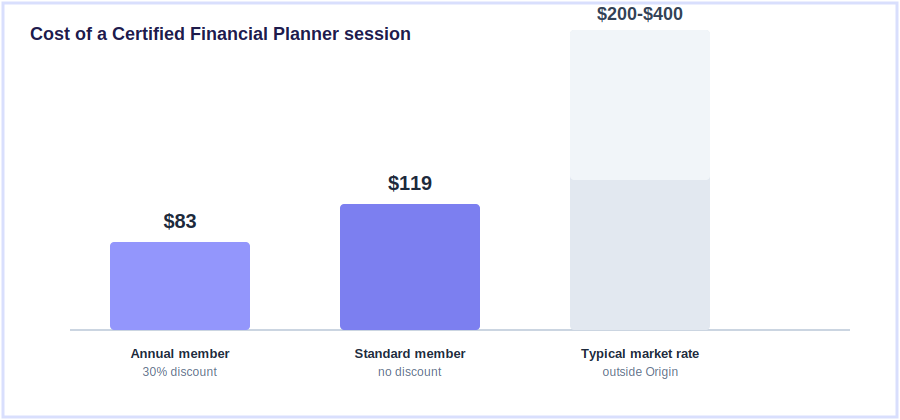
An annual member’s CFP session costs less than a third of the typical market rate.
What you’re not getting from the origin financial planner setup is an ongoing relationship with one dedicated advisor who tracks your full history over years, the way a traditional fee-only planner would. Sessions are booked as needed rather than as part of a standing engagement, and Sidekick’s AI guidance handles the day-to-day questions in between.
For a single meaningful decision this year, a house purchase, a career change, an early retirement projection, one session likely pays for the entire annual subscription several times over. For someone who wants a long-term human relationship managing a complex estate, a dedicated fee-only planner or the Empower wealth-management tier (past $100k in assets) is the better fit.
Combined with the free basic will and discounted full estate planning documents, this origin financial planner bundle is the closest thing to a financial-planning practice built into a budgeting app that this niche currently offers.
What are real users on Origin Financial Reddit threads saying?
Community feedback on the app runs more positive than most newer apps earn, though the critical voices are worth weighing if you’re deciding between Origin and a dedicated budgeting tool.
Scanning origin financial reddit threads over the past few months, the positive side is consistent: account syncing and customer service get consistent praise. One Google Play reviewer noted they’d connected all their accounts after struggling on other platforms, adding that the AI even identified their debt and built an action plan.
Another long-time App Store user called it the best UI they’d seen in any finance app, and singled out the team’s active Reddit presence for genuinely responding to feedback.
The critical voices are consistent: the AI budget builder can feel generic early on. One r/personalfinance commenter noted that after connecting their bank account, the AI-generated budget required significant manual adjustment, and they ended up using the app no differently than Rocket Money. A separate App Store reviewer with a heavy investment background said the forecasting methodology was bare-bones compared to Empower, particularly for retirement modelling across multiple account types.
The overall pattern across origin financial reddit discussion mirrors what this review found: people who want a single dashboard for their entire financial picture love the platform. People who came primarily for deep budgeting or deep investing find the specialist apps still ahead. That’s an honest read of the community consensus.
Origin Financial works best if you…
- Want one app for budgeting, investing, taxes, and planning
- Have investments to track alongside daily spending
- Use multiple finance apps and want to consolidate
- Want AI-driven insights without manually entering every dollar
- Are a couple who wants shared visibility at no extra cost
- Have equity compensation or real estate to track
Look elsewhere if you…
- Want zero-based budgeting with full dollar assignment (use YNAB)
- Need deep investment portfolio analysis (use Empower)
- Want bill negotiation on your behalf (use Rocket Money)
- Only need basic spending tracking and don’t invest yet
- Use Charles Schwab 401k or Webull as primary brokerage
- Won’t remember to cancel before the $1 promo renews at $99
What are the most common questions about Origin Financial?
Direct answers to the questions I see most often about this app, including the ones tied to its pricing catch and day-to-day use.
Is Origin Financial worth it at $99/yr?
The short answer from this origin financial review: Origin is worth $99/yr if you currently pay for two or more separate finance tools. As every origin app review should note, the subscription bundles budgeting, investing, free tax filing, and basic estate planning, services that together typically cost $300+ annually across YNAB, TurboTax, and a dedicated investment tracker. If you only need basic spending tracking, free alternatives like Empower are sufficient.
Is there a real catch with the $1 first-year Origin Financial promo?
This origin financial review answers plainly: yes, the catch is that the standard 7-day free trial is suspended while the promo runs, and a card is required upfront rather than optional. You won’t be charged beyond the $1 unless you forget to cancel before your renewal date, at which point you’re billed the full $99 automatically. Set a reminder if you’re not sure you’ll keep the subscription.
How much does Origin Financial cost per month?
Every origin app review should lead with the same number: the monthly plan costs $12.99/mo, or $99/yr on the annual plan, which works out to roughly $8.25/mo, saving $56.88/yr versus paying monthly. Add-ons: CFP sessions run $119 standard or $83 for annual members, expert-assisted tax filing is $189, and a basic will is free for all members.
Is Origin Financial safe to use with your bank accounts?
This origin app review found no red flags here: Origin Financial is SOC-2 compliant, uses bank-level encryption for data in transit and at rest, and connects to accounts via read-only APIs, meaning the app can view your accounts for analysis but cannot move money or make changes.
It uses three institutional-grade aggregators, Plaid, MX, and Finicity, the same providers used by major US banks and fintechs. Investment accounts are held through DriveWealth, a FINRA and SIPC member.
Is the Origin Financial App easy to use day to day?
Using the origin financial app day to day, most of the friction lives in the initial setup rather than ongoing use. Once accounts are connected, transaction categorisation and Sidekick’s proactive alerts (forgotten bills, subscription creep, cash flow anomalies) require little manual maintenance.
The main daily task is reviewing the AI-generated budget adjustments rather than manually assigning dollars, which some users find freeing and others find too hands-off compared to YNAB’s more active style.
Does this Origin App Review still hold up in 2026?
Yes, with one update worth flagging: pricing and the $1-for-first-year promo mechanics are current as of August 2026, re-verified directly at useorigin.com. The core feature set (Sidekick AI, investing, tax filing, estate planning) hasn’t changed materially since launch, though the team continues to ship smaller updates like improved retirement modelling and partner net-worth segmentation, both flagged as in-progress rather than shipped.
📚 Read Next
- Origin Financial Pricing 2026: The Hidden $1 Deal
- Origin vs Monarch Money 2026: Most People Choose Wrong
- YNAB Review 2026: Is It Still Worth $109/yr?
- Monarch Money Review 2026: Beware $99.99 Catch
- Empower Review 2026: The Best Free Investment Tracker?
- Best Personal Finance Software 2026
- Best Budgeting Apps for Couples 2026
- Best Net Worth Tracking Apps 2026
