
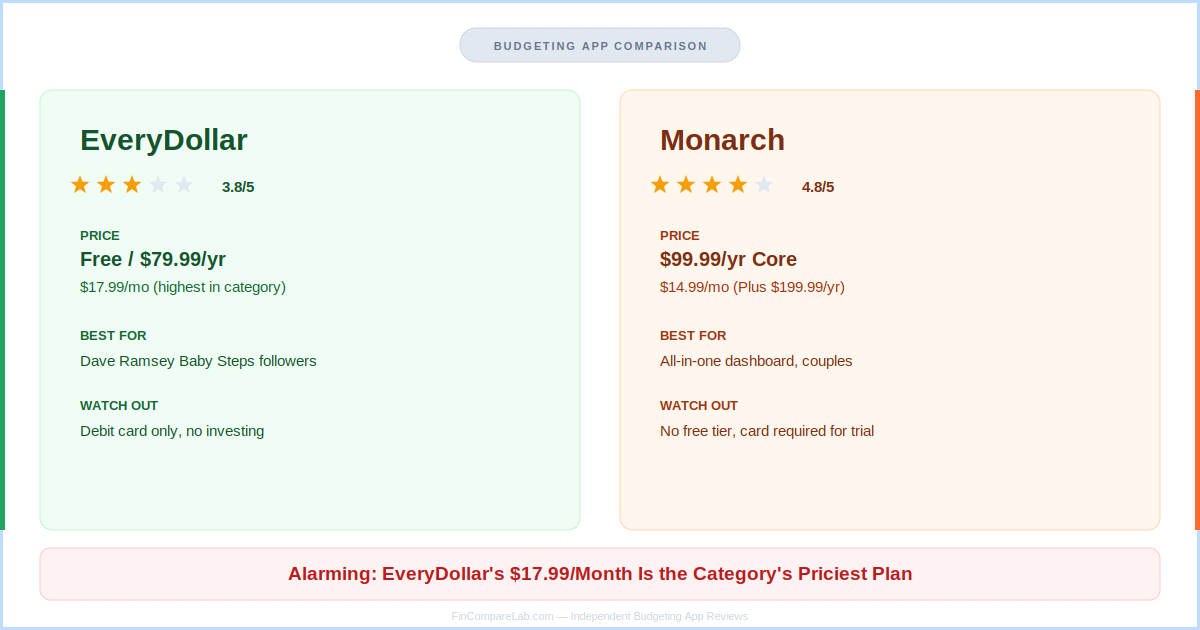
EveryDollar vs Monarch is one of the most searched budgeting app comparisons in 2026 — and the part most reviews skip is that EveryDollar’s $17.99/month price is actually the most expensive monthly plan in the entire budgeting category, even though its annual price is the cheapest of the three apps most people compare it against.
⚡ Quick Verdict
These two apps solve different problems. EveryDollar is Dave Ramsey’s zero-based budgeting app, built around the Baby Steps debt-freedom framework. Monarch Money is an automated, all-in-one financial dashboard — spending, investments, net worth, and couples access in one place. The catch buried in EveryDollar’s pricing: its $17.99/month plan costs more per month than Monarch’s, YNAB’s, or Simplifi’s — annual billing is the only way the price makes sense.
How We Review Apps · Pricing verified from ramseysolutions.com and monarch.com — 22 July 2026
📋 In This Comparison
- Who is each app actually built for?
- Is EveryDollar’s $17.99/month really the most expensive plan in the category?
- What are the key differences at a glance?
- EveryDollar vs Monarch: which one wins for most people?
- How do the budgeting philosophies differ?
- How does EveryDollar pricing compare to Monarch money pricing?
- Which app has better features?
- Which is better for couples?
- Which has better debt payoff tools?
- Is EveryDollar’s free tier worth using?
- Can you use EveryDollar and Monarch at the same time?
- What does Reddit say about EveryDollar vs Monarch money?
- Is EveryDollar Premium worth it in 2026?
- What else do people ask about EveryDollar vs Monarch?
The EveryDollar vs Monarch search keeps coming up because both apps sit in the $80–$100/year range and both positioned themselves as places to land after Mint shut down. But past price and timing, they’re solving different problems — and the pricing details matter more than the sticker price suggests.
EveryDollar is Dave Ramsey’s app, built around the Baby Steps framework — a specific path to debt freedom and wealth building through zero-based budgeting. Monarch Money is a financial dashboard that replaced Mint for millions and added things Mint never had: investment tracking, net worth, couples access, and an AI assistant. It doesn’t prescribe a philosophy — it shows you what’s happening with your money.
Everydollar vs Monarch almost always comes down to one question: are you following the Baby Steps, or aren’t you? And if you are, is $17.99/month — or $79.99 billed annually — a price you’re willing to pay for the coaching built around that system?
Search it the other way round — monarch vs everydollar — and you’ll land on the same handful of comparison posts, because the underlying question doesn’t change based on which app name comes first.
Who Is Each App Actually Built For?
EveryDollar is built for Dave Ramsey followers who want zero-based budgeting tied to the Baby Steps debt-payoff framework. Monarch Money is built for anyone who wants an automated, all-in-one dashboard — spending, investments, and net worth — with no prescribed philosophy attached.
Choose EveryDollar if…
- You follow Dave Ramsey’s Baby Steps
- You’re on a debt snowball payoff plan
- You want guided, coaching-style budgeting
- You prefer a simple, opinionated system
- The free tier covers your manual budgeting needs
- You pay by debit card, not credit
Choose Monarch Money if…
- You want automatic bank sync and categorisation
- You track investments alongside spending
- You budget with a partner (both included on one plan)
- You want net worth tracking built in
- You came from Mint and want a like-for-like upgrade
- You want a full financial dashboard, not a framework
Is EveryDollar’s $17.99/Month Really the Most Expensive Plan in the Category?
Yes — on a straight monthly-price comparison, EveryDollar Premium’s $17.99/month is higher than YNAB ($14.99), Monarch ($14.99), and Simplifi ($6.99/mo promo, $5.99 standard). It’s the highest monthly sticker price in the category.
| App | Monthly price | Annual price |
|---|---|---|
| EveryDollar Premium | $17.99/mo — highest in category | $79.99/yr — cheapest of the three |
| Monarch Core | $14.99/mo | $99.99/yr |
| YNAB | $14.99/mo | $109/yr |
| Quicken Simplifi | $6.99/mo | $83.88/yr |
Pricing verified from official websites — 22 July 2026.
The gap is stark: paying EveryDollar Premium month-to-month costs $215.88/year — a $135.89 premium over the $79.99 annual plan, and by far the largest annual-vs-monthly billing penalty of any app on this list. If you’re going to use EveryDollar Premium at all, annual billing isn’t optional — it’s the only version of the price that makes sense.
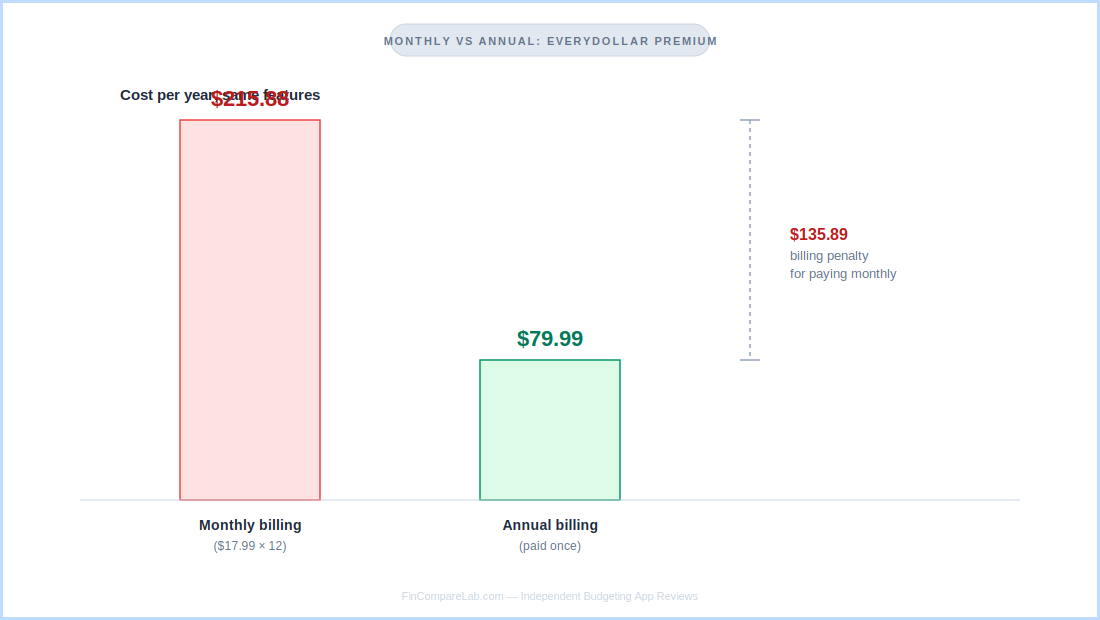
Flip it to annual billing and the picture reverses: EveryDollar’s $79.99/year is actually $20 cheaper than Monarch’s $99.99/year Core plan, and $29 cheaper than YNAB. So the “Alarming $17.99 Trap” only bites people who sign up monthly, don’t realize the trial converts to monthly billing by default, or cancel and re-subscribe repeatedly.
Lock in annual from day one and EveryDollar becomes one of the most affordable paid tiers in the category, not the most expensive.
Why does EveryDollar’s monthly price sit so far above its own annual price?
Ramsey Solutions prices EveryDollar Premium the same way gym memberships and streaming services do: the monthly rate is deliberately unattractive to nudge new users toward committing annually. A 14-day free trial requires a debit card upfront, and if you don’t cancel or switch to annual before the trial ends, you default onto the $17.99/month plan — the most expensive way to own the product.
What Are the Key Differences at a Glance?
In this EveryDollar vs Monarch comparison, the feature gap is wider than the price gap suggests.
| EveryDollar | Monarch Money | |
|---|---|---|
| Budgeting method | Zero-based (Baby Steps) | Flex or Category budgeting |
| Free tier | ✅ Yes — manual budgeting forever | ❌ 7-day trial only, payment method required upfront |
| Annual price | $79.99/yr | $99.99/yr Core · $199.99/yr Plus |
| Monthly price | $17.99/mo — most expensive in category | $14.99/mo |
| Bank sync | ⚠️ Premium only, Finicity-based | ✅ All plans |
| Investment tracking | ❌ None | ✅ Full portfolio tracking |
| Net worth tracking | ❌ None | ✅ Real-time |
| Couples access | Basic household sharing | ✅ Full shared access, one subscription |
| Live coaching | ✅ Premium — live group + 1:1 | ❌ None |
| AI assistant | ❌ None | ✅ Included |
| Payment method | Debit card only — no credit cards | Credit or debit card |
| FinCompareLab rating | ⭐ 3.8/5 | ⭐ 4.8/5 |
Pricing verified from official websites — 22 July 2026.
EveryDollar vs Monarch: Which One Wins for Most People?
Strip away the marketing and the everydollar vs monarch decision is really a two-question filter: do you follow Ramsey’s Baby Steps, and do you want your money automated or manually entered?
If the answer to the first question is yes, EveryDollar vs Monarch tips toward EveryDollar — the coaching, roadmap, and philosophy alignment are worth more than Monarch’s extra features to someone actively working the Baby Steps. If the answer is no, Monarch wins on nearly every axis: investment tracking, net worth, couples access, and an AI assistant, all for $20/year more on annual billing.
For most people reading a general everydollar vs monarch comparison — meaning they aren’t committed Ramsey followers — Monarch is the stronger overall app. EveryDollar’s advantage is narrow but real: it’s the best free option in the category if you’re willing to enter transactions by hand.
Type monarch vs everydollar into Google instead and you’ll surface nearly identical roundups, because the reversed word order pulls the same searcher intent. A monarch money vs everydollar search tends to skew slightly more toward people already using Monarch and double-checking whether they’re missing anything by not switching to EveryDollar — and the honest answer, outside the Ramsey ecosystem, is usually no.
Monarch Money vs Everydollar: Does the Word Order Change the Verdict?
No. Whether you search monarch money vs everydollar, monarch vs everydollar, or the standard everydollar vs monarch order this post is built around, the verdict is identical — it depends entirely on whether you’re following Ramsey’s Baby Steps, not on which app name you typed first.
How Do the Budgeting Philosophies Differ?
This is the most important difference in any EveryDollar vs Monarch money evaluation — and the reason most people end up clearly in one camp.
EveryDollar — Zero-Based Budgeting With Baby Steps Structure
EveryDollar is built entirely around Dave Ramsey’s zero-based budgeting method. Every dollar of income gets assigned a job before the month begins — similar to YNAB — but the framework is explicitly structured around the Baby Steps: a $1,000 starter emergency fund, then the debt snowball, then a 3–6 month emergency fund, and onward.
The January 2026 relaunch added a personalized financial roadmap showing exactly where you are in the Baby Steps, along with daily lessons, live group coaching, and the Margin Finder tool.
Margin Finder is the headline addition — Ramsey Solutions says it helps the average new user surface roughly $3,015 in hidden monthly margin during a guided 15-minute walkthrough. That figure comes from Ramsey Solutions’ own internal data, not an independent study, so treat it as a marketing claim rather than a guarantee.
Monarch Money — Flexible, Method-Neutral Budgeting
Monarch doesn’t prescribe a financial philosophy. It offers two budgeting modes — Flex and Category — and lets you use either, switching anytime. Flex groups spending into fixed expenses, non-monthly recurring, and flexible spending. Category budgeting sets limits per specific category.
Monarch doesn’t push you toward any particular financial goal beyond what you set yourself.
Want to pay off debt? Build a savings goal. Track net worth? There’s a dashboard already syncing your accounts.
There’s no day-one onboarding walking you through Baby Steps — Monarch assumes you’ll set your own priorities.
How Does EveryDollar Pricing Compare to Monarch Money Pricing?
The everydollar vs monarch money pricing question looks close on paper — $79.99 vs $99.99 annually — but the details shift things. Run the same comparison as monarch money vs everydollar and the numbers are identical, of course — only the framing of who’s evaluating whom changes.
| EveryDollar | Monarch Money | |
|---|---|---|
| Free tier | Free forever (manual entry) | None |
| Trial | 14 days — debit card required upfront | 7 days — payment method required upfront |
| Annual | $79.99/yr ($6.67/mo) | $99.99/yr Core ($8.33/mo) · $199.99/yr Plus |
| Monthly | $17.99/mo — most expensive in category | $14.99/mo |
| Promo codes | None found | WELCOME (30% off first year Core, web-only) |
| Couples cost | $79.99/yr (basic sharing) | $99.99/yr — both partners fully included |
| Payment method | Debit card only — no credit cards | Credit or debit card |
Pricing verified from official websites — 22 July 2026.
EveryDollar Premium at $79.99/year gets you bank sync, paycheck planning, coaching content, and the Margin Finder. Monarch at $99.99/year Core adds investment tracking, net worth, an AI assistant, and stronger couples access. The $20/year gap narrows fast once you account for what each actually includes.
One hard blocker for some households: EveryDollar does not accept credit cards for subscription payments. Ramsey Solutions confirms this is a deliberate, security-cited policy — debit card only. If you pay subscriptions by credit card for points or purchase protection, that’s a non-starter with EveryDollar.
One correction worth flagging: Monarch’s trial page previously said “no credit card required,” but as of this pricing check, Monarch’s 7-day trial now states a payment method is required upfront — billing starts automatically unless you cancel before the trial ends. That’s a genuine, newsworthy change from how Monarch’s trial worked earlier in 2026, not just a copy update.
Everydollar vs Monarch Money: Which Price Actually Wins on Annual Billing?
On annual billing, everydollar vs monarch money comes down to $79.99 vs $99.99 — EveryDollar wins by $20, but only if you never need investment tracking, net worth, or an AI assistant. Add those in and Monarch’s extra $20 buys a lot more than EveryDollar’s lower sticker price suggests.
Which App Has Better Features?
The everydollar vs monarch feature gap is consistent and goes in one direction: Monarch covers more financial territory at every tier except coaching.
| Feature | EveryDollar | Monarch Money |
|---|---|---|
| Bank sync | ⚠️ Premium only | ✅ All plans |
| Zero-based budgeting | ✅ Core method | ⚠️ Category mode approximates it |
| Investment tracking | ❌ | ✅ |
| Net worth tracking | ❌ | ✅ |
| AI assistant | ❌ | ✅ |
| Live coaching | ✅ Group + 1:1 (Premium) | ❌ |
| Margin Finder | ✅ Premium (Jan 2026) | ❌ |
| Subscription tracking | ❌ | ✅ |
| Android | ✅ (4.3/5 — rockier than iOS) | ✅ (4.7/5) |
Features verified from official websites and app store listings — 22 July 2026.
Monarch covers more financial territory across every category except coaching. Investment tracking, net worth, AI assistant, subscription detection — none of these exist in EveryDollar at any price tier.
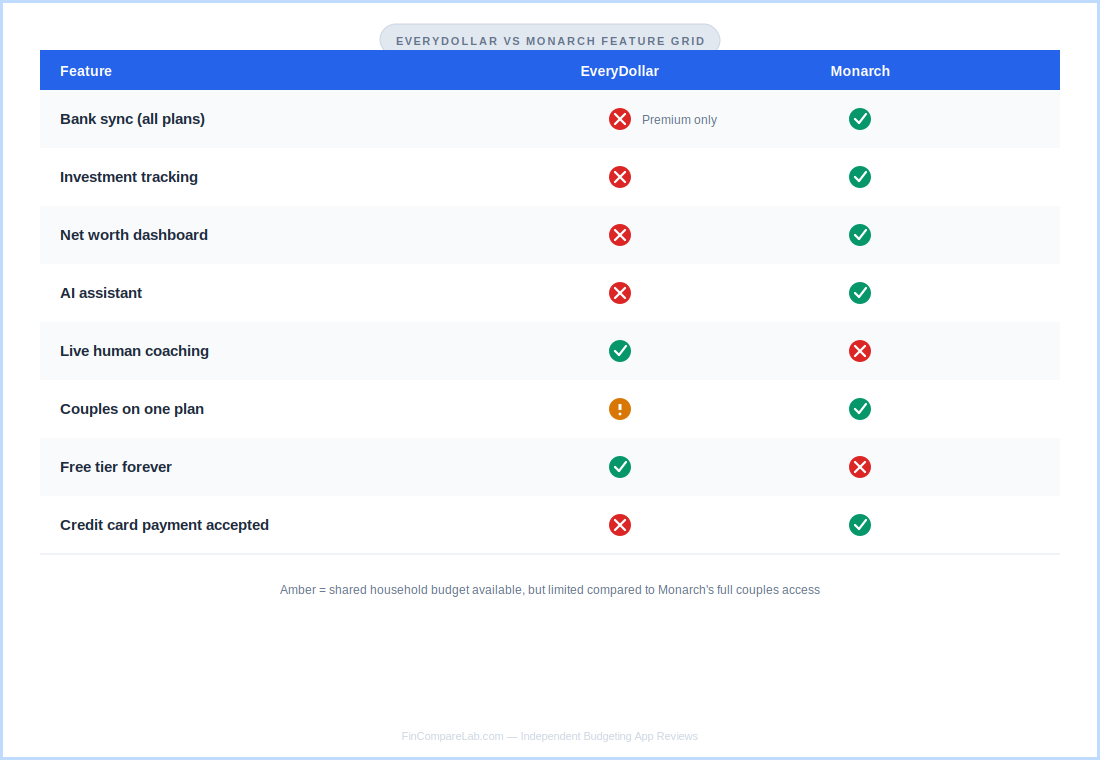
EveryDollar wins in exactly one area: coaching. Live group sessions, daily lessons, the Margin Finder, and the Baby Steps roadmap are genuinely useful — and genuinely unavailable in Monarch. If you want built-in accountability alongside your budget, EveryDollar delivers that; Monarch doesn’t try to.
Which Is Better for Couples?
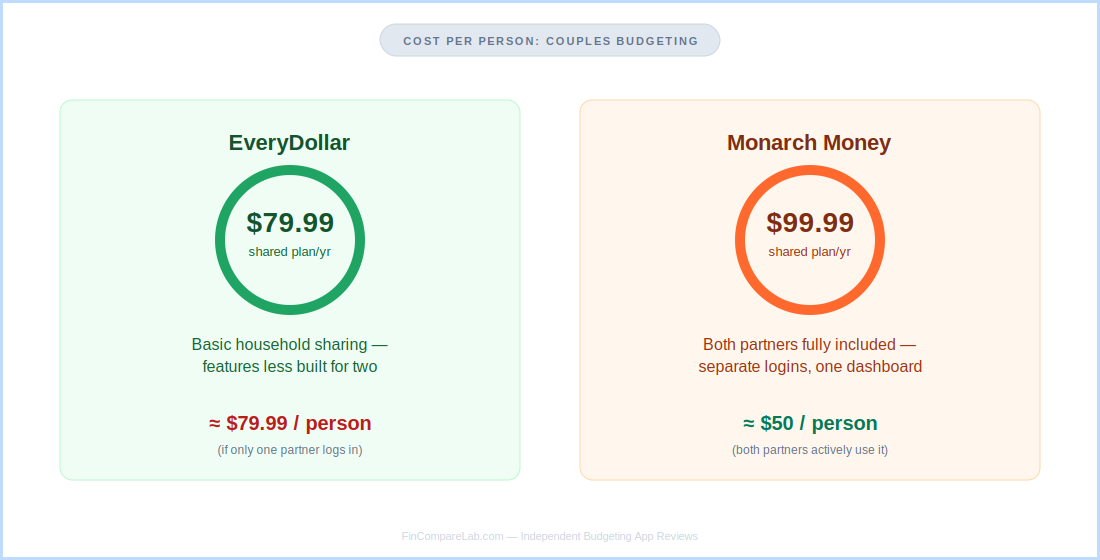
For couples, monarch vs everydollar tilts clearly toward Monarch. Monarch Money treats couples as a first-class feature — one $99.99/year subscription covers both partners, each with their own login and full real-time access to the shared dashboard, plus “yours, mine, and ours” labelling that removes the most common source of confusion in joint budgets.
EveryDollar added household sharing in 2026, but the implementation is more limited — both partners can access the same budget, but collaboration features don’t match Monarch’s depth, and the coaching content is individual-oriented rather than couples-first.
The effective per-person cost shifts the math further in Monarch’s favour: $99.99/year for two people works out to roughly $50/person, versus EveryDollar’s $79.99/year for a couple with more limited shared features.
Which Has Better Debt Payoff Tools?
This surprises most people — especially about EveryDollar. Neither EveryDollar nor Monarch Money has a built-in debt payoff calculator with avalanche or snowball modelling inside the core app.
EveryDollar shows debts and tracks Baby Steps progress, but payoff modelling lives in Ramsey’s broader ecosystem — separate tools and coaching sessions rather than the core budgeting interface. Monarch similarly tracks loan balances as part of net worth but doesn’t model payoff scenarios at any tier.
If a dedicated debt payoff calculator matters to you, YNAB’s loan planner is the best in-app tool in the category. You can also use the free FinCompareLab Debt Payoff Estimator alongside either app — it handles both avalanche and snowball methods. If you came to this monarch vs everydollar comparison specifically hunting for the stronger debt tool, neither app is really built for that job on its own.
Is EveryDollar’s Free Tier Worth Using?
The EveryDollar free tier is genuinely useful for a specific type of user, and genuinely limiting for everyone else. It includes manual zero-based budgeting, custom categories, savings goal tracking, bill reminders, and access on web, iOS, and Android, with no time limit.
What it doesn’t include: bank sync, paycheck planning, Margin Finder, coaching, Baby Steps roadmap, investment tracking, or net worth. Every transaction is entered by hand.
Many Ramsey followers use the free tier by deliberate choice — manual entry forces engagement with every transaction, reinforcing the mindset shift central to the method. If that resonates, the free tier competes with anything at zero cost.
For everyone else, manual-only entry is genuinely painful daily. Once you add bank sync to both apps — $79.99/yr for EveryDollar Premium vs $99.99/yr for Monarch Core — this monarch money vs everydollar comparison tilts toward Monarch’s larger feature set justifying the $20/year gap.
Can You Use EveryDollar and Monarch at the Same Time?
Yes, and some households genuinely do. A common pattern: run EveryDollar for the month-to-month zero-based budget and debt snowball tracking — where the Baby Steps roadmap and coaching add real accountability — while using Monarch purely for investment tracking and net worth, since EveryDollar has neither.
When running both makes sense:
- You’re mid-Baby-Steps and want the coaching, but also have a 401(k) or brokerage account to track
- You want EveryDollar’s manual-entry discipline for spending, plus Monarch’s automated net worth dashboard
- Cost: $79.99/yr + $99.99/yr = $179.98/yr combined — still cheaper than some single premium finance apps
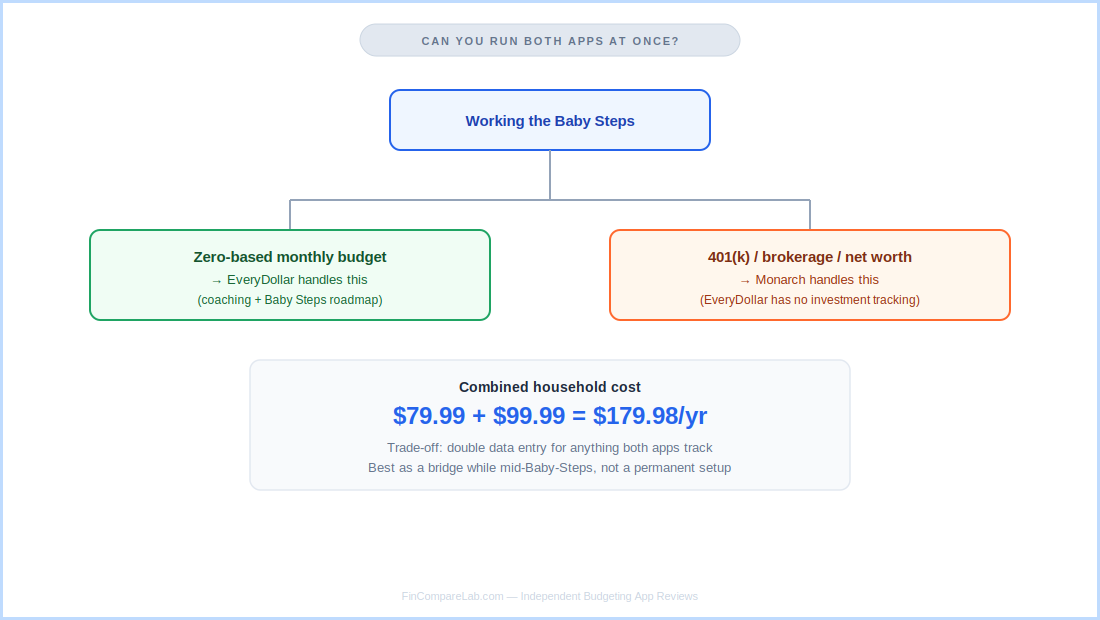
The downside is obvious: double data entry for anything both apps track, and two subscriptions to manage instead of one. Most people are better served picking one app once they know which camp they’re in — but running both temporarily, especially while working through the Baby Steps, is a reasonable bridge.
What Does Reddit Say About EveryDollar vs Monarch Money?
The community consensus on EveryDollar vs Monarch money splits almost entirely along one line: Ramsey follower or not.
In r/DaveRamsey and similar Ramsey-focused communities, EveryDollar is described as the natural fit for people actively working the Baby Steps — the coaching and roadmap keep it aligned with a specific plan, even if commenters acknowledge the pricing feels steep next to competitors offering more automation.
In r/personalfinance, the more common thread is people who switched from Mint directly to Monarch and never considered EveryDollar at all, because they weren’t following Ramsey’s framework in the first place — the investment and net worth dashboard is usually cited as the reason Monarch felt worth the subscription.
A recurring theme across both communities: EveryDollar’s $17.99/month price is seen as the weakest part of the app, and the near-universal advice is to never pay month-to-month — annual billing or don’t subscribe at all.
Search everydollar vs monarch reddit directly and most of what comes back are two separate conversations running in parallel rather than a genuine head-to-head debate — Baby-Steps talk in Ramsey-focused threads, Mint-refugee talk in r/personalfinance. A monarch vs everydollar reddit thread rarely ends with someone switching from one to the other; it usually confirms whichever app the poster was already leaning toward.
Monarch vs Everydollar: What Do Reddit Threads Actually Conclude?
Most monarch vs everydollar threads conclude the same way regardless of who started them: the poster’s existing financial philosophy decides the app, not a feature-by-feature scorecard. A monarch money vs everydollar search on Reddit turns up the identical pattern — people asking the question have usually already picked a side before they post.
Which app do Reddit users recommend more — EveryDollar or Monarch Money?
- r/personalfinance: Monarch is the dominant Mint-replacement recommendation
- r/DaveRamsey: EveryDollar is the default — it’s built for this audience
- r/ynab: Monarch comes up more than EveryDollar when users are evaluating YNAB alternatives
- Cross-community consensus: the two apps aren’t really competing head-to-head — they serve different audiences
Is EveryDollar Premium Worth It in 2026?
At $79.99/year (never $17.99/month), EveryDollar Premium is worth it specifically for active Ramsey Baby Steps followers who want bank sync, live coaching, and the Margin Finder integrated into the same app they budget in. For that user, the alignment between app, roadmap, and accountability system is genuinely powerful.
For everyone else, the case is harder to make. At $79.99/year, you get budgeting and coaching but no investment tracking, no net worth, and no AI assistant. Monarch Money at $99.99/year Core covers all of those for $20 more.
YNAB at $109/year does stricter zero-based budgeting with better reports and a 34-day trial. Both are stronger value propositions for non-Ramsey users.
Is Monarch Money worth it vs EveryDollar Premium on annual billing?
For non-Ramsey users, yes — Monarch Money at $99.99/year delivers meaningfully more than EveryDollar Premium at $79.99/year for $20 extra, making it the stronger value in this everydollar vs monarch comparison for anyone outside the Ramsey ecosystem.
EveryDollar wins for:
- Dave Ramsey followers who want their app and their financial philosophy aligned
- People who want live coaching and accountability baked into their budgeting app
- Users who prefer manual entry — the free tier is a complete tool at zero cost
- Anyone on Baby Step 2 who wants a roadmap tracking their debt snowball progress
- People who actively avoid credit cards and want a debit-first subscription model
Monarch Money wins for:
- Anyone who left Mint and wants the same automatic, all-in-one dashboard experience
- Couples — both partners included at $99.99/year with full shared access
- People with investments who want spending and portfolio visible in one place
- Anyone who doesn’t follow Ramsey and would pay for coaching they won’t use
- Users who want net worth tracking and an AI assistant alongside their budget
My overall take on everydollar vs monarch: for most people who aren’t Ramsey followers, Monarch is the stronger app — it does meaningfully more for $20/year more on annual billing. EveryDollar’s free tier is the best deal in budgeting for anyone willing to do manual entry, and its coaching content is genuinely differentiated. Just don’t get caught paying $17.99/month for either app when the annual price is sitting right there.
What Else Do People Ask About EveryDollar vs Monarch?
These are the most common questions people search alongside everydollar vs monarch, answered directly and matched to the sections above where you’ll find the full breakdown.
Is Monarch Money better than EveryDollar?
For most non-Ramsey users, yes — Monarch Money at $99.99/year adds investment tracking, net worth, an AI assistant, and stronger couples access that EveryDollar doesn’t offer at any price. For active Dave Ramsey followers, EveryDollar’s Baby Steps coaching and roadmap make it the better philosophical fit, even at a higher effective monthly price.
How much does EveryDollar cost vs Monarch Money in 2026?
EveryDollar has a free tier and Premium at $79.99/year or $17.99/month. Monarch Money has no free tier — a 7-day trial requiring a payment method upfront — and costs $99.99/year Core (or $199.99/year Plus) or $14.99/month. On annual billing, EveryDollar is $20/year cheaper. On monthly billing, Monarch is $3/month cheaper, and EveryDollar’s $17.99/month is the highest monthly price of either app.
Is Monarch worth $100 a year?
For most people who want an automated, all-in-one dashboard — spending, investments, net worth, credit monitoring — $99.99/year for Monarch Core is competitive against paying separately for a budgeting app and an investment tracker. If you only need basic zero-based budgeting with no investment tracking, EveryDollar’s $79.99/year is cheaper for that narrower job.
Does EveryDollar have investment tracking?
No. EveryDollar tracks spending and budgets but does not connect to investment accounts or show net worth. Monarch Money includes investment tracking in the Core plan at $99.99/year. Empower is also free and provides deep investment tracking as a standalone option.
Can couples use EveryDollar or Monarch Money together?
Both support shared budgeting. Monarch Money includes both partners under one $99.99/year subscription with full shared access — the stronger couples implementation. EveryDollar has household sharing in Premium, but it’s more limited. For couples, Monarch is the better choice — effective cost is roughly $50/person per year.
Does EveryDollar accept credit cards for subscription payments?
No. EveryDollar requires a debit card for Premium subscription payments — credit cards are not accepted. Ramsey Solutions confirms this is a deliberate policy, citing security restrictions. Monarch Money, YNAB, Simplifi, and every other budgeting app in this category accept credit cards.
What happened to EveryDollar in January 2026?
Ramsey Solutions relaunched EveryDollar in January 2026 with the Margin Finder tool, personalized Baby Steps roadmaps, daily lessons, and live group coaching. The relaunch shifted EveryDollar from a pure budgeting app toward a financial behavior-change platform — though the underlying monthly and annual pricing stayed the same.
What does an everydollar vs monarch reddit search actually tell you?
Not much that a direct feature comparison doesn’t already cover. Everydollar vs monarch reddit threads mostly confirm that Ramsey followers stick with EveryDollar and Mint refugees stick with Monarch — useful as social proof, but not a substitute for checking the pricing and feature tables above against your own situation.
📚 Read Next
- EveryDollar Review 2026 — Full Breakdown
- Monarch Money Review 2026 — Full Breakdown
- EveryDollar vs YNAB 2026 — Which Zero-Based App Wins?
- YNAB vs Monarch Money 2026 — Full Comparison
- EveryDollar Pricing Guide 2026 — Free vs Premium Explained
- Monarch Money Pricing 2026 — Core vs Plus, Promo Codes
- Best Budgeting Apps for Debt Payoff 2026
- Free Debt Payoff Estimator — Avalanche vs Snowball
