
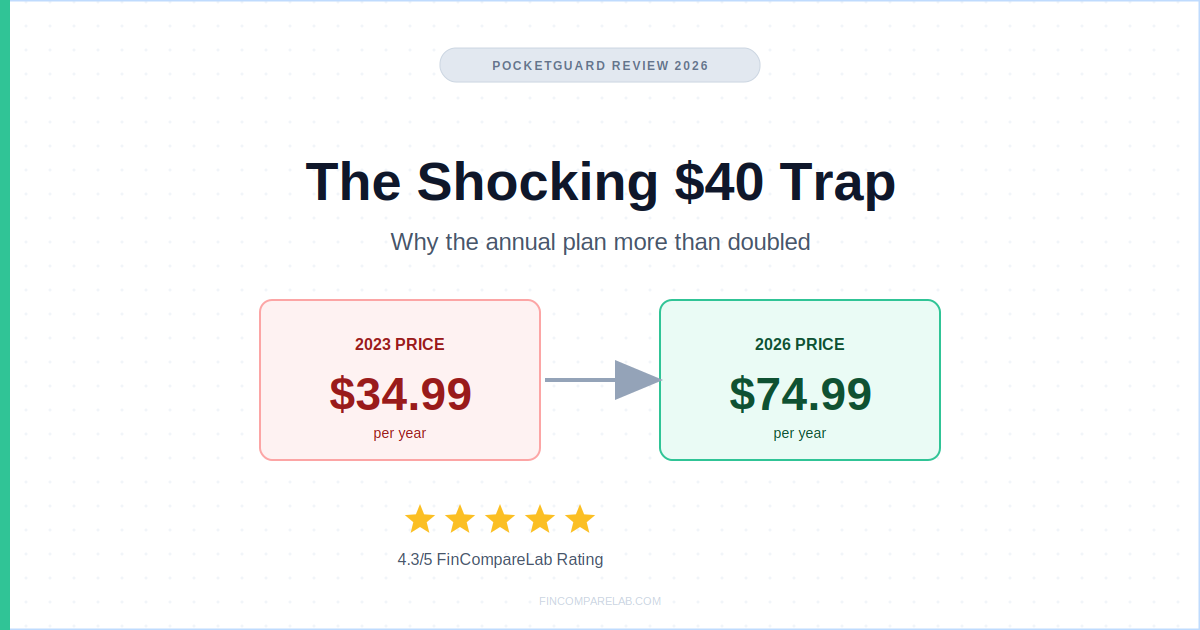
PocketGuard’s annual plan jumped from $34.99 to $74.99 in a few years, and that $40 gap is exactly why this pocketguard review exists: to show what actually changed, what the free plan still gets you, and whether the new price is a fair trade or a quiet trap.
If you want to see the current numbers for yourself before reading further, PocketGuard’s own 7-day free trial lets you check pricing and bank compatibility without committing to anything.
⚡ Quick Verdict
PocketGuard’s “In My Pocket” number is still the fastest way to answer “can I afford this right now?” but the annual plan has more than doubled since 2023, and the free tier’s two-account, two-category cap makes it a trial run, not a real budgeting system.
It earns its price if you’re an overspender who wants a live number, not a method to learn. It doesn’t if you want deep budgeting structure, investment tracking, or rock-solid bank sync across every account type.
How We Review Apps · Pricing verified from pocketguard.com — 3 September 2026
What’s In This PocketGuard Review?
Here’s what this pocketguard review covers, in order:
- What is PocketGuard, and what does this pocketguard review cover?
- What does PocketGuard pricing 2026 look like?
- Why did PocketGuard’s price jump from $34.99 to $74.99?
- Is PocketGuard’s free tier actually usable?
- What are PocketGuard’s best features?
- What do real PocketGuard users and Reddit threads actually say?
- What are PocketGuard’s drawbacks?
- Who should use the PocketGuard app?
- Who should skip PocketGuard?
- How does PocketGuard compare to YNAB and Monarch Money?
- Is PocketGuard worth it in 2026?
- How do I cancel PocketGuard, and what should I watch for?
- Does the pocket guard app work with my bank?
- What do people ask about PocketGuard?
What Is PocketGuard, and What Does This PocketGuard Review Cover?
PocketGuard is a budgeting app built around one number: how much you’re safe to spend right now, after bills and savings goals are already accounted for. This pocket guard review covers the 2026 pricing structure, the specific reasons behind the price jump, the free tier’s real limits, and the one weakness (bank sync) that gets glossed over in most other reviews.
PocketGuard connects your bank accounts, subtracts upcoming bills and savings goals from your balance, and shows what’s left to spend. There’s no budgeting method to learn and no categories to set up before you get a usable number, which is the entire reason people choose it over YNAB or Monarch Money.
The company was founded in 2015 and is based in Menlo Park, California. It’s grown into one of the more recognizable names in the budgeting app category, with over 1.7 million users across the US, Canada, and the UK as of 2026.
That scale matters for a pocketguard review like this one, because it means the bank-sync complaints covered further down aren’t a handful of edge cases. They’re a documented, recurring pattern across a large user base.
What Does PocketGuard Pricing 2026 Look Like?
PocketGuard pricing 2026 breaks down into a limited free tier and a Plus subscription at $12.99 per month, $74.99 per year ($6.25/month, billed annually), or a $149.99 one-time lifetime plan, confirmed directly from pocketguard.com on 3 September 2026. This pocketguard review breaks down every line of that table below, not just the headline number.
| Plan | Cost | What’s included |
|---|---|---|
| Free | $0 | 2 linked accounts, 2 category budgets, basic bill tracking |
| Plus (monthly) | $12.99/month | Unlimited accounts and category budgets, debt payoff planner, Pace |
| Plus (annual) | $74.99/year ($6.25/mo) | Everything in Plus, about 52% cheaper than paying monthly |
| Lifetime | $149.99 one-time | Everything in Plus, paid once, no renewal |
If you want to see how $74.99/year fits your actual numbers before signing up, FinCompareLab’s budget calculator is a quick way to run the math independently, and it’s a step worth taking before any pocket guard review talks you into a full year upfront.
One thing worth flagging on PocketGuard pricing 2026 that most reviews skip: the lifetime plan isn’t sold as an in-app purchase on iOS. It only shows up as a web checkout option through pocketguard.com. If you’re on an iPhone and only ever look inside the app, you may never see it offered.
Why Did PocketGuard’s Price Jump From $34.99 to $74.99?
Why did PocketGuard’s price increase so much? The annual Plus plan cost $34.99 in 2023 and sits at $74.99 now, more than double, and PocketGuard hasn’t published a line-by-line explanation for the jump.
What’s changed on the product side in that window: the Pace overspending alert, an expanded debt payoff planner with avalanche and snowball logic, unlimited transaction rules, and continued investment in the connectivity layer covered later in this pocketguard review. Whether that’s worth an extra $40 a year depends entirely on which of those features you’d actually open more than once a month.
Here’s the context that changes the calculus: at $74.99 a year, PocketGuard now sits close to Monarch Money at $99.99/year and isn’t far under YNAB at $109/year. If price was the reason you were leaning toward the pocketguard app over a more full-featured competitor, that gap has narrowed enough to be worth re-checking before you commit annually.
Why Did PocketGuard’s Price Increase So Much?
PocketGuard’s own team hasn’t given a public breakdown, but the increase lines up with three specific additions: the Pace alert, an expanded machine-learning debt payoff engine, and unlimited custom transaction rules for Plus subscribers. None of those existed at the $34.99 price point, and this pocket guard review would be selling you short if it didn’t say so plainly.
That’s a real product investment, not just a price hike with nothing behind it. The open question isn’t whether PocketGuard added features. It’s whether those particular features are the ones you’ll use enough to justify the gap closing between PocketGuard and full-featured apps like Monarch Money.
Is PocketGuard’s Free Tier Actually Usable?
Only for very simple setups. PocketGuard’s own help center confirms the free plan caps you at two category budgets, and the app itself limits free users to two linked accounts, so most people’s actual finances will outgrow it within the first week.
If you have a checking account, a savings account, and one credit card, you’ve already hit the account limit. And two budget categories won’t tell you much when a real household budget usually needs separate buckets for groceries, transport, utilities, subscriptions, and discretionary spending.
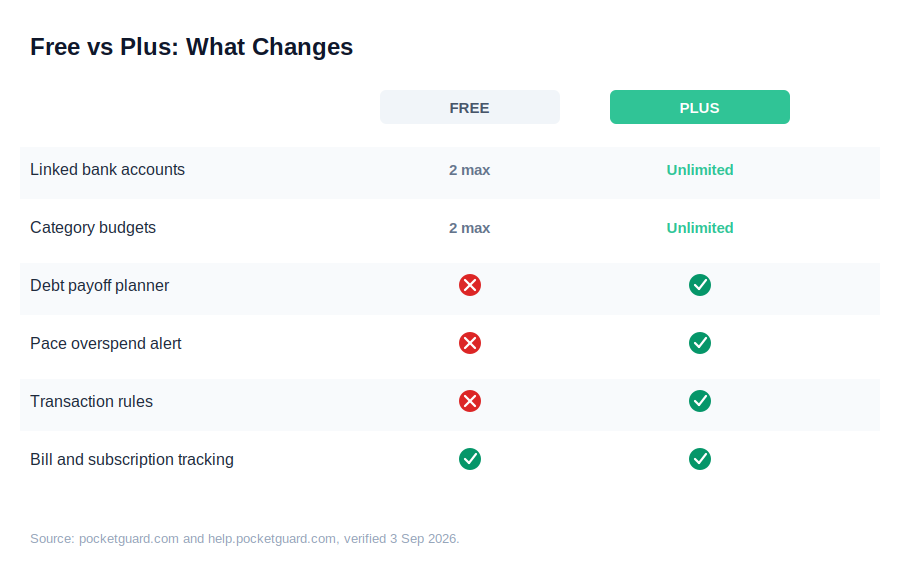
Free caps you at 2 accounts and 2 categories; Plus removes both limits.
So, is pocketguard free? Yes, technically, but “free” here means two accounts and two categories, not a full budgeting system you can rely on past your first week of real use.
My honest read: the free tier exists to let you test whether the “In My Pocket” approach fits how you think about money, not to run your actual budget long-term. If it convinces you within the trial period, the realistic next step is $74.99/year, and the 7-day Plus trial is a lower-commitment way to test unlimited accounts before paying for a full year upfront.
A useful gut-check: at two categories, the free plan can barely represent a household juggling a mortgage, a car payment, and kids’ activities, let alone someone working a debt payoff plan alongside a savings goal. Budget for Plus from day one if your finances have more than one or two moving parts.
What Are PocketGuard’s Best Features?
Everything in the pocketguard app exists to support one number. Here’s how the pocket guard app’s pieces fit together, and why the math behind each one matters more than the marketing copy suggests.
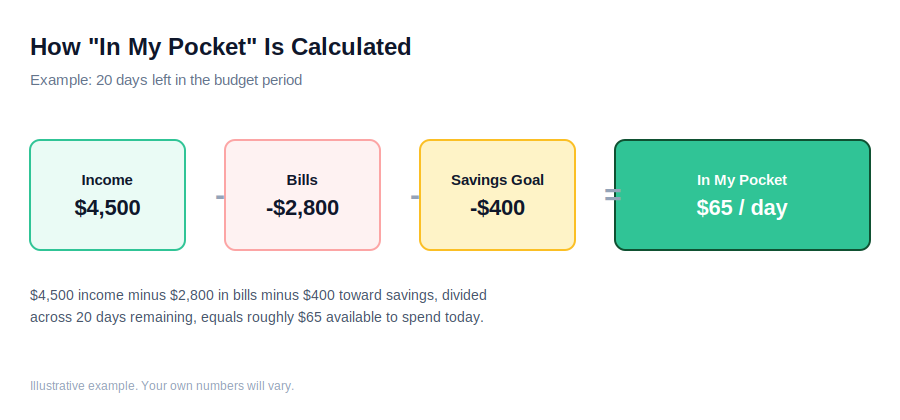
The “In My Pocket” calculation: income minus bills minus goals, divided by days left.
How Does the “In My Pocket” Feature Work?
Available balance, minus upcoming bills, minus savings goals, divided by the days left in your budget period, equals what you can safely spend today. That number updates live as transactions clear and bills approach, rather than sitting static until you manually refresh a spreadsheet.
A worked example: if you earn $4,500 a month, have $2,800 in recurring bills, set aside $400 toward a savings goal, and there are 20 days left in the period, In My Pocket lands around $65 a day.
Spend more than that on a given day and tomorrow’s number drops to compensate, which is a more honest signal than a monthly total that doesn’t account for how many days you have left to spread it across.
What Does the Pace Feature Do?
Pace compares your spending rate against your remaining budget and the days left in the month, flagging whether you’re on pace, under pace, or trending over pace before the month ends. It’s currently iPhone-only for Plus subscribers on the pocketguard app, with Android support expected later in 2026 according to PocketGuard’s own release notes.
How Good Is PocketGuard’s Bill and Subscription Tracking?
PocketGuard scans connected accounts and flags recurring charges automatically, including subscriptions you’ve likely forgotten about, then tracks each one with a due date and amount. That tracking is what makes the “In My Pocket” number trustworthy instead of just a simplified account balance that ignores what’s about to leave your account.
If bill negotiation and subscription cancellation are the main thing you’re after rather than daily spending tracking, PocketGuard vs Rocket Money is worth a look since Rocket Money built its whole product around that specific job.
Does PocketGuard Help With Debt Payoff?
Plus subscribers get a structured repayment plan using either the avalanche method, which targets highest interest first, or the snowball method, which clears the smallest balance first for early momentum. You input balances, interest rates, and a target date, and the app models the schedule instead of leaving you to build one in a spreadsheet.
If you want to sanity-check the numbers before committing to a plan, FinCompareLab’s own debt payoff estimator runs the same avalanche-vs-snowball math for free, no pocket guard app account required.
What Do Real PocketGuard Users and Reddit Threads Actually Say?
I haven’t personally run PocketGuard against my own accounts the way I have with YNAB and Monarch Money, so instead of pretending otherwise, here’s what shows up consistently across Reddit threads, the App Store, and Google Play when real users talk about the app.
The single most recurring complaint, by a wide margin, is bank sync reliability, not the price. A pattern that comes up repeatedly in r/personalfinance and r/budgeting threads is that PocketGuard functions more like an automated expense tracker than a true budgeting system, since it works from an estimated income figure rather than dictating where each dollar should go the way YNAB does.
For people who find YNAB’s zero-based method overwhelming, that’s usually described as a feature, not a flaw. It’s an easier on-ramp, even if it asks less of you.
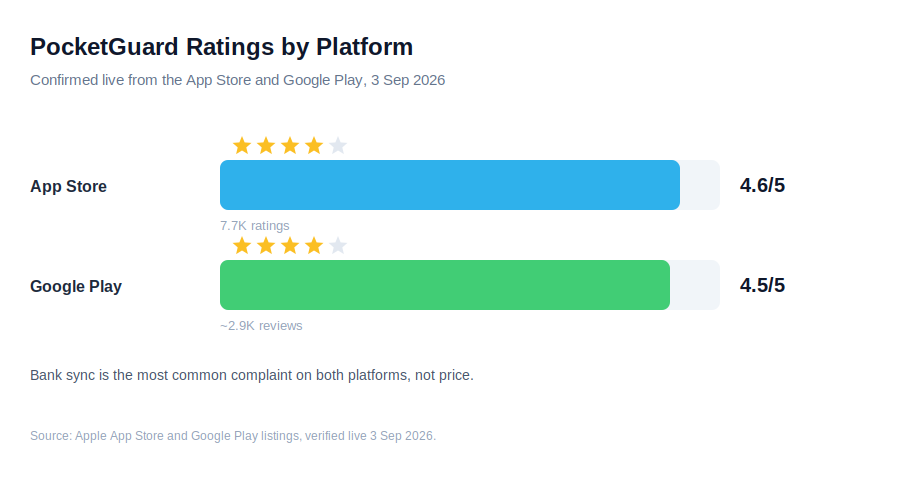
4.6/5 on the App Store (7.7K ratings) vs. 4.5/5 on Google Play (~2.9K reviews), confirmed live 3 Sep 2026.
On the bank-sync complaint specifically: PocketGuard maintains its own list of financial institutions with known connectivity problems, including American Express Personal Savings, HSBC, Marcus by Goldman Sachs, Synchrony Bank, PayPal, Bank of Montreal, CIBC, Desjardins, Royal Bank of Canada, Scotiabank, and Simplii Financial. Users connecting Amex accounts in particular report getting stuck in repeated multi-factor authentication loops.
If your primary bank or savings account is on that list, budget for manual entry or test the free trial with your actual accounts before paying for a year upfront.
On the positive side, the recurring theme across both app stores is that subscription detection genuinely surprises people, flagging forgotten charges within seconds of the first sync, and that setup takes well under 15 minutes for anyone who isn’t dealing with one of the flagged banks above.
That combination of fast setup and immediate subscription wins is likely why the pocketguard app shows up so often in “easier than YNAB” recommendations on Reddit, even from people who ultimately outgrow it.
What Are PocketGuard’s Drawbacks?
No pocketguard review would be honest without the downsides, and pricing is only part of the list. Any pocket guard review that skips straight from pricing to a verdict without covering these is skipping the parts that actually change whether the app works for you.
- Bank sync is the top documented complaint across platforms. The named-bank list above isn’t a rumor; it’s maintained by PocketGuard itself.
- The price more than doubled since 2023. $74.99/year is still less than YNAB, but the gap that used to make the pocketguard app the obvious budget pick has shrunk.
- The free tier is too restricted for real use. Two accounts and two categories won’t cover most people’s actual budgets past the first week.
- No investment or net worth tracking of any depth. This is a spending and debt tool, not a full financial dashboard the way dedicated net worth tracking apps are.
- Less effective for habit change than YNAB. PocketGuard tells you what you can spend; it doesn’t restructure how you think about spending the way a zero-based system does.
- Pace is iPhone-only for now. Android users don’t get the mid-month overspend warning yet.
Who Should Use the PocketGuard App?
The pocketguard app fits a specific type of user well. Consider the pocket guard app if:
- Your main problem is small, frequent overspending rather than big-picture planning
- You want to start immediately with no method to learn first
- You’re working through a structured debt payoff plan and want the schedule built for you
- You want automatic detection of forgotten subscriptions
- You live paycheck to paycheck and need a live, daily safe-to-spend number
- None of your primary banks appear on the pocket guard app’s known sync-issue list
Who Should Skip PocketGuard?
Not every budgeting profile fits the pocket guard app’s leftover-money approach, and a few specific signals point toward a different app instead.
- You want deep budgeting discipline. YNAB’s zero-based budgeting method changes spending habits more thoroughly than the pocketguard app’s leftover-money calculation can.
- You want investment or net worth tracking. Monarch Money covers this; PocketGuard doesn’t.
- You bank with Amex Personal Savings, HSBC, Marcus, or Synchrony. These show up repeatedly on the pocketguard app’s own connectivity problem list.
- You need a genuinely functional free app. Goodbudget’s free tier goes further before it asks you to pay, and the wider best free budgeting apps roundup covers other options built to stay free.
- You’re on Android and want every feature. Pace and some newer tools are iPhone-first.
How Does PocketGuard Compare to YNAB and Monarch Money?
Side by side, this is the fastest way to check whether the pocket guard app or one of its two closest competitors fits your actual financial picture, and it’s the comparison every pocketguard review should lead with before recommending a plan.
| App | Best for | Price | vs PocketGuard |
|---|---|---|---|
| PocketGuard | Daily spending control | $74.99/yr | – |
| YNAB | Strict budgeting, habit change | $109/yr | More structure, steeper learning curve |
| Monarch Money | All-in-one dashboard | $99.99/yr | Adds investment tracking, less spending-focused |
Pricing verified from official websites, 3 September 2026.
Want the direct head-to-head instead of a summary table? See how the pocketguard app stacks up specifically against YNAB and Monarch Money, or browse the full lineup in Best Budgeting Apps in the US (2026).
Is PocketGuard Worth It in 2026?
That’s the question this pocket guard review keeps circling back to: is PocketGuard worth it for you specifically? For a specific type of user, yes. The “In My Pocket” number remains one of the most genuinely useful daily-decision tools in any budgeting app on this site, answering a real question, dozens of times a week, without asking you to open a spreadsheet first.
But go in clear-eyed about two things: the price jump and the bank-sync gap. $74.99 is still less than YNAB or Monarch Money, but it’s no longer the clear budget pick it was at $34.99, and if your primary bank sits on PocketGuard’s own connectivity problem list, the core feature won’t work reliably regardless of price.
My rule of thumb: run the 7-day Plus trial with your actual accounts connected before deciding anything. If In My Pocket updates correctly and you check it more than once a day during that week, PocketGuard is worth it.
If sync breaks on day one or you forget the app exists by day three, it isn’t, for you specifically, even if it’s genuinely a good app for someone with a different bank.
Still deciding between this and something more structured? My YNAB review and Monarch Money review cover the two apps people compare against PocketGuard most, and the full PocketGuard pricing guide breaks down every plan in more depth than fits in this review.
FinCompareLab rating: ★★★★ 4.3/5
The pocketguard app is the best pick on this site for real-time daily spending control, at a price that’s climbed but still undercuts YNAB and Monarch Money. Best for overspenders and debt-payers whose primary bank connects reliably. Not for anyone chasing investment tracking, a genuinely free plan, or a bank on the known-issue list.
How Do I Cancel PocketGuard, and What Should I Watch For?
Cancelling the pocketguard app has a couple of gotchas worth knowing before you sign up, details that matter as much as PocketGuard pricing 2026 itself if you decide it’s not for you.
- Closing your account isn’t the same as cancelling your subscription. Deleting the app or your PocketGuard account doesn’t automatically stop billing; you need to cancel the subscription itself, either in the app’s settings or through your Apple or Google account, depending on where you signed up.
- There’s a 24-hour cancellation deadline on trials. If you’re on the 7-day free trial, cancel at least 24 hours before it ends, or you’ll be billed for the full plan automatically.
- Refund policies vary by platform. If you subscribed through the App Store or Google Play, refund requests go through Apple or Google, not PocketGuard directly.
None of this is unusual for subscription apps, but it’s easy to miss if you’re only reading the marketing page. Set a calendar reminder a day or two before your pocketguard app trial ends if you’re not sure yet whether you’ll keep it.
Does the PocketGuard App Work With My Bank?
Most likely, yes, and it’s worth confirming before you decide is PocketGuard worth it for your specific setup, since a shaky bank connection undermines the entire “In My Pocket” premise the whole pocket guard app is built around.
As of 2026, PocketGuard connects through multiple data aggregators, Plaid, Finicity, and Salt Edge, rather than relying on a single provider, which links to thousands of banks and credit unions across the US, Canada, and the UK.
That broader connector setup is a real improvement for the pocket guard app over relying on Plaid alone, but it doesn’t fix the named-bank issues covered earlier. If your bank isn’t reliable through any of the three connectors, PocketGuard also lets you add a manual cash account and log transactions by hand, which is less convenient but keeps your “In My Pocket” number accurate in the meantime.
What Do People Ask About PocketGuard?
These are the questions this pocketguard review gets asked most often, answered directly and without the hedging.
Is PocketGuard’s free tier still available in 2026?
The question “is pocketguard free” comes up constantly in every pocket guard review, and the short answer is still yes. PocketGuard’s help center confirms the free plan is capped at two category budgets, and the app limits free users to two linked accounts. It’s still live in 2026, just narrow enough that most people upgrade within their first week of real use.
Why did PocketGuard’s price increase so much?
The annual Plus plan rose from $34.99 in 2023 to $74.99 now, more than double. PocketGuard hasn’t published a specific reason, though the increase lines up with added features like Pace and the expanded debt payoff planner.
Is PocketGuard worth it in 2026?
If your main challenge is day-to-day overspending, your bank connects reliably, and you want an instant answer to “can I afford this,” yes, the pocketguard app earns its price. If you want deep budgeting structure, investment tracking, or your bank is on PocketGuard’s known-issue list, YNAB or Monarch Money will likely serve you better.
How does the “In My Pocket” feature work?
It takes your available balance, subtracts upcoming bills and savings goals, and divides what’s left by the days remaining in your budget period to show a daily safe-to-spend number, updating live as transactions clear.
Is PocketGuard safe to connect to my bank?
Yes. PocketGuard connects through regulated aggregators (Plaid, Finicity, and Salt Edge) in read-only mode, using 256-bit SSL encryption. It can view transactions but can’t move money, and it doesn’t store your bank login credentials.
How do I cancel PocketGuard?
Cancel the subscription itself in the app’s settings or through your Apple or Google account; deleting the pocketguard app or your PocketGuard account alone doesn’t stop billing. If you’re on the free trial, cancel at least 24 hours before it ends to avoid being charged.
PocketGuard vs YNAB: Which One Should You Choose?
PocketGuard answers “how much can I spend right now?” in minutes. YNAB asks “where should every dollar go?” and takes one to two weeks to learn properly. Pick PocketGuard for fast, frictionless spending control; pick YNAB if you want to fundamentally change how you manage money over time.
📚 Read Next
