
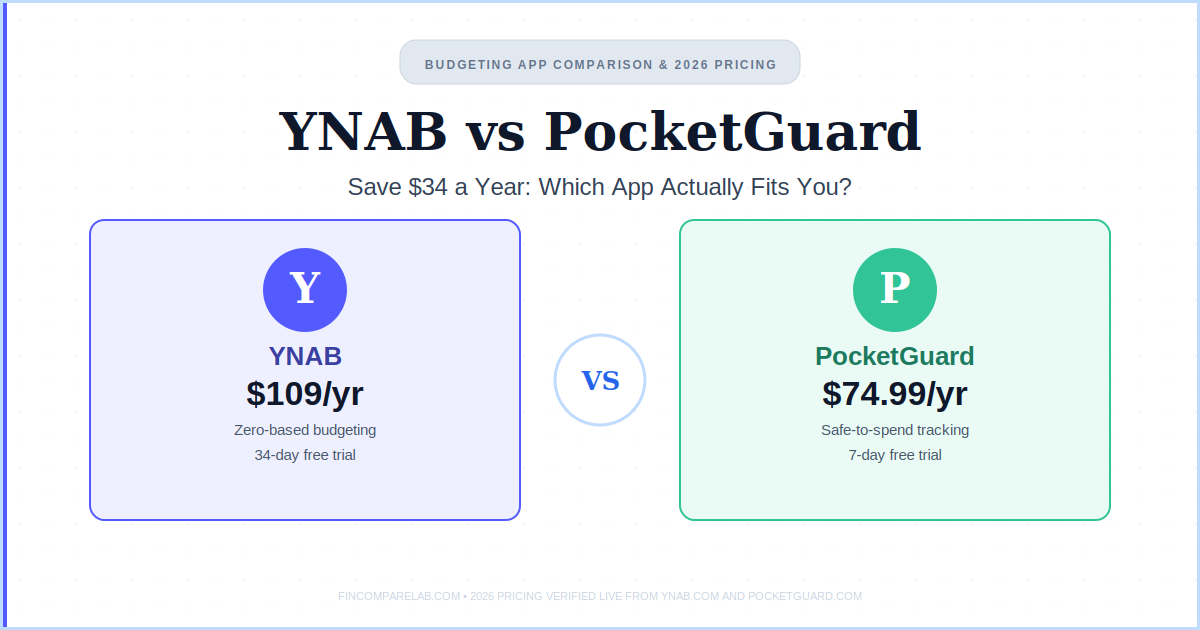
Searching YNAB vs PocketGuard usually comes down to one number: $34 a year. That’s the real gap between YNAB’s $109/year and PocketGuard’s $74.99/year Plus plan, but the cheaper app isn’t automatically the better pick, because these two apps are trying to solve completely different problems.
⚡ Quick Verdict
YNAB costs $34 a year more, but it’s built to change how you handle money long-term. PocketGuard is the $34-cheaper, lower-effort option that tells you one number: what’s safe to spend today. Neither app is wrong, they’re built for different kinds of people.
How We Review Apps · Pricing verified from ynab.com and pocketguard.com — 5 September 2026
📋 What’s in this comparison
- What’s the Quick Answer for YNAB vs PocketGuard?
- What’s the Core Difference Between YNAB and PocketGuard?
- Who Is YNAB Actually Built For?
- Who Is PocketGuard Actually Built For?
- How Do They Compare Head to Head?
- Can You Use Both YNAB and PocketGuard?
- Which Is Better: YNAB or PocketGuard?
- What Do People Usually Ask About YNAB vs PocketGuard?
What’s the Quick Answer for YNAB vs PocketGuard?
YNAB costs $109 a year and makes you assign every dollar a job before you spend it, building a habit over a few weeks. PocketGuard costs $74.99 a year and instead hands you one real-time “In My Pocket” number, no categories required. The $34/year gap is real, but whether it’s worth paying depends on whether you need structure or speed.
A pocketguard vs ynab search almost always ends up at this same $34/year figure, so it’s worth being precise about it upfront. $109 minus $74.99 is $34.01, confirmed live from YNAB’s own pricing page and PocketGuard’s own pricing page, not pulled from a third-party aggregator that might be running a stale promo.
| YNAB | PocketGuard | |
|---|---|---|
| Monthly price | $14.99/month | $12.99/month (Plus) |
| Annual price | $109/year | $74.99/year (Plus) |
| Lifetime option | ❌ Not offered | ✅ $149.99 one-time |
| Free tier | None, 34-day trial only | Disputed, see below ⚠️ |
| Trial length | 34 days, no card required | 7 days |
| Budgeting method | Zero-based, assign every dollar | “In My Pocket” leftover-money number |
| Bank sync | Plaid only | Plaid, Finicity, or Salt Edge |
| Debt payoff tools | ✅ Built into the budget | ✅ Standalone (Plus only) |
| FinCompareLab rating | 4.9/5 | 4.3/5 |
Pricing verified live from ynab.com and pocketguard.com, 5 September 2026.
What’s the Core Difference Between YNAB and PocketGuard?
Every YNAB vs PocketGuard comparison eventually lands on this: the two apps aren’t really competing on features, they’re built around opposite theories of why people overspend.
Whether you search it as pocketguard vs ynab or the other way around, the underlying split holds either way.
YNAB’s theory is that overspending happens because money doesn’t have a plan. Its fix is zero-based budgeting: the moment you’re paid, every dollar gets assigned to a category (rent, groceries, the emergency fund, whatever) before you’re allowed to spend any of it. Go over in dining out, and the app won’t quietly let it slide; you have to consciously pull money from another category to cover it.
That reallocation step is deliberate friction, and it’s the entire mechanism behind why the method works for people who stick with it.
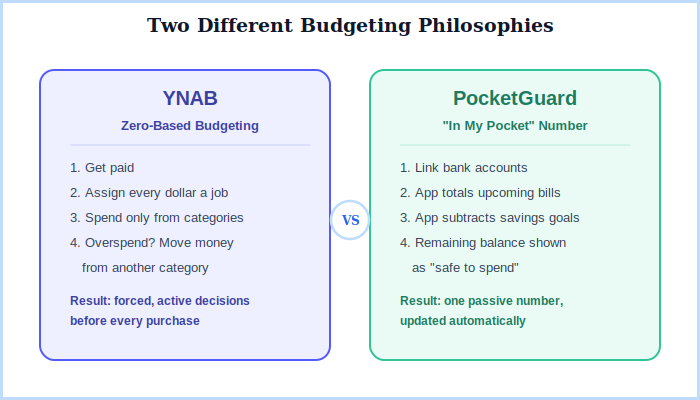
PocketGuard’s theory is different: overspending happens because people don’t have a fast, accurate answer to “can I afford this right now?” Its fix is the “In My Pocket” number, calculated as your available balance minus upcoming bills minus savings goals, recalculated automatically as transactions clear. There’s no reallocation step because there’s no category structure to reallocate within, just one number that goes up or down.
I used YNAB myself from 2011 through earlier this year, long enough to know that the reallocation friction is genuinely the point, not a bug the app hasn’t fixed yet. The habit of physically moving money out of one category to cover another is what made overspending register as a decision instead of something that just happened to me.
That’s also exactly the part of YNAB that burns people out, which is where PocketGuard’s simpler approach earns its audience.
Community sentiment on PocketGuard, paraphrased from real discussion across r/pocketguard threads and app store reviews rather than any single quote, tends to describe the same trade-off from the other direction: people like not having to build a budget from scratch, but the debt payoff calculators and deeper reports feel bolted onto the app rather than woven into daily use the way YNAB’s categories are.
Why Does YNAB Cost More Than PocketGuard?
The $34/year gap isn’t really a pricing decision, it’s a support-cost decision. YNAB backs its method with free live workshops, an active user forum, and live chat support, all of which cost money to run and get built into the subscription price. PocketGuard keeps overhead lower by leaning on automation and a simpler support model, and passes that savings on directly.
👉 See the four rules behind YNAB’s zero-based method → · How YNAB compares to Monarch’s more automated approach →
Who Is YNAB Actually Built For?
In most ynab vs pocketguard research, YNAB has run on the same core idea since 2004: give every dollar a job before you spend it. That’s zero-based budgeting, and it’s the reason people either love the app or bounce off it in the first week.
Set up looks like this in practice. You get paid $3,200. Before you spend a cent, you assign $1,400 to rent, $500 to groceries, $150 to dining out, $300 to the emergency fund, $250 to a car repair fund, and so on, until the full $3,200 has somewhere to go.
As transactions import through the month, you assign each one to its category. If dining out runs dry at $150 and you still want takeout, YNAB doesn’t quietly let the balance go negative, it makes you pull the extra $20 from somewhere else, like the car repair fund. That’s the whole method: constant, small, conscious trade-offs instead of one invisible overspend you don’t notice until the statement lands.
YNAB’s own published figures (not independently audited, but the company’s stated numbers) claim new users save an average of $600 in the first month and more than $6,000 in the first year. That’s not a guarantee, it depends entirely on whether the method sticks, and it won’t happen automatically just from having the app installed.
What Does YNAB Do Well?
- Actually changes spending behavior over time. Most budgeting apps report what already happened. YNAB forces a decision before it happens, which is a structurally different kind of tool.
- 34-day free trial, no card required. Long enough to genuinely test whether the reallocation habit sticks before paying anything.
- Free live workshops with real instructors covering setup, debt payoff, couples budgeting, and irregular income, included in the subscription price.
- Handles irregular income well. Because you only budget money you’ve already received, not money you expect, YNAB naturally fits freelancers and variable paychecks better than apps built around predictable monthly income.
- Shared budgets for up to 6 people on one subscription, genuinely useful for couples and families splitting the cost, and one of the clearer wins in any ynab vs pocketguard comparison for households.
What Should You Know Before Signing Up for YNAB?
- The first week feels unfamiliar for almost everyone. Give it two full weeks before deciding the method isn’t for you.
- It needs regular check-ins, a few minutes, a few times a week. This isn’t an app you install once and forget.
- No investment tracking, spending and savings categories only.
- At $109/year, it’s the pricier of the two apps in this comparison. Worth it if you’ll actually use it consistently, not worth it if the habit doesn’t stick.
That’s the case for YNAB in this ynab vs pocketguard for beginners and long-term-habit sense, worth weighing against PocketGuard’s case below before deciding which app fits.
👉 Read the full YNAB review → · See the complete YNAB pricing breakdown → · Browse YNAB alternatives →
Who Is PocketGuard Actually Built For?
On the other side of this ynab vs pocketguard matchup, PocketGuard launched in 2014 around a single idea: skip the budget-building step entirely and just tell people how much they can safely spend right now.
Here’s exactly how the “In My Pocket” number gets calculated. PocketGuard links your accounts through Plaid, Finicity, or Salt Edge (whichever your specific bank supports), pulls your available balance, subtracts recurring bills it’s identified or you’ve entered, subtracts anything earmarked for savings goals, and shows what’s left as a single figure that updates as transactions clear.
There’s no category structure underneath it, which is exactly why setup takes under 15 minutes instead of the 30 to 45 minutes YNAB’s first budget usually takes.
Does an YNAB vs PocketGuard Free Comparison Even Make Sense?
Not really, and it’s worth being direct about what’s actually confirmed. As of a live check on 5 September 2026, PocketGuard’s own pricing page doesn’t mention a free plan at all, only a 7-day free trial of Premium. That’s a change from earlier App Store and Google Play listings, which described a limited free tier capped around two linked accounts and two categories.
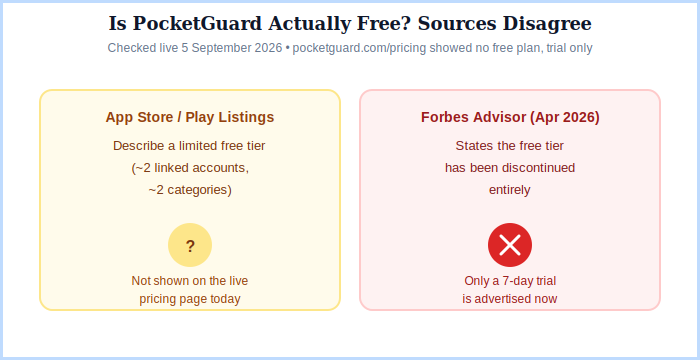
⚠️ Unresolved discrepancy: Forbes Advisor’s April 2026 review states the free tier has been discontinued entirely, which now lines up with what the live pricing page shows. But app store listings in some regions still reference limited free functionality.
I haven’t been able to fully resolve which is currently accurate for every user, so treat any pocketguard vs ynab free comparison as unconfirmed on PocketGuard’s side and check pocketguard.com directly before assuming a free option is available to you.
What Does PocketGuard Do Well?
- The “In My Pocket” number is genuinely practical day to day. Checking it before a discretionary purchase takes seconds and answers the one question that matters in that moment.
- Fastest setup of any app in this comparison. Linked accounts and a working leftover-money number in under 15 minutes, nothing to learn first.
- Finds forgotten subscriptions automatically once accounts are linked, often catching enough waste to cover the subscription cost on its own.
- Debt payoff planning on Plus supports both avalanche and snowball repayment methods as standalone calculators.
- A genuine lifetime purchase option. $149.99 once, confirmed live on pocketguard.com, versus an ongoing subscription, worth it if you’re confident you’ll stick with the app for more than two years, and a genuine point in PocketGuard’s favor in any ynab vs pocketguard cost comparison.
What Should You Know Before Signing Up for PocketGuard?
- It shows you what you can spend, it doesn’t change how you think about spending. Less effective than YNAB for deep habit change, by design, not by flaw.
- No investment tracking, same limitation as YNAB.
- The free tier dispute above means an ynab vs pocketguard free comparison isn’t as simple as it should be, confirm what’s actually included before you sign up.
- The “Pace” feature, which compares your spending rate against days left in the month, is currently iPhone-only. Android users don’t get it, and there’s no confirmed timeline for when that changes.
- Only a 7-day trial, noticeably shorter than YNAB’s 34 days, which matters if you want to test it against a full pay cycle before committing.
- The safe-to-spend calculation assumes fairly predictable bills. If your income or expenses swing month to month, the number can bounce around enough to feel less reliable than YNAB’s category-based tracking.
That’s the case for PocketGuard as a pocketguard alternative to ynab’s more structured approach, see the head-to-head breakdown below for how the two stack up on the specifics that usually decide this.
👉 Read the full PocketGuard review → · See the complete PocketGuard pricing breakdown → · Browse PocketGuard alternatives →
How Do They Compare Head to Head?
Most ynab vs pocketguard comparisons stop at a feature checklist. The more useful question is where each app actually wins on the specific trade-offs that decide this for most people, so that’s what the sections below focus on.
Which App Is Easier to Set Up?
PocketGuard wins clearly here, and this is usually the first thing people notice in a ynab vs pocketguard trial. Link your accounts and you have a working “In My Pocket” number in under 15 minutes, no method to learn and no initial budget to build from scratch.
YNAB takes longer by design: plan on 30 to 45 minutes for your first budget, then another one to two weeks before the reallocation habit starts to feel automatic rather than annoying.
Which App Is Better for Changing Spending Habits?
YNAB wins, and it isn’t close. PocketGuard tells you how much you can spend. YNAB changes how you decide to spend it in the first place, which is the difference between a guardrail and an actual behavior-change system.
If you’ve been overspending for years, seeing your balance usually isn’t enough on its own, a system that forces conscious allocation tends to work better precisely because it removes the option to look away.
Is YNAB Better for Paying Off Debt?
For most people, yes, though PocketGuard’s tools are genuinely solid on their own. YNAB folds debt payments directly into the zero-based budget, so a debt category gets the same forced-allocation treatment as groceries, and the built-in loan planner recalculates your payoff date the moment you assign extra money to it.
PocketGuard Plus offers standalone avalanche and snowball calculators that work well in isolation but sit apart from the daily leftover-money number, so there’s an extra step to connect debt strategy to everyday spending decisions. This is one of the clearer wins in any ynab vs pocketguard debt payoff comparison.
PocketGuard vs YNAB Pricing: Which Is Cheaper Over Five Years?
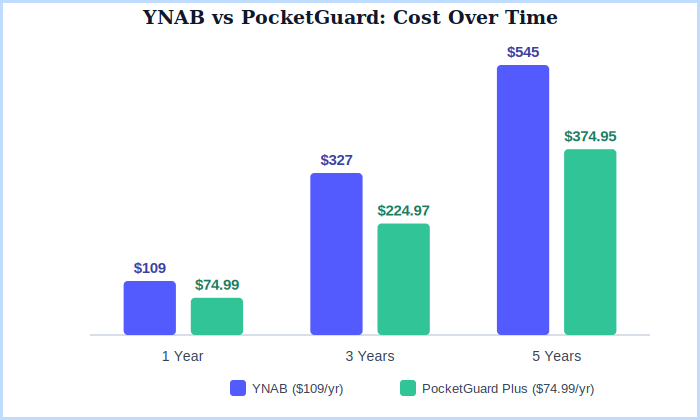
The sticker-price answer to a pocketguard vs ynab pricing question is simple: PocketGuard wins at $74.99/year for Plus versus $109/year for YNAB, a $34.01/year gap, roughly $2.83/month, about the cost of one coffee.
Zoomed out over three years of annual billing, YNAB totals $327 and PocketGuard Plus totals $224.97, a $102.03 gap. Over five years it’s $545 versus $374.95, or just $149.99 once if you take PocketGuard’s lifetime option instead, which would make the five-year gap closer to $395.
Whether that gap is worth paying isn’t really a pricing question, it’s a behavior question: does YNAB’s structured method save you more than $34/year through better spending decisions?
For people who actually stick with the reallocation habit, the answer is usually yes. For people who’d abandon a zero-based budget within a month, PocketGuard’s lower price and lower effort make it the more realistic ynab vs pocketguard choice, not just the cheaper one.
Which App Works Better for Irregular Income?
YNAB, generally, and it’s one of the more decisive splits in this ynab vs pocketguard breakdown. Its core rule, only budget money you’ve already received, never anticipated income, suits freelance and gig income naturally, since there’s nothing to “expect” until it actually lands.
PocketGuard’s safe-to-spend calculation is built around fairly predictable recurring bills and income; if your paychecks swing significantly month to month, the “In My Pocket” number can bounce around enough that it stops feeling like a reliable signal.
Which App Wins for Couples Managing Money Together?
YNAB wins clearly for this specific ynab vs pocketguard for couples use case. Up to 6 people can share one subscription with full, real-time access to the same budget. PocketGuard is built primarily around individual use, without a comparable shared-household budgeting structure, though both partners could each run their own separate PocketGuard account.
How Reliable Is Bank Syncing for Each App?
It’s a detail most ynab vs pocketguard comparisons skip, but both apps depend on third-party aggregators rather than building direct bank connections themselves. YNAB connects exclusively through Plaid.
PocketGuard offers a choice between Plaid, Finicity, and Salt Edge across the US, Canada, and UK, which can genuinely help if your specific bank has spotty support on one aggregator but works fine on another, smaller regional credit unions in particular tend to have uneven Plaid coverage.
In practice, occasional sync delays or a bank asking you to re-authenticate are aggregator issues, not app bugs, and neither app lets you switch aggregators after the fact if the one you’re assigned has trouble with your specific bank.
Can You Use Both YNAB and PocketGuard?
It’s a fair question once you’ve read this far into a ynab vs pocketguard decision. You can, technically, but it doubles your annual cost to $183.99 and there’s real overlap in what each app does, so it’s rarely worth it long-term.
The more practical sequence: try PocketGuard first for a few weeks, using the trial, to see whether the safe-to-spend number alone changes your habits. If you’re still overspending despite seeing the number clearly, that’s the actual signal to move to YNAB’s 34-day trial and go deeper into the zero-based method.
Running both indefinitely rarely earns back the extra $75 to $109 a year on top of a decision you could make once and stick with.
One edge case worth knowing: if you’re switching from PocketGuard to YNAB, you won’t be able to import PocketGuard’s transaction history or categories directly, YNAB’s category structure is different enough that a clean migration tool doesn’t exist between the two. A pocketguard vs ynab switch, in either direction, means budgeting for an hour or two of manual setup rather than expecting a one-click transfer.
Which Is Better: YNAB or PocketGuard?
If you’ve read a handful of other ynab vs pocketguard comparisons and still aren’t sure, that’s normal, the honest answer to which is better ynab or pocketguard depends entirely on whether you want a structured system or a fast, passive number.
Choose YNAB if…
- You want to change your spending habits long-term, not just watch them
- You’re paying off debt and want it woven into your daily budget
- You have variable or freelance income
- You manage money with a partner or family
- You’re okay with a learning curve in exchange for stronger long-term results
- Passive tracking apps haven’t changed anything for you before, a common reason people search pocketguard vs ynab in the first place
Choose PocketGuard if…
- You want a fast answer to “can I spend this right now?”
- You’re new to budgeting and want the gentlest possible start
- You want the lower-cost option, or a one-time lifetime purchase
- You overspend mostly on small, day-to-day purchases
- You want automatic detection of forgotten subscriptions
- You want to be fully set up in under 15 minutes, the fastest path through any ynab vs pocketguard trial
Still weighing an is pocketguard better than ynab or is ynab better than pocketguard question? Start with PocketGuard’s 7-day trial. If the safe-to-spend number alone changes your behavior within two weeks, you’re done, and $34/year ahead. If you’re still overspending despite being fully aware of the number, that’s the actual signal to try YNAB’s 34-day trial instead, the method goes a lot deeper than a single figure ever will.
Still weighing the actual dollar difference for your own numbers, or trying to settle which is better ynab or pocketguard once and for all? My debt payoff estimator can help you see whether YNAB’s structured approach or PocketGuard’s simpler tracking gets you out of debt faster given your specific balances.
My Find My App tool can also factor in a few more apps beyond just these two if neither one feels like a perfect fit.
What Do People Usually Ask About YNAB vs PocketGuard?
These are the questions people search most often once they’ve narrowed a which is better ynab or pocketguard decision down to the details.
Is YNAB or PocketGuard better for beginners?
PocketGuard is easier to start with, minimal setup, nothing to learn, working within 15 minutes. YNAB has a steeper curve but tends to produce stronger long-term results for people willing to engage with it regularly. This is one of the most common ways people frame a ynab vs pocketguard decision.
If you’re completely new to budgeting, start with PocketGuard’s trial; if simple tracking has failed to change your habits before, go straight to YNAB’s 34-day trial instead.
Does YNAB have a free trial?
Yes, 34 days, no credit card required, which is long enough to build a first real budget and see whether the reallocation habit sticks. After the trial it’s $109/year or $14.99/month, with a full free year for college students through YNAB’s College Program.
Which is better for couples, YNAB or PocketGuard?
YNAB, clearly. It supports shared budgets for up to 6 people on one subscription with full real-time access for everyone. PocketGuard is built primarily for individual use without a comparable shared-household structure, so couples actively managing money together tend to get more out of YNAB’s shared budget.
What happens if I go over budget in PocketGuard versus YNAB?
PocketGuard simply shows your “In My Pocket” number dropping, potentially into negative territory, with no forced response. YNAB requires you to actively move money from another category to cover the overspend before you can continue, which is the entire behavioral mechanism the method is built around.
Can I switch from PocketGuard to YNAB without losing my budget history?
Not cleanly. PocketGuard’s transaction history and category structure don’t transfer directly into YNAB’s zero-based system, since the underlying models are different enough that no migration tool bridges them. This is a real limitation worth knowing before a pocketguard vs ynab switch in either direction. Budget an hour or two to rebuild your categories manually rather than expecting an automatic import.
Is the $34 a year savings from PocketGuard actually worth it?
It depends entirely on whether YNAB’s structured method would save you more than $34/year through better spending decisions, which is really the whole question behind any pocketguard vs ynab pricing decision. For people who stick with the reallocation habit, YNAB’s own published figures suggest it usually does, sometimes by a wide margin.
For people who’d abandon a zero-based budget within weeks, PocketGuard’s lower price and lower effort make it the more realistic $34/year savings, not just the cheaper sticker price.
What’s the Bottom Line on YNAB vs PocketGuard?
That’s the full ynab vs pocketguard picture: two apps solving the same underlying problem, spending more than you have, from opposite directions.
YNAB is the more powerful tool if you’re serious about changing how you manage money, not just watching it. The $34/year premium and the learning curve tend to pay for themselves for anyone who actually sticks with the method past the first uncomfortable week.
PocketGuard is the faster, cheaper tool. If you want something quick and immediately useful for day-to-day spending decisions, it does that job well, just go in aware that its free-tier status is currently unclear and confirm what you’re actually signing up for on pocketguard.com before you start a trial.
If you’re still choosing between YNAB or PocketGuard next week, the real test isn’t the app, it’s whether you actually open it. That’s the honest answer to which is better ynab or pocketguard for almost everyone reading this.
YNAB: 4.9/5
Best for serious, long-term habit change. Worth the extra $34/year if you’ll actually use it.
PocketGuard: 4.3/5
Best for fast, simple daily spending control. Confirm the free tier before assuming it’s included.
📖 Read next:
- YNAB Review (2026): full verdict, including my own decade-plus using it
- PocketGuard Review (2026): full verdict, including the free-tier conflict in more depth
- Goodbudget vs PocketGuard (2026): how the free envelope method stacks up
- Monarch Money vs PocketGuard (2026): a more automated middle ground
- PocketGuard vs Rocket Money (2026): two subscription-hunting apps compared
- How to Get Out of Debt Fast (2026): app-agnostic strategy guide
- Best Budgeting Apps for Beginners in the US (2026)
